
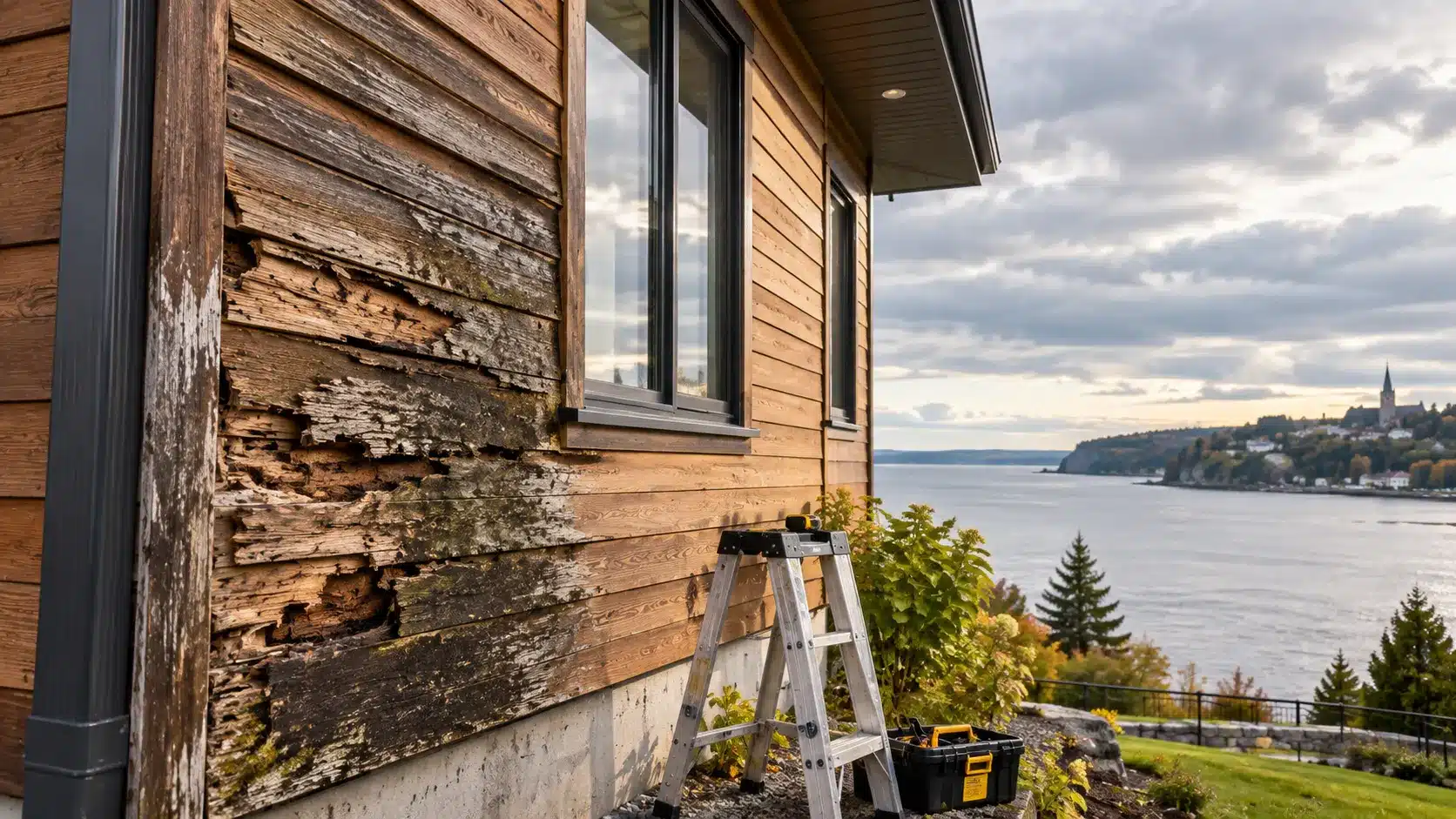
You live near the river in Saint-Romuald, you love the view — but your wood siding, on the other hand, is suffering. Boards that darken, that soften, some paint that peels, areas that crumble. The wood is rotting, and you're wondering what to do. The honest answer: near the river, wood is subjected to difficult conditions, and you must first address the cause of the moisture before choosing a solution.
The good news is that real options exist — repair, or replace with a material better suited to the riverside climate. And a well-chosen siding can last for decades, even facing the river.
At Solutions Rénovation Québec (RBQ license 5811-7821-01), we have been repairing and replacing exterior siding in the riverside sectors of Lévis for years. In this article, we explain why wood rots here and what options are available to you.
Why does wood siding rot faster near the river?
Wood rotting near the river isn't bad luck — it's a direct consequence of particularly harsh conditions. Understanding why helps in choosing the right solution.
The combined effect of moisture and river winds
Saint-Romuald, on the edge of the Saint Lawrence River, is exposed to constant high humidity. Moisture-laden air, frequent fog, and direct exposure to winds that drive rain against the walls create an aggressive environment for wood siding.
The wood absorbs this moisture, swells, dries, contracts — a repeated cycle that weakens it. The river winds make it worse by driving water into the smallest gaps and accelerating the wear of the finish. A riverside home endures these assaults far more than a home inland. That's why wood ages faster there.
The role of freeze-thaw cycles
Our climate adds its share. Repeated freeze-thaw cycles are particularly destructive for wood that is already damp. Water that has penetrated the wood freezes, expands, then thaws — which cracks and bursts the fibers from the inside.
Each cycle weakens the wood a little more and opens new pathways for moisture. Combined with riverside humidity, freeze-thaw significantly accelerates degradation. Wood siding near the river therefore undergoes a double assault: constant humidity and freeze-thaw. It's this combination that explains faster rotting than elsewhere.
The signs of deteriorating siding
Several signs betray deteriorating wood siding. The clearest: soft or spongy wood to the touch, dark or stained wood, cracks, splitting, paint that blisters or peels, and areas that crumble.
Other clues deserve attention: mold or fungus on the wood, deformed or warped boards, and signs of infiltration inside (stains on interior walls). If you observe several of these signs, your siding is deteriorating and deserves an evaluation. Catching it early often limits the damage.
Does your siding show signs of rot?
Deteriorating siding can let water reach the structure. Have your siding evaluated by Solutions Rénovation Québec — especially if you are in a riverside zone.
Repair or replace: how to decide?
When faced with rotting siding, the question arises: repair the affected sections, or replace everything? The answer depends on the extent of the damage — and on what's underneath. Let's see how to decide.
When a partial repair is enough
A targeted repair can be enough when the damage is localized and the rest of the siding is in good condition. The rotten boards are then replaced, the cause of the moisture at that spot is corrected, and the finish is redone.
It's a good option when the rot affects a few boards — often in the most exposed areas, such as the bottom of walls or under overhangs — but the structure and the weather barrier behind are sound. Repairing costs less than replacing everything, provided the problem is truly localized. An evaluation confirms whether that's the case.
When full replacement becomes necessary
In other cases, repairing only postpones the problem. A full replacement is required when the rot is widespread, when several sections are affected, when the finish is at the end of its life everywhere, or when the siding no longer effectively protects the house.
When the wood is affected over a large part of the house, replacing board by board no longer makes sense — it's more economical and more durable to redo everything. It's also an opportunity to switch to a material better suited to the riverside climate. If your siding has reached the end of its useful life, replacement is often the most sensible long-term choice.
Why check the structure behind the siding
Here's a crucial point that too many people neglect: siding is only the visible surface. When wood rots, water has often reached what's behind it — the weather barrier, the insulation, or even the structure (the studs, the plywood).
Before repairing or replacing, you must check the condition of these hidden elements. New siding installed over a structure damaged by water is masking a problem that will continue to worsen. So we inspect what's hidden behind — and correct the infiltration, the weather barrier, or the structure as needed — before closing up. That's what distinguishes a real solution from a cover-up.
A complete diagnosis avoids unpleasant surprises
Siding sometimes hides deeper damage. Request an inspection from Solutions Rénovation Québec — we also check what's hidden behind before recommending a solution.
Alternatives to wood siding for a riverside home
If your wood siding needs to be replaced, it's an opportunity to choose a material better suited to the riverside climate. Several options resist humidity and freeze-thaw much better. Let's take a look.
Vinyl siding
The vinyl is a popular and affordable option. It resists humidity well, doesn't rot, and requires very little maintenance — no painting or staining to redo.
It's an economical and practical choice for a riverside home, since it doesn't fear water. Its limits: it can become brittle in extreme cold and its appearance, although improved over the years, remains less noble than other options. But for a good resistance-to-price ratio against the river's humidity, vinyl is a serious contender. It's often the most accessible option.
Fiber cement
Fiber cement (like the type James Hardie) is recognized for its exceptional durability. It resists moisture, freeze-thaw cycles, fire and insects very well, while offering a beautiful appearance that mimics wood or other textures.
It is an excellent choice for a waterfront home exposed to harsh conditions. It is more expensive than vinyl and its installation requires expertise, but its longevity and resistance make it a solid investment. For those who want durability without the drawbacks of wood, fiber cement is often the top of the line. It combines performance and aesthetics.
Aluminum and steel
Metal siding — aluminum and steel — offers remarkable resistance to corrosion and weathering. They do not rot, withstand the climate well, and require little maintenance.
Aluminum, in particular, does not rust, which is an asset near the river. These sidings are durable and modern in appearance. Their cost varies, and aesthetic appearance is a matter of taste. For a waterfront home, metal is a robust option that handles moisture and river winds well. It is a durability choice to consider.
How to choose according to your budget and exposure
With these options, how do you decide? It depends on several factors: your budget, the degree of exposure of your home to the river, the desired aesthetics, and your maintenance priorities.
Vinyl offers the best price; fiber cement, the best overall durability; metal, excellent resistance without rust for aluminum. All surpass traditional wood when facing riverside moisture. We adapt the recommendation to your specific situation — a home highly exposed to river winds does not necessarily call for the same choice as a partially sheltered home. The right material is the one that balances your priorities.
Find the ideal siding for your waterfront home
The best material depends on your exposure and your budget. Request a consultation with Solutions Rénovation Québec — we advise you according to your home in Saint-Romuald.
Can wood siding be kept near the river?
Do you care about the charm of wood? It is possible to keep it, but let's be honest about what that involves. Wood near the river requires more commitment. Let's see how to make it work.
More resistant species and treatments
Not all woods are equal when facing moisture. Some species that are naturally more resistant, such as cedar, tolerate humid conditions better. Treated or modified woods also offer better durability than standard wood.
The choice of species and treatment makes a real difference in longevity near the river. A suitable wood, well installed with good weatherproofing and proper clearance from the ground, will resist better than ordinary wood poorly installed. If you care about wood, starting with the right product is essential. It is the foundation of success.
The importance of rigorous maintenance
Wood near the river requires regular and rigorous maintenance — there is no way around it. This means regularly inspecting the siding, renewing the stain or finish at appropriate intervals, quickly repairing any damaged board, and monitoring the most exposed areas.
This maintenance is the price to pay to keep wood near the river. Neglected, even good wood will deteriorate quickly in these conditions. If you are ready to take on this maintenance, wood remains possible and magnificent. Otherwise, a low-maintenance material will save you many worries. It is a question of commitment as much as taste.
When replacement is more economical in the long term
Here is the honest calculation to make. Keeping wood near the river involves a recurring maintenance cost — staining, repairs, time — year after year. Over a long period, these costs add up.
A low-maintenance material costs more to install, but eliminates most of that maintenance. In the long term, for a highly exposed home, replacing wood with a durable material can cost less than maintaining it indefinitely — not to mention peace of mind. The right choice depends on your attachment to wood and your tolerance for maintenance. We help you make that calculation honestly.
How much does repairing or replacing siding cost in Saint-Romuald?
The cost depends on the scope of the work, the material chosen and the condition of the structure behind. Here are some benchmarks, to be taken as orders of magnitude (indicative estimates that vary by case, and not guaranteed rates).
Targeted repair
For a localized repair — replacing a few rotten boards, correcting moisture and refinishing — the cost depends on the number of sections affected and access. This is generally the least expensive option, provided the damage is truly localized and the structure is sound. An assessment determines the amount.
Complete replacement
For a complete replacement of the siding, the cost varies mainly by material. As an indication, vinyl is at the low end of the scale, metal and fiber cement in a higher range, and quality wood at the high end depending on the species (indicative orders of magnitude).
Added to this are the surface area to cover, the complexity of the house (stories, openings), the condition of the weatherproofing and structure, and the corrections needed behind the siding. A replacement is a larger investment, but it is also an opportunity to fix hidden problems and switch to a durable material. An on-site estimate gives an accurate figure.
Why acting early avoids major costs
Siding that rots does not just degrade itself — it lets water reach what it protects. Ignored, the problem can spread to the weatherproofing, insulation and structure, turning a siding replacement into a costly structural repair.
Acting early, while the problem is still limited to the siding, costs far less than waiting until water has damaged the structure. It's the logic of prevention: siding is your home's first line of defense against water. Keeping it in good condition protects everything else.
Why entrust your siding work to an RBQ contractor in Lévis?
A exterior cladding protects your entire home against water. The choice of contractor makes the difference between lasting protection and a problem that keeps coming back.
An approach that addresses the root cause
Our priority is to fix the cause of the moisture, not just replace the visible boards. We inspect what's hidden behind the siding — weather barrier, insulation, structure — and we correct the problems before closing everything back up.
This approach avoids masking a problem that would continue to worsen. New siding installed over a damaged structure is money wasted. By tackling the source of the moisture, we ensure that the new siding truly protects your home. It's the difference between a lasting solution and a cover-up.
Expertise adapted to the riverside climate
We know the challenges of riverside homes in Saint-Romuald and Lévis: constant humidity, river winds, freeze-thaw. We choose materials and installation methods suited to these difficult conditions.
This local expertise makes the difference. Siding installed without accounting for riverside exposure will deteriorate faster; siding designed for these conditions will last. We know how to install an effective weather barrier, manage clearance and drainage, and choose the right material for your level of exposure. That's what protects your investment.
Our commitments
We operate under RBQ license 5811-7821-01, led by Marco Savoie, with more than 500 projects completed, more than 10 years of combined experience and a 5-year warranty on labor. We focus on a free estimate, transparent pricing and a clean worksite. These commitments protect you and ensure work done by the rules.
Protect your riverside home with the right siding
The right material, properly installed, means decades of peace of mind. Request a free, no-obligation estimate from Solutions Rénovation Québec.
Myths and realities about wood siding near the river
A few preconceived ideas deserve to be corrected. Here is the truth from the fiction.
«Treated wood never rots.»
Reality: treatment slows degradation, but does not make it impossible. Near the river, with constant humidity and freeze-thaw cycles, even treated wood can rot if it is poorly maintained or poorly installed. No wood is completely immune.
«Repairing a few boards is always enough.»
Reality: it depends on the extent and on what is behind it. If the rot is widespread or if the water has reached the structure, repairing a few boards does not solve the problem. You need to check what is hidden behind the siding.
«Vinyl is the only economical choice.»
Reality: vinyl is the most affordable, but not the only good choice. Fiber cement and metal, although more expensive to purchase, offer durability that can make them more economical in the long term. The best choice depends on your time horizon.
«New siding fixes everything, no matter what is behind it.»
Reality: false. Installing new siding over a damaged structure or weather barrier masks the problem without solving it. Water continues its damage behind. You must address the cause before closing it up.
FAQ – Wood siding that rots in Saint-Romuald
Why does my wood siding rot so quickly near the river?
Because of constant humidity, fog, winds that drive rain against the walls, and freeze-thaw cycles. This combination is particularly aggressive for wood near the river. Water penetrates, freezes, bursts the fibers, and the wood degrades faster than inland.
Can I repair only the rotted sections?
Yes, if the damage is localized and the rest of the siding and the structure behind are sound. The affected boards are replaced, the humidity is corrected, and the finish is redone. But you must first check what is hidden behind — if the water has reached the structure, a partial repair will not be enough.
Which siding best resists river humidity?
Fiber cement and metal (especially aluminum, which does not rust) offer excellent resistance to humidity and freeze-thaw cycles. Vinyl also resists water very well at a more affordable cost. All outperform traditional wood against riverside conditions. The best choice depends on your budget and exposure.
Is vinyl a good choice for a riverside home?
Yes, it is an affordable and practical option: it resists humidity well, does not rot, and requires little maintenance. Its limitations are that it can become brittle in extreme cold and its appearance is less noble than fiber cement or wood. For a good resistance-to-price ratio near the river, it is a serious choice.
How much does siding replacement cost?
It depends mainly on the material and the surface area. Vinyl is the most economical, metal and fiber cement are higher, quality wood is at the high end (indicative orders of magnitude, not guaranteed). Add to that the condition of the structure behind and the necessary corrections. An on-site estimate gives a fair price.
How do you know if water has reached the structure?
The signs: moisture stains on interior walls, very soft wood, extensive areas of rot. But often, only an examination behind the siding confirms it. That is why an inspection that checks the weather barrier and the structure is important before repairing or replacing.
Can wood be kept near the river?
Yes, but with a commitment to rigorous maintenance: good wood species, careful installation, regularly renewed stain, quick repairs. Wood near the river is beautiful but demanding. If you are not ready for that maintenance, a low-maintenance material will save you many worries in the long term.
Is an RBQ contractor necessary for this work?
For durable and well-installed exterior siding, it is strongly recommended. An RBQ contractor checks and corrects what is hidden behind the siding, installs an effective weather barrier, chooses the right materials for riverside exposure, and offers a warranty. It protects your home and your investment.
Rotting siding can be fixed — but it starts with the cause
In the end, if your wood siding is rotting near the river in Saint-Romuald, it is not inevitable, but it is a signal to address. The wood there undergoes particularly harsh conditions — constant humidity, river winds, freeze-thaw cycles — that accelerate its degradation.
The right approach begins with a complete diagnosis: checking the extent of the rot and, above all, what is hidden behind the siding. Repairing or replacing without addressing the cause of the humidity or checking the structure means masking a problem that will continue to worsen. The siding protects your home — you must ensure that this protection is intact all the way to the structure.
And if replacement is necessary, it is an opportunity to choose a material better suited to the riverside climate: affordable vinyl, durable fiber cement, or resistant metal. All outperform traditional wood against river humidity. The right choice is the one that balances your budget, your exposure, and your tolerance for maintenance — for a riverside home well protected for decades.
Is your siding deteriorating in Saint-Romuald or near the river?
Request a free, no-obligation estimate from Solutions Rénovation Québec or call us at 418-476-1747. We evaluate your siding and the structure behind it, identify the cause of the humidity, and propose the solution — repair or replacement — best suited to your riverside home, in compliance with RBQ rules, with no obligation.