
You look at your patio and the observation is clear: the beautiful golden wood of the past has turned dull grey. The reflex is to think that it needs to be stained as soon as possible, and to wonder if it will have to be redone every year. The short, reassuring answer: no, a wood patio does not necessarily need to be stained every year.
Greying is mainly a surface reaction to UV and aging — not necessarily a sign that the wood is finished. Stain protects against moisture and slows degradation, but its duration varies greatly depending on the product, exposure and preparation.
In Lévis, between the summer sun, rain, snow and freeze-thaw cycles, patios work hard. At Solutions Rénovation Québec (RBQ license 5811-7821-01), we help homeowners do the right thing at the right time. In this article, we answer the real question: should you maintain, restore or replace?
Why does a wood patio turn grey?
Grey doesn't appear by chance, and above all, it doesn't always mean what we think. Understanding the phenomenon changes the way we react to it.
Grey is often a natural reaction to UV
The main culprit is the sun. Ultraviolet radiation degrades lignin — the substance that binds wood fibers — on the surface of the boards. This superficial degradation gives that characteristic grey tint.
Exposure to water and weather accentuates the phenomenon. But the important thing to remember is that this color change is not automatically rot. It's often surface wear, aesthetic, that doesn't affect the structural integrity of the wood. A grey patio can be perfectly sound structurally.
Grey doesn't mean the patio is finished
Here's the crucial point. Grey alone is not a condemnation. To know if your patio is truly deteriorated, you need to look at other signs.
What indicates real deterioration: boards that are soft to the touch, deep cracks, splinters, marked deformation, rot, corroded screws and fasteners, or affected joists and structure. These are the signs — not color — that tell you if the wood is at the end of its life. A grey but firm patio, without these symptoms, often just needs refreshing.
A grey patio or a truly damaged patio?
Before stripping and staining, it's better to know what you're dealing with. Have the actual condition of the wood and structure verified by Solutions Rénovation Québec, especially if your patio is old or shows signs of deterioration.
Do you really need to stain a wood patio every year?
It's the most persistent myth. The reality is that frequency depends on several factors — and rarely on a single year. Let's look at this.
Duration depends on the type of product
Not all finishing products offer the same protection over time. Here are some general benchmarks:
| Type of finish | Indicative interval* |
| Transparent stain / penetrating oil | About 1 year |
| Semi-transparent | About 2 to 3 years |
| Opaque / solid | About 4 to 6 years |
General indications to be confirmed according to the manufacturer, exposure, condition of the wood and preparation.
In other words, only a transparent finish or a penetrating oil requires near-annual renewal. A semi-transparent stain often lasts two to three years, and an opaque one even longer. The choice of product completely changes the maintenance chore — it's a decision made with full knowledge of the facts.
The patio's exposure completely changes the frequency
Two identical patios can require very different maintenance depending on their location. A patio facing south or west, in full direct sun, will see its finish wear faster due to UV.
Similarly, a patio very exposed to rain, snow accumulation, or with constantly damp areas will degrade more quickly. Heavy foot traffic and proximity to vegetation (which retains moisture) also play a role. In short, staining frequency depends as much on location as on the product. Both are evaluated.
Why Lévis's climate accelerates wear
Our climate combines multiple aggressions. Summer UV, moisture, freeze-thaw and snow form a chain: the wood swells and contracts through the variations, which causes cracking and degradation, and eventually prematurely wears the coatings.
This constant movement of the wood, specific to our climate with marked temperature swings, puts the finish to the test more than elsewhere. That's why a patio in Lévis requires maintenance designed for these conditions — neither neglected nor exaggerated.
Before staining: should you clean, sand or strip?
Here's a secret many people don't know: preparation matters more than the color chosen. A beautiful stain on a poorly prepared surface won't hold. Let's see how to do it right.
Good preparation matters more than simply choosing a color
The durability of a stain depends first on preparation. The typical process follows a precise order: first an inspection of the wood's condition, then deep cleaning, removal of incompatible old finishes, light sanding when necessary, complete drying, and finally application according to the manufacturer's recommendations.
Skipping or rushing any of these steps compromises the result. A dirty surface, still covered with an old finish, or poorly dried, won't let the new stain adhere or penetrate properly. Preparation is 80 % of success.
Beware of high-pressure cleaning
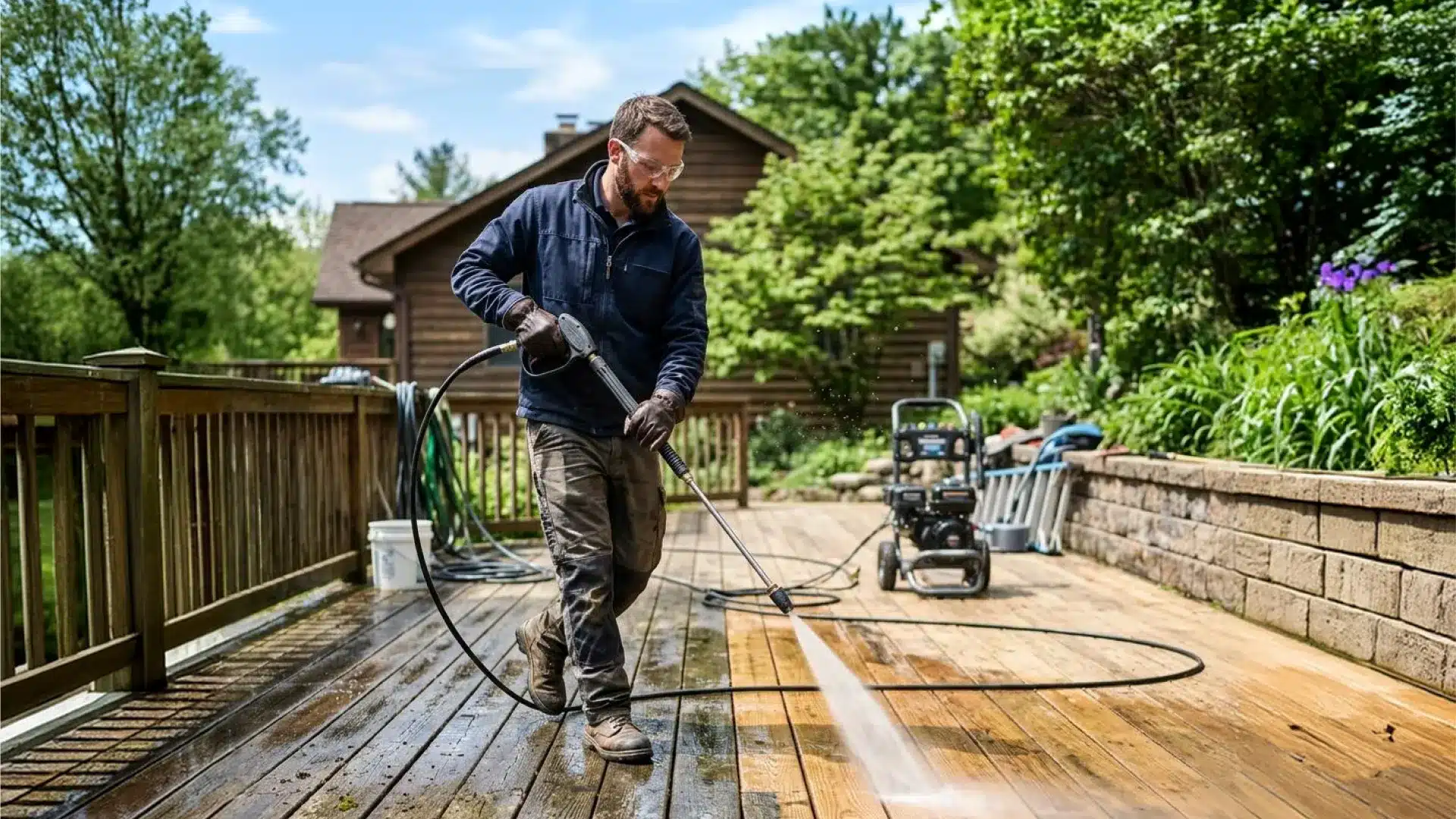
The pressure washer is tempting, but it's a double-edged sword. A jet that's too aggressive can do more harm than good.
Excessive pressure raises the wood fibers, damages the surface, can force water into the boards and creates uneven preparation. Result: damaged wood that will poorly receive the stain. If high pressure is used, it is with caution, at a moderate pressure and at a good distance. Often, a suitable cleaning without excess pressure gives a better result.
The wood must be sufficiently dry before application
You never stain wet wood. The wood's moisture level must be low enough before application, otherwise the stain does not penetrate and does not hold. The acceptable value depends on the product used and its technical data sheet — each manufacturer specifies its conditions. Applying to wood that is still wet means wasting the product and the time. You wait until the wood is ready.
Does your patio need a complete restoration?
Sometimes, simple maintenance is no longer enough. Request an assessment of the condition of your wood from Solutions Rénovation Québec — we help you choose between maintenance, restoration or replacement.
When should you restore the patio rather than simply stain it?
Staining addresses aesthetics, but not underlying problems. In some cases, you need to restore before finishing. Here is how to recognize these situations.
The signs indicating that staining will not be enough
Certain signs show that you are beyond a simple coat of stain. A soft wood indicates possible water infiltration or rot — the affected sections must be inspected and replaced. cracked boards pose a risk of deterioration and discomfort, and require targeted replacement.
Corroded fasteners threaten performance and safety — the hardware is checked. And a weakened structure (joists, beams) is a problem that goes beyond aesthetics: it must be evaluated before any finishing. In all these cases, staining over it would only mask a real problem. Our approach always starts with an honest diagnosis of the condition of the wood and the structure.
Repair a few boards or redo the patio?
The right decision follows simple logic. If the wood is sound and only graying, maintenance is enough — cleaning and protection. If the wear is localized, the affected sections are repaired and the finish is redone.
If the damage is significant but the structure holds, a major renovation of the decking may be required. And if the structure itself is in poor condition, replacement becomes the most sensible option. The right choice depends on the actual condition — hence the importance of the assessment before deciding.
Treated wood, cedar or composite: which option requires the least maintenance?
If annual maintenance tires you out, the question of material comes up. Each has its strengths — the right choice depends on your priorities and your time horizon.
Wood patio: lower initial cost, regular maintenance
Treated wood appeals for its affordable cost and natural appearance. You can also change the stain color over the years, which offers aesthetic flexibility.
The downside is periodic maintenance : cleaning and renewing the finish at regular intervals. Wood is also sensitive to weather and may require repairs board by board over time. It is a beautiful choice for those who love wood and accept taking care of it.
Composite: less maintenance, but higher initial investment
Composite greatly reduces finishing maintenance — no stain to redo. Depending on the products, it offers better color stability over time. But let's be honest about its constraints.
Composite still requires periodic cleaning. Its initial cost is higher. It undergoes expansion and contraction, its surface can heat up more in the sun, and the quality of the installation is decisive for its performance. It is an excellent choice for reducing maintenance, provided you accept the initial investment.
The right choice depends on the cost over several years
To decide well, you must think in terms of total cost, not just purchase price. The complete calculation is: purchase price, then maintenance, then repairs, then lifespan, then time spent — which gives the real cost over several years.
As an indication, here are provincial orders of magnitude (estimates that vary, and not SRQ rates or guaranteed prices in Lévis) : treated wood around 35 $ to 60 $ per square foot, cedar around 60 $ to 90 $ per square foot, and composite or PVC around 100 $ to 130 $ per square foot. Wood costs less initially but requires more maintenance; composite costs more but requires less. Over time, the gap narrows — and for some, the time saved is worth the difference.
«Maintenance-free» does not mean «zero maintenance»
Watch out for marketing vocabulary. No patio is truly «maintenance-free.» Even a quality composite requires regular cleaning and periodic inspection to stay beautiful and safe. «Maintenance-free» means «much less finishing maintenance,» not «you never touch it again.» This is an important nuance so you are not disappointed.
How much does maintenance or restoration of a patio in Lévis cost?
The cost depends mainly on the starting condition of your patio. Here are the factors and reference points, to be taken as orders of magnitude.
The price depends mainly on the condition of the patio
Several elements vary the bill: the surface area, the condition of the boards, the old finish to be removed or not, the cleaning required, the sanding, the accessibility of the patio, the necessary repairs, the type of stain and the number of coats.
A patio in good condition that simply needs refreshing costs little; a patio that must be stripped, repaired and restored requires much more work. This is why the actual condition is assessed before quoting — two patios of the same size can give very different prices.
Stain or replace: how do you compare costs?
For professional staining, expect as a guideline on the order of 75 $ to 4.50 $ per square foot on a surface in good condition, and up to about 6 $ per square foot when the preparation is heavy (orders of magnitude, not a guaranteed rate).
But the real calculation is the life-cycle cost, not just the immediate bill. Maintaining a healthy patio several times can, in the long run, cost more than a replacement with a low-maintenance material — or the opposite, if the wood is still good for years. We compare the cost over time, not just today's amount.
Get a price adapted to your patio
Every patio is different. Request a free quote from Solutions Rénovation Québec — an on-site estimate allows you to distinguish between maintenance, repair and replacement.
Why entrust your patio work to an RBQ contractor in Lévis?
Not everything requires a contractor — but some work does. Making the distinction helps you decide.
Aesthetic maintenance and structural work are not the same thing
Routine maintenance — cleaning, staining — is something a homeowner can generally do themselves. It's aesthetic maintenance, within reach of many motivated people.
Construction, modification or structural intervention work is another matter. Repairing joists, replacing a weakened structure, redoing a patio: this work may fall under different requirements and is best entrusted to a professional. The line is there: cosmetic for you, structural for an RBQ contractor.
Warranties and transparency matter
When entrusting a structural project, warranties make the difference. We operate under RBQ license 5811-7821-01, led by Marco Savoie, with more than 500 projects completed, more than 10 years of combined experience and a 5-year warranty on labour.
We add a free on-site estimate, transparent prices and a clean and safe worksite. These commitments protect you and ensure work done by the rules — especially when the stakes go beyond simple staining.
Have your patio evaluated before choosing between wood and composite
The right choice depends on the real condition of your patio and your priorities. Discuss your project with Solutions Rénovation Québec — we evaluate and advise you honestly.
Myths and realities about maintaining a wood patio
A few preconceived ideas deserve to be corrected. Here is the truth from the fiction.
«A grey patio must absolutely be stained every year.»
Reality: frequency depends on the finish, the wood and exposure. Only a transparent stain or an oil requires near-annual renewal; the others last longer.
«Grey means the wood is rotten.»
Reality: greying is mainly a surface phenomenon related to UV. A grey patio can be perfectly healthy. It's soft boards, cracks and the structure that indicate real deterioration.
«A quality stain compensates for poor preparation.»
Reality: even the best product holds poorly on a poorly prepared surface. Preparation — cleaning, removing old finishes, drying — matters more than the product itself.
«Composite requires no maintenance.»
Reality: it reduces finishing maintenance, but it still requires periodic cleaning and inspection. «Maintenance-free» never means «zero maintenance.».
FAQ – Grey wood patio in Lévis
Why does my wood patio turn grey?
Mainly because of UV rays, which degrade the lignin on the wood's surface. Exposure to water and weather accentuates the phenomenon. It's surface wear, often aesthetic, which does not automatically mean the wood is deteriorated deep down.
Should I stain my patio every year?
Not necessarily. Only a transparent stain or a penetrating oil requires near-annual renewal. A semi-transparent one often lasts two to three years, and an opaque one four to six years. Frequency also depends on exposure to sun and weather.
How do I know if my grey patio is still in good condition?
Check beyond the colour: look for soft boards, deep cracks, splinters, rot, fasteners or a structure that moves. If the wood is firm and without these signs, it is probably healthy and only needs cleaning and protection.
Which stain lasts the longest on a patio?
In general, opaque or solid stains last the longest — often four to six years — because they offer the best protection against UV. Semi-transparent ones last less, and transparent ones or oils, even less. The choice also depends on the desired appearance.
How much does it cost to stain a patio in Lévis?
As a guideline, expect on the order of 1.75 $ to 4.50 $ per square foot on a surface in good condition, and up to about 6 $ per square foot if the preparation is heavy (orders of magnitude, not a guaranteed rate). An on-site estimate gives a fair price according to the real condition.
Is it better to stain or replace an old patio?
It depends on the condition of the wood and the structure. If the wood is healthy, staining is enough. If the damage is localized, we repair and finish. If the structure is affected, replacement becomes more sensible. Grey alone is never a reason to replace.
Is composite really maintenance-free?
No — it requires much less finishing maintenance, but not zero. A quality composite still requires regular cleaning and periodic inspection. «Maintenance-free» is a marketing shortcut: the right expression would be «low maintenance.».
How long does a wood patio last in Quebec?
Ça varie beaucoup selon le bois, l’entretien et l’exposition. Bien entretenu, un patio en bois traité peut durer de nombreuses années. Négligé, il se dégrade plus vite dans notre climat. L’entretien régulier et une bonne structure sont les clés de sa longévité.
Est-ce qu’un entrepreneur RBQ est nécessaire pour refaire un patio?
Pour l’entretien courant (nettoyer, teindre), non — un propriétaire peut souvent le faire. Pour des travaux de construction, de modification ou d’intervention structurale, un RBQ contractor est recommandé : il assure la conformité, la sécurité et une garantie sur le travail.
Votre patio est gris : entretenir, restaurer ou remplacer?
Au final, un patio gris n’est pas une condamnation — c’est un signal à interpréter. Voici une matrice simple pour vous orienter :
| État observé | Décision probable |
| Gris mais bois sain | Nettoyage + protection |
| Finition usée | Préparation + nouvelle teinture |
| Planches localement endommagées | Réparation + finition |
| Bois fortement détérioré | Rénovation / remplacement |
| Fatigue d’entretien | Évaluer composite / PVC |
Retenez surtout ceci : le gris, à lui seul, n’est pas une raison de remplacer votre patio. C’est l’état du bois et de la structure qui compte, pas la couleur. Un patio gris mais solide n’a souvent besoin que d’un bon nettoyage et d’une protection adaptée.
Et si l’entretien vous pèse, c’est peut-être le moment d’évaluer un matériau à plus faible entretien — en comparant honnêtement le coût sur plusieurs années, pas juste le prix d’achat. La bonne décision, c’est celle qui convient à votre bois, votre budget et votre tolérance à la corvée.
Besoin de savoir quoi faire avec votre patio à Lévis?
Request a free, no-obligation estimate from Solutions Rénovation Québec or call us at 418-476-1747. On évalue l’état réel de votre patio à Lévis, on vous dit franchement s’il faut entretenir, restaurer ou remplacer, et on vous propose la solution qui vous convient — sans engagement.