
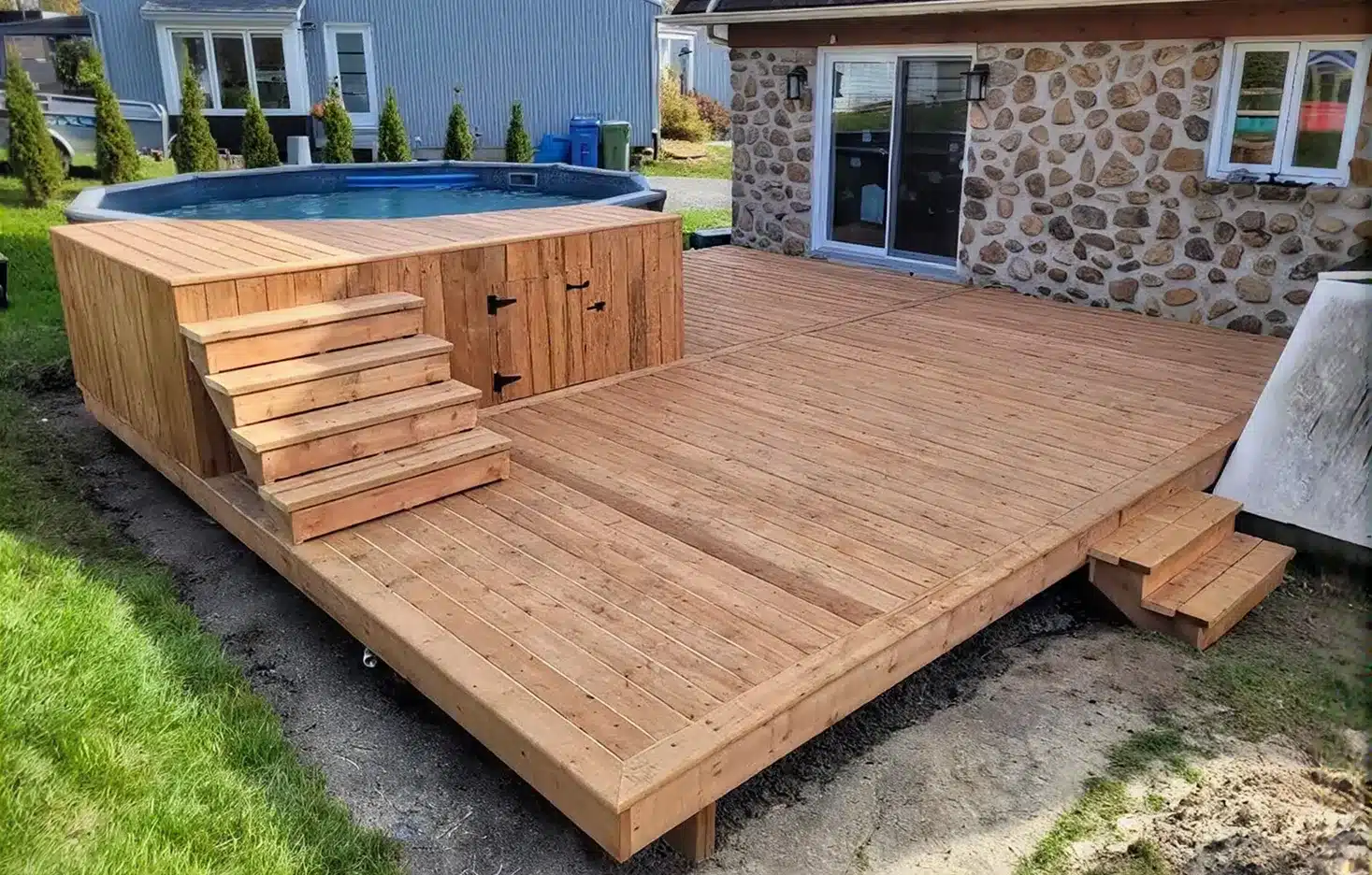
A patio that sinks after only two winters is more common than one might think in the Charny area and across the entire South Shore of Quebec. And it's not inevitable — it's almost always the result of a poorly designed foundation, poorly evaluated soil, or an installation done too quickly without taking local conditions into account.
The climate in Lévis is particularly demanding for outdoor structures. Repeated freeze-thaw cycles, the humidity of the St. Lawrence River, and the clay soils characteristic of the Charny area create conditions that put any structure built on insufficient foundations to the test. When the piles don't go deep enough, the soil does its work — and the patio follows.
The 5 most common causes of a sunken patio in Charny
A patio that sinks doesn't happen by chance. There's always a technical reason behind the problem. And in the vast majority of cases we see in Charny and the surrounding area, these reasons overlap. Here's what we most often find during our inspections.
Piles too short — above the frost line
This is the most common cause, and the most avoidable. In Quebec, the frost line is between 5 and 2.5 metres deep depending on the region and soil types. In Charny, with clay soils that retain water, this line must be taken very seriously.
When piles are installed above this line — which we still see too often on patios built quickly — the soil that freezes in winter expands and lifts the piles. When it thaws, it sinks. After one or two cycles, the structure begins to move visibly. This movement amplifies each year if nothing is corrected.
Recommended standard in Quebec
For a durable installation in the Lévis region, poured concrete piles must go to a minimum of 2 metres deep — and ideally deeper, depending on the soil type. Certified screw piles, installed below the frost line, offer the best long-term stability and comply with the requirements of the 2025 Quebec Construction Code. The materials used must be CCMC-certified to guarantee their performance in our climatic conditions.
Unstable clay soil in the Charny area
Clay soil is particular: it absorbs water like a sponge, freezes while expanding significantly, then contracts when it thaws. This cycle of swelling and sinking is much more pronounced in clay than in sandy or gravelly soil.
In several zones of the Charny area, the soils are saturated with water for a good part of the year — particularly in spring and after heavy rains. A patio founded on insufficient piles in this type of soil will move. Not maybe — will move. It's a matter of physics, not luck.
Deficient drainage around the patio
Water that accumulates around and under a patio is the direct enemy of stability. Without an adequate drainage slope — we're talking about a minimum of 1,5 % that directs water away from the structure —, water stagnates, infiltrates the soil, and increases hydrostatic pressure against the foundations.
In spring, when the snow melts quickly, a poorly drained patio receives significant volumes of water in a short time. If this drainage isn't planned from the design stage, water makes its way wherever it can — and it always ends up affecting the stability of the soil under the piles.
Undersized patio structure
A patio must be designed to support real loads: the weight of occupants, furniture, and especially snow accumulated in winter. In Quebec, a snow load of 2.4 kPa or more is standard in structural calculations — which represents considerable weight on a 10 × 12 foot structure.
When the beams are spaced too far apart, the wood used is undersized, or the structure wasn't calculated for these loads, it gradually deforms. It's not always spectacular at first — but after two or three winters, the effects become visible.
Poor initial installation
We regularly see patios built quickly, often at the end of the season or by teams without sufficient experience with local conditions. No soil study, no verification of frost depth, no control of the drainage slope. The result holds up the first summer — and begins to sink the following spring.
It's the myth of the «easy to build» patio that does the most damage. An outdoor deck in our climate is a structure that must be thought out and designed seriously — not improvised on a Saturday morning.
Does your patio show signs of sinking? Request a free inspection from SRQ — we identify the cause before proposing anything to you.
How much does it cost to repair a sunken patio in Lévis?
The answer depends directly on the extent of the damage and what needs to be corrected. Here are the realistic ranges for the types of interventions we most often carry out in the region.
For replacing or adding piles, expect between 200 and 300 $ per pile, installation included (reasonable estimate, 2025). For the foundations of a 10 × 10 foot patio, this typically represents between 1,200 and 2,400 $ depending on the number of support points required. A complete structural repair — new piles, beam levelling, replacement of damaged wood — generally falls between 8,000 and 15,000 $ (reasonable estimate based on SRQ projects in the region).
What you need to understand is that the longer you wait, the more it costs. A slightly sunken patio treated early requires much less work than a patio that has moved for three additional winters. Waiting can increase the bill by 40 to 60 % (reasonable estimate) — not to mention the safety risks that increase with each season.
Repair or rebuild: how to decide
The decision depends on three factors: the level of subsidence, the condition of the structure's wood, and the stability of the soil under the existing piles. If the subsidence is localized and the main structure is still sound, a targeted repair — replacing the deficient piles and leveling — may be sufficient.
If the wood is rotten, if several sections are moving, or if the soil under the patio is compromised over a large area, a complete reconstruction with adequate foundations is often more economical in the long term than trying to save a weakened structure.
Why some patios sink after only 2 years
The type of foundation is the determining factor. Shallow-poured sonotubes — still widely used because they cost less to install — generally do not last more than 2 to 5 years in the clay soils of Charny. Certified screw piles installed below the frost line, however, can last 30 years and more without problem.
| Foundation type | Estimated lifespan |
| Shallow Sonotubes | 2–5 years in clay soil |
| Certified helical piles (below frost line) | 30 years and more |
(Reasonable estimates based on SRQ field experience)
The initial cost difference between these two options is real — but it is largely recovered by avoiding repeated repairs.
The durable solution: install piles below the frost line
The real solution to a sunken patio is not to level the structure and hope it holds. It is to correct the foundations so they no longer move. In our Quebec soils, that means piles installed below the frost line — without exception.
Galvanized steel helical piles are our preferred approach for this type of repair. They are installed without major excavation, go precisely below the frost line, and offer immediate and lasting stability. Installation is fast, clean, and does not disturb the ground around the structure.
How SRQ stabilizes a sunken patio
Every project begins with a complete inspection of the ground and the existing structure. We assess the condition of the existing piles, the installation depth, the condition of the framing wood, and the drainage slope around the patio. This diagnosis guides all subsequent decisions.
Then, we present a detailed quote that clearly explains what must be done, in what order, and why. No surprises during the project. Once the work is approved, we proceed with the installation of the new certified piles, leveling of the structure, and the necessary adjustments to the beams and joists.
RBQ standards and compliance
All our patio repair work is carried out in compliance with the Quebec Construction Code and the requirements of the RBQ license 5811-7821-01. The piles used are CCMC-certified — a certification that guarantees their performance in Quebec climate conditions. Installation depths are calculated for each project based on soil type and anticipated loads.
Steps of a successful patio leveling
A well-done leveling follows a precise sequence: installation of new piles below the frost line, verification of leveling, adjustment of load-bearing beams, replacement of damaged wood pieces if necessary, and final verification of the drainage slope. It is methodical — and that is what makes the difference between a repair that lasts and one that fails at the next thaw.
Do you want a precise diagnosis of your patio? Contact SRQ for a free inspection in Charny and Lévis — we travel, we assess, we clearly explain your options.
How to prevent your patio from sinking again
Prevention is always cheaper than repair. And for a patio in Quebec, the best practices are well known — they are just too often ignored to save a few dollars at installation.
4 best practices used by serious contractors
A patio that lasts in our climate rests on four non-negotiable elements. The piles must go below the frost line — that is the foundation. The drainage slope must be at least 1.5 % in all directions that move water away from the structure. The framing must be sized for actual loads, including snow. And an annual visual inspection — ideally in spring after the thaw — allows any movement to be identified before it becomes a serious problem.
Common homeowner mistakes
We understand the temptation to want to fix the problem quickly. But some correction attempts do more harm than good. Leveling a sunken patio with a hydraulic jack without correcting the foundations gives a temporary result that generally does not last more than one summer. Adding concrete blocks under the pieces that have moved is the same thing — a surface solution to a structural problem. And ignoring drainage while hoping the problem resolves itself guarantees that the next repair will be more costly than the previous one.
Why choose Solutions Rénovation Québec (SRQ) for your patio
Local RBQ contractor in Lévis
At SRQ, we have been working on outdoor structures in the Lévis, Charny, Saint-Nicolas and Chaudière-Appalaches region for more than ten years. We know the soils of our region, the local climate requirements, and the methods that hold up in our conditions. This is not theory — it is what we apply in the field on every project.
Marco Savoie, RBQ-licensed general contractor (5811-7821-01), personally supervises outdoor renovation work. We do not subcontract our projects to teams without local experience — we do the work ourselves, with the right materials and the right methods.
SRQ method: diagnosis → durable solution
Our approach is simple and predictable. We start by understanding the problem before talking about a solution. No recommendation before the inspection. No pressure to sign a quote on the corner of a table.
The process our clients know: complete field inspection, detailed quote with all line items itemized, pile installation and structural work according to standards, and delivery of a clean site with documentation of the work performed.
Warranty and customer satisfaction
All our patio repair and construction work is covered by our 5-year warranty on labor. We have completed more than 500 residential projects in the region with a average rating of 4.9/5 of our clients. We maintain this record project after project — because we do things correctly from the start.
Ready to solve the problem once and for all? Request your quote from Solutions Rénovation Québec — 418-476-1747, Monday to Friday, 8 a.m. to 5 p.m.
FAQ — Sunken patio in Quebec
Why does my patio sink after winter?
Because the ground freezes and expands in winter, then contracts during the thaw. If the piles are not installed below the frost line, they move with the ground. This repeated movement gradually causes the structure to sink. In the clay soils of Charny, this phenomenon is particularly pronounced.
What depth should piles be in Quebec?
In the Lévis region, poured concrete piles must go down to a minimum of 1.2 metres. For screw piles, the depth is calculated to reach below the frost line — between 1.5 and 2.5 metres depending on the soil type. An RBQ contractor can determine the appropriate depth for your specific lot.
Is a sunken patio dangerous?
Yes, potentially. A patio that has moved may have destabilized guardrails, anchors that have lost their rigidity, or sections that no longer support the intended loads. It's a safety issue — particularly if children use the structure or if the patio is elevated.
How much does it cost to repair a patio in Lévis?
Between $1,200 and $2,400 for foundation work on a 10 × 10 foot patio, and between $8,000 and $15,000 for a complete structural repair (reasonable estimate, 2025). The cost varies depending on the extent of the damage, the soil type, and the materials required.
Screw piles or poured concrete: which option to choose?
Both can work if properly installed. Screw piles have the advantage of being installed more quickly, without major excavation, and offer excellent stability in difficult soils such as clay. Concrete poured into a fibre tube is a valid option if the depth is respected. In both cases, the installation depth is the decisive factor.
Do I need a permit to repair my patio?
If the work affects the load-bearing structure — replacement of piles, modification of the framing — a building permit may be required according to the regulations of the City of Lévis. Your RBQ contractor can guide you through these steps.
Is it covered by home insurance?
Generally no, if the sinking is caused by an inadequate foundation or deficient installation. Some policies cover damage caused by sudden and unforeseen events. It is worth checking directly with your insurer.
How long does a patio repair take?
For pile replacement and structure leveling, generally allow 2 to 4 business days. If partial or complete reconstruction is necessary, timelines can extend to 1 to 2 weeks depending on the scope of work.
Conclusion — A sinking patio can be fixed — but it is better to act early
A sunken patio in Charny or elsewhere on the South Shore is not an irreversible problem. But it is a problem that worsens over time — and each additional winter without correction increases repair costs and safety risks.
The real solution is foundations that go below the frost line, adequate drainage, and a structure sized for our actual winter loads. That is what we do at SRQ from the start — no shortcuts, no temporary solutions.
Does your patio show signs of sinking? Contact Solutions Rénovation Québec for a free inspection — honest diagnosis, detailed quote, zero pressure. 418-476-1747.