
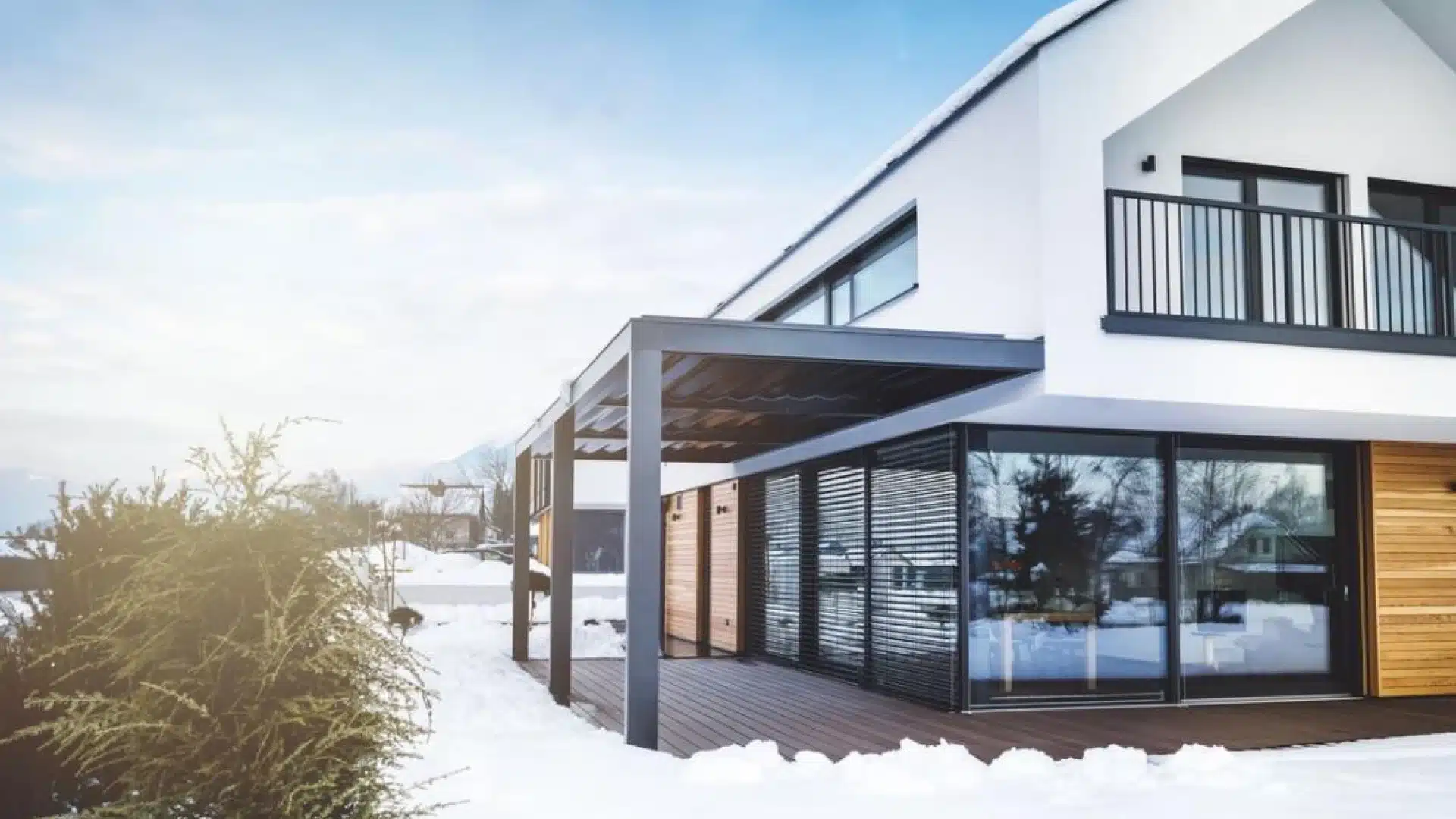
The short answer: yes, it's possible to build a patio in winter in Lévis. But let's be honest — some steps are more complex than in the middle of the high season, and everything depends on the method used.
The challenge is the soil. When the ground freezes, foundations become a central issue. That's where the frost line, the screw piles and the risk of frost heaving come into play — concepts that can't be glossed over in our climate.
At Solutions Rénovation Québec (RBQ licence 5811-7821-01), we've been building patios adapted to local winters for years, for bungalows and single-family homes 25 years and older. In this article, we explain when winter construction is realistic, and when it's better to wait.
Get a free evaluation of your patio project by an RBQ contractor before winter.
Why are several homeowners considering building a patio in winter?
At first glance, winter seems like the worst season for this kind of project. Yet more and more homeowners are thinking about it — and they have good reasons.
The idea is often to get ahead. Rather than fighting for a spot on the schedule in spring, you plan quietly during the cold season.
Better contractor availability
Winter is the low season for outdoor construction. Good contractors have more room in their schedule, which means a faster start and more attention for your project.
In spring, it's the opposite: everyone wants their patio at the same time. Schedules fill up fast, and the wait gets longer. Taking advantage of winter availability means avoiding that race.
Preparing your outdoor space for spring
Many winter projects serve to be ready as soon as the first nice days arrive. You can do the evaluation, the design, the permits and sometimes part of the work during winter.
The result: when spring arrives, your patio is already well underway or finished, and you enjoy it as soon as the temperature allows. While others wait their turn, you're already outside.
Avoiding the high-season wait
Booking your project in advance means locking in your spot before the rush. It's a simple strategy that pays off, especially in the current context.
The impact of construction delays in Quebec
The construction sector is experiencing strong demand and pressure on labour. In spring, the schedule fills up quickly and delays stretch out. By booking early — starting in winter — you get ahead and avoid waiting weeks, even months, in the middle of high season.
What are the main challenges of building a patio in winter in Lévis?
Let's be clear about the challenges, because they're real. Building in winter requires more planning and precautions than in summer. Three issues dominate: frozen ground, freeze-thaw cycles and snow loads.
A good contractor knows these challenges and knows how to manage them. A bad one ignores them, and it's the homeowner who pays the price at thaw.
Frozen ground and foundations
The main challenge is frozen ground. When the ground is frozen deep, digging and pouring foundations becomes more complex and requires adapted methods.
The foundation is everything for a patio. If it's poorly done or poorly anchored, the entire structure suffers. This is the step where you absolutely must not cut corners.
Why the frost line is essential
In our region, the frost line — the depth at which the ground freezes — is generally around 1.2 to 1.5 m (order of magnitude to be confirmed depending on the terrain and local standards). The foundations or anchors of a patio must go below this line.
The reason is simple: below the frost line, the ground doesn't freeze and remains stable. An anchor that stops above it will suffer frost heaving, which pushes the structure upward. Respecting this depth is what guarantees stability over time.
The freeze-thaw cycles specific to Lévis
In Lévis, the ground doesn't just freeze once — it freezes and thaws repeatedly all winter. Each cycle moves the ground, which swells and then contracts.
This constant movement is hard on a structure. A poorly anchored patio will follow these movements, season after season, until it becomes unstable.
How ground movement affects a patio
Concretely, a patio victim of freeze-thaw shows clear signs: sagging in places, cracking of rigid elements, and misalignment of the structure. A deck that was level at construction can tilt or ripple after a winter if the anchoring wasn't done below the frost line. That's exactly what we're trying to prevent.
Snow and ice loads
The other local reality is snow. A patio, especially if it's covered or attached to a structure, must support the weight of snow and ice accumulated all winter.
This weight is not negligible. The structure must be designed to absorb it without bending.
Resistance standards required for outdoor structures
Outdoor structures must be sized for the climatic loads of our region, including snow. It's a matter of safety and compliance with the Construction Code. An undersized structure is a real risk under a good snowfall. Designing for the real load is non-negotiable.
Check the feasibility of your terrain before investing in winter construction.
In which cases can a patio actually be built in winter?
Winter construction is not a myth, but it relies on the right methods. Some approaches adapt well to the cold, others not at all.
Here are the situations where building a patio in winter becomes realistic.
Installation on screw piles
Screw piles are the star solution for winter. Rather than pouring concrete — sensitive to cold — steel piles are screwed deep into the ground, below the frost line.
This method allows foundations to be installed even when the ground is frozen at the surface, without waiting for concrete to dry. It's fast, clean and well suited to the cold season.
Why screw piles are often preferred
Screw piles offer a deep and stable anchor, driven below the frost line, which protects them from frost heave. They adapt well to our climate and are suitable for different types of terrain. For a winter patio, it's often the most logical choice — less dependence on temperature, more long-term stability.
Preparatory work and light structure
Even when certain steps must wait, a lot of work can move forward in winter. Design, planning, obtaining permits and ordering materials are all done very well during the cold season.
The assembly of a light structure, once the foundations are in place, can also be carried out in many cases. This saves time so you're ready as soon as conditions allow.
Use of heated tents and temporary protections
When work requires milder conditions, temporary shelters and supplemental heating can be used. These protections create an acceptable working environment despite the cold.
It's a useful solution, but it has its limits.
The limits of this approach
Temporary protections add costs: equipment rental, heating, additional labour. Site access can also be complicated by snow and ice, and the weather remains an unpredictable factor. That's why each project is evaluated honestly: sometimes it's worth it, sometimes it's better to wait a few weeks.
Which materials best withstand a patio exposed to Lévis winters?
The material of your patio determines its longevity and maintenance. They all face the same enemies here: freeze-thaw, snow, humidity, salt. But they don't react the same way.
Here's an honest portrait of the three main options.
Treated wood
Treated wood is the most affordable option, and that's what makes it popular. It offers a natural and warm look that appeals to many people.
The downside is maintenance. Wood must be stained or sealed regularly to withstand humidity and freeze-thaw. Without this maintenance, it greys, cracks and degrades faster. Its lifespan is decent if cared for, shorter if neglected.
Composite
Composite offers an excellent compromise for our climate. It resists humidity well, doesn't rot and requires practically no maintenance — no annual staining to plan for.
Its lifespan is generally longer than that of wood, which compensates for its higher initial cost. For a homeowner who wants a beautiful patio without the chore of maintenance, it's a solid and durable option.
Aluminium
Aluminum shines for its corrosion resistance — it doesn't rust, even when exposed to salt and humidity. This is particularly true for structures and railings.
MC Mel welded aluminum products, for example, are rust-free and maintenance-free, designed to last in our climate. For railings and structural elements of a patio, aluminum is a durability choice that's hard to beat.
Comparative table of materials
Here's a quick overview for comparison:
| Material | Cost | Durability | Maintenance | Frost resistance | Long-term value |
| Treated wood | Low | Medium | High | Good (if maintained) | Medium |
| Composite | Medium-high | High | Very low | Excellent | High |
| Aluminum | Medium-high | Excellent | Very low | Excellent | High |
Get a personalized budget according to the material best suited to your property.
Permits, regulations and compliance in Lévis
Before building, you need to know what the City requires. A patio often involves rules on placement, height and safety.
Note: requirements vary by project and zoning, and may change. Always validate your situation with the City of Lévis before starting.
When is a permit required?
Several patios require a municipal permit, especially if they are raised, attached to the house or of a good size. A small, ground-level patio may sometimes be exempt, but this is not a universal rule.
The best approach is to check from the start. Building without a permit where one was required exposes you to a notice of non-compliance and costs — or worse, having to dismantle the structure.
Requirements for railings and raised structures
As soon as a patio is raised, railings become a regulated safety issue. Height, spacing of balusters, strength: these elements must meet standards to protect occupants.
A raised structure also involves increased strength requirements. It's technical work that can't be improvised.
What the City of Lévis checks
The City generally looks at several aspects: the height of the structure, its placement on the lot, minimum distances from property lines, and safety elements such as railings. Knowing these criteria from the design stage avoids unpleasant surprises at inspection.
Why work with an RBQ contractor
An RBQ contractor knows these requirements and designs your patio so that it is compliant from the start. You avoid costly mistakes and inspection rejections.
RBQ license 5811-7821-01
We operate under RBQ license 5811-7821-01, led by Marco Savoie. This license is a protection for you: it guarantees that the work meets standards and that a responsible professional is accountable for it. For a structure that must withstand snow and frost safely, that matters.
How to avoid costly mistakes during a winter patio project?
Mistakes on a winter patio cost dearly, because they often surface during the thaw — when everything is already built. Knowing them means avoiding them.
Here are the four mistakes we see most often, and how we prevent them.
Insufficient foundations
This is the number one mistake. Foundations or anchors that don't go below the frost line will move with freeze-thaw cycles. The risk : a patio that tilts, sinks or becomes unstable. Our solution : anchors, often helical piles, driven below the frost line. The proof : this is the method we apply systematically, validated on over 500 projects.
Inadequate drainage
Standing water freezes and causes damage. Neglected drainage leads to water accumulation, ice and accelerated deterioration. We design the patio so that water drains away rather than accumulating around support points.
Poor site planning
In winter, improvisation doesn't forgive. A poorly planned site — without accounting for weather, access and necessary protections — accumulates delays and problems. Serious upfront planning is what allows work to be done safely and by the rules.
Choosing materials incompatible with the climate
Not all materials tolerate our climate the same way. A poor choice results in premature deterioration and quick repairs. We recommend materials suited to freeze-thaw and local humidity, for a patio that lasts rather than one that disappoints.
Why trust Solutions Rénovation Québec for your patio?
A patio is a structure that must hold up under snow and frost for years. The choice of contractor makes all the difference in solidity and durability.
Here is what we bring to a patio project in Lévis and the surrounding area.
More than 500 projects completed
With more than 500 projects completed and more than 10 years of combined experience, we have seen just about every situation that local terrain can present. This experience translates into careful work and good advice.
5-year warranty on labor
We back our work with a 5-year labour warranty. If a problem related to the installation arises, we take care of it. That is the commitment we make to every client.
Expertise adapted to the Québec climate
Our design always starts from the local climate. Deep frost, freeze-thaw cycles, snow accumulation: we know these realities and we build accordingly.
Concretely, that means anchors below the frost line, structures sized for actual snow load, and materials chosen to last. These are the details that separate a solid patio from a patio that shifts.
A clear and transparent process
From the first contact, we explain the steps, costs and timelines. No surprises along the way, no hidden fees at the end.
Our method
Our approach follows a clear sequence: assessment of the terrain and the project, detailed quote with no surprises, planning of the site, construction by the rules, final inspection to validate everything, and complete cleanup before leaving. You always know where your project stands.
Discuss your patio project with our team before the next construction season.
Myths and realities about building a patio in winter
A few misconceptions circulate on the subject. Let's sort out fact from fiction.
Myth — It is impossible to build a patio in winter
False. With the right methods, particularly helical piles, winter construction is entirely feasible. It's not the season that blocks it, it's the lack of an adapted method.
Reality — Certain methods allow for safe work
Screw piles, temporary protections and good planning make it possible to work safely despite the cold. It's all a matter of approach and experience.
Myth — All patios resist frost
False. A patio whose foundations do not extend below the frost line will move with freeze-thaw cycles, regardless of its beautiful surface appearance.
Reality — Anchoring makes all the difference
It is the deep anchoring, below the frost line, that ensures stability. A well-anchored patio stays level year after year; a poorly anchored patio does not hold up.
Myth — Winter is always cheaper
Not necessarily. Better contractor availability is an advantage, but it is not a guarantee of automatic savings.
Reality — Winter protections can increase costs
When a project requires heated shelters or temporary protections, these measures add costs. Winter can be advantageous, but the outcome depends on the method required for your specific project.
FAQ – Building a patio in winter in Lévis
Can screw piles be installed in winter?
Yes, it is even one of the great advantages of this method. Screw piles are installed in frozen ground without waiting for concrete to dry, which makes them well suited to winter construction.
What is the minimum depth below the frost line?
In our region, the frost line is generally around 1.2 to 1.5 m (order of magnitude to be confirmed depending on the terrain and local standards). Anchors must extend below this line to remain stable and avoid frost heave.
Is a permit required for a patio in Lévis?
Often yes, especially for a raised patio, one attached to the house or of significant size. A small ground-level patio may sometimes be exempt. Check your specific case with the City of Lévis before starting.
Does composite resist cold better than wood?
Generally yes. Composite resists moisture better, does not rot and requires much less maintenance than wood. For a durable patio without chores, it is often a better choice in our climate.
How much does a 12 x 12 foot patio cost?
The cost varies depending on the material, the type of foundation, the height and the complexity. An accurate estimate requires an on-site evaluation — be wary of prices quoted without having seen your property. We provide a detailed and transparent quote, with no hidden fees.
Can a patio be built on snow-covered ground?
It is possible with the right methods, such as screw piles, but snow and ice complicate access to the site. An evaluation of the ground allows us to confirm feasibility in your case.
Is winter work faster?
Sometimes, thanks to better contractor availability and screw piles that avoid the concrete drying delay. But weather and the necessary protections can also slow down certain steps. It depends on the project.
What are the risks of frost for a deck?
The main risk is frost heave: if the anchors do not extend below the frost line, the structure moves, sinks or cracks with freeze-thaw cycles. Good anchoring prevents this problem.
When is it preferable to wait until spring?
When the project requires a lot of poured concrete, mild working conditions, or when winter protection costs exceed the benefits. An honest contractor will tell you frankly if waiting is the best choice for your case.
Why choose an RBQ contractor for a patio?
Because an RBQ license guarantees competence, compliance with the Building Code and clear accountability. For a structure that must safely withstand snow and frost, the expertise of a licensed professional protects your investment.
Conclusion – Building a patio in winter in Lévis: possible, but under certain conditions
So, can you build a patio in winter in Lévis? Yes — winter construction is realistic, especially with screw piles that free you from frozen ground and concrete drying.
But success depends on a few essential principles. Foundations and anchoring below the frost line are critical, a permit is often required, and our demanding climate — deep frost, freeze-thaw cycles, snow loads — requires serious design. Neglecting any one of these points means risking a patio that moves with the first thaw.
In the end, the expertise of an RBQ contractor makes all the difference. Evaluating the ground, managing regulations, anchoring correctly and choosing the right materials: that is what turns a winter project into a durable patio rather than a source of problems. And sometimes, the best advice is to honestly tell you what the right time is for your project.
Request a free estimate from Solutions Rénovation Québec or call us at 418-476-1747 to discover the best time to build a durable patio on your property — with no obligation.