
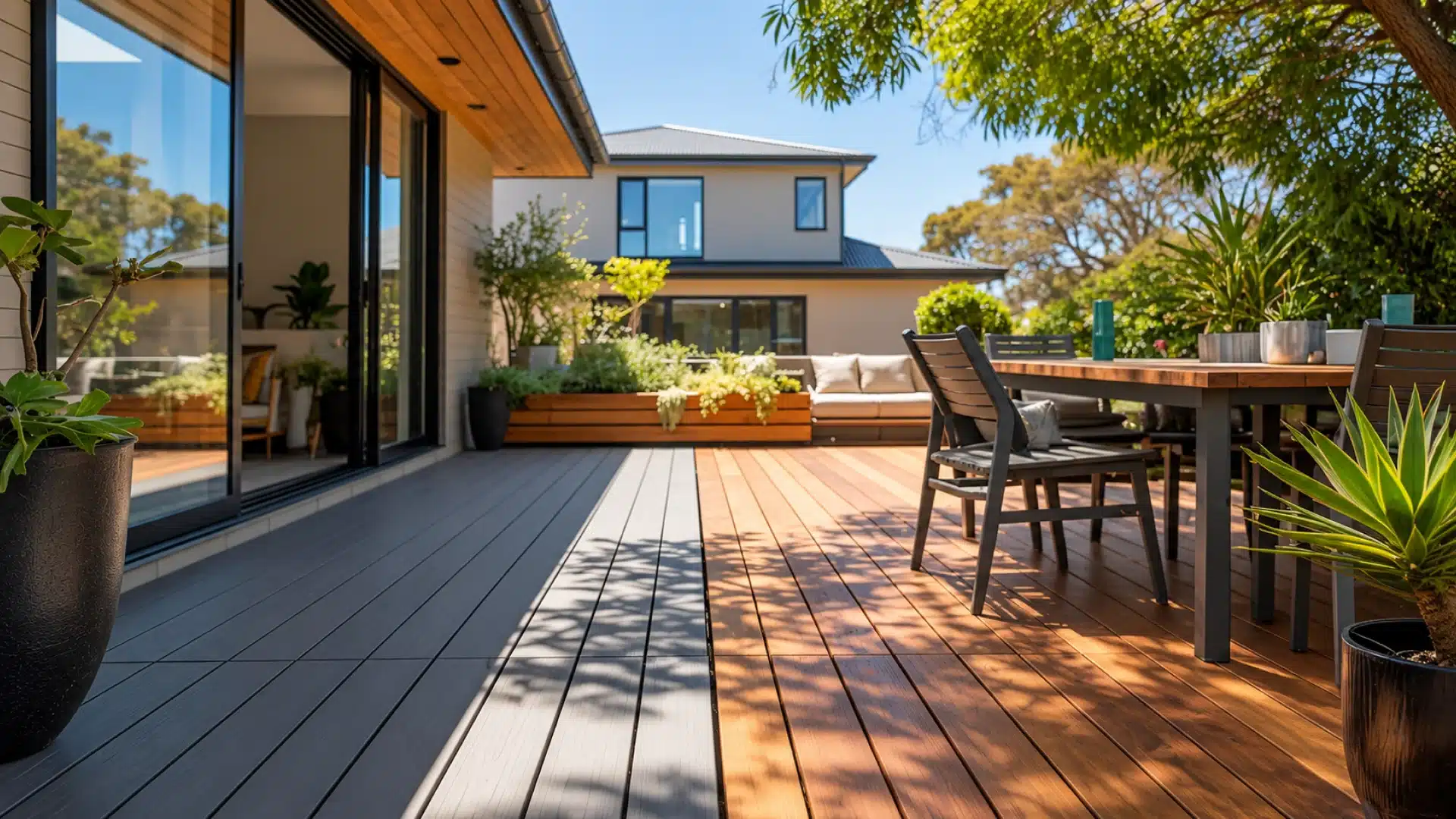
In Lévis, you don't build a patio like elsewhere in Quebec. The proximity of the St. Lawrence River changes the game: constant humidity, fog, winter salt and repeated freeze-thaw cycles. These conditions wear down decks faster.
That's why the question «wood or composite?» doesn't have the same answer here as in a dry region. The right choice depends on your property's actual exposure to this humidity.
At Solutions Rénovation Québec (RBQ license 5811-7821-01), we build patios for bungalows and single-family homes in the riverside sectors of Lévis for years. In this article, we compare wood and composite against our climate, to help you choose what lasts.
Why the river's humidity completely changes the choice of a patio
Lévis has a particular climatic reality in Quebec. Bordered by the St. Lawrence River, the region is bathed in high humidity that doesn't compare to that of drier inland areas.
Morning fog, frequent near the river, deposits moisture on surfaces day after day. This constant humidity is the number one enemy of a deck. It seeps in, it stagnates, it makes materials work.
Add to that winter de-icing salt, which attacks surfaces and hardware. And above all, the repeated freeze-thaw cycles that expand and contract materials endlessly.
Result: in a riverside sector, a patio ages faster than elsewhere. For a home near the river, choosing the right material isn't an aesthetic detail — it's what determines whether your patio lasts 10 years or 25 years.
The real effects of humidity on a wood patio
Wood is a living material that reacts to humidity. Near the river, this reaction is amplified. Wood absorbs water, swells, then dries and contracts — a cycle that, repeated, leads to warping and cracks.
With time and constant humidity, the risk of rot and fungus increases. Poorly ventilated wood or wood in contact with standing water can develop mold and degrade from the inside.
That doesn't mean wood is a bad choice — well treated, well ventilated and well maintained, it holds up. But near the river, it requires more vigilance and regular maintenance to stay in good condition.
What good construction practices require
Structural wood must meet a controlled moisture content — generally, wood at 19% moisture or less is targeted for construction, according to good practices. Beyond that, the risks of movement and degradation climb.
Ventilation and drainage under the deck are just as essential. Air must circulate so the wood dries between wet episodes, and water must drain away rather than stagnate. These principles, in line with the recognized recommendations of the wood industry and compliance with the Construction Code, make the difference between a wood patio that lasts and one that rots prematurely.
Why composite resists better in riverside sectors
Composite is designed precisely to resist what wood undergoes. Quality composites, particularly those with coextruded protection, are wrapped in a protective layer that limits water absorption.
This protection changes everything near the river. A well-designed composite absorbs very little moisture, doesn't rot and resists UV without degrading like wood. It doesn't swell, doesn't crack and doesn't require annual staining.
For a deck exposed to fog and the constant humidity of a riverside sector, composite offers peace of mind that wood requires more effort to match. It's often the choice that ages best in these conditions.
The limits of composite that you should also know
Let's be honest: composite isn't magic. It still requires regular cleaning to avoid the accumulation of dirt and surface mold, especially in shaded and humid areas.
It also needs good drainage and a well-ventilated wood structure underneath — because even a composite deck often rests on wood joists. Finally, quality varies enormously from one manufacturer to another. A low-end composite can disappoint. That's why the choice of product and manufacturer matters as much as the material itself.
Need advice tailored to your property in Lévis? Request a free quote from Solutions Rénovation Québec — we assess your actual exposure to humidity.
Wood or composite patio: complete comparison
To decide well, you need to look beyond the purchase price. Let's compare the two materials on costs, lifespan and safety.
Installation cost comparison
At purchase, wood is clearly more affordable than composite. That's what explains its popularity. But the initial gap only tells part of the story.
| Criteria | Treated wood | Composite |
| Installed price (indicative) | ~$35 to $60/sq ft | ~$100 to $130/sq ft |
| Lifespan | Good (with maintenance) | High |
| Maintenance | Regular (staining, sealing) | Minimal (cleaning) |
| Product warranty | Shorter | Often long |
Indicative ranges (reasonable estimates that vary depending on the product, structure and terrain). For a 12 x 12 ft patio, the starting price gap between the two materials is therefore significant — but it must be put into perspective with the cost over the lifespan.
Cost comparison over 25 years
This is where the picture changes. A wood patio requires annual maintenance — cleaning, staining or sealing — to withstand our climate. These costs accumulate year after year.
Over a long period, wood may also require the replacement of damaged boards, or even a partial renovation. Composite, on the other hand, avoids most of this maintenance and generally lasts longer without major intervention.
When you add up the purchase cost and the maintenance cost over 25 years, the initial gap narrows — sometimes, it reverses.
Why composite often becomes less expensive in the long term
The calculation is simple: composite costs more upfront, but the avoided maintenance and its superior lifespan compensate over time. No staining every two years, no sealing, fewer board replacements.
For a homeowner who keeps their house for a long time, composite can therefore cost less in total, while requiring much less effort. It is an upfront investment that pays off over time — especially in a humid area where wood works hard.
Safety comparison
Safety also deserves attention, especially for a family. Wood, over time and with humidity, can develop splinters and become slippery when wet or covered in moss — a real risk near the river.
Composite generally offers a more stable surface, without splinters, and several products offer a non-slip finish. On the other hand, a dark composite can heat up more in the sun. For a yard where children play, the stability and lack of splinters of composite are often compelling arguments.
Request an estimate adapted to your budget to compare the two options at your home.
Which materials to choose according to your house?
The right choice doesn't depend only on the material — it depends on your house and its location. Here's how we guide the decision according to the situations we encounter most often in Lévis.
House over 25 years old
In a house 25 years or older, the first thing to check isn't the decking — it's what's underneath and around it. Drainage, foundations, ventilation: these elements determine the lifespan of the patio, regardless of the material chosen.
A preliminary inspection allows you to identify existing drainage or structural problems. These issues are addressed first, then the material is chosen. On a sound base, both wood and composite can perform well.
House near the Saint Lawrence River
This is the scenario where composite often has the advantage. A house near the river experiences constant humidity, winds, snow and sometimes water accumulation. These conditions are hard on wood.
Composite, with its low water absorption and rot resistance, tolerates this environment better. If your property is directly exposed to the river's humidity, it's a factor that clearly leans toward composite — or toward a very well-maintained high-end wood.
New construction
For a new construction, the logic is often that of long-term investment. A premium composite requires a higher starting budget, but offers minimal maintenance and excellent durability.
For a homeowner who plans to stay for a long time and values peace of mind, it's a choice that adds property value while reducing future chores. Wood remains a valid option if natural aesthetics come first and you accept the maintenance.
Have the existing structure inspected before building — free inspection, no obligation.
Mistakes that reduce the lifespan of a patio
Certain mistakes shorten the life of a patio, regardless of the material. Knowing them means avoiding them.
Here are the three most common ones we observe in the field.
Choosing based solely on price
The classic mistake: taking the cheapest option without thinking about what comes next. Low-end wood in a humid area, or poor-quality composite, will disappoint quickly.
The real calculation is the cost over the lifespan, maintenance included. Sometimes wood is the right choice, sometimes composite — but rarely the cheapest product chosen with eyes closed. We recommend according to your actual exposure and your timeline.
Neglecting ventilation under the deck
It's a silent but costly mistake. Without air circulation under the deck, humidity remains trapped and attacks the wood structure from below.
The importance of ventilation and drainage
Good air circulation allows the structure to dry between wet episodes. Good drainage evacuates water instead of letting it stagnate. Together, ventilation and drainage protect the structure and extend the life of the patio — it's also a matter of compliance and best practices. In a riverside area, neglecting these two points condemns the patio to premature aging.
Using a non-RBQ contractor
Entrusting a patio to a contractor without an RBQ license is taking a risk. Without a license, you don't have the same protections, warranties or compliance insurance.
An RBQ contractor builds according to standards, manages compliance and is accountable for their work. For a structure that must safely withstand snow, frost and humidity, this protection matters. It's the difference between a well-built patio and a gamble.
Myths or realities about wood and composite patios
A few misconceptions circulate. Let's sort out what's true from what's false.
«Wood always costs less.»
True at purchase, false over the lifespan. Once annual maintenance and replacements are added up over 25 years, the gap with composite narrows — and can even reverse.
«Composite requires no maintenance.»
Needs nuance. Composite requires much less maintenance than wood, but not zero: regular cleaning is still necessary to prevent surface mold, especially in shade and near the river.
«All composites are identical.»
False. Quality varies enormously from one manufacturer to another. A premium coextruded composite has nothing in common with a low-end product. The choice of manufacturer is decisive.
«Treated wood never rots.»
False. Treatment slows degradation, but does not make it impossible. Without proper ventilation, drainage and maintenance, even treated wood can rot — especially in a humid environment like ours.
How Solutions Rénovation Québec builds durable patios
A durable patio is not just a question of material — it is a question of design adapted to the terrain and careful installation. Here is our approach.
Our approach adapted to the climate of Lévis
Everything starts with the terrain and its exposure. We analyze the soil, drainage, possible ventilation, orientation and exposure to humidity from the river. It is this reading of the site that guides our recommendations.
A patio in the shade, exposed to river fog, does not call for the same choices as a sunny, well-drained patio. We adapt the material and design to your reality, not to a one-size-fits-all recipe.
Materials selected to last
We work with materials chosen for our climate: quality composite for damp areas, carefully selected treated wood when it is the right choice. But the visible material is only part of the equation.
Hardware and fasteners matter just as much. In a salty and humid environment, corrosion-resistant fasteners prevent the structure from loosening over time. This is the kind of detail that separates a patio that lasts from a patio that deteriorates.
An RBQ-compliant installation
Our installation meets standards, from drainage to ventilation, including anchoring and structural capacity.
What this means in practice
We operate under RBQ license 5811-7821-01, led by Marco Savoie. This means construction according to the Code, attention to safety, and work for which a professional is accountable. This compliance protects you — at inspection, with your insurer and at resale.
Get a free quote for your future patio adapted to your terrain.
Why trust SRQ
A patio is a structure that must withstand humidity, frost and snow for years. The choice of contractor makes all the difference in solidity and durability.
Here is what we bring to the table for every project: a RBQ licence 5811-7821-01 that guarantees compliance and accountability; a 5-year warranty on labor because we stand behind our work; more than 500 projects completed and more than 10 years of combined experience, with a specialized team that knows the local climate.
We add what matters day to day: transparent communication, a clean and organized worksite, and zero hidden fees — the agreed price is the price paid. These commitments reduce risk for you, and this is exactly what we would look for ourselves before entrusting a project of this value.
FAQ – Wood vs composite patio in Lévis
Is composite really worth its price in Lévis?
Often yes, especially near the river. Its higher initial cost is offset by minimal maintenance and a longer lifespan. In a humid area, its resistance to rot and moisture makes it an investment that pays off over time.
Does treated wood hold up near the river?
Yes, but it requires more vigilance. Well treated, well ventilated, well drained and regularly maintained, wood holds up in a riverside area. Without this maintenance, constant humidity wears it down faster than elsewhere. It is a valid choice for those who accept the maintenance.
Which material is least slippery when it rains?
Composite generally offers better grip, especially products with a non-slip finish. Wood can become slippery when wet or covered with moss, a frequent risk near the river. For family safety, composite often has the advantage.
Do I need a permit to build a patio?
Often yes, especially for a raised patio or of good size. A small ground-level patio may sometimes be exempt. Rules vary, so check your specific case with the City of Lévis before starting.
What is the real lifespan of a composite deck?
A quality composite, properly installed on a sound structure, generally lasts many years with minimal maintenance — often beyond 25 years for premium products (reasonable estimate). The quality of the product and the installation greatly influence this result.
How much does a 12 x 12 patio cost in Lévis?
The cost varies depending on the material, structure, height and terrain. As an indication, wood is around 35 $ to 60 $ per square foot and composite around 100 $ to 130 $ per square foot, installed (reasonable estimates). A precise quote requires an on-site evaluation.
Does composite become burning hot in the sun?
A dark composite can heat up more than wood in direct sunlight. Choosing a lighter shade mitigates this effect. For a very sunny deck, this is a factor to consider when choosing the color.
How do you get a quote with SRQ?
It is simple: contact us through our website or by phone, and we will schedule a free on-site evaluation. We examine your terrain and your needs, then provide you with a detailed and transparent quote, with no hidden fees and no obligation.
Schedule your free estimate with Solutions Rénovation Québec.
Conclusion – Wood or composite: the right choice depends on your exposure to the river
In the end, there is no universal winner between wood and composite — there is the right choice for your situation. Near the Saint Lawrence River, with constant humidity, fog and salt, composite often offers the best resistance and the least maintenance. Wood remains a great option for those who love its natural appearance and accept the maintenance it requires.
What really matters is looking beyond the purchase price: the cost over the lifespan, the real exposure of your terrain, and the quality of the installation underneath — drainage, ventilation, fasteners. A poorly designed patio deteriorates quickly, regardless of the material.
This is where an RBQ contractor makes the difference. Evaluating your terrain, recommending the right material and building according to the rules is what transforms a patio into a durable investment rather than a repair that keeps coming back.
Request your free quote from Solutions Rénovation Québec or call us at 418-476-1747. We evaluate your terrain in Lévis, take into account your exposure to the river, and offer you the patio that will truly last — with no obligation.