
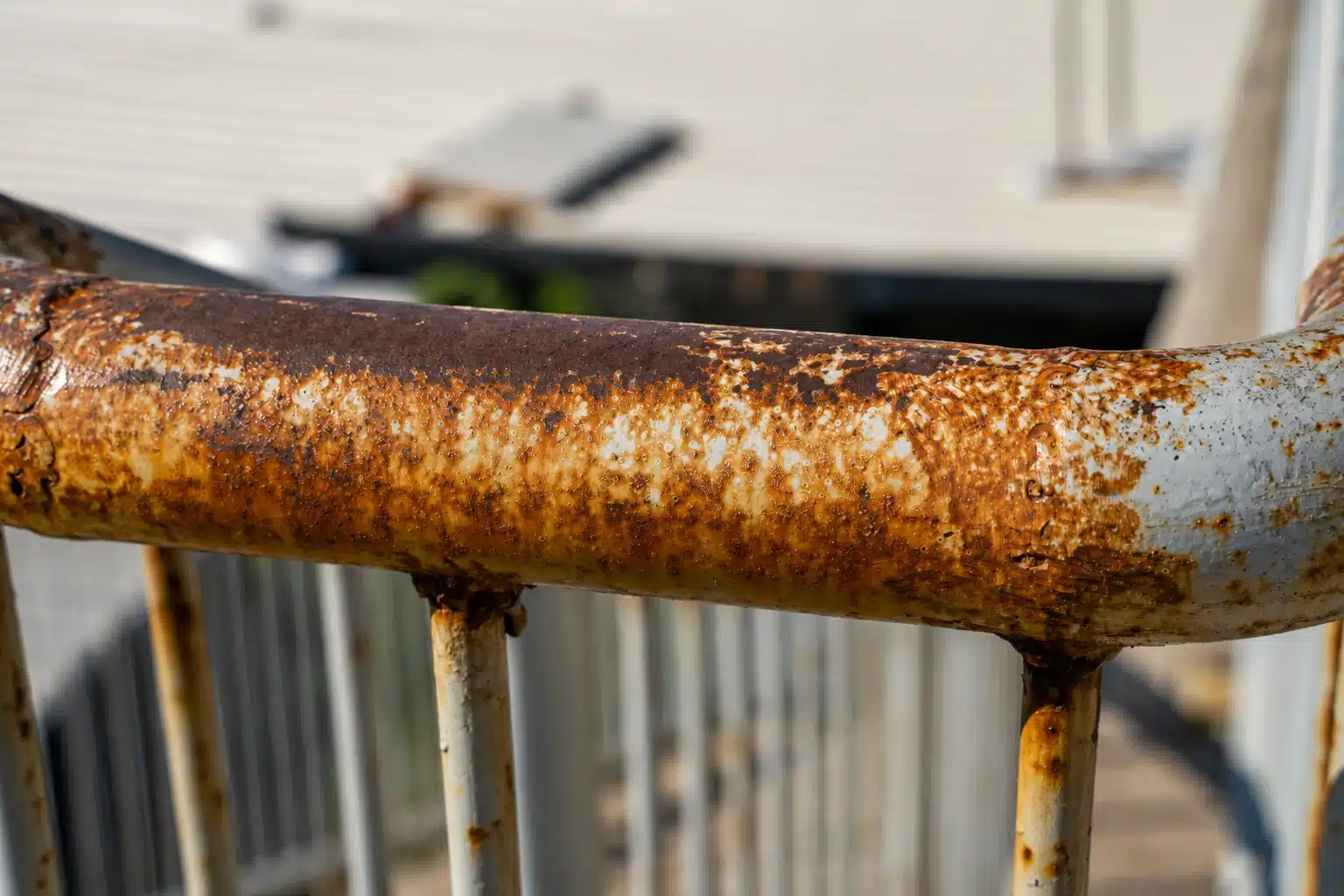
You had a beautiful steel railing installed a few years ago. First winter, everything is fine. Second winter, some traces of rust appear at the welds. Third winter, the paint starts to flake and the concrete underneath is stained orange.
This scenario, we see it often in Lévis — and it is not inevitable. It is the predictable result of a material poorly suited to a particularly aggressive environment. De-icing salt, the humidity of the St. Lawrence River, repeated freeze-thaw cycles: it is a combination that destroys the surface protections of steel faster than elsewhere in Quebec.
What is more concerning is that rust is not just an aesthetic problem. A corroded railing can represent a real risk for the people who use it — and the Quebec Building Code imposes clear requirements on the solidity of guardrails.
At Solutions Rénovation Québec (SRQ), we have been installing and replacing outdoor railings and stairs in the Lévis region for over 10 years. We are licensed RBQ contractors (license 5811-7821-01) and we explain here why it rusts, what it implies, and how to fix it durably.
Does your railing show signs of corrosion? Contact SRQ for a safety inspection with no obligation
Why do steel railings rust faster in Lévis?
Steel corrosion is a chemical reaction between the metal, oxygen and humidity. In a dry and stable environment, it takes time. But in Lévis, we accumulate several acceleration factors that cause this process to spiral — sometimes in just two or three seasons.
De-icing salt strongly accelerates corrosion
The sodium chloride and magnesium chloride used for de-icing driveways, stairs and sidewalks are among the most corrosive agents that exist for ferrous metals. They penetrate the microcracks in the paint, settle in the welds and keep the metal in contact with humidity long after the surface appears dry.
That is why a railing that looks fine in November can show pronounced rust patches as early as March.
Why Quebec winters destroy steel protections
Freeze-thaw cycles are particularly destructive. When water infiltrates a microcrack in the paint or coating, it freezes and expands. The crack widens slightly. The next water penetrates further. And so on, repeatedly, throughout the winter.
In Lévis, we can count more than a hundred freeze-thaw cycles per season. (reasonable estimate based on climate data for the region) Each cycle weakens the surface protection a little more — and once the steel is exposed, rust progresses rapidly.
The effect of salt on patios, balconies and stairs
Salt splashes do not only come from the roadway. They also come from the salt we spread ourselves on the steps and the front porch. This salt deposits on the railing anchors, accumulates at the base of the posts, and creates concentrated corrosion zones where the metal touches the concrete or wood — precisely at the most critical points for the solidity of the whole.
Humidity near the St. Lawrence River makes the situation worse
Steel corrosion is directly proportional to the ambient humidity level. The more humid the air, the faster the chemical reactions that degrade the metal. And Lévis, built along the river, is one of the cities most exposed to riverside humidity in the entire Chaudière-Appalaches region.
Why Lévis is more exposed than other regions
The proximity of the river generates higher ambient humidity, particularly in spring and autumn. The river winds also carry saline particles — subtle but constant — which act as an additional accelerator on exposed metal surfaces.
A railing installed two streets from the river will degrade significantly faster than a railing installed in an inland neighborhood, all other things being equal. This is not a hypothesis — it is what we observe in the field, year after year.
Poorly protected welds and cuts rust first
Look closely at your steel railing. If rust has appeared somewhere, there is a good chance it is at the welds, the cut ends, or the anchor points in the concrete. This is not a coincidence.
Galvanization and powder coatings protect flat and regular surfaces well. But a weld creates heat that can locally compromise the surface protection. A cut exposes bare metal. An anchor in concrete creates a space where humidity and salt accumulate without ever drying completely.
Common mistakes during installation
One of the things we often see during inspections is post anchors installed without treatment of the cut ends, or with a finishing sealant applied too thin to last more than one winter. Welds left raw without touch-up paint or coating after installation. Gaps between the post and the concrete that accumulate water rather than draining it.
These are not always gross mistakes — but in the climatic context of Lévis, these details make all the difference between a railing that lasts 15 years and one that rusts in three.
Do you have a railing that is starting to rust? Have it inspected before it becomes dangerous
Is a rusty railing only an aesthetic problem?
This is the question we are often asked. And the short answer is no. Rust may seem superficial at first — a few orange traces on the paint — but it progresses toward the interior of the metal and eventually compromises the structural resistance of the piece.
Rust gradually weakens the structure
Iron oxide (rust) is a friable material. Unlike intact steel, it does not resist lateral loads and impacts. When the cross-section of a post or handrail is sufficiently corroded, the piece can bend or give way under a load that would have been perfectly normal for the original steel.
The problem is that this loss of strength is not always visible from the outside. A railing can look solid in appearance and be significantly weakened inside the metal.
The risks for children and seniors
A railing is precisely there for the people who need it most to maintain their balance — children on stairs, seniors on an icy balcony in January. If the railing gives way at the moment someone truly leans on it, the consequences can be serious.
As a property owner, you have a legal responsibility toward the occupants and visitors of your property. A defective railing that causes an injury can directly engage this liability.
RBQ standards require safe guardrails
The Quebec Building Code sets precise requirements for outdoor guardrails and railings. These are not suggestions — they are obligations that every owner must respect, and that every RBQ contractor is required to apply during an installation or replacement.
What the Building Code requires
Guardrails must reach a minimum height — generally 900 mm (about 36 inches) for residential balconies, and up to 1,070 mm in certain configurations. They must withstand specific lateral loads, which a corroded railing can no longer guarantee. The spacing between the bars must be tight enough that a child cannot pass their head through.
A railing installed to standards at the time of construction may no longer meet them today if corrosion has compromised its solidity. See our railing and staircase installation services that meet standards
Rust can damage your patio and your concrete
A problem we often see and rarely mention is the impact of rust on adjacent surfaces. Oxide drips seep into porous concrete and create permanent stains — orange, brown, sometimes black depending on the metal's composition.
Why stains become permanent
Concrete is an extremely porous material. Once iron oxide has seeped into the surface pores, common cleaning products do practically nothing. Specialized acid treatments can help in some cases, but they risk damaging the concrete if poorly applied.
By leaving a rusty railing in place too long, you risk ending up with a patio or front steps permanently stained — an aesthetic and potentially commercial problem if you are considering selling the property.
Get a complete diagnosis before the repair costs more
Repair a steel railing or replace it?
This is the central decision for most homeowners we meet in this situation. And as with roofing or bathroom humidity, the right answer depends on the actual condition of the part — not just its appearance.
When a temporary repair can work
If the corrosion is strictly superficial — surface rust on paint that is starting to peel, without penetration into the metal — careful sanding, a rust-inhibiting primer and a quality exterior paint can provide a few extra years.
This is a valid option for a relatively recent railing (less than 5 years old) whose structure is still sound, and for which the budget does not allow for immediate replacement.
The limits of surface repairs
The reality is that this solution requires rigor and consistency. If the treatment is not done correctly — metal properly prepared, suitable primer, adequate weather conditions during application — the rust returns in less than one winter. And even when done well, this treatment will need to be repeated every two to four years in the climatic context of Lévis.
This is recurring maintenance that represents a real cumulative cost. Many homeowners end up calculating that it would have been better to invest in a replacement from the start.
Why many homeowners are switching to aluminum
Aluminum is the material that has established itself as the main alternative to steel for residential exterior railings and stairs in Quebec. And it's not a trend — it's a logical response to local climatic conditions.
The advantages of aluminum in the Quebec climate
Aluminum does not rust. Technically, it oxidizes — but this oxidation creates a natural protective layer (alumina) that stabilizes the surface and prevents degradation from progressing. Unlike steel rust, this layer does not spread and does not weaken the structure.
In practice, this means: no rust-inhibiting paint to redo. No stains on concrete. No premature replacement after a few winters. A quality aluminum railing, properly installed and properly anchored, can last 20 to 30 years with minimal maintenance — an annual spring rinse to remove salt residue, and that's about it.
Real long-term cost comparison
The purchase cost of steel is often compared to that of aluminum — and steel may seem cheaper at the outset. But this calculation omits the real costs that accumulate over the product's lifespan.
Why steel often costs more over time
Rust treatment every 2 to 4 years. Replacement of heavily corroded sections. Cleaning or replacement of stained concrete. And eventually, complete replacement of the railing after 8 to 12 years — with removal costs on top.
A properly installed aluminum railing does not have these costs. Over 20 years, the difference in total cost is significant — and in most cases, aluminum becomes less expensive, not more expensive.
Price ranges 2026 in Lévis (reasonable estimates)
- Exterior aluminum railing: between $55 and $150 per linear foot, depending on the model, complexity and access.
- Tempered glass guardrail: between $90 and $250 per linear foot — a high-end option for patios with a view.
- Complete replacement for a standard patio: between $5,500 and $8,500 for all the railings and stairs of a typical single-family home in Lévis, supply and installation included.
These prices vary depending on the surface area, configuration and finishes chosen. An on-site visit is necessary for a precise figure.
Request a transparent quote for a durable railing
Why is aluminum better suited to Lévis?
We have been working with aluminum for several years for residential exteriors in the Lévis region. It's not because it's the most profitable solution for us — it's because it's the solution that gives the best results for our clients in this specific climatic context.
Aluminum naturally resists corrosion
Steel needs external protection — paint, galvanization, powder coating — to resist corrosion. When this protection is compromised (by salt, freeze-thaw, a scratch), steel begins to rust.
Aluminum, on the other hand, spontaneously forms a stable oxide layer on its surface as soon as it is exposed to air. This layer is impermeable to water and chlorides. It does not spread. It does not weaken the underlying metal.
Why it doesn't rust like steel
In an environment rich in humidity and salt — such as the shores of the Saint Lawrence River in Lévis — aluminum maintains its mechanical properties throughout its useful life. No section weakened by oxide. No progressive breaking point. The railing you install today will have the same structural strength in 15 years, provided the anchors are properly done from the start.
The systems installed by SRQ are designed for Quebec
We don't order the first railings available in a catalog and install them hastily. The systems we install are selected and installed to withstand the specific conditions of the region.
The materials and methods used
Welded aluminum: the joints are welded, not simply screwed or clipped. A well-executed weld on aluminum is stronger and more watertight than a mechanical assembly.
Durable coating: a thermosetting powder coating applied at the factory provides a surface resistant to UV, scratches and winter conditions — without the maintenance constraints of paint on steel.
Secure anchors: the posts are anchored according to the loads specified by the Building Code, with anchor plates and stainless steel or aluminum fasteners to prevent galvanic corrosion between metals.
RBQ Compliance: each installation is carried out according to current standards, by a team supervised by a licensed contractor. See our aluminum railing and staircase projects
Modern models also increase property value
A well-chosen aluminum railing is not only functional — it improves the overall appearance of the home's exterior. Clean lines, matte black or off-white finishes, options with partial glass balusters: there are configurations for all architectural styles, from traditional bungalows to contemporary homes.
Modern aesthetics + peace of mind
And unlike steel, which requires constant attention to stay presentable, an aluminum railing keeps its appearance with minimal maintenance. A spring rinse to remove salt and sand residue, and you're set for another season without worrying about it.
That's what our clients often appreciate the most: no longer having to think about it.
Explore aluminum railing options with SRQ
How to prevent corrosion of outdoor railings?
If you still have a steel railing and aren't ready to replace it yet, a few simple steps can slow down degradation and give you a few extra years.
Clean off salt residue after winter
Salt accumulated during winter continues to work on the metal long after the last snowfall. A rinse with clear water in early spring — before temperatures really rise — helps eliminate chloride deposits that become embedded in joints and anchors.
Simple steps that extend lifespan
A thorough rinse with water, focusing on welds, anchor points and cut ends. A soapy water cleaning on areas that are starting to flake. A quick visual inspection to identify areas to treat before they worsen.
These 30 minutes of work in spring can easily save you a repair costing several hundred dollars in the fall.
Watch for the first signs of corrosion
Rust is much easier to treat on the surface than once it has penetrated the metal. The ideal is to catch it early — an area of paint that swells slightly, an orange discoloration at welds, a trickle of rust running onto the concrete.
Why acting early reduces costs
A small rusted area treated quickly — sanding, primer, paint touch-up — can cost very little and last a few extra years. The same area ignored for two winters may require complete replacement of the affected section, or even the entire railing if corrosion has reached the anchors.
Plan regular exterior inspections
An inspection of your exterior twice a year — spring and fall — allows you to keep an eye on the general condition of your railings, balconies, stairs and siding. It's not a costly process, and it can identify developing problems well before they become urgent.
The ideal times to inspect
Spring: right after the thaw, to assess damage caused by salt and freeze-thaw. This is the time for surface repairs if needed.
Fall: before the first snowfalls, to ensure everything is in good condition before winter conditions. An anchor post that starts to come loose is much simpler to fix in October than in January.
Plan an exterior inspection with SRQ
Why do Lévis homeowners choose SRQ?
We've been installing railings, stairs and guardrails in the Lévis area for over 10 years — in 1970s bungalows in Charny, recent single-family homes in Saint-Romuald, residences with river views in the sectors most exposed to riverside humidity.
Expertise adapted to the Chaudière-Appalaches climate
We know what salt, humidity and freeze-thaw do to exterior materials in our region. Our recommendations don't come from a general guide — they come from what we observe in the field, year after year, in the same climatic conditions you experience.
That's why we recommend aluminum in the vast majority of cases for exteriors in Lévis. Not because it's the easiest product to sell — because it's the one that will give you the fewest problems over 20 years.
Compliant and durable installations
Every installation is carried out according to the standards of the Quebec Building Code, under the responsibility of Marco Savoie, licensed RBQ contractor (5811-7821-01). Our work is covered by a 5-year warranty on labor — a real warranty, not a marketing formula. If something goes wrong with our installation during that period, we come back without discussion.
More than 500 residential projects completed
That's 500 homeowners who have trusted SRQ for interior and exterior work. The majority of our mandates come from referrals — clients who recommend us to a neighbor, a family member. It's the best indicator we can give you of the quality of our work and our way of communicating.
Our worksites are clean. We protect your property, we pick up our offcuts, and we leave the premises tidy. Little details like that matter.
Talk to an SRQ specialist today
Frequently asked questions about rusted railings in Lévis
Why does my railing rust so quickly?
Because Lévis's climatic context is particularly aggressive for steel: de-icing salt, riverside humidity, repeated freeze-thaw cycles. These three factors combined degrade protective coatings much faster than in inland regions or in a drier climate. It's not necessarily an installation problem — it's often simply the wrong material for this environment.
Is it dangerous to keep a rusted railing?
It depends on the degree of corrosion. Surface rust on paint is primarily aesthetic in the short term. But corrosion that has penetrated the metal — particularly at welds or anchors — weakens the structural strength of the railing. At that stage, the railing can give way under normal load, which represents a real risk for occupants and visitors.
Is aluminum really better than steel?
In Lévis's climate, yes — without hesitation. Aluminum doesn't rust, doesn't stain concrete, doesn't require recurring maintenance, and maintains its mechanical properties throughout its service life. The only advantage of steel is a potentially lower purchase cost — but this cost is generally caught up with and exceeded by maintenance and premature replacement costs.
How much does a new exterior railing cost in Lévis?
For a standard aluminum railing, expect between $55 and $150 per linear foot, installation included. For a tempered glass guardrail, between $90 and $250 per linear foot. Complete replacement of the railings and stairs of a typical single-family home generally ranges between $5,500 and $8,500. (reasonable estimates, 2026) An on-site visit is necessary for a precise figure — this assessment is free at SRQ.
Can a rusty railing simply be repainted?
If the corrosion is superficial and the underlying metal is still intact, yes — provided the surface is properly prepared (sanding down to sound metal, degreasing, rust-inhibiting primer) and a paint suited to Quebec's outdoor conditions is used. A sloppy job won't last more than one winter. And even done well, this treatment will need to be repeated regularly. It's not a permanent solution.
Do railings have to comply with RBQ standards?
Yes. The Quebec Building Code imposes specific requirements: minimum guardrail height, resistance to lateral loads, maximum spacing between balusters, and anchoring strength. These standards apply to both new installations and replacements. A licensed RBQ contractor is required to comply with them — something any contractor working on your property should be able to confirm to you.
What is the lifespan of an aluminum railing?
A quality aluminum railing, properly installed with appropriate anchors, can last between 20 and 30 years in Quebec's climate — with minimal maintenance. Modern powder coatings hold up well against UV and winter conditions. This is significantly longer than a steel railing poorly suited to the local climate, which may require complete replacement in 10 to 15 years.
Why does rust come back after a few winters?
Because the paint or coating on the steel has been compromised — by salt, freeze-thaw cycles, mechanical impact, or simply normal wear. Once the surface protection is breached, the steel is in direct contact with moisture and chlorides. Rust then progresses beneath the paint, which swells and gradually flakes off. Repainting over it without treating the corroded metal only hides the problem temporarily.
What maintenance should be done in the spring?
A complete rinse with water to eliminate salt residue. A visual inspection of the welds, anchors and cut ends to detect the first areas of rust. If areas are affected, sanding and rustproofing treatment before the temperature rises too much — treatment products adhere better on slightly cold metal. For an aluminum railing, a simple rinse is enough in the vast majority of cases.
When should a guardrail be completely replaced?
As soon as corrosion has significantly reached the anchors or posts. As soon as the railing moves or wobbles when held firmly. As soon as the rust is so extensive that surface treatment is no longer economically viable. And in all cases where an inspection reveals that structural strength is compromised — because at that point, the railing no longer protects anyone, it represents a risk.
Solutions Rénovation Québec — RBQ Licence 5811-7821-01 2552 chemin du Fleuve, Lévis, Québec, G6W 1Y3 📞 418-476-1747 | srq.quebec@gmail.com Monday to Friday, 8 a.m. – 5 p.m. renovationsolutionsquebec.ca