
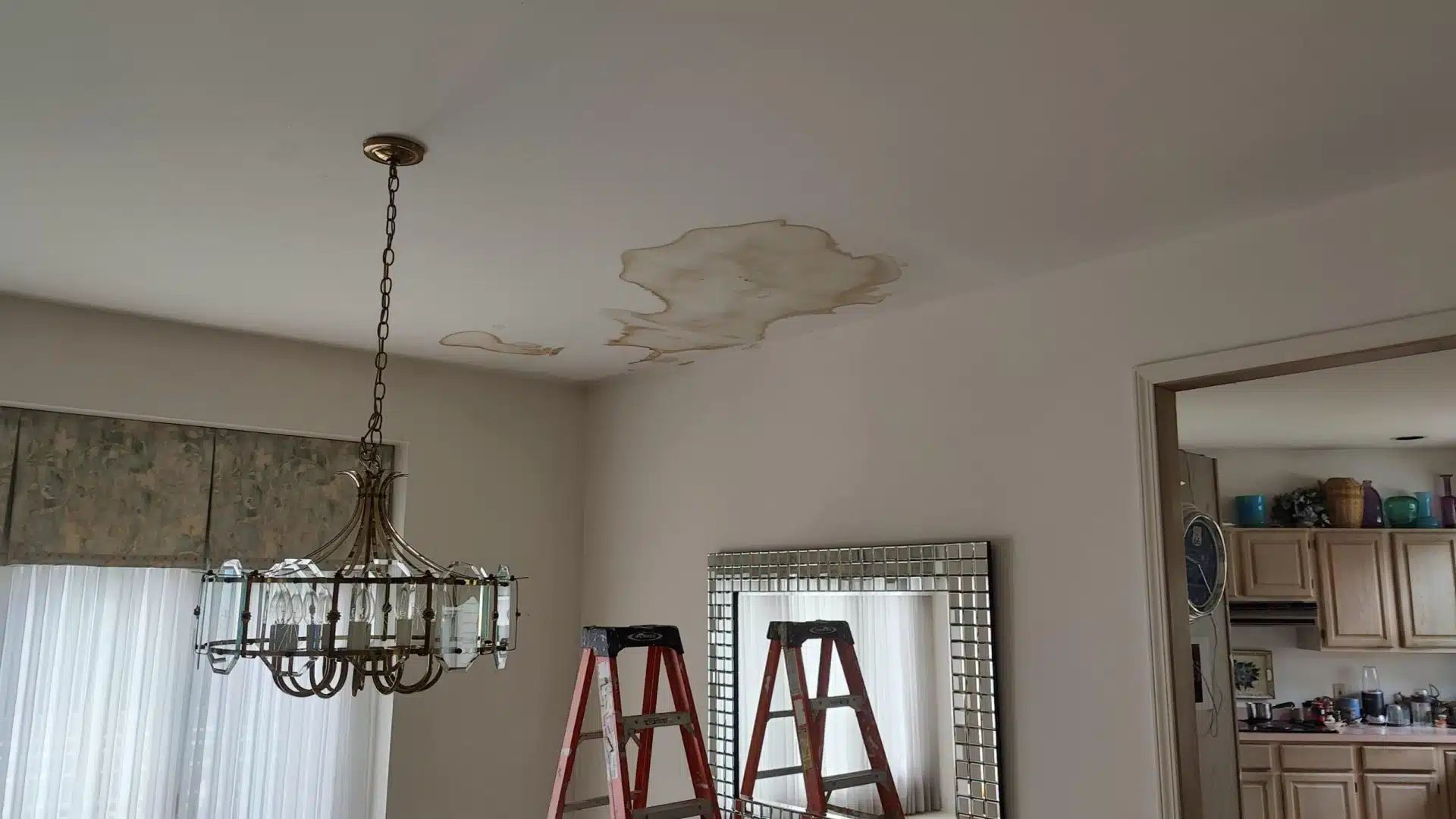
You look up and you see it: that yellow or brown ring on the ceiling. The first reflex is often to think «well, a little coat of paint and we won't talk about it anymore.» Except that repainting is almost never the first step — and here's why.
A water stain on the ceiling, it's a symptom, not just an aesthetic defect. It signals past or active moisture somewhere above. And water has the annoying habit of traveling through the assembly before appearing, so the stain isn't always at the location of the leak.
In Lévis, in bungalows and homes 25 years and older, these stains often have very specific causes: roof, plumbing, snow and thaw, ice dams, or condensation. At Solutions Rénovation Québec (RBQ license 5811-7821-01), we help homeowners distinguish the cosmetic mark from the real problem. In this article, we explain when repainting is enough and when repairs are needed.
Does a water stain on the ceiling necessarily mean a leak?
Not always a leak in the classic sense, but almost always moisture. The stain is the trace left by water that has passed through or soaked into the materials. The real question isn't «is it serious?» but «where is the water coming from, and is it still active?».
An old, stable stain whose cause has been resolved may be nothing more than a cosmetic memory. A stain that grows or keeps coming back, however, signals a problem that is still alive. Distinguishing the two is the starting point.
That's exactly what too many people skip: they repaint without checking if water is still flowing. As a result, the stain comes back, and the problem behind it has worsened in the meantime.
Signs that indicate you need to find the source
Certain signs clearly indicate that the stain is an active symptom, not just a mark. A stain that is growing, paint that is blistering or flaking, a softened, swollen or deformed drywall, a ceiling that feels damp to the touch: these are signs of present moisture.
Also watch for: a musty smell, drops or a trickle, or the appearance of the stain after rain, snow melt or a period of extreme cold. And context matters — a stain near a bathroom, kitchen or pipe often points to plumbing. These signs justify finding the source before anything else.
Why the location of the stain isn't always the location of the leak
Here's the classic trap. Water doesn't always fall straight down: it travels along joists, follows slopes, and comes out where it can. The stain therefore sometimes appears at a distance from the actual leak.
Materials — insulation, wood — can also retain moisture and move it. An infiltration from the attic can show up several feet from its entry point. And a plumbing leak can follow a pipe before breaking through the ceiling elsewhere. That's why we don't rely on the stain's location to draw conclusions: you have to trace the path of the water.
A stain that keeps coming back deserves a check
Before paying for a new coat of paint, have the cause identified. Request an on-site evaluation from Solutions Rénovation Québec — we look for where the water is coming from before talking about finishing.
Paint or repair: how do you know what to do?
That's the decisive question. The answer depends on one thing: the actual condition of the ceiling and the cause. Repainting and repairing don't address the same situations.
Let's see how to decide.
Cases where a simple repaint may be possible
Repainting may be enough, but only if several conditions are met. First, the source must be definitively resolved — no more water entering. Then, the material must be completely dry, verified, not just dry on the surface.
The drywall must also not be damaged, there must be no smell or mold, and the stain must be old and stable. If all these boxes are checked, a cosmetic intervention — stain-blocking primer and paint — is appropriate. But all these conditions must truly be met, not just «roughly.».
Cases where the drywall must be repaired or replaced
In many cases, repainting isn't enough. Saturated or deformed drywall, material that has become crumbly, persistent moisture, repeated infiltration: all situations that require repair.
Add to that suspected mold, affected insulation, or damage from a major leak, and replacing the drywall becomes necessary. Painting over damaged or damp drywall means masking a problem that will resurface — and sometimes worsen behind the new finish.
The role of drying before drywall, primer and paint
Here's the most important principle in this entire article: you never finish over moisture. Before closing up a ceiling, you measure moisture, dry and dehumidify as needed, and verify that everything is dry at depth.
Skipping this step means trapping moisture behind the drywall, primer and paint. The problem then continues out of sight — mold, deterioration — until it resurfaces bigger. Confirmed drying is the non-negotiable condition before any finishing. Paint and primer come last, never first.
Where can a water stain on the ceiling of a home in Lévis come from?
To solve the problem, you need to know the source. In Lévis, a few causes come up often. Here they are.
Roof leak and infiltration through the attic
The roof is a frequent suspect, especially on older homes. Aging shingles, defective flashing, poorly sealed roof penetrations can let water in.
Winter adds its own risks: snow accumulation, thaw, and especially ice dams that force water to back up under the shingles. An insufficient attic ventilation makes everything worse. Water then enters through the roof, circulates in the attic, and comes out at the ceiling — sometimes far from its point of entry.
Plumbing leak
Plumbing is the other main suspect, especially when the stain is under a bathroom or kitchen upstairs. A leaking pipe, a defective joint, a drainage problem can let water seep in.
The water then often follows the pipe or the structure before breaking through the ceiling. A stain that appears under a water room on the upper floor strongly points to the plumbing. This is a lead to check as a priority in this context.
Condensation and excessive humidity
Not all stains come from an obvious leak. Condensation can also be the cause. When indoor relative humidity is high and meets a cold surface — often due to poor ventilation, an inadequate vapour barrier, or insufficient insulation or thermal bridges — water condenses.
The temperature difference between the warm interior and the cold attic promotes this phenomenon in winter. The stain then results from an accumulation of moisture, not a leak. The treatment is different: here, it is ventilation and insulation that need to be corrected.
Why Lévis's climate can amplify the problem
Our climate creates a chain of risks. freeze-thaw cycles, snow and thaw, ice dams: all of this can lead to infiltration, then to moisture in the assembly, and finally to a stain on the ceiling.
Heavy precipitation and intense weather events add to the risk. That said, not every stain should automatically be attributed to the climate — plumbing and condensation remain frequent causes independent of the weather. Our climate is an aggravating factor, not a catch-all explanation. Hence the importance of diagnosis.
What are the risks of simply repainting a water stain?
Repainting without fixing the cause is tempting but risky. Here is concretely what can happen.
The stain can reappear
This is the most common scenario. The problem : the source was not addressed. The risk : a new ring reappears, and the ceiling deteriorates progressively. The solution : identify and correct the cause before finishing.
Repainting over an active source means buying a few weeks of peace before the stain returns — often bigger. The money spent on paint is then wasted, and the underlying problem has continued its work.
Moisture can damage the drywall and insulation
Water doesn't just stain — it degrades. Drywall is a porous material that softens, swells and loses its strength when it stays wet. Wet insulation loses its effectiveness and can become contaminated.
After a significant infiltration, these materials deserve a more thorough evaluation than a simple glance. Repainting over weakened drywall or waterlogged insulation means ignoring real damage beneath the surface. These porous materials must be checked, and sometimes replaced.
Mold is not limited to what is visible
This is the risk most often taken lightly. Persistent moisture in porous materials creates favourable conditions for mold — and this mold can develop where you can't see it, above the ceiling or in the insulation.
The absence of visible mold does not mean the absence of a problem. According to public health authorities, persistent moisture must be corrected without delay, and an inspection allows assessing whether decontamination is necessary. Repainting over it risks walling in a mold problem that affects air quality.
How SRQ evaluates a ceiling with a water stain in Lévis
Our approach is methodical, because a stained ceiling requires a real diagnosis before any work. Here is how we proceed.
Identify the probable source
We start by looking for where the water comes from. A visual inspection and an analysis of the context — position of the stain, season, rooms above — guide us toward the probable cause: roof, plumbing, attic or condensation. Without this step, we repair blindly.
Check the condition of the ceiling and materials
We then assess the actual condition of the ceiling: the drywall, the joints, the paint, and the insulation when accessible. We look for signs of moisture or deformation. This evaluation determines whether the materials are salvageable or need to be replaced.
Determine whether to dry, repair or replace
We then apply simple logic: if the source is active, we stop it or have it repaired first. Then we dry, we verify that everything is dry, we repair or replace the affected materials, we prepare, and only then do we paint. This order is non-negotiable — each step prepares the next.
Carry out the finishing work
Once the ceiling is dry and sound, we proceed to finishing: drywall replacement if necessary, joint taping, surface preparation, stain-blocking primer, and finish paint. The blocking primer prevents the old ring from «bleeding through» the new paint — a technical detail that makes a difference in the result.
Why drying must precede finishing
We repeat it because it is the heart of everything: never trap moisture behind a new finish. A ceiling that appears dry on the surface can retain moisture deep down. We measure, we confirm, then we close it up. This is what distinguishes a durable repair from a cover-up that will return.
Does your ceiling have a ring that keeps coming back?
A recurring stain is a signal not to be ignored. Request a free on-site estimate from Solutions Rénovation Québec — we identify the cause and propose the right solution.
How much does ceiling repair cost after an infiltration in Lévis?
The question of cost is legitimate, but it has no single answer — because an identical stain can hide very different damage. Here is what influences the price, and some orders of magnitude.
What actually influences the price
Several factors vary the bill: the area affected, the depth of the damage, the condition of the drywall, the condition of the insulation, and the origin of the water. Add to that the necessary drying work, possible replacement of materials, joint taping, painting, and access to the ceiling.
Two stains of the same size can therefore produce very different bills depending on what is behind them. That is why we evaluate the actual condition before quoting, rather than judging by the diameter of the ring.
Why a small stain can require more than a paint repair
A small stain doesn't mean a small problem. As a guideline, some ceiling work can start around 400 $, and a repair of approximately 100 sq ft can fall within a range of around 800 $ to 1,500 $ depending on the extent of the damage and the work required (indicative orders of magnitude, not a guaranteed rate — the actual cost depends on the on-site assessment).
These amounts illustrate one thing: it's better to request an estimate based on the actual condition of the ceiling than to evaluate the cost solely from the visible surface area of the stain. The real measure is the extent of the damage underneath.
Why choose an RBQ contractor to repair your ceiling in Lévis?
A stained ceiling isn't just a paint problem — it's a water problem that needs to be properly addressed. The choice of contractor makes the difference.
A renovation isn't limited to hiding the stain
The problem : a botched repair leads to a recurrence. The risk : purely cosmetic work leaves the problem hidden, and it gets worse. Our approach : diagnosis of the cause, repair, finishing and coordination of necessary work. The proof : we operate under RBQ licence 5811-7821-01, with over 500 projects completed and a 5-year warranty on labour.
Our goal isn't to make the ring disappear for the duration of a sale — it's to restore a healthy, durable ceiling.
An approach designed for Quebec homes
We know the realities of our homes: seasonal variations, freeze-thaw, humidity, roofing and insulation issues, infiltration risks. We integrate these factors into our diagnosis and our solutions.
A stained ceiling in Lévis doesn't always have the same cause as elsewhere — the climate plays a role. Our local expertise allows us to trace back to the true source and propose a repair suited to our conditions.
Get an evaluation before the stain gets worse
The sooner we act, the less it costs. Request a free, no-obligation quote from Solutions Rénovation Québec — we evaluate your ceiling before the problem grows.
Myths and realities about water stains on ceilings
A few preconceived ideas deserve to be corrected. Here is the truth from the fiction.
«I can just apply stain-blocking paint.»
Reality: only after addressing the cause and confirming that the substrate is dry and in good condition. A stain-blocking primer is useful, but it replaces neither drying nor repair. Applied to an active problem, it only postpones the stain.
«If the stain is small, the problem must be small.»
Reality: the visible dimension says nothing about the actual extent of moisture above. A small ring can conceal much larger damage in the assembly. You don't judge the problem by the size of the mark.
«There's no visible mould, so everything is fine.»
Reality: the absence of visible mould doesn't rule out hidden moisture or mould above the ceiling. What you see isn't always the complete picture. A verification is necessary when moisture has persisted.
«A fresh coat of paint is enough after a leak.»
Reality: depending on the damage, the drywall or insulation may require repair before finishing. Repainting is the last step, not the complete solution. Everything depends on the condition of the materials beneath the surface.
FAQ – Water stains on ceilings in Lévis
Does a yellow stain on the ceiling mean a leak?
Often, yes — the stain indicates past or active moisture. It's not always a clear-cut leak: it can also be condensation. What matters is knowing whether the source is still active. A stain that grows or returns indicates a problem that is still present.
Can I paint directly over a water stain?
Only if the cause has been addressed, the material is completely dry, the drywall is in good condition, and there's no odour or mould. Otherwise, repainting only masks an active problem, which will return. If in doubt, have the cause verified before painting.
When should ceiling drywall be replaced?
When it is saturated, deformed, crumbly, or affected by persistent moisture or mould. Drywall damaged by water loses its strength and cannot simply be repainted. An evaluation determines whether it can be salvaged or must be replaced.
How do you know if the water comes from the roof or the plumbing?
Context provides clues: a stain under a bathroom or kitchen on the floor above points to plumbing; a stain that appears after rain or snowmelt points to the roof. But water travels, so a professional diagnosis confirms the true source.
Can a water stain lead to mould?
Yes, if moisture persists in porous materials like drywall or insulation. Mould can develop above the ceiling, out of sight. That's why you need to correct the moisture and, if necessary, have the presence of mould evaluated before closing up.
How much does ceiling repair cost after a leak in Lévis?
It varies depending on the extent of the damage. As a guideline, some work starts around $400, and a repair of approximately 100 sq ft can range between $800 and $1,500 (orders of magnitude, not a guaranteed rate). An on-site estimate, based on the actual condition, gives an accurate figure.
Is an RBQ contractor necessary for this work?
It's not mandatory in all cases, but strongly recommended. An RBQ contractor diagnoses the cause, coordinates the corrections (roofing, plumbing, insulation) and ensures a compliant repair with warranty. For a water problem, this complete approach prevents recurrences.
What should I do if the stain reappears after painting?
It's a sign that the source hasn't been addressed. Don't add another coat of paint — instead, have the cause diagnosed. A recurring stain indicates active moisture that continues to cause damage behind the finish. You need to trace it back to the source.
Can SRQ handle the repair and finishing?
Yes. We can diagnose the cause, coordinate or carry out the necessary corrections, repair or replace the drywall, and complete the finishing — stain-blocking primer and paint. The idea is to deliver a dry, healthy, well-finished ceiling, not just to hide the stain.
Fix the cause before repainting: the right approach for your home in Lévis
In the end, the winning approach comes down to five steps: identify the source, stop the infiltration, dry and verify, repair or replace the drywall if necessary, then prime and repaint. In that order, always.
The goal is not simply to make the ring disappear. It is to restore a dry, healthy, durable and properly finished ceiling. A stain that comes back is a problem that was masked instead of fixed — and that costs more in the long run.
Repeindre a sa place, mais à la fin du processus, jamais au début. Dans notre climat humide, où toiture, plomberie et condensation peuvent tous être en cause, ce diagnostic préalable fait toute la différence entre une réparation durable et un cache-misère.
Votre plafond présente une tache d’eau?
Request a free, no-obligation estimate from Solutions Rénovation Québec or call us at 418-476-1747. On évalue votre plafond à Lévis, on remonte à la source de l’eau, et on vous propose la bonne solution — de la réparation à la finition, dans les règles de la RBQ, sans engagement.