
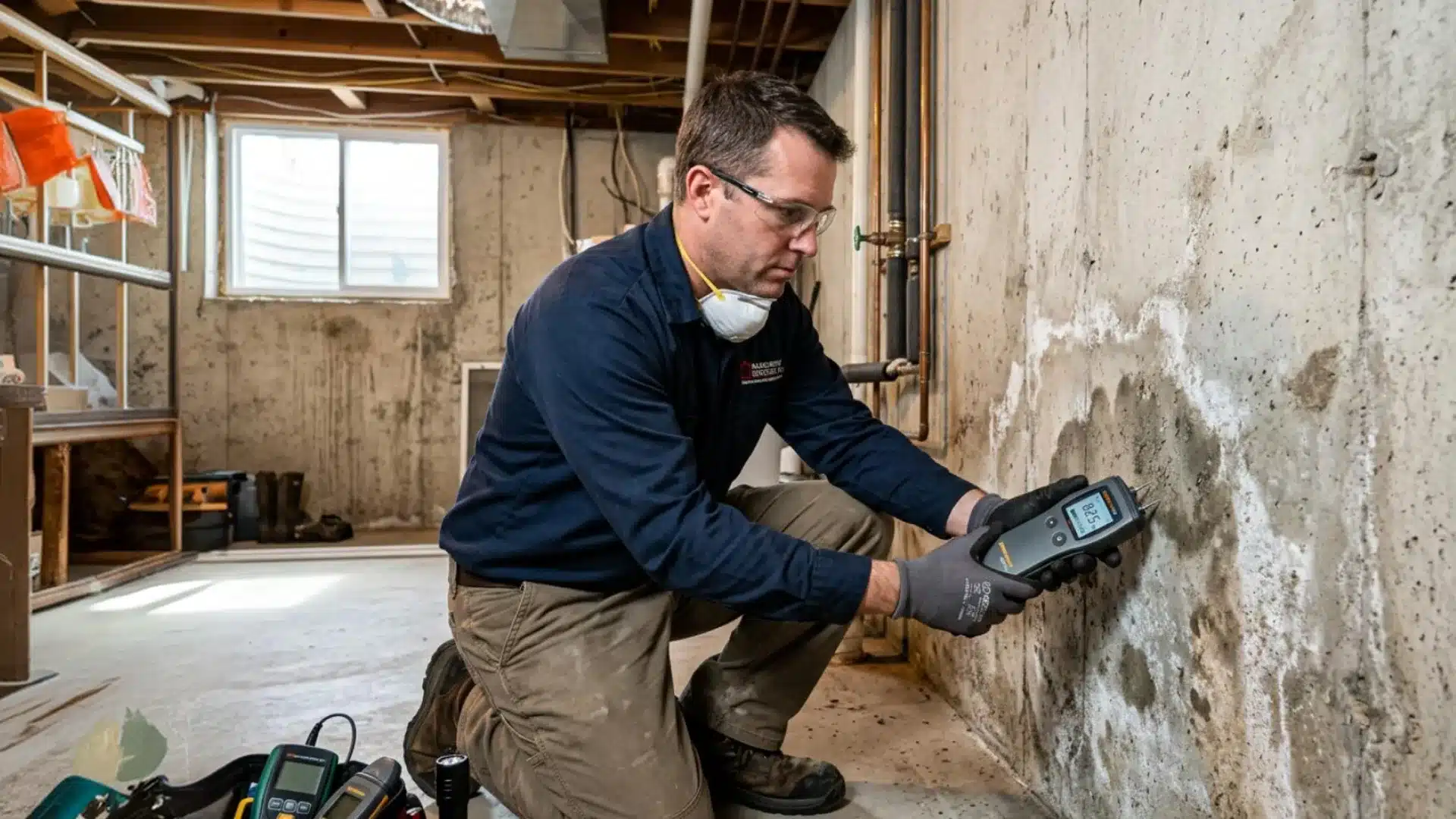
You go down to the basement and it hits you right away: that musty smell, damp earth, old. We tend to dismiss it — «it's just a basement» — but that smell is often the first signal of a moisture problem that deserves attention.
In Lévis, with the proximity of the St. Lawrence River and our older homes, this kind of smell is common. The good news is that a problem caught in time is easily fixed; the downside is that if ignored, it gets worse and costs a lot.
At Solutions Rénovation Québec (RBQ license 5811-7821-01), we inspect and decontaminate basements in the region for years. Here's what that smell can mean, when to worry, and how to fix the problem for good.
Is a musty smell really a cause for concern?
The musty smell isn't just unpleasant — it's a clue. It often appears even before you see the slightest spot of mold, because the compounds released by mold growing can be smelled before they're seen.
In other words, when it smells, the process has already started somewhere. It could be behind a partition, under a floor, or in insulation, out of sight.
Homes in Lévis are particularly exposed to this. The high humidity near the St. Lawrence, combined with often older basements, creates a favorable environment. It's not inevitable, but it's a real risk factor in our area.
However, a temporary smell must be distinguished from a chronic problem. A smell that appears after a heavy rain and disappears quickly is one thing; a persistent smell that keeps coming back is another. The latter deserves investigation to find the source.
What this smell can reveal
Behind a persistent musty smell there is almost always excess moisture. The usual culprits: water infiltration through the foundation, condensation on cold surfaces, or excessive humidity with poor ventilation.
The problem is that mold often grows where you can't see it: behind partitions, under floors, or in contaminated insulation. The smell then becomes the only visible clue — or rather, the only «smellable» clue. That's why it should never be ignored.
The main causes according to inspections in Quebec
In the field, the causes often recur. Infiltration through the foundation is common, as is condensation related to poor humidity control. Insufficient ventilation prevents the air from drying, which makes everything worse.
Add to that drainage problems : a clogged or deficient French drain, a backup, or cracks in the foundation caused by freeze-thaw cycles. Each of these causes lets water in or allows it to stagnate, and water is the fuel for mold. Identifying the right cause is half the solution.
The signs that require a rapid inspection
Some signs shouldn't wait. A persistent smell that keeps coming back is the first. Then come the visible signs: black or greenish spots, paint that bubbles or peels on basement walls.
Other clues are more subtle: abnormally cold floors, a humidity level exceeding 60%, or allergy symptoms that worsen when you spend time in the basement. If you check several of these boxes, it's time to have an inspection before the damage spreads.
Do you smell a persistent odor? Have your basement inspected before the damage becomes much more costly.
An early inspection costs far less than a major repair later. Have your basement inspected by Solutions Rénovation Québec — we identify the true cause before it causes damage.
Is it dangerous for your health… and for your home?
The musty smell isn't just a matter of comfort. Mold can affect both the health of occupants and the integrity of the home. Let's look at both aspects, without dramatizing but without minimizing.
The impacts on health
Mold releases spores into the air, and these spores can affect indoor air quality. In some people, exposure causes irritation, allergy symptoms, or worsening of respiratory problems such as asthma.
More vulnerable people — children, the elderly, or those with existing respiratory sensitivities — are generally more affected. This isn't a reason to panic, but it is a reason to take the problem seriously, especially if occupants spend time in the basement.
What public health authorities recommend
Generally, public health authorities such as Santé Québec and Health Canada recommend acting as soon as there is visible mold growth or associated respiratory symptoms. The principle is simple: don't wait.
The general recommendation is twofold: quickly correct the source of moisture and clean or have the mold cleaned appropriately. For significant contamination, a professional inspection and intervention are advised, both to properly assess the extent and to intervene safely. For personalized health advice, a health professional remains the reference.
The consequences on the structure
Beyond health, moisture and mold attack the house itself. Wood that is permanently damp can rot, which weakens the framing and structural elements over time.
Contaminated insulation loses its effectiveness, which affects comfort and heating costs. And this damage often progresses silently, hidden behind walls, until it becomes serious.
There is also the impact on value and insurance. An untreated mold problem can reduce a property's value and become an issue at resale or during an insurance claim. In short, a small problem ignored today can become a big bill tomorrow — for your health as well as your wallet.
Why is this problem so common in Lévis?
Lévis has characteristics that make basements more vulnerable to moisture. Understanding these factors helps explain why the problem comes back so often here.
The effect of the Saint Lawrence River
The proximity of the river makes Lévis a more humid environment than many regions. Ambient humidity is high, fog is frequent, and this humidity ends up in homes sooner or later.
A basement, by nature cool and in contact with the ground, becomes a natural point of condensation. When humid air meets the cold surfaces of the foundation, water condenses — and that is the beginning of the problem. The river is not to blame in itself, but it creates the conditions.
Freeze-thaw cycles
Our climate imposes freeze-thaw cycles repeated, hard for the foundations. Water seeps into microcracks, freezes, expands, then thaws — and the cycle starts again.
Over time, this movement opens cracks in the foundations and shifts the soil. These cracks become entry paths for water and moisture into the basement. It is a major factor in the infiltration observed in the region.
Homes built before 1980
Older homes, built before 1980, often accumulate several vulnerabilities. Their aging insulation, waterproofing membranes often nonexistent at the time, and inadequate ventilation make them more exposed to moisture problems than recent constructions. In a housing stock like that of Lévis, these homes are numerous — hence the frequency of the problem.
Each basement reacts differently to the Lévis climate. An inspection makes it possible to identify the true cause before undertaking any work.
Two neighboring basements can have very different causes. Request a diagnosis from Solutions Rénovation Québec — we identify the real source before proposing anything.
Myth or reality?
A few misconceptions circulate about moldy basements. Let's sort fact from fiction.
«Anti-mold paint solves the problem.»
False. Anti-mold paint can mask the appearance, but it never solves the water source. The problem continues behind the paint and eventually resurfaces. It is a cover-up, not a solution.
«It's just an old smell.»
False. A musty smell signals compounds and often spores in the air, invisible but very present. Dismissing the smell means ignoring a possible risk to health and to the home. The smell is a symptom, not a simple nuisance.
«A dehumidifier is enough.»
Nuanced. A dehumidifier helps control ambient humidity and is part of the solution. But alone, it does not correct the source — an infiltration or a crack will continue to let water in. It manages the symptom, not the cause.
«I can clean everything myself.»
Nuanced. For a small surface area, careful cleaning may suffice. But as soon as there is significant or hidden contamination, DIY shows its limits: you risk dispersing spores, missing the contamination behind the walls, and not following safety standards. A serious case requires professional intervention.
How an RBQ contractor actually treats a moldy basement
Treating a moldy basement is not just cleaning what you see. It is a methodical process aimed at eliminating the cause, not just the symptom. Here is how we proceed.
Step 1: Complete inspection
It all begins with a thorough inspection. We measure humidity, examine the foundations, evaluate ventilation, and if needed use tools such as a camera to locate hidden contamination. This step paints the real picture of the situation.
Step 2: Find the cause
Next, we trace back to the source. Is it infiltration through the foundations? Condensation? An insulation or drainage problem? Identifying the exact cause is essential — without it, any treatment is only temporary. This is the step that distinguishes a real solution from a cover-up.
Step 3: Decontamination
Then comes the decontamination itself. We confine the area to avoid dispersing spores, dry out the space, remove and replace contaminated porous materials (insulation, drywall, wood too affected), and carry out specialized cleaning of surfaces.
This step must be done with care and method. A sloppy cleaning can worsen the contamination by dispersing spores throughout the house, rather than containing and eliminating it.
Compliant procedures
We work in compliance with applicable standards — RBQ, sanitation, and workplace safety rules (CNESST) to protect both occupants and workers. Decontamination affects air quality and safety, so these procedures are not optional. This is what guarantees work done by the rules, without additional risk.
Step 4: Prevent recurrence
Decontaminating without prevention guarantees a return of the problem. The last step, the most important in the long term, is to ensure the mold does not come back.
This involves correcting the source and taking lasting measures: better insulation, adequate ventilation, a waterproofing membrane if necessary, and humidity control. By fixing the cause and strengthening the basement's defenses, we obtain a solution that lasts — not just until the next rainy spring.
A good contractor does not just treat the mold: he eliminates the cause.
That is the whole difference between fixing and masking. Request an inspection and an action plan from Solutions Rénovation Québec — we tackle the source, not just the symptoms.
How much does the problem cost when you wait?
Let's talk money, because that is often what makes people hesitate. The truth is that a moisture problem almost always costs less fixed early than late.
Average cost of an intervention
The cost depends on the extent of the problem. A targeted decontamination and correction often falls within a range of around $5,000 to $15,000 (reasonable estimate that varies by case).
If the problem has been left to worsen and a major renovation is needed — redoing a large part of the basement, replacing many materials, correcting the structure — the bill can climb toward $20,000 to $50,000 (reasonable estimate). The gap illustrates well why the timing of intervention matters.
Why waiting often costs more
Waiting lets the problem spread. Mold gains ground, wood degrades further, insulation to be replaced increases, and structural damage accumulates.
A problem that would have cost a few thousand dollars to fix early can become a major renovation once ignored too long. Add to that the loss of property value and possible complications at resale or with insurance. In short, waiting is rarely a saving — it is often a bill that grows in silence.
Why choose Solutions Rénovation Québec?
A mold problem affects your health, the structure and the value of your home. Choosing the right contractor makes the difference between solving the problem for good and seeing it come back.
A diagnosis-driven approach
Our philosophy is simple: we tackle the root cause, not the symptom. We don't offer cosmetic solutions that mask the problem. We find where the water is coming from and fix it. That's the only way to get a lasting result.
Renovations adapted to the Québec climate
We design our work for our climate. Humidity, freeze-thaw, proximity to the river: we know these realities and we choose materials and methods that offer lasting performance in these conditions. A solution designed for Lévis, not a generic recipe.
Your warranties
We operate under RBQ license 5811-7821-01, led by Marco Savoie, with a 5-year warranty on labor and more than 500 projects completed. We focus on a clean worksite, transparent pricing and clear communication. These commitments protect you and ensure work done by the rules.
Get an inspection and a no-obligation quote to protect your home before the damage gets worse.
The sooner you act, the less it costs. Request your free inspection and quote from Solutions Rénovation Québec — with no obligation.
Regions served
We intervene for wet basement and mold problems in Lévis, where proximity to the river makes these issues particularly frequent, as well as in the greater region: Québec, la Beauce, Drummondville, Trois-Rivières, Victoriaville, Sherbrooke, Montmagny and Plessisville.
Throughout this territory, we find the same realities: humidity, homes 25 years and older, and a climate that puts basements to the test. Our expertise adapts to the particularities of each sector and each home.
FAQ – Moldy basement in Lévis
Does a moldy smell disappear on its own?
Rarely in a lasting way. If the smell always comes back, it's because a source of humidity is feeding it. It may fade temporarily — after a dry period, for example — but as long as the cause isn't corrected, it reappears. It's a signal not to ignore.
How do you know if mold is hidden?
The clues: a persistent smell without visible mold, paint that bubbles, stains that go through the walls, or allergy symptoms in the basement. Hidden mold often develops behind partitions or under the floors. A professional inspection, sometimes with a camera, allows it to be located.
Is anti-mold paint enough?
No. It can improve the appearance in the short term, but it doesn't fix the water source. The problem continues behind the paint. For a real solution, you need to correct the cause of the humidity, not just cover the surface.
Should I have the air tested?
It can be useful in certain cases, particularly to assess the extent of a contamination or in the presence of symptoms. But the most important thing is first to identify and correct the source of humidity. A professional inspection will tell you if an air test is relevant in your situation.
Does my insurance cover the damage?
It depends on your policy and the cause. Some situations are covered, others are not — particularly if the problem results from a lack of maintenance left too long. That's one more reason to act early. Check your specific coverage with your insurer.
What humidity level is acceptable in a basement?
In general, the goal is to keep relative humidity below 60%, ideally in an even lower range, to limit mold growth. A level that regularly exceeds this threshold indicates a humidity problem to correct.
How much does a decontamination cost in Lévis?
It varies depending on the extent. A targeted intervention is often between $5,000 and $15,000, while a major case left unchecked can reach $20,000 to $50,000 (reasonable estimates). An inspection allows for an accurate cost to be established. Acting early generally keeps the bill lower.
How do you prevent the problem from coming back?
By correcting the source and strengthening the basement's defenses: good insulation, adequate ventilation, waterproofing membrane if needed, functional drainage and humidity control. It's this combination that ensures mold doesn't come back after decontamination.
Conclusion – A moldy smell can be fixed, but it shouldn't be ignored
In the end, if your basement smells moldy in Lévis, it's neither a catastrophe nor a detail to brush aside. It's a signal to listen to. Acting quickly protects your family's health, preserves the structure and value of your home, and prevents the problem from getting worse.
The key is to correct the cause before major damage. Paint or a dehumidifier alone aren't enough — you need to find where the water is coming from and fix it for good. In our humid climate, that's what distinguishes a lasting solution from a problem that comes back every spring.
If your basement smells moldy, request a professional inspection from Solutions Rénovation Québec or call us at 418-476-1747. An accurate diagnosis today can save you much more extensive repairs tomorrow — with no obligation.
This article is for informational purposes and does not replace medical advice. If occupants show health symptoms, consult a health professional.