
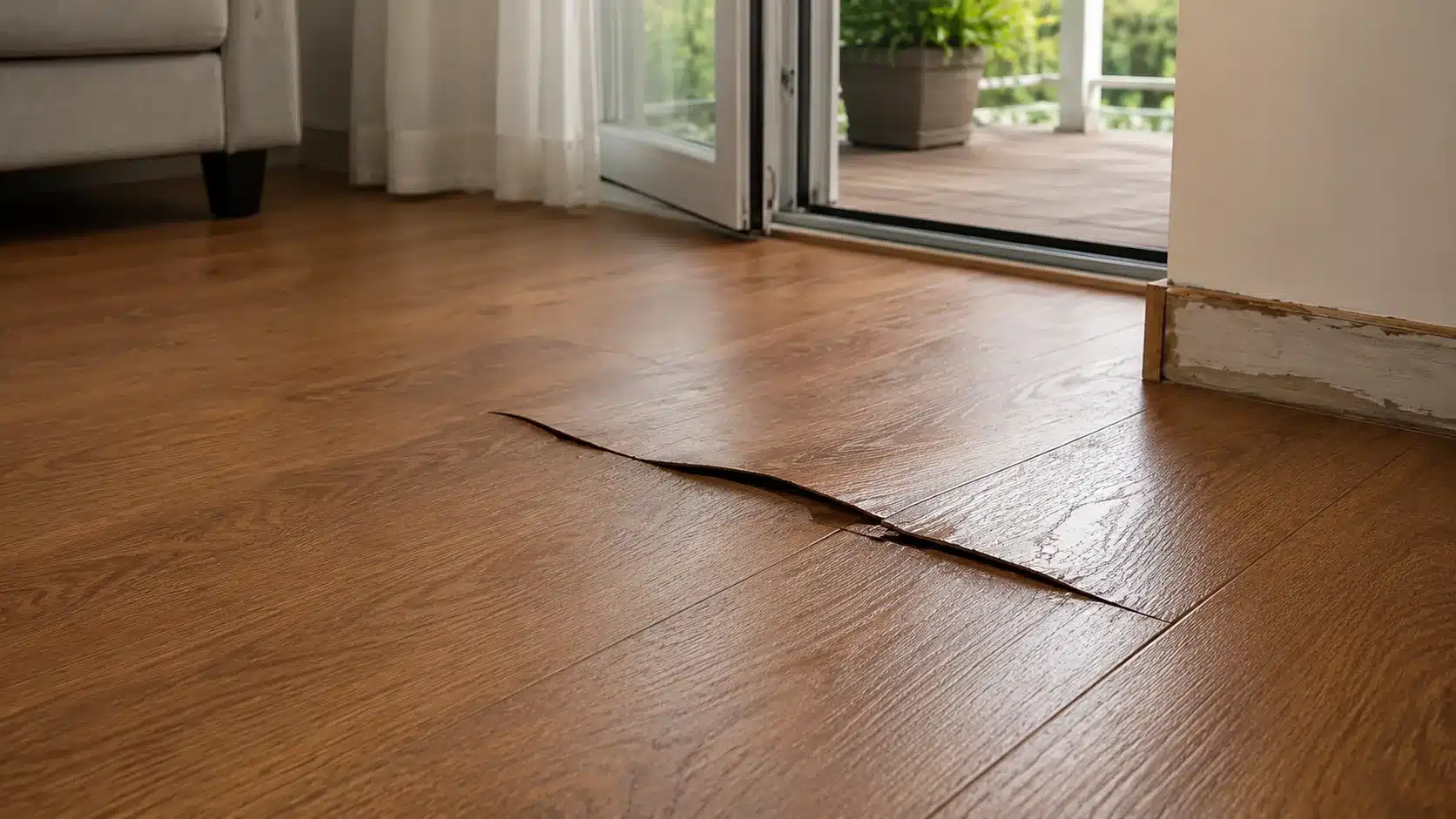
A floor that warps a few months after installation is not normal. It's also not a question of bad luck or bad material in itself. It's almost always the symptom of an underlying problem that wasn't detected — or was ignored — before or during installation.
In Lévis and surrounding areas like Saint-Nicolas, Charny and Saint-Romuald, this type of situation is seen regularly. Basements of homes built between 1950 and 1980 present particularly demanding conditions: high humidity, concrete slabs without modern drainage, and freeze-thaw cycles that stress the foundations every winter. When these factors are not taken into account before installing a floor, problems arise quickly.
The real causes of a floor that warps quickly
Warping is always a symptom — never the real cause. Most of the time, the flooring has simply reacted to something the environment imposed on it: excessive humidity, structural movement, or an installation that did not respect the minimum required conditions.
Identifying the right cause before repairing is what makes the difference between a lasting solution and a problem that comes back two years later. Here's what is most often observed in the field in the Lévis region.
Moisture in the concrete slab
This is the number one cause of warped floors in Quebec basements. The concrete slab is a porous material. It absorbs and releases moisture continuously, depending on the seasons, outdoor conditions and the state of drainage around the foundations.
When a moisture-sensitive flooring — laminate, ordinary floating vinyl, engineered wood — is installed directly on a slab whose moisture level is too high, it gradually absorbs that moisture. The material swells, deforms, and begins to warp. Depending on the severity of the problem, it can take a few weeks or a few months before the damage becomes visible.
Moisture test before installation
Before installing anything on a concrete slab, a moisture test is essential. The simplest method: tape a 61 × 61 cm square of polyethylene to the slab with adhesive tape on all sides, and leave it in place for 48 to 72 hours. If condensation forms under the plastic, the slab is too damp to receive flooring directly.
The threshold generally recommended by manufacturers is a relative humidity below 60 % at the slab surface. Beyond that, a suitable treatment or subfloor is necessary before any installation. This test is not optional — it's a basic step that any serious installer should perform systematically.
A defective floor installation
Even on a dry slab, a floor can warp if the installation was not done correctly. Three errors are constantly seen on job sites that we are called to correct.
The first is the absence of a vapor barrier between the slab and the flooring. Without this barrier, ambient moisture migrates freely to the floor. The second is poor acclimation of the material: floating floors must rest in the room where they will be installed for a minimum of 48 hours to adapt to local temperature and humidity conditions. Skipping this step means installing a material that will move once in place. The third is insufficient expansion space at the perimeter — without a gap around the walls, the floor has nowhere to go when it expands, and it lifts.
Recommended installation standards in Quebec
Canadian standards, particularly the CAN/CGSB standard for vapor barriers and manufacturers' recommendations, clearly specify the minimum installation conditions. A minimum 48-hour acclimation, a compliant vapor barrier positioned on the correct side, and an expansion space of 10 to 12 mm at the perimeter are basic requirements — not options. When these steps are rushed or omitted, the floor pays the price a few months later.
The effect of Quebec's climate (freeze-thaw)
Our climate imposes significant thermal variations on residential structures. In winter, the ground freezes and contracts. In spring, it thaws and expands. These seasonal movements are transmitted to the foundations — and by extension, to the concrete slab on which your floor rests.
In basements that lack modern perimeter drainage, spring meltwater can accumulate against the foundations and slowly seep under the slab. This additional moisture, combined with the seasonal movements of the concrete, creates particularly difficult conditions for floor coverings.
Impact on the foundations of homes in Lévis
Older homes in Lévis — built before building codes required adequate drainage under the slab — are particularly exposed. Foundation concrete from that era is often less dense, more porous, and more prone to micro-cracks caused by repeated freeze-thaw cycles. These cracks allow water to seep in at an accelerated rate, worsening moisture at the slab surface.
Your floor is warping and you don't know why? Request an inspection from Solutions Rénovation Québec — we identify the real cause before proposing anything to you.
How to repair a warped floor durably
The temptation is to want to fix the problem quickly: reinstall the floor, move on. But if the underlying cause is not corrected, the same problem will return in the months that follow — and the repair will cost even more.
A lasting repair starts with an honest diagnosis. Not with buying new materials.
Remove the flooring and correct the cause
The first step is to completely remove the buckled flooring. It's the only way to properly assess the condition of the slab and understand what happened underneath. You can then measure the moisture level of the slab, check the condition of the existing vapour barrier if there was one, and inspect the drainage.
Depending on what is found, corrections may include: waterproofing treatment of the slab, repair of cracks in the foundation, installation or replacement of the vapour barrier, or improvement of perimeter drainage. These are essential preparatory works — not extras.
Importance of structural diagnosis
If the buckling is associated with visible water infiltration or persistent moisture, a complete structural diagnosis is recommended before laying anything down again. Uncorrected infiltration will continue to feed the problem regardless of the quality of the new flooring. Basement ventilation must also be assessed — an underused and poorly ventilated space accumulates moisture more quickly.
Install a suitable subfloor
In many Quebec basements, laying flooring directly on the slab is simply not the right approach — even after correcting the moisture. A raised subfloor, composed of a panel with an integrated insulating membrane, creates an additional barrier between the slab and the finished flooring. It also improves thermal comfort and greatly facilitates replacement in the event of future problems.
This is a solution we frequently recommend in Lévis, particularly in homes where the slab shows seasonal moisture variations even after treatment. The additional cost is justified by the long-term protection it offers.
Check the minimum height (Quebec Code)
Before installing a raised subfloor, you must ensure that the available height allows it. The Quebec Construction Code requires a minimum clear height of 1 metres between the finished floor and the finished ceiling for a space to be considered habitable. A raised subfloor generally loses 1 to 2 inches — this must be calculated before starting.
Choose the right flooring for a basement
Once the cause has been corrected and the subfloor is in place, the choice of flooring is decisive in preventing the problem from recurring. Not all floors are created for Quebec basements.
Laminate and engineered wood, despite their attractive appearance, remain materials sensitive to moisture. In a basement, even a well-prepared one, seasonal variations can affect them over time. SPC vinyl (Stone Plastic Composite), on the other hand, is composed of a stone composite core — it is waterproof, dimensionally stable, and does not react to moisture variations.
Why SRQ recommends SPC vinyl
SPC vinyl is our main recommendation for basements, for concrete reasons: it does not buckle, does not swell, does not rot. It is comfortable underfoot, easy to maintain, and available in a wide variety of finishes. In an environment where moisture is a variable that can never be fully controlled at 100%, choosing a waterproof material is not a luxury — it's common sense.
Are you ready to repair your floor once and for all? Request your quote from SRQ — we make sure to correct the cause before laying anything down again.
How much does it cost to repair a buckled floor in Lévis?
It's a legitimate question — and the answer depends directly on the cause of the problem and the extent of the damage. Here are realistic ranges for the projects we most often encounter in the region.
For a complete replacement of the flooring, including removal of the existing floor, surface preparation and installation of new quality flooring, generally expect between 8 and 15 $ per square foot (reasonable estimate based on SRQ 2025 projects). On an average basement of 400 to 600 sq ft, that represents a project between 4,000 and 8,000 $, depending on the materials chosen and the necessary corrections.
Why repairs cost more than the initial installation
Repairing a buckled floor is more complex than a new installation. You have to remove the old flooring, analyze the slab, correct the underlying problems, install a new vapor barrier or subfloor, then install the new flooring. Each step has a cost.
When the cause wasn't addressed during a first repair attempt, the cycle starts over — and each redo costs more. That's why an incomplete repair can end up costing 30 to 50 % more than a job done right from the start (reasonable estimate). Doing things in the right order the first time is always cheaper in the long run.
Want an accurate estimate for your situation? Request a free inspection from SRQ — we give you a clear picture before talking about budget.
Why trust Solutions Rénovation Québec (SRQ)
RBQ contractor specializing in basements
At SRQ, we've been working on residential home basements in Lévis, Québec, Beauce and Chaudière-Appalaches for over ten years. We've seen the same mistakes repeated on hundreds of job sites — and we know exactly what to look for during an inspection.
Marco Savoie, RBQ-licensed general contractor (5811-7821-01), ensures that every project starts with an honest diagnosis. We don't propose solutions before understanding the problem. And we don't install a new floor over an unresolved problem — no matter the pressure to go fast.
A clear and transparent renovation process
We know that homeowners have often had bad experiences with contractors who disappear after the work or who leave surprises on the final bill. Our way of working is simple and predictable from the start.
Project steps
- Moisture and slab inspection — complete diagnosis before any recommendation
- Detailed quote — each item itemized, no hidden fees
- Problem correction — moisture treatment, subfloor, vapor barrier as needed
- Durable installation — materials suited to the specific conditions of your basement
Warranty and customer satisfaction
Our work is covered by a 5-year warranty on labor. We have completed more than 500 residential projects in the region with a average rating of 4.9/5 from our clients. It's not a marketing promise — it's the result of work done seriously, job site after job site.
Have a problematic floor? Schedule your inspection with SRQ today — 418-476-1747, Monday to Friday, 8 a.m. to 5 p.m.
FAQ — Buckled floor in Québec
Why does my floor only buckle after a few months?
Because the process takes time. Moisture gradually infiltrates the material, and the deformations accumulate before becoming visible. A floor installed in spring may only show signs in autumn, when humidity conditions change.
Is it moisture that causes buckling?
In the vast majority of cases, yes — directly or indirectly. Slab moisture, seasonal infiltration, or poorly managed condensation are the most frequent causes in basements in the Lévis region.
Can a buckled floor be repaired without replacing everything?
Sometimes, if the buckling is localized and the cause has been identified and corrected. But in most cases, if the problem comes from the slab or the vapor barrier, the flooring must be removed to access the source of the problem. A surface repair on a structural problem never lasts long.
What floor is best for a basement in Québec?
SPC vinyl is our main recommendation. It's waterproof, stable, and designed for environments with variable humidity. It's the choice best suited to the real conditions of Québec basements.
How long does the repair take?
For a standard basement, generally allow 3 to 5 business days for removal, correction of underlying problems and installation of the new flooring. This timeframe may vary if additional work is necessary — crack treatment, drainage improvement, installation of a raised subfloor.
Is SPC vinyl really moisture-resistant?
Yes — it's its main characteristic. Its stone composite core doesn't swell, doesn't deform and doesn't react to water. Unlike laminate or ordinary floating vinyl, it maintains its dimensional stability even in variable humidity conditions.
Is an RBQ contractor necessary?
For work that involves the basement structure, drainage or foundation corrections, yes. A licensed RBQ contractor knows the applicable standards, can obtain the required permits, and offers a warranty on their work. For a simple flooring replacement without an underlying problem, it's not mandatory — but it remains a guarantee of quality.
How to prevent floor buckling?
By starting with a slab moisture test before any installation. By using a compliant vapor barrier. By choosing flooring suited to the basement conditions. And by ensuring the installation meets installation standards — acclimation, expansion space, surface preparation. These steps take time, but they prevent costly problems later on.
Conclusion
A floor that buckles six months after installation is disappointing. But it's repairable — if you tackle the right problem. Reinstalling a floor without correcting the slab moisture or the vapor barrier deficiencies means wasting time and money for the same result.
At SRQ, we've learned to never skip the diagnosis step. That's what allows us to propose solutions that last — not temporary fixes that come back to haunt the homeowner two seasons later.
Is your floor causing you problems? Contact Solutions Rénovation Québec for a free inspection — we find the cause, we clearly explain the solution to you, and we give you a detailed quote with no obligation. 418-476-1747.