
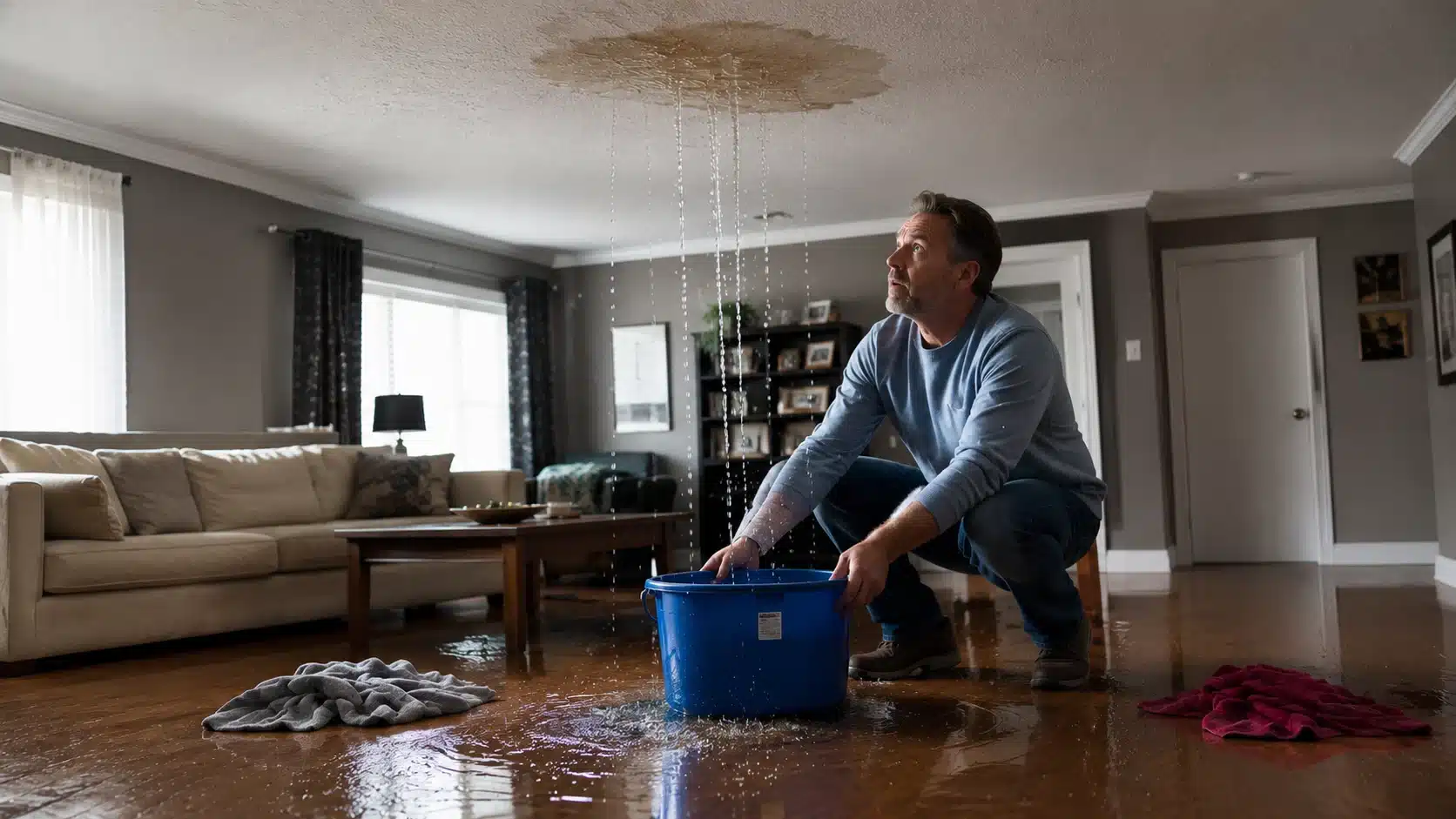
A brown stain on the ceiling. A trickle of water in the window frame. A musty smell that sets in after a night of rain.
If you recognize this scenario, you are not alone. It is one of the most common situations seen among homeowners in Charny and the surrounding area of Lévis — especially after a heavy storm or rain that lasts several hours.
The good news: water infiltration can be fixed. The less good news: it does not fix itself. And the longer you wait, the more the damage — and the costs — accumulate.
At Solutions Rénovation Québec (SRQ), we regularly work in homes in Charny, Saint-Romuald and Lévis for this kind of situation. We are RBQ contractors (licence 5811-7821-01), and here we explain what really causes these leaks, what to watch for, and how to fix them properly.
Do you have an active infiltration? Contact us for a quick inspection
Why do roofs in Charny often leak after heavy rain?
There is rarely a single cause. In general, it is a combination of factors — and Quebec's climate context amplifies all of it.
A roof in good condition can absorb a lot. But a roof that is 20 or 25 years old, with shingles that have lost their granules, cracked flashing or overflowing gutters, becomes vulnerable as soon as the rain exceeds a certain volume or intensity.
Here is what we most often observe in the field.
Asphalt shingles age faster in Quebec
An asphalt shingle can last 20 to 30 years in a temperate climate. But in Quebec, repeated freeze-thaw cycles — sometimes 100 to 150 cycles per winter in the Chaudière-Appalaches region — significantly accelerate their degradation. (reasonable estimate based on regional climate data)
When the granules disappear, the shingle loses its protection against water and UV. It hardens, cracks, and gradually lets moisture in — especially during heavy rains when water accumulates on the surface.
The impact of the Lévis and Chaudière-Appalaches climate
The Lévis region is subject to significant precipitation, river winds and temperature variations that put roofing materials to the test. In winter, ice infiltrates under damaged shingles. In spring, rapid thawing creates pressures that aging underlayers can no longer handle.
This is not a problem specific to your home. It is the reality of living in this corner of Quebec.
Why homes in Charny are more vulnerable
Many bungalows in Charny were built between the 1960s and 1985. These homes often have insufficient attic ventilation, original insulation that has never been updated, and one or two original roofs replaced without always addressing the underlying problems.
A well-maintained 40-year-old home can last a long time yet. But if ventilation is poor, moisture accumulates in the decking and the wood begins to work — which opens paths for water.
Flashing and gutters are often the real cause
Many homeowners look at their shingles first. But in a significant proportion of the cases we handle in Lévis, the problem comes from the flashing — those metal pieces that form the joint between the roof and the chimney, plumbing vents, dormers or walls.
When flashing lifts, corrodes or detaches, rain enters directly through there — and the water follows the slope to reappear a few feet further inside the house. That is why people often look for the leak in the wrong place.
Clogged gutters also pose a serious problem. When water can no longer drain normally, it overflows, backs up under the fascia boards and ends up in the roof space or in the insulation.
What a homeowner can safely check
From the ground or from a window, you can observe a few signs without climbing onto the roof:
- Shingles that are missing or visibly warped
- Gutters that overflow or come loose
- Moss or vegetation on the roof
- Water or rust stains on the fascias
For anything that requires climbing onto the roof, we strongly advise against doing it yourself. A fall from a roof can be fatal, and evaluating a roofing problem requires a trained eye to be useful.
A small leak can become a major problem quickly
What we often see is homeowners who wait. The stain on the ceiling is not big. The rain has stopped. We tell ourselves we will deal with it next summer.
Except that water, once it has entered, continues to spread. It follows the rafters, infiltrates the insulation, accumulates in the decking. In a few weeks, a problem costing a few hundred dollars can become a partial or complete renovation.
The risks to the structure and to health
Moisture in the wood leads to rot in the rafters and decking — the structural pieces that support your roof. Once the wood is affected, the repair is much more complex.
The other risk is mould. It can set in in wet insulation or on damp wood within a few days under the right conditions. And once it is established, it requires serious decontamination — a service we offer, but one we would prefer you never need.
Do you see a stain on the ceiling or smell an odour after the rain? Request a roof inspection from SRQ
What signs indicate that an urgent repair is needed?
Not all signs are equal. Some allow you to wait a few weeks before acting. Others require intervention within the following days.
Here is how to distinguish the urgent from the less urgent.
Visible signs never to ignore
— A moisture stain that grows after each rain
— Water actively dripping in the attic or in a room
— Missing shingles after a storm
— A musty smell that sets in during the first hours after rain
— Bulging or peeling on a painted ceiling
If you notice one or more of these signs, don't put off the inspection until later.
What happens when you wait too long
We mentioned it above, but it's important to repeat it clearly: an untreated infiltration can invalidate certain clauses of your home insurance if you cannot demonstrate that you acted with diligence.
Some insurers require proof that the problem was not known and left untreated for a long time. A documented inspection by an RBQ contractor can protect you in this context.
After a storm, some damage remains invisible
A storm can damage your roof without there being any immediate sign inside. A flashing that lifts slightly. An underlayment membrane that tears under the impact of a branch. A shingle that cracks without detaching completely.
This damage often only appears at the second or third following rain — when the water finally finds its way.
Why infiltrations progress between the walls
Water that enters through the roof does not always fall directly into the room below. It follows the wood, the insulation, the membranes. It can travel several feet before manifesting inside, which makes diagnosis difficult without a serious inspection.
This is one of the reasons why we always do a complete inspection before proposing anything to you. We don't repair blindly.
Has your roof recently been through a storm? Have your roof inspected before the next storms
Repair or completely redo the roof?
This is the question we are asked most often during a first visit. And the honest answer is that it depends. It depends on the age of the roof, the extent of the damage, and what we find under the shingles.
We have no interest in proposing a complete redo if a targeted repair can solve the problem durably. A good reputation is built with recommendations — not with inflated work.
When a targeted repair is sufficient
If the roof is less than 15 years old and the damage is localized — a defective flashing, a few missing shingles around a vent, a section affected by a branch — a well-done repair can give you several more years.
The important thing is to ensure that the repair is done with the right materials and according to the rules of the art. A patch of tar or caulking over a detached flashing is a temporary solution that rarely lasts more than one winter in Quebec.
Situations where SRQ recommends a quick intervention only
Recent leak on a roof in generally good condition. Localized damage after a storm. Replacement of a flashing around a chimney or a skylight. These cases are often resolved in one day and at a reasonable cost.
When a complete redo becomes more cost-effective
If the roof is more than 20 years old, if infiltrations are observed in several places, or if the wood decking shows signs of rot or sagging, surface repair is no longer a valid solution. It's like changing the tires on a car whose chassis is rusted.
In these cases, a complete redo is more economical in the long term. We solve the problem once, correctly, with a 5-year warranty on labor.
The signs of a roof at the end of its life
— Shingles that curl or lose their granules massively
— Visible sagging of the surface between the rafters
— Multiple infiltration zones on different sections
— Deficient attic ventilation for several years
— Roof that has already been covered with a layer over the old one
This last point is important: if your roof is installed over an old layer, it cannot receive a third layer according to standards. Everything will have to be removed before starting over.
How much does a roof cost in Quebec in 2026?
Prices vary according to the surface area, the complexity of the roof, access, and the materials chosen.
Price ranges in Lévis and Charny (reasonable estimates, 2026)
Asphalt shingles (standard, single-family home):
Between 9,500 $ and 16,500 $ for a medium-sized house, with removal of the old roof, replacement of the decking as needed, and installation of a quality underlayment.
Metal roof (painted steel or galvalume steel):
Between 22,000 $ and 45,000 $ depending on the type of product, the slope and the surface area. Metal costs more to install, but its lifespan can exceed 50 years with little maintenance — it's often the last roof we install.
These prices include materials, labor and site cleanup. To get a precise figure for your home, a visit is required. It's free at SRQ, with no obligation.
Get a transparent quote with no pressure
Why choose an RBQ contractor for a roof leak?
In Quebec, residential roofing work must be carried out by a contractor licensed by the Régie du bâtiment du Québec. This is not just an administrative formality — it's a concrete protection for you as a homeowner.
The risks of improvised or non-compliant repairs
We regularly see houses where repairs have been done by someone without a license — a helpful neighbor, a handyman, or an unaccredited contractor. In most cases, it's caulking, tar in a tube or mastic applied to the surface.
It can hold for a few months. But as soon as winter arrives and frost plays on the materials, the temporary patches fail — and the infiltration often resumes worse because it has progressed underneath during that time.
Why temporary patches often fail
Tar and silicone do not provide the necessary adhesion on oxidized shingles or on damp wood. They mask the problem without solving it. And if non-compliant work has been done on your property, it can complicate a future claim with your insurer or during resale.
What SRQ does differently
We don't show up on a roof with a tube of caulking. We always start by understanding the problem.
SRQ Process
- Complete visual inspection — roof, accessible attic, interior (stains, moisture, decking)
Clear diagnosis — we explain exactly what we found and why it's leaking
Detailed submission — firm price, specified materials, realistic timelines
Safe execution — trained team, protective equipment, compliance with RBQ standards
Complete cleanup — we leave your property as we found it
We work with a team of 5 to 10 specialists depending on the projects, and Marco Savoie supervises the compliance of the work.
Materials adapted to the Quebec climate
We select underlayments, membranes and shingles designed to withstand freeze-thaw cycles. Attic ventilation is an integral part of every re-roofing — because a roof that doesn't breathe doesn't last in Quebec.
Warranty, compliance and peace of mind
All our roofing work is covered by a 5-year warranty on labour. If a problem related to our installation occurs during this period, we come back without discussion.
Why the 5-year warranty reassures homeowners
A warranty is a way of saying we're ready to stand behind what we do. If we weren't confident in the quality of our installation, we couldn't offer that.
It also gives you a real recourse if something goes wrong — a recourse you don't have with an unlicensed contractor or one without a written commitment.
Talk to an SRQ roofing specialist
How to prevent water infiltration in the future?
A well-installed roof requires little maintenance. But a little attention twice a year can save you costly surprises.
Annual inspection and gutter maintenance
Clogged gutters are among the most frequent and most preventable causes of infiltration. Leaves, debris, shingle granules — all of it accumulates and prevents water from flowing properly.
A gutter cleaning in the fall, after the leaves have fallen, and a quick check in the spring are enough in most cases.
The best times to inspect your roof in Quebec
Spring: right after the thaw, to see the damage caused by winter — lifted shingles, displaced flashings, ice areas.
Fall: before the first snowfalls, to identify and fix any problem before the cold complicates the work.
An inspection by an RBQ contractor generally takes between 30 and 60 minutes and gives you a clear picture of the condition of your roof.
Ventilation and insulation: the forgotten elements
Attic ventilation is probably the most underestimated factor in the lifespan of a roof in Quebec.
When warm, humid air from the house rises into the attic without being able to escape, it condenses on cold surfaces. This creates moisture on the decking, promotes mould, and in winter, causes ice dams at the edge of the roof.
Reducing ice dams in winter
An ice dam is when snow melts on the warm part of the roof (poorly insulated or poorly ventilated) and refreezes at the edge. The water held back by the ice works its way up under the shingles.
The lasting solution is not to de-ice the roof every winter — it's to fix the insulation and ventilation at the source. An attic that maintains a temperature close to the outside doesn't accumulate ice dams. Current standards recommend an insulating value of R-40 to R-60 for the Lévis area, depending on the configuration. See our attic insulation and ventilation service
Preventing costs less than an emergency
A preventive inspection costs a fraction of what an emergency repair in the middle of winter costs. And it can identify developing problems before they become structural damage.
How to avoid major water damage
— Clean the gutters twice a year
— Have the roof inspected after every major storm
— Don't ignore a stain on the ceiling, even a small one
— Maintain good attic ventilation
— Document the condition of your roof for your insurer
These simple actions can make the difference between a repair costing a few hundred dollars and a complete re-roofing.
Why do Charny homeowners trust SRQ?
For over 10 years, we've been working with homeowners in the Lévis, Charny, Saint-Romuald and Quebec areas. More than 500 residential projects completed — from small repairs to complete re-roofings, including interior renovations and decontamination work.
A human and transparent approach
We tell you what we found, clearly. We explain the options. We give you a firm price and we honour it. No hidden fees that appear along the way, no pressure to choose the most expensive solution.
If a targeted repair can solve your problem, that's what we propose. If the roof is at the end of its life and everything needs to be redone, we tell you that too — with the concrete reasons that justify that decision.
Expertise adapted to the realities of Quebec
We know the houses around here. The 1970s bungalows in Charny. The row houses in Saint-Romuald. The recent single-family homes in Lévis-Est. Each type of construction has its particularities, and our experience with these houses allows us to get straight to the point.
We also know the climate. The long winters. The January thaws. The springs that arrive quickly with their abundant rain. All of this influences our choice of materials and our installation methods.
More than 500 residential projects completed
It's not a number meant to impress — it's what it represents in terms of situations encountered, problems diagnosed, solutions found. Every roof we've redone or repaired has taught us something.
And our worksites are clean. We protect your property, we pick up our materials, and we leave with the premises tidy. It's a detail that matters to homeowners — and to us too.
Schedule your free inspection in Charny or Lévis
Frequently asked questions about roof leaks in Charny
Why does my roof only leak when it rains heavily?
Because light rain doesn't generate enough pressure or volume to penetrate a partial weakness in the roof. During heavy rain, water accumulates faster than it drains, and it finds the paths that are normally waterproof. A slightly lifted shingle or a slightly detached flashing can hold up in normal rain and only give way under intense rain.
Can a small infiltration cause mold?
Yes — and often faster than we think. Mold develops in a humid environment within 24 to 72 hours depending on conditions. A recurring infiltration, even a modest one, creates exactly these conditions in the insulation and structural wood.
How much does a roof repair cost in Lévis?
It depends on the problem. Replacing flashing or a few shingles to replace can cost between $350 and $900. A more extensive repair around a chimney or skylight can range from $800 to $2,500. To get a precise figure, an on-site inspection is necessary. (reasonable estimates, 2026)
Does a 20-year-old roof need to be replaced?
Not necessarily — but it deserves a serious inspection. In Quebec, a standard-quality asphalt shingle roof can last between 15 and 25 years depending on exposure, ventilation and maintenance. At 20 years, it may be in good overall condition or at the end of its life. Only an inspection can tell you.
Does insurance cover water infiltration?
Most insurance policies cover damage caused by sudden and accidental infiltration — for example, a storm that tears off shingles. However, infiltration caused by wear and tear or lack of maintenance is generally excluded. If you have any doubt, call your insurer before doing any work, and document the situation well.
Can I repair my roof myself?
Technically, some small jobs are accessible to a skilled handyman. But in Quebec, roofing work of a certain scope must be carried out by an RBQ-licensed contractor. And regardless of regulations, a roof is a dangerous place — falls are the leading cause of death on construction sites. We strongly advise against climbing onto your roof without proper training and equipment.
How do I know if the flashing is defective?
From the inside, look around the chimney, skylights and vents for signs of water or rust. From the outside (without climbing up), you can sometimes see flashing that is lifting or has caulking that is peeling off. But a serious evaluation of the flashing requires an inspection by someone trained for it.
When should you call an RBQ contractor?
As soon as you notice a water stain on the ceiling, a musty smell after rain, or you know that your roof is more than 15 years old and has never been inspected. Don't wait to see water actively dripping — at that stage, the damage is often already significant.
How long does a roof inspection take?
Generally, between 30 and 60 minutes for a standard single-family home. We inspect the exterior surface, the flashing, the gutters, and when possible, the attic from the inside. At the end, we give you a clear picture of what we found.
What is the best season to redo a roof in Quebec?
Summer and early fall are ideal — temperatures allow good shingle adhesion and conditions are safe for workers. We can also work in spring as soon as temperatures stabilize above 7 °C. In winter, work is possible but more complex, and some shingle manufacturers do not cover the product warranty for installations done below certain temperatures.
Solutions Rénovation Québec — RBQ Licence 5811-7821-01
2552 chemin du Fleuve, Lévis, Québec, G6W 1Y3
📞 418-476-1747 | srq.quebec@gmail.com
Monday to Friday, 8 a.m. – 5 p.m.
renovationsolutionsquebec.ca