
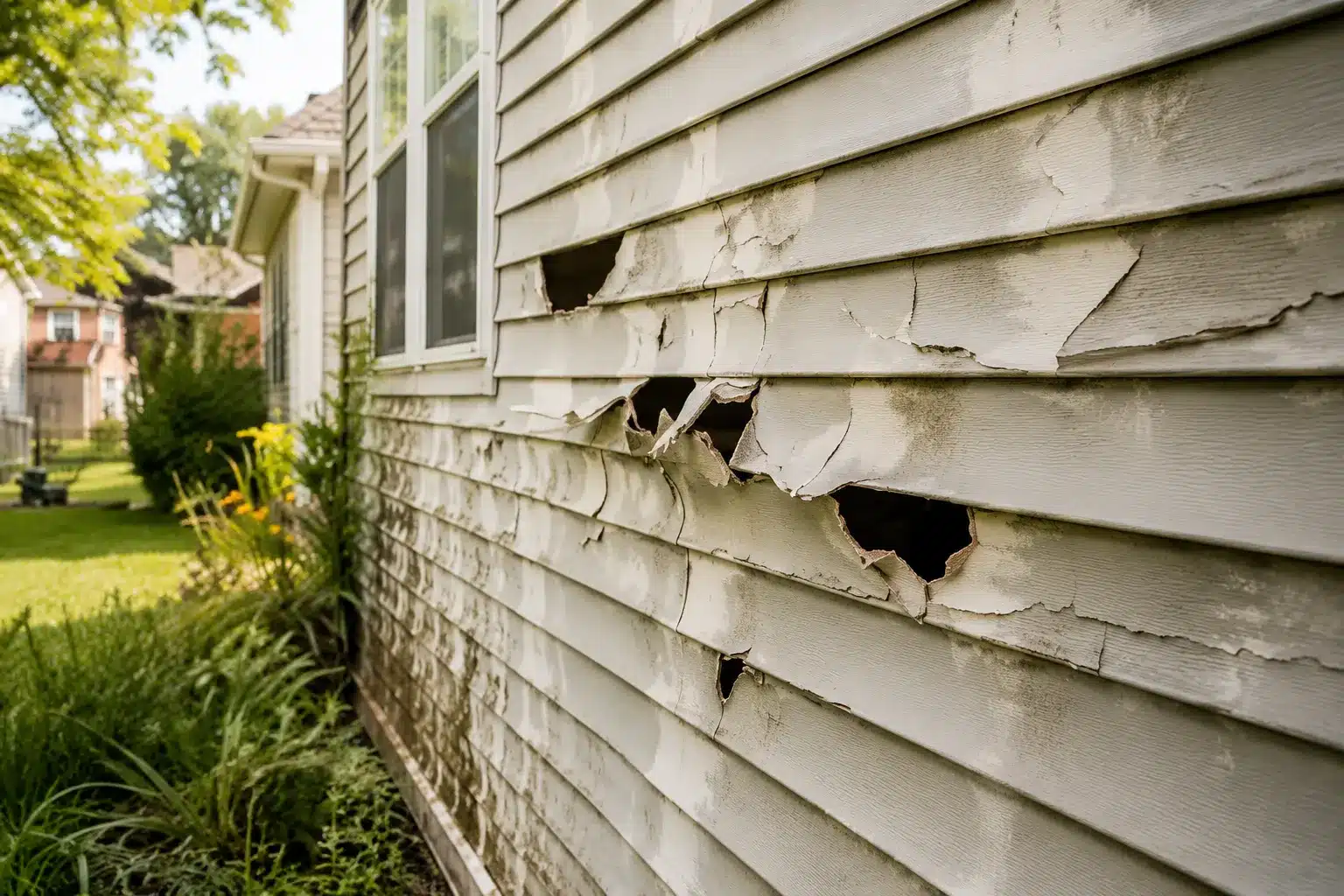
Every spring, it's the same ritual for many homeowners in Lévis: you walk around the house after winter and notice cracks in the siding. Sometimes one or two panels, sometimes several entire sections. It's not a seasonal coincidence — it's the direct result of the weather conditions our homes are exposed to every winter.
The Lévis region experiences approximately 65 freeze-thaw cycles per year (reasonable estimate based on historical climate data). Each cycle causes the vinyl to contract and expand. On a material of insufficient quality or poorly installed, these repeated stresses eventually create cracks — sometimes visible to the naked eye, sometimes microscopic but just as problematic. At Solutions Rénovation Québec (SRQ), we have been inspecting and replacing exterior siding in the region for over ten years. Here's what we see in the field, and what can be done about it.
The main causes of cracks in vinyl siding
Winter cracks are not inevitable. They always have a specific technical cause — and in the vast majority of cases, that cause was avoidable from the moment of installation.
The freeze-thaw cycles of Lévis's climate
Vinyl is a material that expands in heat and contracts in cold. Under normal conditions and with a quality product, these movements are absorbed without issue. But when temperatures swing rapidly back and forth across the freezing point — which is common in Quebec in November, March and April — the stresses on the material intensify.
What weakens vinyl is not so much the stable deep cold of January as the rapid variations: a day at -15 °C followed by a thaw at +5 °C, then a return to freezing. These repeated thermal shocks stress the material in both directions. On vinyl that already has a few years of wear or whose chemical composition is not suited to Quebec winters, that is enough to cause microcracks that gradually widen.
Vinyl that is too thin or of inferior quality
The thickness of vinyl is directly linked to its resistance to thermal shocks. A low-end vinyl with a thickness of less than 0.040 inch becomes brittle in the cold — it loses its natural flexibility and behaves more like a rigid material than like a flexible covering capable of absorbing movement.
A premium vinyl of at least 044 inch in thickness, formulated with thermal stabilization additives, maintains its flexibility even at negative temperatures. The difference in behavior between the two, after five Quebec winters, is significant. This is often where the essential lies — not in the installation, but in the choice of material from the start.
Incorrect installation without adequate ventilation
Even a quality vinyl can crack if the installation does not follow the basic rules. Two errors come up frequently on the job sites we are called in to correct.
The first: the absence of a ventilated air gap behind the siding. Without ventilation, moisture accumulates against the substrate, creates significant humidity variations behind the cladding, and promotes movement of the material. The second: panels fastened too tightly. Vinyl must be able to move freely during temperature variations. If the nails or screws are driven in too deeply, they prevent this natural movement — and the material cracks at the stress points.
Cracked siding: what risks for your home?
A crack in siding is more than an aesthetic problem. Depending on its depth and location, it can have concrete consequences for your home's envelope.
Water infiltration and moisture in the walls
Vinyl siding is the first line of defense against precipitation. A crack that goes through the thickness of the panel creates a direct opening for rainwater and melting snow. In our spring conditions — abundant rain combined with melting snow — cracked siding can let significant volumes of water penetrate against the wall's backing.
If this moisture cannot drain quickly, it accumulates in the insulation or against the exterior gypsum board. Mold takes hold in these areas — often without the homeowner noticing until the damage is advanced.
Accelerated deterioration of the cladding
A crack never stays stationary. With each freeze-thaw cycle, the water that infiltrates the crack freezes, expands, and widens it a little more. What starts as a hairline crack in the fall can become a split panel section by the following spring. Without intervention, the deterioration accelerates from one season to the next.
Impact on property value
Cracked siding is visible — and potential buyers notice it. During a pre-purchase inspection, exterior cladding in poor condition is systematically noted and can justify a lower offer or a repair condition. For homeowners considering a resale in the coming years, the condition of the exterior siding is a value factor that deserves attention.
Does your siding show cracks after winter? Request a façade inspection with SRQ — we assess the extent of the damage and clearly explain your options.
Can cracked vinyl siding be repaired?
The answer depends on the number of panels affected and the underlying cause. Here are the real options — without false hope.
Local repair: a temporary solution
If one or two sections are cracked and the rest of the siding is in good condition, targeted replacement of the damaged panels is technically possible. This is the least costly solution in the short term. The problem is that finding replacement panels whose color exactly matches the existing ones is difficult — vinyl ages and changes shade over time. And if the cause of the cracks is not corrected, the adjacent panels risk following the same path.
Partial or complete siding replacement
When cracks affect several facades or a large area, partial replacement often creates an uneven visual result. A homeowner who replaces every other facade ends up with a house in two different tones — the old siding faded on one side, the new one a brighter shade on the other. In these cases, a complete replacement is often wiser in the long term, both for appearance and for durability.
Average cost to repair or replace in Lévis
For a partial replacement or targeted facade repair, costs generally range between 8,000 and 15,000 $ depending on the area affected. A complete siding replacement on a standard single-family home varies between 18,000 and 30,000 $ (reasonable estimate based on SRQ projects in the region, 2025). These ranges vary depending on the total area of the house, the type of vinyl selected, and the corrections needed on the substrate or ventilation.
Are you evaluating your options for your cracked siding? Get an estimate from SRQ — detailed quote, no obligation, no hidden fees.
How to prevent winter cracks in siding
If you replace your siding now, the decisions you make will determine whether you relive this problem in five years or avoid it for the next twenty years.
Choosing a superior-quality vinyl
The minimum recommended thickness for residential siding in Quebec is 044 inch — ideally more for highly exposed facades. Beyond thickness, look for a product with a formulation specifically designed for northern climates: thermal stabilization additives, low-temperature impact resistance, and an explicit manufacturer warranty. A vinyl that costs a little more upfront but lasts twenty-five years is systematically more economical than an entry-level product to be replaced in ten years.
Install ventilation behind the siding
The ventilated air gap behind the cladding is not an optional detail — it is a structural element of the installation. It allows moisture to escape, reduces thermal variations in the material, and significantly extends the lifespan of the siding. An installation without adequate ventilation, even with premium vinyl, will age prematurely.
Comply with Building Code standards
RBQ-compliant installation and proper fastening
The Quebec Building Code specifies installation requirements for exterior cladding, including fastening tolerances that allow the material to move freely. Nails must be positioned correctly in the fastening slots — neither too tight nor too loose. This simple rule, often ignored in quick installations, is directly linked to the durability of siding in our climatic conditions. An RBQ contractor knows these requirements and applies them on every job site.
Professional diagnosis of cracked siding in Lévis
Complete façade inspection
A professional inspection goes beyond counting cracked panels. We assess the orientation of each facade and its level of exposure to thermal shock, the general condition of the vinyl across the entire house, the presence and condition of the air gap behind the cladding, and the condition of the substrate in the affected areas.
Verification of material quality
We also check the thickness of the vinyl in place and, if possible, the original brand and product line to determine whether a manufacturer warranty is still applicable. Some manufacturers cover material defects even on installations several years old — but claiming this coverage requires a precise process that your contractor can handle for you.
Report and replacement recommendations
Following the inspection, we present you with a clear picture: the extent of the damage, the identified causes, and the replacement options suited to your home and your budget. We recommend premium vinyl products that have proven themselves in our winter conditions — not the products with the most attractive margin for us.
Want a professional's opinion before deciding? Book a free inspection with SRQ — we travel to Lévis and all surrounding regions.
Why choose Solutions Rénovation Québec for your siding
At SRQ, we have been doing exterior renovations on residential homes in Lévis, Quebec, Beauce and Chaudière-Appalaches for over ten years. We know the characteristics of the homes in our region, the climatic conditions they face, and the materials that truly withstand our winters.
Marco Savoie, RBQ-licensed general contractor (5811-7821-01), supervises every siding replacement project. We select materials based on the real conditions of each facade — sun exposure, wind exposure, orientation, type of existing substrate. And we install according to standards, with proper fastening that allows the vinyl to move freely through the seasons.
Our results speak for themselves: over 500 residential projects completed in the region, a average rating of 4.9/5 of our clients, and a 5-year warranty on labor on every installation.
Clear and transparent renovation process
Every siding project at SRQ follows the same predictable process: complete inspection of the existing facade, detailed quote with all line items, professional installation compliant with RBQ standards, and complete job site cleanup upon delivery. No surprises along the way.
Ready to solve your siding problem once and for all? Request your quote from Solutions Rénovation Québec — 418-476-1747, Monday to Friday, 8 a.m. to 5 p.m.
FAQ — Cracked vinyl siding in winter in Quebec
Why does my vinyl siding crack in winter?
Because vinyl contracts in the cold and some materials lose their flexibility at low temperatures. Repeated freeze-thaw cycles create stresses that lower-quality or poorly installed products cannot absorb indefinitely. The result: cracks that appear progressively, often at fastening points or at junctions between panels.
Can cold really break vinyl siding?
Yes — not the stable cold of January, but rapid temperature variations. A shift from -15 °C to +5 °C in 24 hours heavily stresses the material in both directions. On vinyl of insufficient quality or already weakened by a few years of wear, this type of thermal shock can cause visible cracks.
How much does siding replacement cost in Lévis?
Between $8,000 and $15,000 for a partial replacement, and between $18,000 and $30,000 for a complete replacement on a standard single-family home (reasonable estimate, 2025). The cost varies depending on the surface area, the type of vinyl chosen, and the corrections needed to the substrate or ventilation.
Can a crack in vinyl be repaired?
For a crack localized on an isolated panel, a targeted panel replacement is possible. But if the cause of the cracks — poor installation, vinyl too thin, lack of ventilation — is not corrected, the problem will recur on adjacent panels.
What vinyl thickness is recommended in Quebec?
A minimum of 044 inch is recommended for residential siding in our climate. For facades highly exposed to wind or thermal shock, greater thicknesses are preferable. Avoid products below 0.040 inch — they are not designed for our winters.
Can freeze-thaw damage the walls behind the siding?
Yes, if cracks allow water to infiltrate. Water that gets behind the siding freezes in the insulation or against the substrate, expands, and creates progressive damage. A quick inspection after discovering cracks allows you to check whether damage has already occurred inside the wall.
Are cracks covered by the warranty?
It depends on the origin of the cracks. If they result from a material defect, the manufacturer's warranty may apply — some premium lines cover structural defects for 20 to 25 years. If they are caused by poor installation, the contractor's warranty is concerned. At SRQ, our 5-year warranty on labor covers problems related to our installation.
How do you choose a reliable contractor to replace siding?
First, check the RBQ license — it's the baseline. Then, ask for references on similar projects in your area, a detailed written quote with specified materials, and an explicit warranty on labor. A contractor who cannot provide these elements is not ready to take responsibility for their work.
Conclusion — Winter cracks can be avoided with the right choices from the start
Vinyl siding that cracks in winter is almost always the consequence of a product undersized for our climate conditions, an installation that did not follow the basic rules, or both at once. It's not inevitable — it's a problem that can be avoided with the right materials and the right methods.
When it's time to replace, investing in superior-quality vinyl properly installed according to standards is the only choice that saves you from reliving the same situation in five years. That's exactly the approach we apply at SRQ on every siding project.
Has your siding suffered this winter? Contact Solutions Rénovation Québec for a free inspection — honest diagnosis, transparent quote, installation guaranteed 5 years. 418-476-1747.