
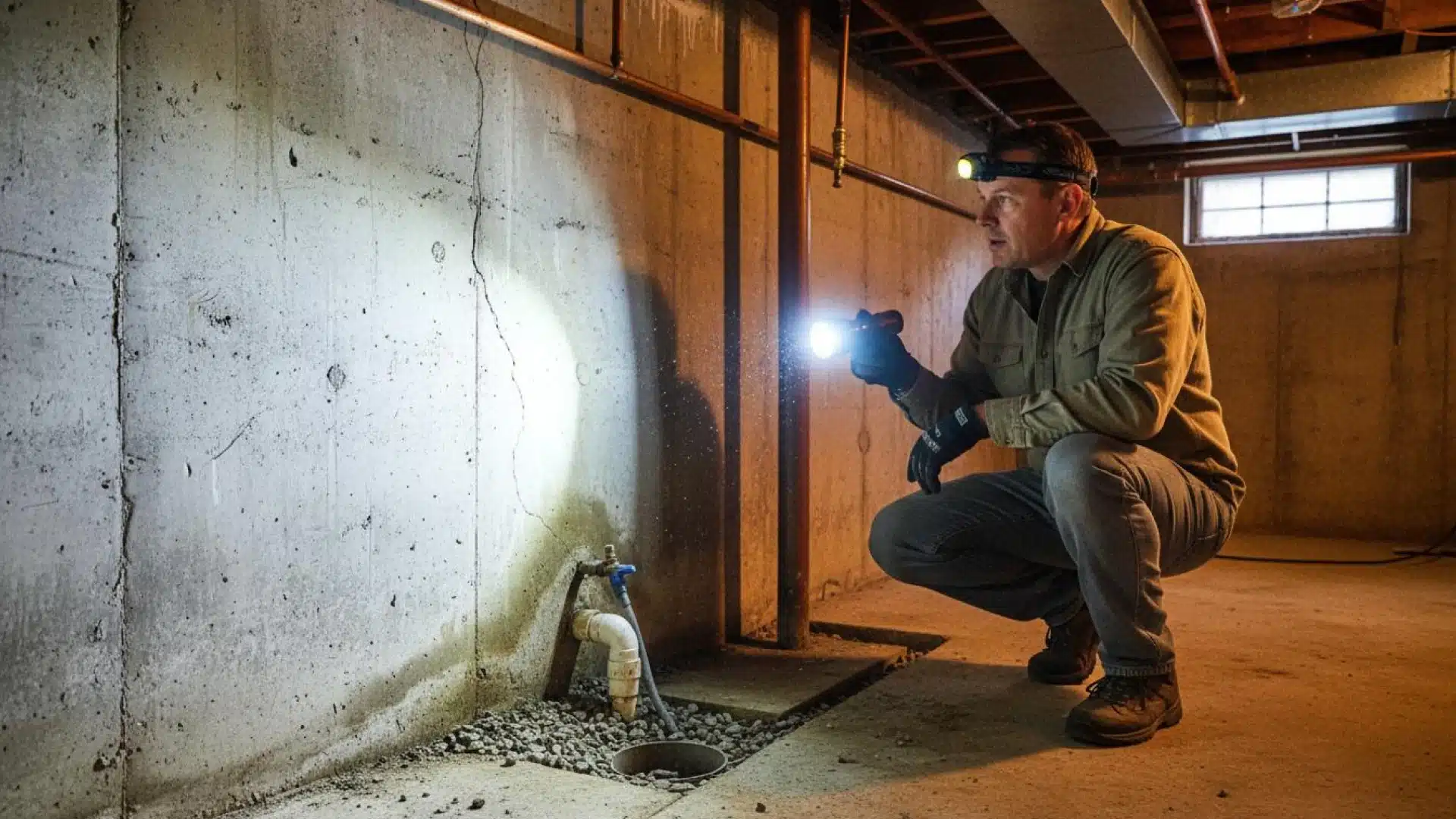
Your basement has already flooded, and now you dream of finishing it — turning it into a family room, an office, a bedroom. The desire is good, but there is a trap: finishing a basement that has already been flooded without correcting the cause is building on a problem.
In Lévis, between the proximity of the river, spring floods and clay soils, basement flooding is not rare. The good news is that a basement that has already flooded can be finished — provided you follow the right steps in the right order.
At Solutions Rénovation Québec (RBQ license 5811-7821-01), we prepare and finish basements in the region taking these realities into account. In this article, we explain the essential precautions before embarking on finishing.
Can you finish a basement that has already been flooded?
The short answer: yes, but not right away, and not without preparation. A basement that has been flooded can absolutely become a beautiful living space — provided you first resolve what caused the flooding.
This is a question that comes up often in Lévis, because many homeowners have experienced at least one episode of water in the basement. The classic mistake is wanting to renovate too quickly, to turn the page. We understand the impulse, but it costs dearly.
The golden rule: finishing is never the first step. Before installing the slightest sheet of drywall, you must ensure that the cause is corrected and that everything is perfectly dry. Skipping this step guarantees problems.
The most costly mistakes are precisely those of haste: finishing over residual moisture, ignoring the source of the infiltration, using unsuitable materials. Each one leads sooner or later to redoing the work.
Why the damage is often invisible
The problem with water is that it hides. A basement can seem dry on the surface and remain damp where you cannot see. Porous materials — drywall, insulation, wood — absorb water and retain it for a long time.
This hidden moisture is the ideal breeding ground for mold, which then develops out of sight. You can have a basement that looks clean but hides contamination behind the walls or under the floors. This is precisely what makes the inspection necessary.
What hides behind the walls
Behind the walls of a basement that has been flooded, you can find several problems: spores of mold growing, rot that attacks the wood, corrosion on metal elements, and residual moisture trapped in the insulation.
These problems are not visible from the outside, but they degrade the structure and the air quality. Uncovering them before finishing means avoiding walling them in — and paying for them later.
The consequences of premature finishing
Finishing too quickly means risking a recurrence. If the cause is not corrected, the water will return, and this time it will ruin a brand-new basement. You then lose your investment.
Add to that rapid deterioration: materials installed over residual moisture deteriorate quickly, grow mold and must be redone. And there is the insurance issue — a finish done without correcting a known problem can complicate a claim in the event of a new loss. In short, haste almost always costs more than patience.
Before investing in a basement finish, have it confirmed that your home is completely dried out and safe.
Finishing can wait; preparation cannot. Have your basement inspected by Solutions Rénovation Québec — we confirm that everything is dry and sound before finishing anything.
Why are Lévis basements more vulnerable?
Lévis combines conditions that make basements more exposed to flooding and infiltration. Understanding these factors helps target the right protections.
The effects of spring floods
Spring is a risky period. Snowmelt and rain raise water levels and the water table. This rise exerts pressure on the foundations and pushes water to seek a path inside.
In lower areas or near waterways, this risk is amplified. A basement that is fine all summer can take on water during the spring thaw, when the water table is at its highest. It is a seasonal factor not to be underestimated.
The clay soils of several areas
Several areas of Lévis rest on clay soils, which retain water. When the clay is saturated, it exerts pressure — hydrostatic pressure — against the foundations.
This pressure pushes water toward the slightest weak point: a crack, a joint, an old penetration. The foundations then undergo constant stress, especially during wet periods. It is a very common infiltration mechanism in the region.
The impact of freeze-thaw
Our cycles of freeze-thaw repeated aggravate everything. Water infiltrates into microcracks, freezes, expands, then thaws — a cycle that recurs dozens of times each winter.
This movement works the foundations, widens existing cracks and creates new ones. Result: infiltration paths that multiply over the years. Freeze-thaw is a key factor in the vulnerability of basements here.
Houses built before 1990
Older houses, built before 1990, often have aging or deficient drains, worn or absent waterproofing membranes, and were built according to standards different from today's. These characteristics make them more vulnerable to infiltration. In Lévis's housing stock, these houses are numerous — hence the frequency of basement water problems.
Each lot presents different challenges. An inspection allows you to identify priority corrections before renovation.
Your situation is unique. Request a consultation with Solutions Rénovation Québec — we identify the priority corrections for your lot before thinking about finishing.
The essential steps before finishing a basement
Finishing a basement that has been flooded follows a precise sequence. Each step prepares the next, and skipping one of them compromises everything else. Here is the order to follow.
Step 1: Verify the cause of the flooding
First of all, you need to know why the water came in. Was it an infiltration through a crack, a sewer backup, a rise in the water table? The cause determines the solution. Without this diagnosis, you are repairing blindly — and often missing the real source.
Step 2: Measure the humidity
Next, you measure. A hygrometer allows you to check the relative humidity of the air and the humidity of the materials. This is what confirms whether the basement is truly dry, deep down, not just on the surface.
Why a humidity test is essential
The humidity test is not a formality — it is what guarantees that you are not finishing over a problem. A material that feels dry to the touch can retain enough moisture to feed mold. Respecting the right thresholds before finishing is protecting the health and air quality of the future space. You do not install anything until the measurements are good.
Step 3: Fix foundation problems
Once the cause is known and the moisture measured, the foundation is repaired. This can mean repairing cracks, improving drainage, installing or replacing a membrane, or waterproofing.
This is the heart of prevention. A waterproof and well-drained foundation is what prevents water from coming back. This step is more important than everything that follows, because it addresses the source.
Step 4: Install the necessary protections
Finally, the protections that will defend the basement long term are put in place. Depending on the situation, this includes a French drain functional drain, a sump pump, a backflow preventer against sewage backups, a waterproof membrane and moisture-resistant insulation.
These elements form a complete defense system. Each plays a role: draining water, pumping it, blocking backflow, waterproofing. Together, they greatly reduce the risk of a new flood. It is only once these protections are in place that one can think about finishing.
Fixing the source before finishing prevents repeated renovations and significant costs.
The order of the steps is not negotiable. Request a technical inspection from Solutions Rénovation Québec — the basement is properly prepared before finishing.
The most effective solutions to prevent a new flood
Preventing a recurrence relies on a few proven solutions. Here are the main ones, with their role.
French drain
The French drain is a perimeter drainage system installed at foundation level, which collects water from the soil and evacuates it before it enters. It is a basic protection against infiltration.
Like any system, it requires maintenance to remain effective — a clogged drain no longer drains. A functional French drain is often the centerpiece of a good prevention strategy.
Exterior waterproofing
Waterproofing exterior consists of protecting the foundations from the outside, generally with a membrane applied after excavation. It is the most complete treatment, because it blocks water before it reaches the concrete.
This work is more extensive — it involves excavating around the foundation — but its effectiveness is superior. For a basement that has already been flooded, it is often the most durable solution.
Why prioritize exterior work
Exterior waterproofing addresses the source: it prevents water from reaching the foundation. An interior solution, on the other hand, manages water once it has already entered the concrete. Treating the problem on the outside generally offers more durable performance, because the water is stopped before it causes damage. This is the principle of addressing the cause rather than the symptom.
Sump pump and emergency power supply
The sump pump evacuates water that accumulates in a sump pit, before it rises into the basement. It is an essential active protection in many cases.
A crucial point often overlooked: the emergency power supply. A pump plugged into the grid becomes useless during a power outage — which often happens during storms, at the worst possible moment. A backup battery ensures the pump continues to work when you need it most. It is a detail that can save your basement.
Insulation suited to basements
Basement insulation, especially after a flood, must be chosen to resist moisture. Water-repellent materials that do not retain water and do not degrade when exposed to moisture are preferred.
Good, suitable insulation also improves energy efficiency and the comfort of the future space. It is a double investment: protection against moisture and heating savings. The right material in the right place makes all the difference in a basement.
How much should be budgeted before finishing a basement?
Let's talk budget. The amounts that follow are orders of magnitude (reasonable estimates that vary depending on the case). An inspection allows precise costs to be established for your situation.
Inspection
A professional inspection is often around 300 $ to 800 $ (reasonable estimate). It is a small investment that guides everything else and avoids costly mistakes.
Drying and decontamination
If the basement requires drying and decontamination after the flood, plan for approximately 3,000 $ to 10,000 $ (reasonable estimate), depending on the extent of the damage and contamination.
French drain and waterproofing
Drainage and waterproofing work, which protects against a recurrence, often falls between 8,000 $ and 20,000 $ (reasonable estimate), depending on access, the excavation required and the extent of the corrections.
Complete finishing
Finally, complete basement finishing — once everything is secured — can range between 25,000 $ and 60,000 $ (reasonable estimate), depending on the surface area and the level of finishing. Several factors influence this budget: adding a bathroom, quality of materials, complexity of the layout.
These amounts may seem high, but they protect your investment. A well-prepared and well-finished basement lasts for years; a basement finished too quickly can be ruined at the first new flood. Preparation is money saved in the long term.
Myths or realities?
A few misconceptions circulate about flooded basements. Let's separate fact from fiction.
«A sump pump is enough.»
False. The pump is useful, but it manages the water that comes in — it doesn't stop it from entering. Without drainage or waterproofing, the source of the problem remains. The pump is part of the solution, not the whole solution.
«Sealing the walls solves the problem.»
False. Sealing or painting the walls from the inside does not block water that pushes in from the outside under pressure. It's a surface treatment that masks the problem without solving it. The real solution addresses the source, often from the outside.
«A single flood won't have consequences.»
False. Even a «single» flood can leave hidden moisture and contamination that cause long-term damage. And if the cause isn't corrected, it can happen again. A flood always deserves a serious inspection.
«I can finish the basement after a few weeks of drying.»
Nuanced. Drying time depends on the extent, the materials and the conditions. A few weeks may be enough in some cases, but only a reliable moisture reading confirms it. You don't rely on the calendar — you rely on measurements.
A prevention plan adapted to your property costs far less than a second flood.
Better to prevent. Request a prevention plan from Solutions Rénovation Québec — adapted to your property and its real risks.
Why entrust this work to Solutions Rénovation Québec?
Preparing and finishing a basement after a flood requires expertise in prevention as much as in finishing. The choice of contractor determines whether your investment is protected.
An approach based on prevention
Our priority is to keep the water from coming back. We establish a complete diagnosis, analyze the cause of the flood, and propose permanent solutions rather than surface fixes. Finishing a basement without solving the cause is not our way of working.
Renovations adapted to the Québec climate
We design our work for our climate: freeze-thaw, humidity, spring floods. We choose materials and methods that offer resilience in these conditions, for a basement that holds up over time.
Our commitments
We operate under RBQ licence 5811-7821-01, led by Marco Savoie, with a 5-year warranty on labour and more than 500 projects completed. We focus on a clean worksite and a transparent quote, with no hidden fees. These commitments protect you and ensure work done by the rules.
Regions served
We work on basement preparation and finishing in Lévis and its sectors — including Saint-Nicolas and Desjardins — where floods, clay soils and freeze-thaw make these issues frequent.
We also serve the greater region: Québec, Beauce, Chaudière-Appalaches, Centre-du-Québec, Mauricie and Estrie, including Sherbrooke, Drummondville, Trois-Rivières, Victoriaville, Montmagny and Plessisville. Everywhere, our expertise adapts to local realities and to each home.
FAQ – Finishing a basement that has already flooded in Lévis
How long should you wait before finishing a flooded basement?
There is no fixed delay — it depends on the extent, the materials and the drying conditions. What matters isn't the calendar but the moisture readings. We only finish once the hygrometer confirms that everything is dry deep down, and that the cause has been corrected.
How do you know if the walls are completely dry?
With a hygrometer and material moisture readings, not by touch. A wall can seem dry on the surface while retaining moisture inside. Only reliable measurements confirm that it is ready to receive a finish. It's a step not to improvise.
Is a French drain always necessary?
Not in every case, but often recommended after a flood, especially on clay soil. The French drain evacuates water from the ground before it enters. The necessity depends on the cause of the flood and the ground conditions, which an inspection can establish.
Is a sump pump enough?
No, rarely on its own. The pump manages the water that comes in, but doesn't stop it from entering. It's part of a system with drainage and waterproofing. And think about a backup battery: a pump without electricity during a storm no longer protects anything.
Which materials best resist a possible new infiltration?
Water-repellent materials, which don't retain water and don't degrade if exposed to moisture. For insulation and coverings in a basement after a flood, we favour these adapted materials rather than products that swell or grow mould on contact with water.
Does insurance cover the finishing after a flood?
It depends on your policy and the circumstances. Some situations are covered, others not, especially if a known problem hasn't been corrected. Finishing without solving the cause can also complicate a future claim. Check your specific coverage with your insurer.
Do I need a permit before certain work?
Possibly, depending on the nature of the work — especially if it affects the structure, plumbing or electricity, or if it adds a bathroom. Requirements vary and can change. Validate your project with the City of Lévis before starting.
How do I prevent a new flood from ruining my investment?
By correcting the cause before finishing, and by installing the right protections: drainage, waterproofing, pump with backup battery, backwater valve, adapted insulation. It's this preparation that protects your finished basement. Finishing without preventing means risking losing everything at the next flood.
Conclusion – A successful finish always begins with good preparation
In the end, yes, you can finish a basement that has already been flooded in Lévis — but never by skipping steps. A successful finish begins with a complete correction of the causes: finding out why the water came in, drying everything out, repairing the foundations and installing the right protections.
Lévis homeowners must deal with very specific realities: proximity to the river, spring floods, clay soils and freeze-thaw. These factors make prevention even more essential. Neglecting these realities means risking seeing a beautiful finished basement ruined at the next rise in water levels.
And the math is simple: preventing always costs less than rebuilding. A professional diagnosis and rigorous preparation protect your investment over the long term, so that your basement stays dry, healthy and pleasant for years.
Has your basement already been flooded? Request a no-obligation inspection with Solutions Rénovation Québec or call us at 418-476-1747 to establish a durable renovation plan that complies with RBQ requirements — with no commitment.