
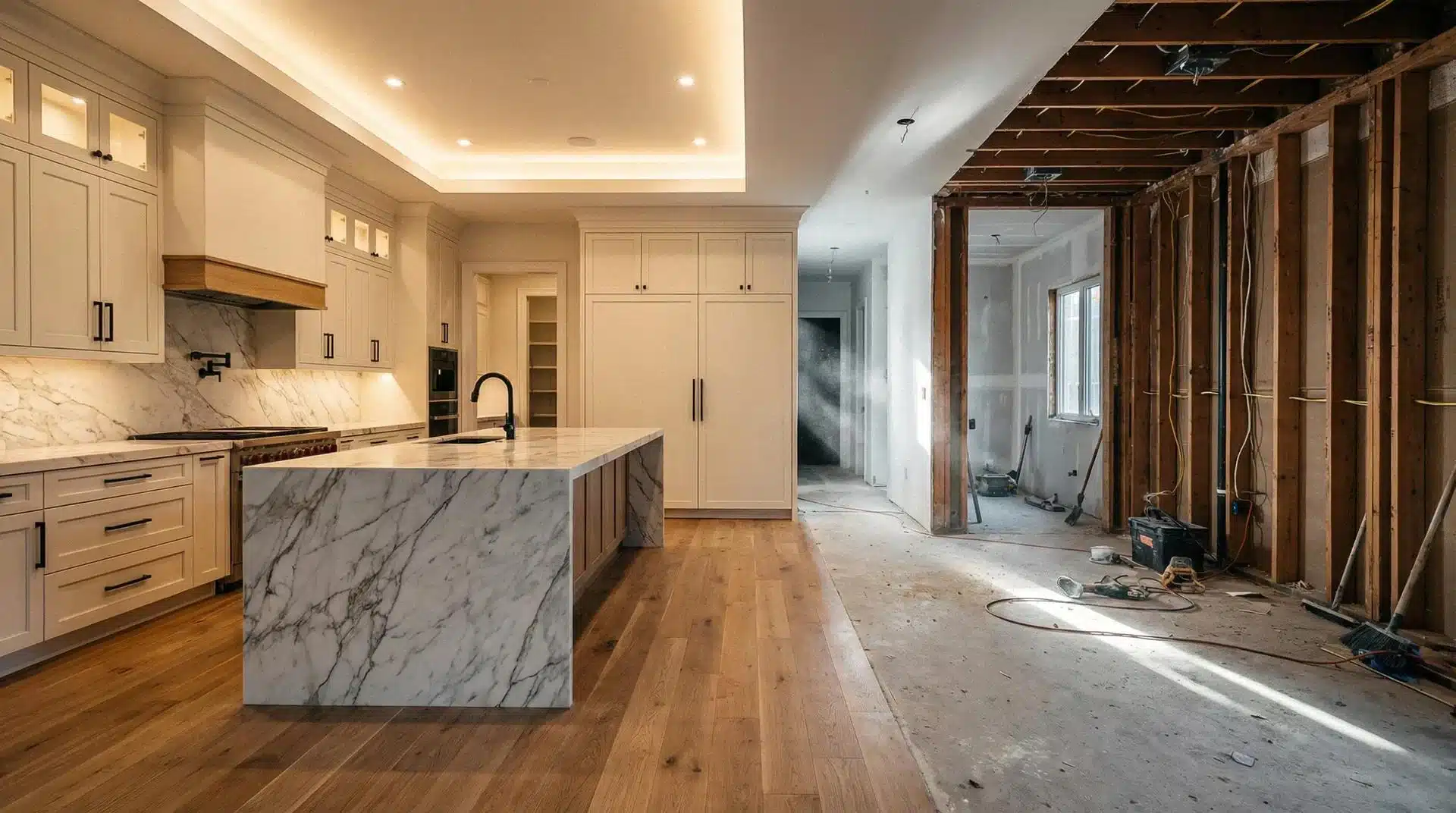
Residential renovation spending in Quebec exceeded 29 billion in 2025 according to the Association of Construction and Housing Professionals of Quebec. This figure says something important: homeowners are investing seriously in their homes. But investing seriously starts with asking the right questions before opening your wallet.
In Old Lévis and throughout the region, many homeowners find themselves facing the same dilemma: renovate the entire house at once, or go step by step? Both approaches have their logic. Both also have their pitfalls. And the wrong choice is often the one made without having all the elements in hand.
The average renovation project in Quebec is around 34 000 $ (reasonable estimate). Depending on how you plan your work, you can end up below this budget or well above it. This guide gives you the elements to decide intelligently, based on your home, your budget and your actual situation.
Why this choice influences the budget and the value of your home
It's not just a matter of personal preference. The way you plan your work has direct consequences on what you spend in total, on the duration of disruptions to your daily life, and on the market value of your property when you sell or refinance.
A well-executed complete renovation can increase the value of a home by approximately 11 % in Lévis (reasonable estimate based on regional real estate market trends). That's not nothing, on a property valued at $350,000, that's nearly $40,000 in added value. But the work still has to be done well, well coordinated, and actually improve the performance and appearance of the home.
Financial planning, project duration and real estate impact are three dimensions that influence each other. A project decided piecemeal, without an overall vision, can cost much more and create less value than a well-structured project from the start.
The context of older homes in Old Lévis
Most homes in the Old Lévis area are between 25 and 70 years old, some even date back to the early 20th century. These properties have character, but they have also accumulated generations of modifications, additions and deferred maintenance.
What is regularly found in these homes: insulation that no longer meets current standards, moisture problems hiding behind apparently sound finishes, structures that have been modified over time without always respecting the original construction logic. It's not dramatic, but it requires a serious assessment before planning anything.
Climate challenges specific to Quebec
The climate context of Lévis adds a layer of complexity. Freeze-thaw cycles stress foundations, exterior cladding and sealant joints. Water infiltration, through foundations, around windows or under thresholds, is a chronic problem in homes that have not been properly treated. Condensation in walls can cause invisible damage for years before manifesting clearly.
These realities directly influence the renovation strategy. In a home whose envelope is not watertight, renovating the kitchen or bathroom without addressing moisture problems is building on an unstable foundation. This is one of the strongest arguments in favor of a global vision of the project, even if the work is spread out over time.
The most frequent planning errors
The error seen most often is the lack of coordination between phases. A homeowner redoes their bathroom. The following year, they redo the hallway floor. The year after, they tackle the kitchen. At each phase, there are demolition costs, protection costs, restoration costs for adjacent areas. Costs add up, and often, previous work must be partially undone for the new work to integrate properly.
Poorly coordinated work can increase cumulative costs by 20 to 30 % compared to a globally planned project (reasonable estimate). This is not theoretical. It's what is concretely observed when intervening after piecemeal renovations done without an overall plan.
The solution is global project planning, even if the work is done in phases. Deciding in advance on the sequence, the interfaces between spaces, and the systems (plumbing, electrical, ventilation) that affect several rooms at once avoids costly duplication.
You have a project in mind but don't know where to start? Request a free consultation, we come to evaluate your home on site and help you structure a plan that makes sense for your situation.
Complete renovation: advantages and limits
A complete renovation means deciding to renovate several components of the home at the same time: the kitchen, the bathroom, the floors, the insulation, the finishes. Everything is planned together, everything is carried out within the same mobilization of resources.
For a home of 150 to 200 m², expect between 3 and 6 months of work. It's a significant commitment, in time, money, and disruption to daily life. But it's also the approach that offers the most consistent results and, often, the best cost-result ratio over the long term.
The main advantages of a global renovation
The first advantage is consistency. When everything is redone at the same time, materials harmonize, transitions between spaces are designed together, and the final result has a visual and technical unity that cannot be achieved by doing rooms one by one over 5 years.
The second advantage is energy efficiency. Complete insulation, walls, ceilings, basement, can generate energy savings of 20 to 30 % (reasonable estimate). These savings are only truly realized when the entire envelope is treated coherently. Insulating one wall here and one ceiling there without a global vision creates thermal bridges and leaves untreated areas that cancel out part of the gains.
The third advantage, often underestimated: mobilizing the trades is more efficient. Plumber, electrician, plasterer, tiler, when they work in the same planned sequence, each trade does not block the others. Timelines overlap intelligently rather than adding up.
The challenges of a complete project
The initial investment is higher, that is the reality. For an average-sized house in the Lévis region, a complete renovation can represent $50,000 $ to $100,000 $ depending on the starting condition and the level of finish chosen (reasonable estimate).
You also need to plan for the unexpected. In houses that are 30, 40, 50 years old, you always find surprises once you open the walls: hidden moisture, non-compliant structural modifications, outdated electrical systems. These discoveries can extend timelines and inflate the budget. In poorly planned projects, budget overruns can reach 40 % (reasonable estimate), which is why the preliminary inspection and the detailed quote are so important.
The solution to this risk is not to avoid a full renovation, it is to do it with a contractor who inspects seriously before providing an estimate.
Are you considering a full renovation? Get an on-site estimate, we inspect your home in detail and provide you with a complete and realistic quote before you make a decision.
Phased renovation: a progressive approach
Phased renovation means spreading the work over several years according to priorities and financial capacity: we start with the kitchen, then the bathroom, then the basement. Or the reverse, depending on what is most urgent.
In terms of duration, a phased approach generally spans 6 to 12 months per phase, depending on the scope of each intervention, and the overall project can extend over 3 to 5 years.
The advantages of phased renovations
The main advantage is financial. Spreading expenses over time allows you to finance each phase without taking on heavy debt all at once. For homeowners whose available annual budget is limited, it is sometimes the only realistic way to move forward.
The immediate disruption is also less intense. Redoing one room at a time allows you to maintain a normal life in the rest of the house. For families with young children or elderly people, minimizing active construction zones at the same time is a legitimate consideration.
The limits and long-term risks
Phased renovation has significant limits that are not always visible in advance. The first is technical inconsistency. If the bathroom is redone first with a certain plumbing configuration, and the kitchen is redone two years later with another logic, the systems may not integrate optimally. In homes where plumbing, electrical and ventilation run through multiple spaces, each phase can affect, or block, the following phases.
The second limit is the real cost. Repeated demolitions, construction protections at each phase, the same trades intervening multiple times over separate periods, all of this adds up. The total cost of a project carried out in phases is often 20 to 30% higher than the same project carried out in a single mobilization (reasonable estimate based on field experience).
The third limit: underlying problems are not resolved. If moisture in the walls is not treated from the first phase, it continues to affect the areas just renovated while waiting to address the others.
You are thinking of going phase by phase but want to avoid the pitfalls? Contact us for a consultation, we help you define a sequence of work that makes sense technically and financially.
Direct comparison: full renovation vs phased
To help you decide, here is what both approaches concretely deliver on the dimensions that matter most.
Costs and overall budget
On paper, phased renovation seems cheaper because the disbursements are spread out. In reality, the total cost of a phased project is almost always higher than that of a full renovation of the same scope. Site costs repeat, trades travel multiple times, and the interfaces between affected areas must be redone or adapted at each stage.
A full renovation requires a larger initial investment, but it optimizes every dollar spent because everything is coordinated within a single plan.
Duration and impact on family life
A full renovation means 3 to 6 months of intense discomfort, then it is over. Phased renovations mean a recurring construction site that can stretch over 6 to 12 months per phase, with interruptions between phases that are not necessarily restful. You live in a house that is «under renovation» for years.
For many families, the psychological and practical impact of a series of spaced-out construction projects is heavier than that of a single intensive period. It is a subjective dimension, but a real one, and it is worth taking into account in the decision.
Energy performance and durability
This is probably the strongest technical argument in favor of a comprehensive approach. A full renovation that includes insulation, airtightness and ventilation treats the building envelope as a coherent system. The results in energy performance are significantly better, and the risks of moisture problems are reduced by approximately 25 % compared to uncoordinated partial renovations (reasonable estimate).
In Vieux-Lévis homes subject to Quebec's climatic conditions, this is a difference that matters over 10 or 20 years.
Standards and permits for renovating in Lévis
Regardless of the approach chosen, full or phased, residential renovations in Lévis are governed by precise standards that cannot be ignored.
Why the RBQ license is essential
The Régie du bâtiment du Québec oversees construction and residential renovation work throughout the province. A contractor holding an RBQ license has demonstrated their technical skills, is insured, and is required to comply with the Quebec Construction Code.
Structural compliance and occupant safety are not negotiable. In the event of non-compliant work, it is the homeowner who bears the legal and financial consequences, not the unlicensed contractor who disappeared after the job. In terms of civil liability, working with a licensed contractor is a real protection.
Municipal permits and heritage rules
The City of Lévis requires permits for several types of renovation work: structural modifications, expansions, and work affecting the exterior envelope of buildings. In heritage areas such as Vieux-Lévis, additional rules apply to preserve the architectural character of the built environment.
These permits are not a formality; they are there to ensure that the work is carried out according to standards, and that neighbors and future occupants of the house are protected. A serious contractor incorporates these steps into their planning from the start.
Not sure which permits are required for your project? Contact us, we know the requirements of the City of Lévis and can guide you through the process.
Why choose Solutions Rénovation Québec for your project
You don't choose a contractor based on a construction site photo or a promise of a low price. You choose them based on what they've done, how they work, and the clarity with which they communicate.
Certified residential contractor
Solutions Rénovation Québec is a residential renovation company based in Lévis, holder of the RBQ license 5811-7821-01. All our work is carried out in accordance with the Quebec Construction Code. Our license is public and verifiable directly on the Régie du bâtiment website, take the time to do it, as we encourage you to do for any contractor you consult.
Our clients give us an average rating of 4.9 out of 5, not because we make extravagant promises, but because we do what we say we're going to do, within the agreed timelines and budget.
Expertise in renovating Quebec homes
With over 500 projects completed and more than 10 years of combined experience in the region, we have worked on homes of all ages, in all conditions. From 1970s bungalows in Lévis to single-family homes in Beauce to heritage properties in Old Lévis, we know the specific challenges of these buildings and we know how to address them.
We offer complete project management, from planning to delivery, with realistic budget planning from the start. No invented numbers to win the contract, and no surprises along the way.
SRQ Process
Here's how we work on each project:
- On-site inspection and complete estimate, free and without obligation
- Detailed planning, work sequence, schedule, line-by-line budget
- Execution of the work with a team of 5 to 10 specialists depending on the scope of the project
- Clean delivery, final inspection, warranty of 5 years on labor
No hidden fees. No work started without your approval of each stage. That's how we've worked from the beginning.
Your project deserves a serious evaluation. Request a free quote or call us at 418-476-1747, Monday to Friday, 8 a.m. to 5 p.m.
FAQ: Home renovation in Quebec
Is it cheaper to renovate in phases?
Not necessarily, and often not. In the short term, expenses are more spread out, which eases immediate financial pressure. But the total cost of a project carried out in phases is generally 20 to 30% higher than a project of the same scope planned and executed in a single mobilization (reasonable estimate). Repeated site costs, recurring demolitions and adjustments between phases drive up the overall bill. If your financial situation allows, a complete renovation is almost always more economically advantageous in the long term.
How much does a complete renovation cost in Quebec?
The average cost of a residential renovation project in Quebec is around 34 000 $ (reasonable estimate). For a complete renovation of a medium-sized home in Lévis, which includes the kitchen, bathroom, floors, insulation and finishes, plan for a budget between $50,000 and $100,000 depending on the starting condition and the materials chosen. An on-site quote is the only way to get a precise figure for your situation.
How long does home renovation take?
For a complete renovation of a 150 to 200 m² home, allow between 3 and 6 months of active work. For phased renovations, each phase takes between 6 weeks and 6 months depending on the scope, and the entire project can stretch over several years. These timelines take into account planning, permits, material orders and sequencing between trades.
Do you need a permit to renovate in Lévis?
Yes, in several cases. Structural work, modifications to the exterior envelope, extensions and certain plumbing and electrical work require permits issued by the City of Lévis. In heritage sectors such as Old Lévis, specific authorizations are added for work visible from the outside. A serious contractor integrates these steps into project planning, it's not something we handle after the fact.
Does a complete renovation increase a home's value?
Yes, measurably. A well-executed complete renovation can increase a property's value by approximately 11 % in Lévis (reasonable estimate based on regional real estate market trends). The gains are greater when the renovation improves appearance, energy performance and compliance with current standards at the same time. A home renovated room by room, without overall coherence, generates less added value.
Can you live in the house during the work?
It depends on the scope of the project. For work limited to one or two rooms, it's generally possible with some adjustments. For a complete renovation, which touches the kitchen, bathroom and common areas simultaneously, it's often difficult and sometimes inadvisable for safety reasons (dust, construction products, electrical risks). We always discuss this question during planning to find the best way to minimize inconvenience.
How do you avoid budget overruns?
There are two factors that make the difference: a serious inspection before the quote, and a detailed line-by-line quote. An inspection that reveals hidden problems before pricing is the best way to avoid surprises during the project. A vague quote with a global price and no detail is often a sign that unforeseen issues won't be handled transparently. Demand the detail, and choose a contractor who stands behind their estimates.
How do you choose a reliable contractor?
Three basic checks: the RBQ license (verifiable on the Régie du bâtiment website), references from similar projects in the region, and the clarity of the quote. A contractor who takes the time to visit your home before pricing, who explains their approach and who documents each expense item is a contractor who takes their work seriously. Beware of abnormally low prices, they almost always hide something.
Solutions Rénovation Québec (SRQ), RBQ-certified general contractor RBQ license: 5811-7821-01 2552 chemin du Fleuve, Lévis, Québec, G6W 1Y3 Tel.: 418-476-1747 | renovationsolutionsquebec.ca Areas served: Lévis, Québec, Beauce, Chaudière-Appalaches, Centre-du-Québec, Mauricie, Estrie