
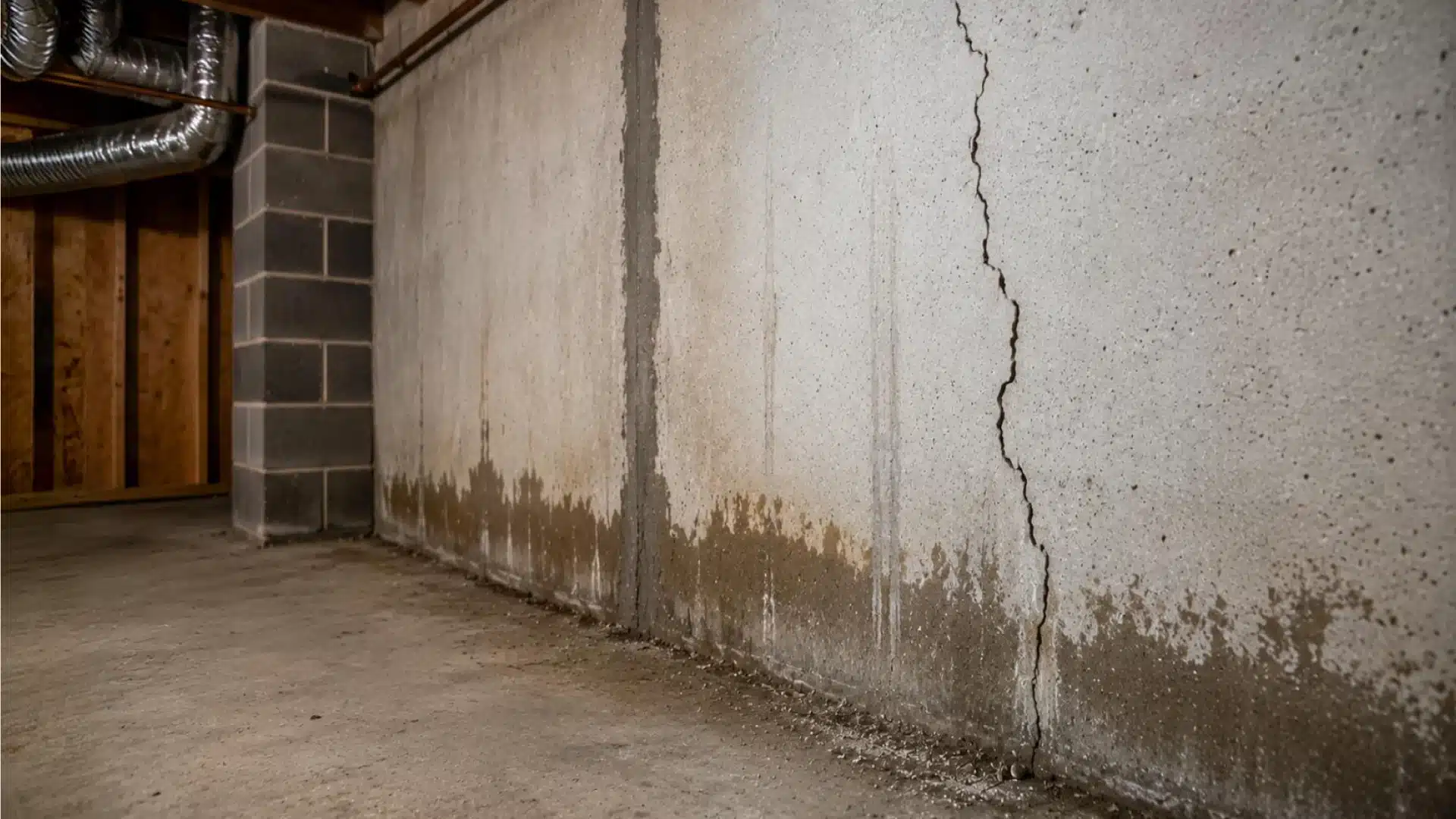
It's probably already happened to you: you go down to the basement and a strange smell greets you. Earthy, musty, old cellar. The question that comes right after: is it mold? And is it serious?
In Saint-Henri, in the Lévis area, this question is frequent. Between the region's humidity, the clay soils and the older houses, basements are exposed. The key is to make the right diagnosis before panicking — or before ignoring everything.
At Solutions Rénovation Québec (RBQ license 5811-7821-01), we have been inspecting and decontaminating basements for years. In this article, we help you understand what your smell means, to distinguish humidity and mold, and to know when to act.
An unusual smell in your basement is never a coincidence
A strange smell in the basement isn't just «like that.» It's almost always a sign that something is happening on the humidity side. And often, the smell is the very first symptom, well before anything is visible.
The mold release compounds that are smelled before they are seen. So when it smells, the process has probably already started somewhere, out of sight.
However, you need to distinguish between an occasional smell and a persistent smell. A smell that appears after a heavy rain and then disappears is a signal to watch. A smell that always comes back, regardless of the weather, indicates an active source of humidity that deserves to be found.
The basements of Saint-Henri are particularly affected by these issues, for reasons we will see further on: regional humidity, clay soils and the age of the housing stock. It's not bad luck, it's a set of conditions.
The most common smells and what they mean
Not all basement smells tell the same story. An earthy or cellar smell often suggests high humidity in contact with the soil or concrete. A more pronounced mushroom or musty smell generally points to active mold growth.
These smells almost always come from damp materials and the spores they release, invisible to the naked eye. The intensity and persistence of the smell give clues about the extent of the problem. The stronger and more constant it is, the more seriously you need to look.
Why mold often stays invisible
The trap is that mold hides. It frequently develops where you don't look: behind the drywall, in contaminated insulation, under a floating floor, or on the basement ceiling.
That's why the smell is so important — it is sometimes the only clue to a hidden contamination. You can have a basement that looks clean to the eye and yet hides a problem behind the walls. The absence of visible stains does not mean the absence of mold.
The first signs that should worry you
Beyond the smell, certain signs deserve quick attention. A humidity level exceeding 60%, stains on walls or ceilings, peeling paint, swollen or warped wood are clear clues.
Also watch for: allergy or irritation symptoms that worsen when you spend time in the basement. If several of these signs add up, it's time to have it inspected rather than waiting for it to get worse.
Do you notice a persistent smell? A quick inspection often avoids much more costly work.
Acting early means paying less. Have your basement inspected by Solutions Rénovation Québec — we identify the cause before it causes damage.
Why is this problem frequent in Saint-Henri and Lévis?
Saint-Henri and all of Lévis combine conditions that make basements vulnerable to humidity. Understanding these factors helps to understand why the musty smell comes back so often here.
The influence of the St. Lawrence River
The proximity of the river makes the region a more humid environment than many others. Ambient humidity is high and fog is frequent, and this humidity ends up in the houses.
A basement, cool and in contact with the ground, becomes a natural condensation point. When humid air meets the cold surfaces of the foundations, water condenses — and that's often where the smell begins. The river creates the conditions, even a few kilometers away.
Clay soils and infiltration
Clay soils, present in several areas, retain water. When they are saturated, they exert pressure — hydrostatic pressure — against the foundations, pushing water to find the slightest weak point.
This pressure, combined with cracks that appear over time, promotes infiltration into the basement. A foundation crack, even a thin one, becomes an entry path for water when the soil is waterlogged around it. It's a frequent mechanism in our area.
The effects of freeze-thaw on foundations
Our repeated freeze-thaw cycles amplify the problem. Water infiltrates into microcracks, freezes, expands, then thaws. This movement works the foundations and the soils.
Over time, it widens existing cracks and creates new ones, opening more doors to water infiltration. Freeze-thaw is a major factor in the degradation of foundations in the region.
Houses over 25 years old
Older houses often combine several weaknesses: aging insulation, insufficient ventilation and waterproofing membranes often absent at the time of their construction. These characteristics make them more exposed to humidity and mold problems. In an area like Saint-Henri, where these houses are numerous, the problem is all the more common.
Each house has its own causes of humidity. Have the diagnosis confirmed before investing in repairs.
Two neighboring houses can have different causes. Request a diagnosis from Solutions Rénovation Québec — the real source is found before proposing any work.
Is it really mold?
Good news: a strange smell doesn't always mean mold. Sometimes, it's humidity without active growth. Making the distinction is essential, because it changes the solution.
Let's see how to make it clear.
The most common causes
Behind a basement smell, the same causes are often found. An infiltration through the foundations lets water in. Condensation deposits moisture on cold surfaces. A drainage problem — French drain clogged or deficient — prevents water from draining away. Or a leak, sometimes discreet, around the plumbing.
Each of these causes creates the conditions favorable to mold. Identifying which one is at play in your home is the first step toward a real solution.
How to differentiate humidity and mold
Humidity and mold are related, but they are not the same thing. Humidity is the condition; mold is the consequence when humidity persists.
Concretely, several indicators are examined: the relative humidity level (measured with a hygrometer), the presence or absence of stains, the nature of the odor, and the impact on air quality. A simply damp basement can smell musty without active mold; a basement with mold will generally have stains and a more pronounced odor. A proper diagnosis distinguishes the two — and sometimes, addressing humidity early prevents mold from taking hold.
When is a laboratory recommended?
In some cases, a more in-depth analysis is useful. An air analysis, carried out by a certified inspector, may be recommended when the extent of the contamination is difficult to assess, or when occupants show health symptoms.
Public health authorities, such as Santé Québec, emphasize above all the importance of acting on visible growth and correcting the source of humidity. A laboratory analysis is not always necessary — often, visual inspection and humidity measurements are enough to guide action. A professional will tell you whether a test is relevant in your case.
DIY inspection or professional inspection?
You can do an initial check yourself: measure humidity with a hygrometer, look for stains, identify damp areas. It's a good reflex for assessing the situation. But DIY has its limits — you can miss hidden contamination behind walls, underestimate the extent, or expose yourself to spores without protection. For a serious or persistent problem, a professional inspection provides a complete and safe picture.
What are the risks for your family and your home?
A moldy basement is not just an olfactory nuisance. It can affect the health of occupants and the integrity of the house. Let's look at both, without dramatizing but without trivializing.
The impacts on health
Mold releases spores that affect indoor air quality. In some people, it causes allergies, irritation, or aggravation of respiratory problems such as asthma.
More vulnerable people — children, the elderly, immunocompromised individuals or those with respiratory sensitivities — are generally more affected. If occupants spend time in a contaminated basement, that is a serious reason to act.
Health authority recommendations
Generally speaking, public health authorities such as Santé Québec recommend acting quickly as soon as there is mold growth and avoiding prolonged exposure. The principle is consistent: correct the source of humidity and clean or have the mold cleaned without delay. For personalized health advice, a health professional remains the reference.
The consequences for your property
On the home side, humidity and mold cause progressive damage. Wood that is permanently damp can rot, weakening the framing and structural elements over time.
Insulation that is contaminated loses its effectiveness, which affects comfort and heating costs. This damage often advances silently, hidden in the walls.
Add to that the impact on value and insurance: an untreated mold problem can reduce property value, complicate a resale, and cause problems during a claim. A small problem ignored today can become a big expense tomorrow.
How Solutions Rénovation Québec durably solves the problem
Solving a musty-smelling basement is not just about cleaning and perfuming. It's a process aimed at eliminating the cause. Here's how it's done.
Step 1: Complete inspection
It starts with a thorough inspection: humidity measurement with a hygrometer, ventilation assessment, examination of the foundation, and if needed the use of a camera to locate hidden contamination. This step establishes the real picture of the situation.
Step 2: Identify the true source
Next, the exact cause is traced: infiltration, condensation, drainage or insulation problem. Without this identification, any treatment remains temporary. This is the step that makes the difference between solving and masking.
Step 3: Safe decontamination
Then comes decontamination. The area is confined to avoid dispersing spores, contaminated porous materials are removed, specialized cleaning is carried out, and the space is dried out.
This step requires method and precaution. A poorly done cleaning can disperse spores throughout the house instead of containing them. This is precisely why a professional approach is important here.
Work that complies with standards
Work is done in compliance with applicable standards — RBQ, sanitation, and workplace safety rules (CNESST) to protect occupants and workers. Decontamination affects air quality, so these procedures are not optional. This is what guarantees safe and well-done work.
Step 4: Prevent recurrence
Decontaminating without preventing is inviting the problem to return. The final step ensures that mold does not reappear.
This involves correcting the source and taking lasting measures: adequate mechanical ventilation, better insulation, a waterproof membrane if needed, a functional French drain, and humidity control. By tackling the cause and strengthening the basement's defenses, you get a result that lasts — not just until the next wet spring.
The best way to eliminate an odor is to permanently eliminate its cause.
That's our entire philosophy. Request a consultation with Solutions Rénovation Québec — we tackle the source, not just the smell.
How much can a moldy-smelling basement cost?
Let's talk numbers, because that's often what makes people hesitate. The amounts below are order-of-magnitude estimates (reasonable estimates that vary depending on the case). An inspection allows for an accurate cost to be established.
Inspection
A professional inspection is often around 300 $ to 800 $ (reasonable estimate), depending on the depth of the assessment. It's a small investment that can avoid big expenses by identifying the problem early.
Decontamination
A decontamination with source correction generally falls within a range of around 5,000 $ to 20,000 $ (reasonable estimate), depending on the extent of the contamination and the work required.
Complete renovation
If the problem has been left to worsen and a large part of the basement needs to be redone, the bill can reach 25,000 $ to 60,000 $ (reasonable estimate). This gap illustrates why the timing of intervention matters just as much.
Why waiting costs more
Waiting lets the problem spread: mold gains ground, wood deteriorates, insulation to be replaced increases, the framing can be affected. A problem fixable for a few thousand dollars today can become a major renovation tomorrow. Add to that the loss of property value. Waiting is rarely a saving.
Myths or realities?
A few misconceptions circulate. Let's sort out what's true from what's false.
«Anti-mold paint solves the problem.»
False. It masks the appearance without addressing the water source. The problem continues behind the paint and eventually resurfaces. It's a cover-up.
«It's normal in an old basement.»
False. A slight coolness, perhaps; a real persistent musty smell, no. It's not an inevitability linked to age, it's a signal of moisture to be corrected. Normalizing it means letting the problem grow.
«A dehumidifier is enough.»
Partially true. A dehumidifier helps control ambient humidity and is part of the solution. But alone, it doesn't fix an infiltration or a crack — the source continues to feed the problem. It's a tool, not a complete solution.
«Store-bought products replace decontamination.»
False. Consumer products can help for a small surface area, but they don't replace a real decontamination in cases of significant or hidden contamination. They treat the surface, not the cause or the contamination behind the walls.
Don't treat only the symptoms. Have the source of the problem verified before undertaking renovations.
Fixing the surface without the cause is wasted money. Have the source verified by Solutions Rénovation Québec before renovating.
Why trust Solutions Rénovation Québec?
A mold problem affects health, structure and the value of your home. The choice of contractor determines whether the problem is fixed for good or whether it comes back.
An approach based on diagnosis
Our priority is to find the real causes, not to sell a cosmetic solution. We establish a clear diagnosis, explain it to you with full transparency, and propose an action plan that addresses the source. Without a solid diagnosis, no lasting solution.
Solutions adapted to the Quebec climate
We design our interventions for our climate: humidity, freeze-thaw, older homes. We choose materials and methods that perform durably in these conditions, rather than a generic approach that wouldn't withstand our winters.
Our commitments
We operate under RBQ license 5811-7821-01, led by Marco Savoie, with a 5-year warranty on labor and more than 500 projects completed. We focus on a clean worksite, clear communication and no hidden fees. These commitments protect you and ensure work done by the rules.
Our service areas
We intervene for wet basement and mold problems in Saint-Henri and throughout Lévis, where the region's humidity makes these issues frequent. We also serve the greater region: Québec, la Beauce, Drummondville, Trois-Rivières, Victoriaville, Sherbrooke, Montmagny and Plessisville.
Throughout this territory, we find the same realities: humidity, clay soils, freeze-thaw and homes 25 years and older. Our expertise adapts to the particularities of each sector and each home.
FAQ – Basement that smells strange in Saint-Henri
Why does my basement smell only after rain?
It's often the sign of an infiltration linked to water pressure in the soil after rain. When clay soil becomes saturated with water, the pressure pushes moisture through foundation cracks. The smell that returns after each rain points to an infiltration problem to be corrected.
Is a smell without visible mold worrying?
Yes, it deserves attention. The smell can signal hidden contamination behind walls, under floors or in insulation. The absence of visible stains doesn't mean absence of mold. An inspection allows you to verify what's happening out of sight.
How do you know if spores are hidden?
The clues: a persistent smell without a visible source, peeling paint, stains coming through walls, or allergy symptoms in the basement. A professional inspection, sometimes with a camera, allows you to locate the hidden contamination.
Should I have the air quality analyzed?
Sometimes it's useful — particularly to assess the extent of a contamination or in the presence of health symptoms. But the most important thing remains identifying and correcting the source of humidity. A professional inspection will tell you if an air analysis is relevant in your case.
Does my insurance cover the work?
It depends on your policy and the cause of the problem. Some situations are covered, others are not, especially if the problem results from neglected maintenance left to worsen. That's one more reason to act early. Check your specific coverage with your insurer.
How much does an inspection cost in Saint-Henri?
A professional inspection is often around 300 $ to 800 $ (reasonable estimate), depending on the depth of the assessment. It's a small investment that can avoid big expenses by detecting the problem early and guiding the right corrections.
How to prevent mold from coming back?
By correcting the source and reinforcing the basement: adequate mechanical ventilation, good insulation, waterproof membrane as needed, functional French drain and humidity control. It's this combination that prevents mold from reappearing after decontamination.
When should you call an RBQ contractor?
As soon as the smell persists, there are visible stains, significant contamination or health symptoms among occupants. A RBQ contractor provides a complete diagnosis, intervenes according to the rules and addresses the cause. The earlier you call, the simpler and more affordable the correction.
Conclusion – Une odeur bizarre, c’est un signal à écouter, pas à ignorer
Au final, un sous-sol qui sent bizarre à Saint-Henri est un signal d’alerte qui mérite qu’on s’y arrête. Ce n’est pas toujours une catastrophe, mais ce n’est jamais rien. L’odeur est souvent le premier symptôme d’un problème d’humidité qui, ignoré, s’aggrave.
L’essentiel à retenir : le diagnostic est plus important que le nettoyage. Distinguer humidité et moisissure, trouver la vraie source, et corriger la cause — c’est ce qui protège la santé de votre famille, la structure de votre maison et sa valeur. Une intervention précoce évite presque toujours des réparations majeures plus tard.
Vous habitez Saint-Henri ou les environs? Demandez une inspection sans obligation avec Solutions Rénovation Québec or call us at 418-476-1747 pour identifier rapidement la cause de l’odeur et obtenir un plan de correction durable — sans engagement.
This article is for informational purposes and does not replace medical advice. If occupants show health symptoms, consult a health professional.