
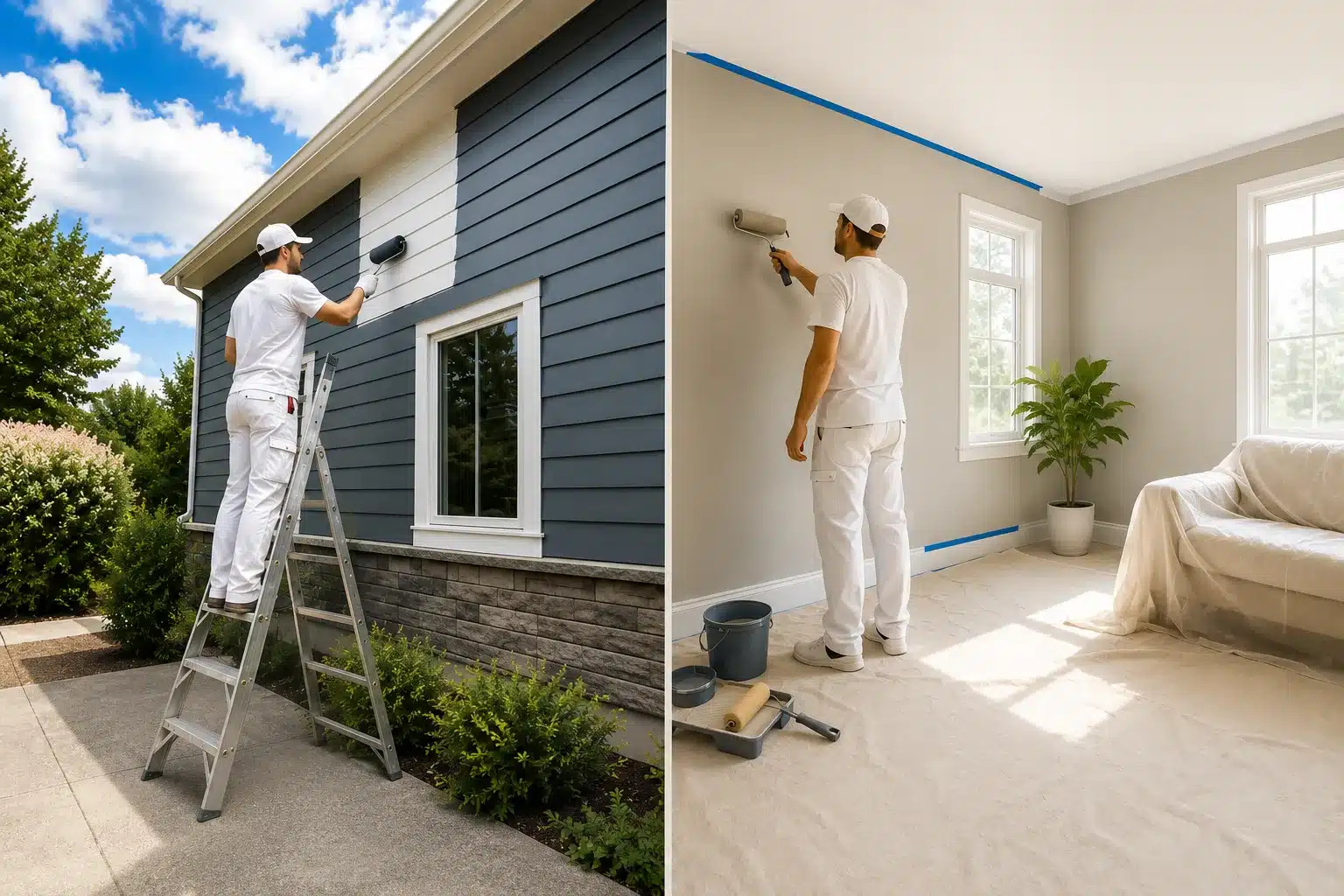
The direct answer: exterior paint and interior paint are two products designed for opposite worlds. One faces rain, sun and frost; the other lives in a controlled, heated environment. Swapping them guarantees problems.
In Lévis, the issue is even more pronounced. Our freeze-thaw cycles, seasonal humidity, UV rays and extreme temperature swings require specialized products to protect the building durably.
At Solutions Rénovation Québec (RBQ license 5811-7821-01), we paint the interior and exterior of homes in the region for years, choosing the right product for the right place. In this article, we explain why this distinction matters so much — and what it changes for your home.
Get the advice of an SRQ specialist before choosing the paint suited to your home.
Why you should never use the same paint indoors and outdoors
It's a tempting mistake: there's leftover interior paint in the garage, and you figure you'll use it outside to finish a cornice. Bad idea. These products are not interchangeable.
The difference isn't just a marketing question. It's in the very formulation of the paint, designed for radically different conditions.
Two formulations designed for opposite realities
Exterior paint is formulated to withstand the elements: rain, snow, UV, freeze-thaw and extreme temperature variations. It contains additives that make it flexible, resistant to solar rays and capable of managing humidity.
Interior paint, on the other hand, lives in a controlled environment. It prioritizes aesthetics, ease of application, low VOC levels and resistance to cleaning. It doesn't need to endure sun or frost — and it isn't designed for that.
What happens when you use the wrong product
Using interior paint outside means exposing it to conditions it cannot withstand. The risk : rapid peeling, cracks, blistering and premature discoloration. The paint degrades within a few months instead of lasting for years.
Our solution : we systematically choose a product suited to the environment and the material, with the right preparation. The proof : across more than 500 projects, it's this rigor that distinguishes work that lasts from work that needs to be redone. Conversely, exterior paint used indoors can release more VOCs and harm the air quality of a closed room.
Why Lévis's climate amplifies these problems
Our climate does not forgive the wrong choice. The region experiences on the order of 50 to 100 freeze-thaw cycles per year (order of magnitude for the regional climate), each one stressing the painted surfaces.
Add to that seasonal humidity and significant thermal variations between summer and winter. A paint that isn't designed for these conditions cracks, peels and lets water seep in. That's precisely what a quality exterior paint is made to prevent.
The characteristics of interior paint
Interior paint has a clear mandate: beautify, last in a controlled environment and preserve air quality. It doesn't face the elements, but it has its own requirements.
Let's look at what defines it.
Priority on aesthetics and comfort
Indoors, appearance comes first. Interior paint offers a range of finishes — matte, velvet, satin — that play on the ambiance and visual comfort of a room.
It is also formulated for a uniform finish and beautiful coverage. The goal is an impeccable aesthetic result in a space where you live daily, not resistance to the elements.
Low VOCs and indoor air quality
Modern interior paints prioritize low levels of volatile organic compounds (VOCs). These VOCs are responsible for the smell of fresh paint and can affect air quality.
Why this matters for Quebec families
In Quebec, homes are closed and heated for much of the year, so indoor air quality matters. For families — especially in children's bedrooms — a low-VOC paint reduces odors, limits the risk of irritation and allergies, and contributes to a healthier environment. It's a criterion we take seriously in our recommendations.
Stain resistance and daily maintenance
In high-traffic rooms, interior paint must also resist wear and cleaning. Washable finishes allow you to wipe away fingerprints, splashes and marks without damaging the wall.
This is essential in a kitchen, a hallway or a child's bedroom. A washable paint keeps walls beautiful longer and makes frequent cleaning — which family life demands — easier.
The characteristics of exterior paint
Exterior paint has a completely different mandate: to protect. It is the first line of defense of your home's envelope against the elements.
Here's what makes it capable of facing our conditions.
Protection against UV rays
The sun is a sneaky enemy. UV rays discolor and degrade painted surfaces over time. Exterior paint contains additives that resist UV and preserve color longer.
Without this protection, a facade pales, dulls and degrades prematurely. This is one of the reasons an interior paint doesn't hold up outside: it simply doesn't have that defense.
Resistance to freeze-thaw cycles
This is the king criterion in our climate. Exterior paint must endure repeated freezing and thawing without cracking or peeling.
The importance of coating elasticity
When the temperature varies, materials expand and contract. A good exterior paint is elastic: it moves with the substrate instead of cracking. This flexibility prevents cracks and peeling through freeze-thaw cycles. This is exactly what an interior paint, rigid, lacks, which would crack in the first winter.
Moisture and water vapor management
An exterior paint must manage water intelligently. It protects against rain while letting the material breathe — this is what is called vapor permeability.
This breathability is crucial. If moisture remains trapped under the paint, it causes blistering, peeling and mold. A well-chosen exterior paint lets water vapor escape while blocking rain, which preserves the coating and prevents rot.
Protection of the building envelope
Ultimately, exterior paint protects the entire envelope of your home. It is a barrier between the materials and the elements.
Depending on the cladding — wood, fiber cement, aluminum or masonry — the requirements vary. Each material requires a suitable product and primer. A well-applied exterior paint extends the life of the cladding and protects the structure underneath. It is an investment in the durability of the building, not just in its appearance.
Have the condition of your cladding inspected before investing in painting work exterior.
Complete comparison: exterior vs interior paint
To properly grasp the difference, let's compare the two products on the criteria that matter.
Composition
Exterior paint contains additives for flexibility, UV and moisture resistance. Interior paint focuses on coverage, low VOC and ease of cleaning.
Moisture resistance
Exterior paint is designed to manage water and vapor. Interior paint withstands occasional cleaning, but not prolonged exposure to moisture.
UV resistance
Exterior paint resists sunlight and retains its color. Interior paint does not have this protection, since it is not exposed to direct sunlight.
Average lifespan
Outdoors, a quality paint that is well applied lasts several years before requiring a recoat. Indoors, a paint can last even longer, since it undergoes less wear and tear.
Maintenance required
Exterior paint requires periodic inspection and touch-ups depending on exposure. Interior paint mainly requires routine cleaning, made easier by washable finishes.
Average cost
Exterior paint generally costs more, due to its specialized additives. This higher cost is explained by the performance it must deliver.
Detailed comparison table
| Criteria | Interior paint | Exterior paint |
| Use | Interior walls and ceilings | Facades and exterior cladding |
| Durability | High (controlled environment) | High (designed for the elements) |
| Moisture resistance | Moderate | High (manages rain and vapor) |
| UV resistance | Low | High |
| Average cost | Lower | Higher |
| Maintenance | Routine cleaning | Periodic inspection and touch-ups |
| Lifespan | Long | Several years depending on exposure |
The most frequent mistakes observed by SRQ
In the field, certain mistakes recur and cost dearly. They almost all have one thing in common: someone tried to save time or money in the wrong place.
Here are the four most common.
Neglecting surface preparation
This is the number one mistake. Applying paint to a poorly prepared surface — dirty, flaking, unprimed — compromises all durability. The paint adheres poorly and peels prematurely.
This step is never skipped. A clean, repaired and primed surface is the foundation of a job that lasts.
Painting on damp cladding
Painting over moisture means trapping it. Outdoors as well as indoors, this leads to blistering, peeling and mold.
Always check the condition of the substrate before painting. If there is moisture, address the source first — otherwise, the problem resurfaces, paint or no paint.
Choosing a product based on price alone
Taking the cheapest paint seems economical, but it often backfires on the owner. A low-end product wears out quickly, marks easily and must be redone sooner.
We recommend the right product for the use, thinking about the total cost over time. A quality paint often costs less in the end.
Ignoring the manufacturer's recommendations
Each paint has its application conditions: temperature, humidity, drying time, number of coats. Ignoring these instructions compromises the result.
We respect the manufacturer's specifications and the conditions of our climate. It is a technical detail that makes a real difference to durability.
Why preparation largely determines durability
We repeat it to our clients: most of a paint's durability — often estimated at around 70 % (estimate based on field experience) — depends on the preparation, not the product itself. Cleaning, scraping peeling areas, repairing defects and the right primer: it's this combination that makes the paint last. A good product on poor preparation won't last.
What type of paint should you choose depending on the surface?
The right product depends on the material to be painted. Each surface has its requirements, and using the wrong primer or the wrong paint compromises the result.
Here are our guidelines for the most common surfaces.
Wood siding
Exterior wood moves with humidity and needs a flexible, breathable paint with an appropriate primer. Well protected, it lasts; poorly protected, it rots. Preparation and the right product are essential here.
Fibrocement
Fiber cement is durable but requires specific products and a primer to adhere properly. It's an increasingly common material, and it's worth meeting its requirements for a durable result.
Aluminum and metal
Metal surfaces require primers and paints designed for adhesion to metal and corrosion resistance. Without the right product, the paint peels. This is a case where the technical choice is decisive.
Interior drywall
Indoors, drywall is the most common surface. It requires an appropriate primer — especially on new or repaired drywall — then an interior paint suited to the room's use.
Kitchen and bathroom
These damp rooms are a special case. We favor moisture-resistant and washable paints, with glossier finishes that withstand condensation and frequent cleaning.
Solutions recommended by SRQ
Our approach is simple: the right primer, the right product, for the right surface. We use primers suited to each material, moisture-resistant products in exposed rooms, and washable paints where wear is heavy. It's not a single solution for the whole house — it's the right solution for each surface.
Receive personalized recommendations based on the materials present on your property.
Why trust Solutions Rénovation Québec?
A durable painting project isn't just about the product. It's the right preparation, the right technical choice and careful execution. The choice of contractor makes the difference in the lifespan of the result.
Here's what we bring to a painting project in Lévis and the surrounding area.
RBQ license 5811-7821-01
We operate under RBQ license 5811-7821-01, led by Marco Savoie. This compliance is your protection: work done by the rules, by a contractor who is accountable for it.
More than 500 residential projects completed
With more than 500 projects completed and more than 10 years of combined experience, we know the homes here, their surfaces and our climate. This experience translates into good advice and careful work.
5-year warranty on labor
We back our work with a 5-year warranty on labor. If a problem related to execution arises, we take care of it.
Customer satisfaction at the heart of our work
Our clients' satisfaction is our best calling card. [REVIEW NOTE — TO BE CONFIRMED: insert your actual average rating here, e.g. Google Business, once verified.] What matters to us is a job well done that homeowners recommend to those around them.
A transparent process from start to finish
From the first contact, we explain the steps, costs and timelines. No surprises, no hidden fees.
Quote, preparation, execution, clean delivery
Our method follows a clear sequence: a quote detailed, a preparation rigorous surface preparation, a execution careful, and a clean delivery — we leave, you enjoy the result. You always know where your project stands.
Talk to an SRQ expert to durably protect your home against Quebec's weather conditions.
Myths and realities about exterior and interior paint
A few misconceptions circulate. Let's sort out what's true from what's false.
Myth — An interior paint can be used outside
False. Interior paint has neither the UV resistance, nor the flexibility, nor the moisture management needed to face our climate.
Reality — It deteriorates quickly
Used outdoors, an interior paint peels, cracks and fades within a few months. The initial savings quickly turn into work to be redone.
Myth — All exterior paints are identical
False. Formulations vary depending on the material to be painted — wood, fiber cement, metal, masonry — and depending on exposure conditions.
Reality — Formulations vary depending on the material
Chaque surface demande le bon produit et le bon apprêt. Utiliser une peinture extérieure générique sur le mauvais matériau mène à un décollement prématuré. Le choix technique compte autant que la qualité du produit.
Mythe — La peinture est uniquement esthétique
Faux, surtout à l’extérieur. On pense souvent que la peinture ne sert qu’à embellir.
Réalité — Elle protège l’enveloppe du bâtiment
À l’extérieur, la peinture est une barrière protectrice qui prolonge la vie du revêtement et protège la structure contre l’eau et les UV. C’est une fonction de protection avant d’être une question de couleur.
FAQ – Peinture extérieure vs intérieure à Lévis
Peut-on utiliser de la peinture extérieure à l’intérieur?
Ce n’est pas recommandé. La peinture extérieure peut dégager plus de COV, ce qui nuit à la qualité de l’air dans une pièce fermée. Elle est aussi formulée pour des contraintes qui n’existent pas à l’intérieur. Mieux vaut utiliser le bon produit pour chaque environnement.
Combien de temps dure une peinture extérieure au Québec?
Bien appliquée sur une surface bien préparée, une peinture extérieure de qualité dure généralement plusieurs années. La durée exacte dépend de l’exposition au soleil, de l’orientation de la façade et du matériau. Une inspection périodique permet de planifier les retouches.
Quelle est la meilleure période pour peindre l’extérieur à Lévis?
Généralement de la fin du printemps au début de l’automne, quand les températures sont clémentes et l’humidité raisonnable. Peindre par temps trop froid, trop chaud ou trop humide compromet l’adhérence et le séchage. On planifie les travaux extérieurs en conséquence.
Pourquoi la peinture extérieure coûte-t-elle plus cher?
Parce qu’elle contient des additifs spécialisés : résistance aux UV, flexibilité pour le gel-dégel, gestion de l’humidité. Cette performance supplémentaire justifie le coût plus élevé. C’est un investissement dans la protection de votre maison.
La peinture intérieure protège-t-elle contre l’humidité?
Partiellement. Les peintures intérieures lavables résistent à un nettoyage et à une humidité occasionnels, surtout dans les cuisines et salles de bain. Mais elles ne sont pas conçues pour gérer l’humidité comme une peinture extérieure. Régler la source d’humidité reste essentiel.
Quels sont les risques d’utiliser le mauvais produit?
Écaillage, fissures, cloques, décoloration et décollement prématuré à l’extérieur; qualité de l’air compromise et durabilité réduite à l’intérieur. Dans les deux cas, on finit par devoir refaire les travaux, ce qui coûte plus cher que d’avoir bien choisi dès le départ.
Une peinture faible COV est-elle aussi durable?
Oui. Les peintures à faible COV d’aujourd’hui offrent une durabilité comparable aux produits traditionnels, tout en améliorant la qualité de l’air. On peut avoir performance et santé en même temps, surtout à l’intérieur.
Est-ce qu’un permis est nécessaire pour repeindre une façade?
Repeindre une façade sans modifier le revêtement ni la structure est généralement un travail d’entretien qui ne demande pas de permis. Si des secteurs ont des règles particulières sur les couleurs ou l’apparence, mieux vaut vérifier auprès de la Ville de Lévis au moindre doute.
Comment prévenir l’écaillage causé par le gel?
En utilisant une peinture extérieure flexible et respirante, sur une surface bien préparée et sèche, appliquée dans de bonnes conditions. L’élasticité de la peinture lui permet de bouger avec le matériau à travers les cycles de gel-dégel sans craquer.
Why hire an RBQ contractor for painting work?
Parce qu’un entrepreneur RBQ assure une préparation professionnelle, le bon choix de produits pour chaque surface et une exécution soignée — les clés d’un résultat durable. Vous évitez les erreurs coûteuses et bénéficiez d’une garantie sur le travail.
Conclusion – Le bon produit au bon endroit pour protéger votre investissement
Au final, la règle est simple : on n’intervertit jamais peinture intérieure et extérieure. Chacune est conçue pour son environnement, et les mélanger mène à des problèmes coûteux.
La peinture extérieure protège l’enveloppe de votre maison contre les UV, l’humidité et nos cycles de gel-dégel. La peinture intérieure embellit vos pièces tout en préservant la qualité de l’air. Dans notre climat québécois exigeant, adapter le produit à son usage n’est pas un détail — c’est ce qui maximise la durabilité.
Et tout repose sur une bonne préparation et un bon choix technique. Un entrepreneur RBQ qui choisit le bon produit pour la bonne surface, avec la rigueur nécessaire, transforme un projet de peinture en protection durable plutôt qu’en dépense récurrente.
Request your free quote from Solutions Rénovation Québec or call us at 418-476-1747 pour choisir la peinture adaptée à votre maison et à votre budget — sans engagement.