
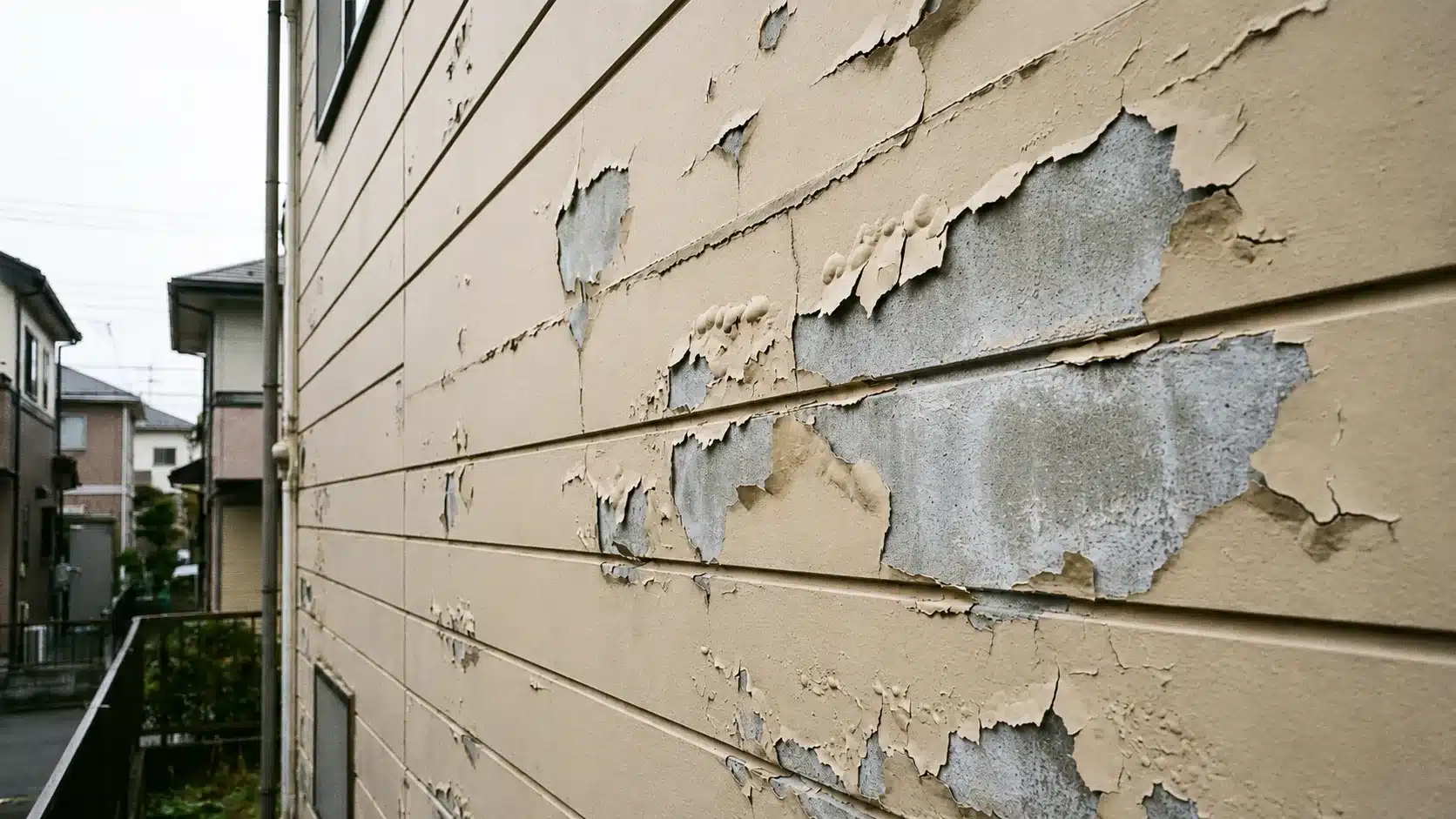
Every spring, it's the same thing. The snow melts, the sun comes back — and on the side of the house, patches of paint lifting, blistering, peeling off in pieces. Yet you had painted just two or three years ago.
It's not inevitable, and it's not normal either. An exterior paint applied correctly, with the right products and rigorous preparation, should last between 7 and 15 years in Quebec's climate context. If it fails after one or two winters, there's a specific cause — and that cause can be fixed, provided you don't simply paint over the problem.
In Lévis, the situation is amplified by several local factors: the proximity of the St. Lawrence River, rapid temperature variations in mid-season, and a housing stock composed largely of bungalows built between the 1960s and 1985 whose siding has been renovated several times without always being properly prepared.
At Solutions Rénovation Québec (SRQ), we regularly work on exteriors in this situation — inspection, diagnosis, complete preparation, application of the right products. We are RBQ licensed contractors (license 5811-7821-01) and we explain here what really causes peeling, what needs to be done to remedy it, and how to avoid reliving the same situation in two years.
Is your exterior paint starting to lift? Contact SRQ for an inspection before the damage worsens
Why does exterior paint peel after winter?
The short answer: water and cold. But the mechanics behind this phenomenon are more precise than that — and understanding what happens allows you to make the right choices so it doesn't happen again.
Freeze-thaw cycles weaken the paint
In Quebec, a typical winter season has between 60 and 65 freeze-thaw cycles — days when the temperature rises above 0°C then drops back below, sometimes within the same day. (reasonable estimate based on provincial climate data) Each of these cycles stresses building materials: expansion when it thaws, contraction when it freezes again.
A rigid or poorly adhered paint doesn't follow these movements. It detaches, cracks, then gradually peels.
How water behind the paint causes peeling
The most common scenario is this: moisture infiltrates the wood or fiber cement siding — through a crack in the paint, a poorly sealed joint, or simply through vapor migrating from inside to outside. This moisture freezes inside the material. The ice expands. It lifts the paint from the inside, creating the blisters and lifted patches found in spring.
This isn't a paint quality problem per se — it's a problem of moisture trapped under the paint. Repainting without fixing the source of moisture will reproduce exactly the same result the next winter.
Why Lévis experiences more climate stress
Cities located near a large body of water like the St. Lawrence River experience faster and more frequent temperature transitions than inland regions. Ambient humidity is naturally higher there, particularly during shoulder seasons. River winds bringing moisture-laden air hit cold exterior surfaces — creating repeated condensation conditions on exposed walls.
For homes in Charny, Saint-Romuald or riverside sectors, this climate reality is omnipresent. It's not a factor that can be ignored when choosing products or planning exterior work.
Poor surface preparation causes the majority of problems
If we had to identify a single cause of prematurely peeling paint, it would be this one. Surface preparation is the longest, most tedious and most often botched step — and yet it determines the lifespan of everything that comes after.
Paint can only adhere durably to a clean, dry, stable and adequately prepared surface. If any of these conditions isn't met, adhesion will be insufficient — and freeze-thaw cycles will do the rest.
The most common mistakes before painting
Painting on a damp surface: it's the most common mistake. Wood or fiber cement must be completely dry before application — which can take several days after rain or cleaning.
Lack of primer: primer isn't optional on new or stripped surfaces. It creates the chemical bond between the substrate and the finish coat. Without it, the paint adheres to the surface but doesn't grip deeply — and peels at the first serious stress.
Painting over unstable existing coats: if the previous paint is already lifting in places, applying a new coat over it fixes nothing. The new coat will simply lift with the old one.
Insufficient cleaning: dust, mold, chalking residue or powdery old paint prevent adhesion. A simple rinse isn't enough in most cases.
Why pressure washing alone isn't enough
Pressure washing is useful for removing surface dirt and testing the adhesion of old paint — anything that comes off under the jet had no business being there anyway. But it doesn't replace manual scraping of detached areas, sanding edges to avoid visible ridges, or the full drying time the wood needs before painting.
In our practice in Lévis, preparation easily accounts for 20 to 40 % of the total time of an exterior painting project. This is not wasted time — it is what makes the difference between a paint job that lasts 10 years and one that peels within two winters.
Paint not suited to Quebec fails quickly
Not all exterior paints are created equal — and moreover, not all are designed for the specific constraints of the Quebec climate. A rigid paint in an environment where materials move a lot will simply crack. A vapor-impermeable paint in a house where moisture migrates from the inside to the outside will trap that moisture and create exactly the conditions that lead to peeling.
Products designed to withstand the Quebec climate
The best exterior paints for our region combine three essential properties: flexibility to follow the movement of materials during freeze-thaw cycles, breathability to let water vapor pass through without detaching, and high adhesion on common substrates such as wood, fiber cement and stucco.
High-flexibility acrylic formulations are today the reference for Quebec exteriors. Elastomeric products offer even greater flexibility for surfaces subject to significant movement. In all cases, the choice of product must be made based on the substrate, exposure and climatic context — not just price.
Don't know why your paint is peeling? Have the cause verified by SRQ before starting the work again
Is peeling only cosmetic?
It's tempting to see it as a surface problem — the house looks less attractive, but nothing serious. In some limited cases, that's true. But in many others, peeling paint is the visible symptom of a more serious problem progressing underneath.
Peeling paint can hide water infiltration
Exterior paint has two roles: it beautifies the surface and it protects the material behind it. When it no longer does its protective job, water begins to reach the wood, fiber cement or exterior gypsum directly. And once water is in these materials repeatedly, damage accumulates quickly.
The signs that there is a more serious problem
Certain clues should trigger a more thorough inspection, not just scraping and touching up the paint:
— Wood that feels soft or spongy when pressed near a peeled area
— Blisters filled with water rather than air under the paint
— A musty or damp smell in the room adjacent to the affected wall
— Moisture stains inside that seem to coincide with the areas of exterior peeling
— Black mold visible under the lifted paint
If you observe one or more of these signs, the problem is no longer simply a matter of paint. The material behind must be inspected before deciding on the course of action. See our water infiltration repair service
Moisture accelerates the deterioration of materials
Water that regularly reaches the framing lumber or the siding boards creates a cycle of progressive degradation. The wood swells by absorbing moisture, then shrinks as it dries — this movement weakens the fibers and eventually leads to rot. Fiber cement resists a little better, but it is not waterproof either and can disintegrate in layers under the effect of persistent moisture.
Why acting quickly reduces costs
An area of peeling paint treated quickly — scraping, drying, priming, touch-up — can cost a few hundred dollars and last several years. The same area ignored for one or two more seasons may require replacement of the siding boards behind, or even work on the structure if the rot has progressed to the load-bearing elements.
It is the same principle as a roof leak: the longer you wait, the more expensive the problem is to fix. Early inspection almost always costs less than late repair.
Older homes in Lévis are more vulnerable
The bungalows built between 1960 and 1985 in the Charny, Saint-Romuald and Lévis neighborhoods were designed according to the standards of the time — standards that did not take into account the levels of waterproofing and moisture management that we know today.
The realities of 1960–1980 construction
These houses often have an envelope that breathes a lot — sometimes too much. Water vapor generated inside (kitchen, bathroom, laundry) migrates easily toward the exterior walls. Without an effective vapor barrier, this moisture reaches the exterior siding and contributes directly to paint adhesion problems.
Add to this the natural structural movement of an old house — assemblies that have worked for 40 or 50 years, joints that have moved, layers of paint accumulated on certain sections. In this context, a new coat of paint applied without a prior diagnosis has very little chance of lasting long.
Avoid major repairs by having your exterior inspected now
How should a durable exterior paint job be applied?
Here we present the approach we follow at SRQ for each exterior painting project. It is not the fastest way to work. But it is the way that gives results that last.
Step 1 — Complete inspection of surface condition
Before ordering anything or sanding anything, we inspect. We look at the condition of the existing paint zone by zone, we test adhesion, we look for signs of infiltration or rot, and we check the joints and sealants around windows, doors and corners.
Check moisture, cracks and existing adhesion
This inspection determines the extent of the work required — and avoids unpleasant surprises during the project. If we discover deteriorated wood behind the siding, it is better to know before starting to paint. We inform you, we adjust the quote if necessary, and we proceed in the right order.
Step 2 — Complete preparation before painting
This is the longest and most decisive step. We scrape off everything that no longer adheres. We sand the edges to avoid visible thickness differences under the new coat. We treat areas of exposed wood. We clean the surfaces of any trace of mold, chalking or greasy residue.
Why this step determines the lifespan
A paint job is only as good as the surface it is applied to. Two houses side by side, same products, same application — but rigorous preparation on one side and sloppy on the other: the results will be completely different after two or three winters.
We do not rush this step. If the surface is not ready, we wait — even if it delays the start of the application.
Step 3 — Use products suited to the Quebec climate
The choice of products is made according to the substrate (wood, fiber cement, stucco), the exposure (north or south side, shade or full sun), and local climatic conditions. It is not the same product for all situations.
Recommended types of paint
High-flexibility acrylic: the reference for most residential exteriors in Quebec. Good adhesion, breathability, resistance to UV and freeze-thaw. It follows the movements of the substrate without cracking.
Specialized primers: depending on the substrate and the condition of the surface, we choose a penetrating primer for porous wood, a blocking primer for stains or treated areas, or an adhesion primer for smooth surfaces or surfaces previously painted with oil-based products.
UV resistance: facades exposed to full south in Lévis receive a significant amount of solar radiation in summer. A product without good UV resistance will yellow or lose its binder prematurely.
Step 4 — Respect the proper application conditions
Paint applied in bad conditions — too cold, too humid, intense direct sun — will dry incorrectly and will never offer the adhesion it could have under optimal conditions.
Why temperature and humidity change everything
The ideal range for exterior paint application is between 10 °C and 25 °C, with a relative humidity below 70% and no rain expected within 24 to 48 hours following application.
In Quebec, this window is available from mid-May to mid-October — with periods to avoid during heat waves or on very humid days. We plan our projects taking these constraints into account, not just based on the calendar.
Request a transparent estimate for your exterior work
Repair locally or completely repaint?
As with roofing or railings, the answer depends on the actual condition of the surfaces — not just what is visible at first glance. And we have no interest in recommending a complete redo if a targeted repair can solve the problem durably.
When a localized repair may be enough
If the peeling is concentrated on one or two specific areas — the north side that receives little sun, the lower section that takes the splashes, the area around a window whose sealant had failed — and the rest of the surface is in good condition with solid adhesion, a targeted intervention can be entirely sufficient.
Situations where a targeted intervention works
Limited and well-defined peeling area. Stable and sound substrate behind the affected area. Existing paint in good general condition on the rest of the surface. Cause identified and correctable — a joint replaced, a piece of board replaced, a sealant redone.
In these cases, we scrape the area, treat it, prime it, and repaint to blend. It's clean, durable, and economical.
When you need to start from scratch
If the peeling is present on several sides of the house, if the paint is powdery everywhere (it leaves a white mark when you run your hand over it), or if persistent moisture is found behind several areas — a localized touch-up will only delay the inevitable.
Signs that a simple touch-up won't be enough
— Peeling over more than 30 to 40 % of the total surface
— Existing paint that does not pass the adhesion test (adhesive tape that lifts the paint easily)
— Accumulated paint layers that create excessive and unstable thickness
— Presence of moisture behind the coating in several distinct locations
— Active mold under the paint over extended sections
In these situations, a complete stripping followed by a properly prepared refinishing is the only option that will give a durable result. It is more expensive in the short term — but it is the last time you have this problem for a long time.
The average costs of exterior painting in Lévis in 2026
Prices vary considerably depending on the surface area, height, complexity of the house and the condition of the surface — but here are the realistic ranges for the Lévis region.
Comparison with and without adequate preparation (reasonable estimates, 2026)
Complete exterior painting — standard single-family home:
Between 4 500 $ and 20 000 $, depending on the surface area, the number of storeys, the complexity of the architecture and the products chosen.
Preparation represents between 20 % and 40 % of the total cost of a well-done job. It is the portion that you don't see once the work is finished — but it is what determines whether the paint lasts 3 years or 12 years.
What the absence of preparation costs: a paint applied to an unprepared surface that peels after two winters, followed by a second complete job — twice the cost of a well-done job from the start. Not to mention the possible damage to the siding that moisture has had time to reach in between.
Consult an RBQ contractor before restarting exterior work
Why do Lévis homeowners choose SRQ?
We have been working on residential exteriors in the Lévis region for more than 10 years. From 1970s bungalows in Charny with their period wood siding. Two-storey houses in Saint-Romuald exposed to the river winds. Recent residences whose first paint job was poorly done and that need to start over.
Methods adapted to Quebec's realities
We don't take shortcuts on preparation. We don't paint when weather conditions aren't suitable. We choose products based on the substrate and the local climate context — not based on what is cheapest this month.
These are decisions that sometimes cost more time in the short term. But they make all the difference in the durability of the work — and that's why our clients don't come back to us for the same problems two years later.
An approach focused on real durability
Every exterior painting job begins with an honest diagnosis. If we find moisture or deteriorated wood behind the siding, we tell you before starting — not in the middle of the work. If a targeted touch-up can suffice, we recommend it. If a complete stripping is necessary for it to truly last, we explain it to you with the concrete reasons.
Your budget is respected. Surprises along the way don't happen at SRQ.
A transparent and recognized RBQ company
Marco Savoie, licensed RBQ general contractor (5811-7821-01), supervises every job. Our exterior work is covered by a 5-year labour warranty — a real warranty, not a clause with 15 exceptions.
More than 500 residential projects completed in the Lévis and Chaudière-Appalaches region. Clean job sites, a site left in order, and clear communication from the first call to the final invoicing.
Plan your exterior inspection with SRQ
Frequently asked questions about peeling paint in Lévis
Why does my paint peel after only one winter?
In the vast majority of cases, it is a matter of insufficient surface preparation or poorly suited products. If the paint was applied to a damp surface, without primer, or over unstable existing layers, the freeze-thaw cycles of the first winter are enough to break the adhesion. A well-applied paint on a well-prepared surface should not lift after a single winter, even in the climatic context of Lévis.
Can freeze-thaw really damage paint?
Yes — directly and indirectly. Directly, because materials move during temperature changes and a rigid or poorly adhered paint does not follow this movement. Indirectly, because water that infiltrates under the paint freezes and expands, lifting the paint from the inside. Quebec has between 60 and 65 freeze-thaw cycles per year on average — it is a serious constraint that cannot be ignored when choosing products.
Should you always sand before repainting?
Not systematically sand the entire surface — but yes, you must always prepare adequately. That means scraping off everything that lifts, sanding the edges to eliminate differences in thickness, cleaning mold and residue, and priming the exposed areas. The intensity of the preparation depends on the condition of the existing surface — but the step cannot be skipped.
What is the best exterior paint for Quebec?
There is no single universal product — it depends on the substrate, the exposure and the condition of the surface. That said, high-flexibility acrylic formulations are generally the best option for Quebec residential exteriors: they resist UV well, are breathable, flexible to temperature variations and adhere well to most common substrates. For very mobile or highly exposed surfaces, elastomeric formulations may be more appropriate.
Can moisture come from inside the walls?
Yes, and it’s more common than people think — especially in homes built before the 1990s. Water vapor produced indoors (cooking, showering, drying laundry) naturally migrates outward through the walls. Without an effective vapor barrier, this moisture reaches the exterior cladding and can create conditions for peeling even if the exterior paint is properly applied. In these cases, fixing only the paint is not enough — the source of moisture must also be addressed.
How much does a complete exterior paint job cost in Lévis?
For a standard single-family home, expect between $4,500 and $20,000 depending on the surface area, height, architectural complexity, and products used. Preparation accounts for between 20% and 40% of this cost. This is not an expense to cut — it’s what determines whether the work lasts 10 years or 3 years. (reasonable estimate, 2026) An on-site visit is necessary for a precise figure — this assessment is free at SRQ.
Can you paint in spring or fall?
Yes, provided the application conditions are met. The temperature must be at least 10 °C at the time of application and for the following 24 to 48 hours. In spring in Lévis, this generally means waiting until mid-May. In fall, you can work until mid-October in good years. Rain and high humidity should be avoided in all cases.
How do you know if the wood behind the paint is damaged?
Press firmly on the area with your thumb — if the wood gives slightly or feels spongy, it’s a sign of rot. You can also test with a pointed object: healthy wood resists, rotten wood gives way easily. If the paint is completely detached on a section, look at the wood surface underneath: gray, disintegrated fibers or dark marks are indicators of deterioration. When in doubt, an inspection by an RBQ contractor is the safest way to assess the actual condition.
Is blistering paint a sign of water infiltration?
Yes, in the majority of cases. Blisters form when moisture is trapped between the paint and the substrate and cannot escape. If the blisters contain water when pierced, it’s a clear sign that there is an active moisture source — either exterior (infiltration) or interior (vapor). If they contain only air, the problem is probably due to poor initial adhesion rather than active infiltration, but an inspection is still needed to be certain.
Why do some homes keep their paint longer?
Three main factors: the quality of surface preparation during the last job, the products used, and the home’s exposure. A home with good preparation, suitable products, and less demanding exposure (less direct north or exposure to river winds) will naturally keep its paint longer. Maintenance also plays a role — a small area treated quickly before it grows, joints redone regularly, gutters that work well. These are small actions that significantly extend the lifespan of a paint job.
Solutions Rénovation Québec — RBQ Licence 5811-7821-01 2552 chemin du Fleuve, Lévis, Québec, G6W 1Y3 📞 418-476-1747 | srq.quebec@gmail.com Monday to Friday, 8 a.m. – 5 p.m. renovationsolutionsquebec.ca