
You walk down the hallway and it creaks. You get up at night and every step echoes. A creaking floor is annoying — but is it just the wood acting up or a sign of something more serious? That's the right question to ask.
In Lévis, with our humidity variations and our freeze-thaw cycles, the floors work hard. Some creaks are perfectly normal; others deserve a closer look. Knowing how to tell the difference means avoiding both unnecessary worry and a neglected problem.
At Solutions Rénovation Québec (RBQ license 5811-7821-01), we've been inspecting, repairing and installing floors in the region for years. In this article, we help you distinguish a harmless creak from a warning sign.
Do all floors creak over time?
For the most part, yes — most floors end up making some noise over the years. Wood is a living material that moves, and a slight occasional creak is often part of the normal life of a home.
But not all creaks are equal. The difference between a normal creak and a sign of an anomaly comes down to its frequency, its location and what accompanies it. A small seasonal squeak has nothing to do with a creak that gets worse or that comes with sagging.
In fact, some floors stay silent for decades. That's not luck: it's the result of a good installation, a solid subfloor and adequate humidity control. Silence is something you build.
In Quebec, seasonal variations play a big role. In winter, heating dries out the air and the wood contracts; in summer, humidity makes it swell. These movements can generate temporary noises. The important thing is to recognize the early signs that should not be ignored.
Creaks considered normal
Some creaks are completely benign. Hardwood, in particular, reacts to expansion and contraction cycles related to relative humidity. In winter, dry air makes it shrink slightly; in summer, it regains volume.
These seasonal movements sometimes produce small noises, especially at the start of the heating season. A humidifier in winter also helps stabilize humidity and reduce these creaks. As long as the noise is slight, occasional and follows the seasons, it's generally normal — the floor is just doing its job as a living material.
When the noise becomes concerning
The picture changes when the creak becomes pronounced, frequent or localized in the same spot. A sudden, loud creak, a noise always in the same place, or a visible deformation of the floor are different signals.
These symptoms can indicate structural movement, sagging or a problem under the floor. Unlike the seasonal creak that comes and goes, these noises tend to persist or get worse. That's the time to have the situation evaluated.
Signs that require an inspection
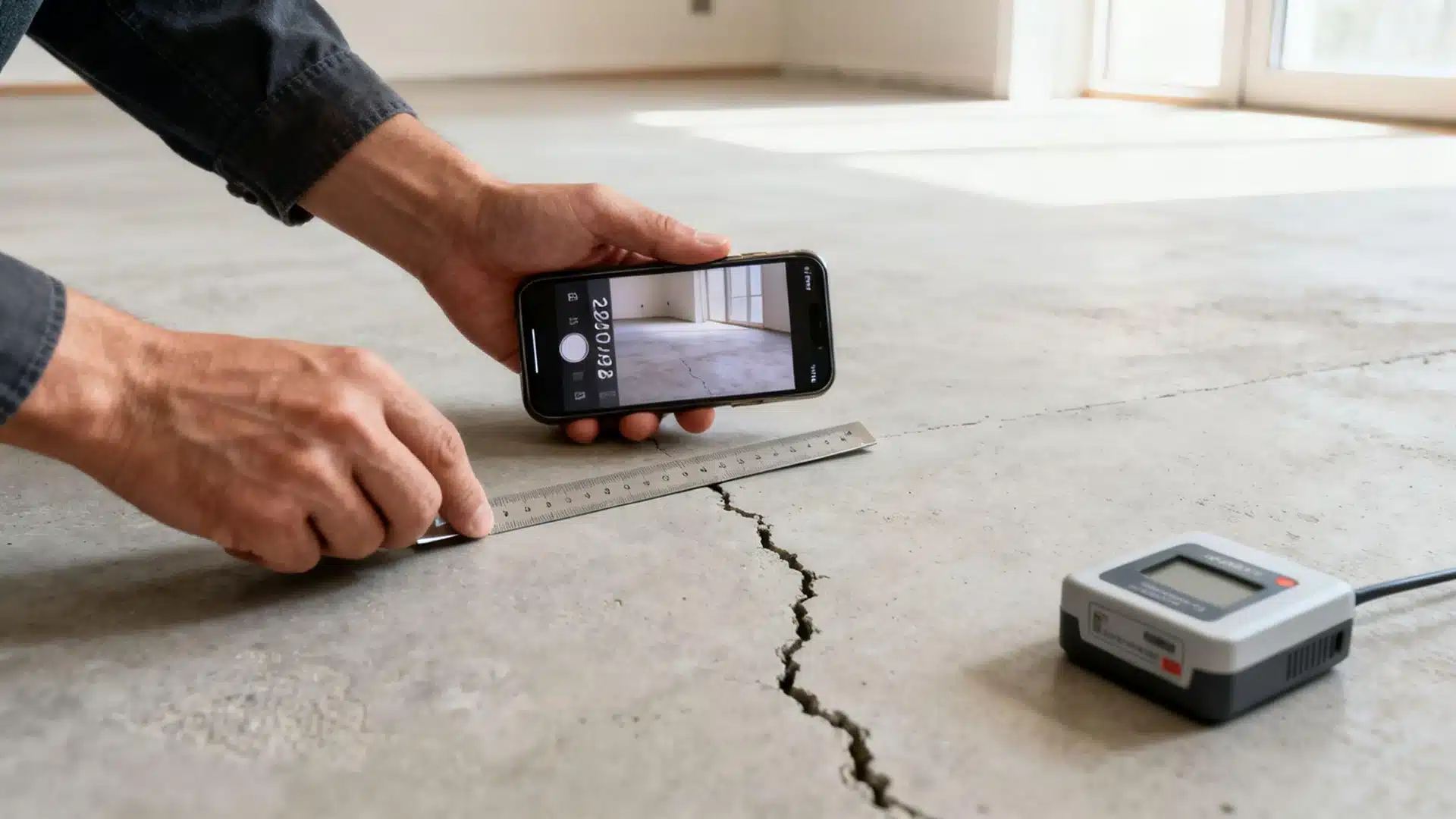
Beyond the noise, certain accompanying signs warrant a quick inspection: a floor that feels soft or flexes underfoot, bumps or dips, cracks in the flooring, or doors that suddenly close poorly. These clues suggest structural movement or a moisture problem underneath. When the creak is accompanied by any of these, you shouldn't wait.
Is your floor creaking more and more? An inspection can quickly determine whether the problem is simply seasonal or related to your home's structure.
When in doubt, it's better to check. Have your floor inspected by Solutions Rénovation Québec — we determine whether it's benign or whether intervention is needed.
Why do floors creak more in Lévis?
Lévis has conditions that make floors work harder than elsewhere. Understanding these factors helps grasp why creaking is so common here.
The impact of the Quebec climate
The proximity of the St. Lawrence River brings high humidity, and our seasons impose marked hygrometric variations. Add to that the freeze-thaw cycles, that make structures move.
Between the dry, heated winter and the humid summer, the humidity gap is significant. Floors, especially wood, react to these variations by swelling and contracting. It's a major regional factor: our climate stresses floors more than a stable climate would.
How wood reacts to the climate
Wood absorbs and releases moisture from the air. When humidity rises, it swells; when it drops, it shrinks. This phenomenon of expansion and shrinkage is natural, but in our climate with pronounced gaps, it is amplified.
A floor installed without accounting for these movements — without room to move, without acclimation — will creak more. A floor's stability depends largely on how this reaction to the climate was anticipated. That's where installation makes the difference.
Houses over 25 years old
Older homes are more prone to creaking. Over time, the joists and subfloor work, the wood ages, and some settling of the structure occurs naturally.
These accumulated movements create play between components, which generates creaks. In Lévis's housing stock, rich in homes 25 years and older, this is a frequent reality. That doesn't mean there's always a serious problem — but it sometimes deserves a check.
The invisible problems under the floor
Often, the cause of the creak hides beneath the visible floor. A moisture problem, poor insulation, a foundation issue or an infiltration can affect the subfloor and the structure.
The creak is then only the audible symptom of a deeper problem. That's why we don't rely on the noise alone: you have to look at what's happening underneath to understand the real cause. Treating the noise without treating the cause is a waste of effort.
Before replacing your floor, make sure to identify the true cause of the creaking to avoid unnecessary work.
Replacing without diagnosing is sometimes pointless. Request a diagnosis from Solutions Rénovation Québec — we find the real cause before proposing anything.
The main causes of a creaking floor
A floor can creak for several reasons, from the most minor to the most serious. Here are the most common causes we encounter.
Poorly secured subfloor
This is one of the most common causes. When the subfloor is not perfectly secured to the joists — insufficient or loose screws or nails — it creates play.
This play allows slight movement, and friction between the components produces the characteristic creak. Each step moves the subfloor against the structure or fasteners, hence the noise. This is often repairable without major demolition, once the area is identified.
Joists that work
Joists are the beams that support the floor. Over time, with load and aging, they can work, dry out and move slightly.
This movement of the joists, especially in older homes, generates creaking. Wood that has dried and aged reacts differently than it did originally. This is generally benign, but in some cases, it can point to a more significant issue.
When the problem becomes structural
The creaking becomes concerning when it is accompanied by sagging, noticeable deflection, or signs affecting the beams and foundation. At that point, we are no longer talking about a simple noise, but a possible structural problem.
A sagging floor, beams showing signs of weakness, or a connection to a foundation problem require a serious evaluation. This is the kind of situation where a professional inspection is necessary, because the stakes go beyond comfort.
Inadequate installation
Sometimes, the cause goes back to the installation itself. The absence or insufficiency of expansion joints prevents the floor from moving freely, which creates tension and noise. A lack of acclimation of materials before installation causes them to adjust afterward.
Inadequate glue or fastening also contributes to the problem. These installation errors are a frequent cause of early creaking — a new floor that creaks quickly often points to the installation.
Excessive humidity
Humidity is a recurring factor. An infiltration, condensation, a damp basement under the floor or insufficient ventilation can cause the wood to swell and create movement.
The floor then reacts to this humidity by working, which generates creaking. This is particularly common on the ground floor above a damp basement. Fixing the humidity is often part of the solution to the creaking.
Can it be repaired without replacing the floor?
Good news: in many cases, yes. A floor that creaks does not automatically mean everything must be torn out. It all depends on the cause and the extent.
Let's look at when a repair is enough and when replacement becomes preferable.
Possible minor repairs
For many creaks, targeted repairs are enough. You can often re-screw the subfloor to the joists, reinforce the areas that move, add shimming to eliminate play, or improve the fastening.
These interventions fix the noise without replacing the floor, provided the right point of friction has been identified. That's the advantage of a good diagnosis: it allows you to target the repair where it matters, without unnecessary work.
When a replacement is preferable
In some cases, repair is no longer enough. A very worn or damaged floor, or a humidity problem chronic that has deteriorated the covering and the substrate, may justify a replacement.
When the subfloor itself is affected or the covering is too damaged, repairing would only postpone the problem. Replacement then becomes the most sensible long-term choice. An honest diagnosis will tell you which case you are in.
Why fixing only the noise is not enough
Beware of the trap of treating only the symptom. If the creaking comes from humidity or a structural problem, silencing the noise without correcting the cause leads to a recurrence. The noise returns, or worse, the real problem worsens silently. A good repair addresses the cause, not just the sound.
A targeted repair often costs much less than a complete replacement when done before the damage worsens.
Acting early often means repairing rather than replacing. Request a consultation with Solutions Rénovation Québec — we assess whether a targeted repair is enough.
How much do repairs cost?
The cost depends on the cause and the extent of the problem. Here are some benchmarks, to be taken as orders of magnitude (reasonable estimates that vary depending on the case). An inspection allows for an accurate cost to be established.
Localized repair
For a targeted repair — re-screwing, reinforcing, eliminating play in certain places — often expect in the range of $500 to $2,000 (reasonable estimate), depending on access and scope.
Complete reinstallation
If the floor must be redone or the subfloor corrected, a complete reinstallation can range between 5,000 $ and 15,000 $ (reasonable estimate), depending on the surface area and the type of floor.
The factors that influence the price
Several factors vary the bill: the area to be treated, the type of floor (floating, hardwood, vinyl), the condition of the subfloor, and the presence of a humidity problem to correct. A simple surface creak costs little; a substrate or humidity problem requires more work. That's why the diagnosis always precedes the quote.
How to prevent creaking during a new installation?
If you are installing a new floor, a few precautions prevent many future creaks. Prevention happens before and during installation.
Check the humidity level
Humidity is the key factor. Before installation, the humidity of the air and materials is measured with a hygrometer, and the floor is left to acclimate to the conditions of the house. Installing a floor that has not reached equilibrium with its environment invites movement and creaking.
Recommended levels before installation
The idea is that the wood's humidity and the ambient humidity are in equilibrium before installation. Too great a gap between the floor and its future environment causes movement after installation. So the levels are checked and everything is prepared — it's a technical step that is never skipped for durable work.
Properly prepare the subfloor
The subfloor is the foundation of the covering. It must be well leveled, solid and properly fastened to the joists. A flat, firm substrate without play prevents most creaking. This preparation, often invisible once the floor is installed, is nonetheless crucial.
Choosing the right installation techniques
Finally, installation techniques matter. Proper fastenings (screws, glue as the case may be), adequate expansion joints to let the floor move, and a method suited to the material make the difference. An installation done by the rules of the art, taking our climate into account, greatly reduces the risk of creaking.
A diagnosis before installation often avoids creaking, costly repairs and disputes after the work.
Prevention starts before installation. Request a preventive inspection from Solutions Rénovation Québec before your next flooring installation.
Why choose Solutions Rénovation Québec?
A floor that creaks can come from humidity, the subfloor, the structure or the installation. The choice of contractor makes the difference between solving the problem and seeing it return.
An approach based on diagnosis
Our priority is to find the real cause before acting. We do a complete inspection — humidity, subfloor, structure — and propose a durable solution rather than a surface fix. Addressing the cause is what prevents recurrence.
Methods adapted to the Quebec climate
We work taking our climate into account: humidity, freeze-thaw, seasonal variations. We respect the acclimation of materials and proper installation techniques, for floors that stay quiet in our conditions.
Our commitments
We operate under RBQ license 5811-7821-01, led by Marco Savoie, with a 5-year warranty on labor and more than 500 projects completed. We focus on a detailed quote, a clean worksite and transparent communication. These commitments protect you and ensure work done by the rules.
Regions served
We repair and install floors in Lévis and the greater region: Québec, la Beauce, la Chaudière-Appalaches, Drummondville, Trois-Rivières, Sherbrooke, Victoriaville, Plessisville and Montmagny.
Everywhere in this territory, we find the same realities: river humidity, freeze-thaw cycles, seasonal variations and homes 25 years and older with their wood subfloors. Our expertise adapts to each sector and each home.
Myths vs realities
A few common beliefs circulate about squeaky floors. Let's sort out what's true from what's false.
«All floors squeak, so there's nothing to be done.»
False. Some squeaks are normal, but many can be corrected. A pronounced squeak or one that gets worse is not inevitable — it has a cause that can be identified and fixed.
«A little powder or lubricant permanently solves the problem.»
False. These tricks can temporarily reduce a squeak, but they don't fix the cause (the play, the humidity, the fastening). The noise comes back. It's a cover-up, not a solution.
«If the floor doesn't visibly move, there's no risk.»
False. A problem can develop under the floor — humidity, a subfloor that detaches — without visible movement on the surface at first. The squeak can be the first sign before it becomes visible.
«The manufacturer is always responsible.»
False. Depending on the cause, responsibility may fall to the installation, the home's humidity or the material. It's not automatic. A diagnosis determines where the problem actually comes from.
«After a few years, it's too late to intervene.»
False. It's almost never too late to diagnose and correct a squeaky floor. On the contrary, intervening before the problem gets worse costs less and preserves the floor.
FAQ – Squeaky floor in Lévis
Why does my floor squeak more in winter?
Because heating dries out the air, which causes the wood to shrink. This shrinkage creates play between the boards and components, resulting in more squeaking in cold season. A humidifier that stabilizes ambient humidity often helps reduce this seasonal phenomenon.
Does a floating floor squeak more than hardwood?
It depends on the installation and the support. A poorly laid floating floor or one on an uneven subfloor can squeak, just like poorly fastened hardwood. Neither squeaks «by nature» — it's mainly the quality of the installation and the preparation of the support that determine the result.
Do squeaks indicate a foundation problem?
Not necessarily. Most squeaks come from the subfloor or the joists, not the foundation. But if they are accompanied by sagging, cracks or doors that close poorly, a link with the structure or foundation is possible. An inspection confirms it.
Can I repair a squeaky floor without taking it apart?
Often yes, for minor cases. We can frequently re-screw the subfloor, add shimming or reinforce the fastenings without taking everything apart — sometimes from underneath if the basement is accessible. It depends on the cause and the access, which a diagnosis allows us to assess.
How do I know if the subfloor is the cause?
The subfloor is the cause in a large share of squeaks. The clues: a noise localized in the same spot, that occurs under the weight of a step. An inspection, sometimes from the basement, allows us to verify the fastening of the subfloor to the joists and identify the play.
Can humidity make a floor squeak?
Yes, it's a frequent factor. Humidity causes the wood to swell, and humidity variations make it work, which generates movement and squeaking. A damp basement under the floor is a common cause. Fixing the humidity is often part of the solution.
When should I have my floor inspected?
As soon as the squeak gets worse, is always localized in the same spot, or is accompanied by other signs: soft floor, bumps, cracks, doors that close poorly. These symptoms justify an inspection to rule out — or confirm — a structural or humidity problem.
How can I prevent my new floor from squeaking after installation?
By following good practices: measuring and balancing humidity, acclimating the materials, properly preparing and fastening the subfloor, providing expansion joints, and entrusting the installation to a RBQ contractor who knows our climate. It's this rigor that gives a quiet and durable floor.
Conclusion – A squeak should be understood before worrying… or ignoring it
In the end, a squeaky floor is neither always harmless nor always serious. Light, seasonal squeaks can be perfectly normal — wood that lives through the seasons. But frequent noises, localized or accompanied by other symptoms, can reveal an installation, humidity or structural problem.
The key is not to panic, but not to ignore it either. Early intervention often limits costs and preserves the floor's lifespan. A small squeak fixed today is better than a subfloor problem tomorrow.
And to decide between harmless and worrying, nothing beats a professional diagnosis. Identifying the real cause before undertaking work means avoiding unnecessary expenses as much as neglected problems. In our humid climate, this diagnosis makes all the difference.
Does your floor squeak everywhere in Lévis or the surrounding area? Request a no-obligation inspection with Solutions Rénovation Québec or call us at 418-476-1747. We analyze the cause of the squeaks and propose a durable solution, compliant with RBQ requirements and adapted to our climate — with no commitment.