
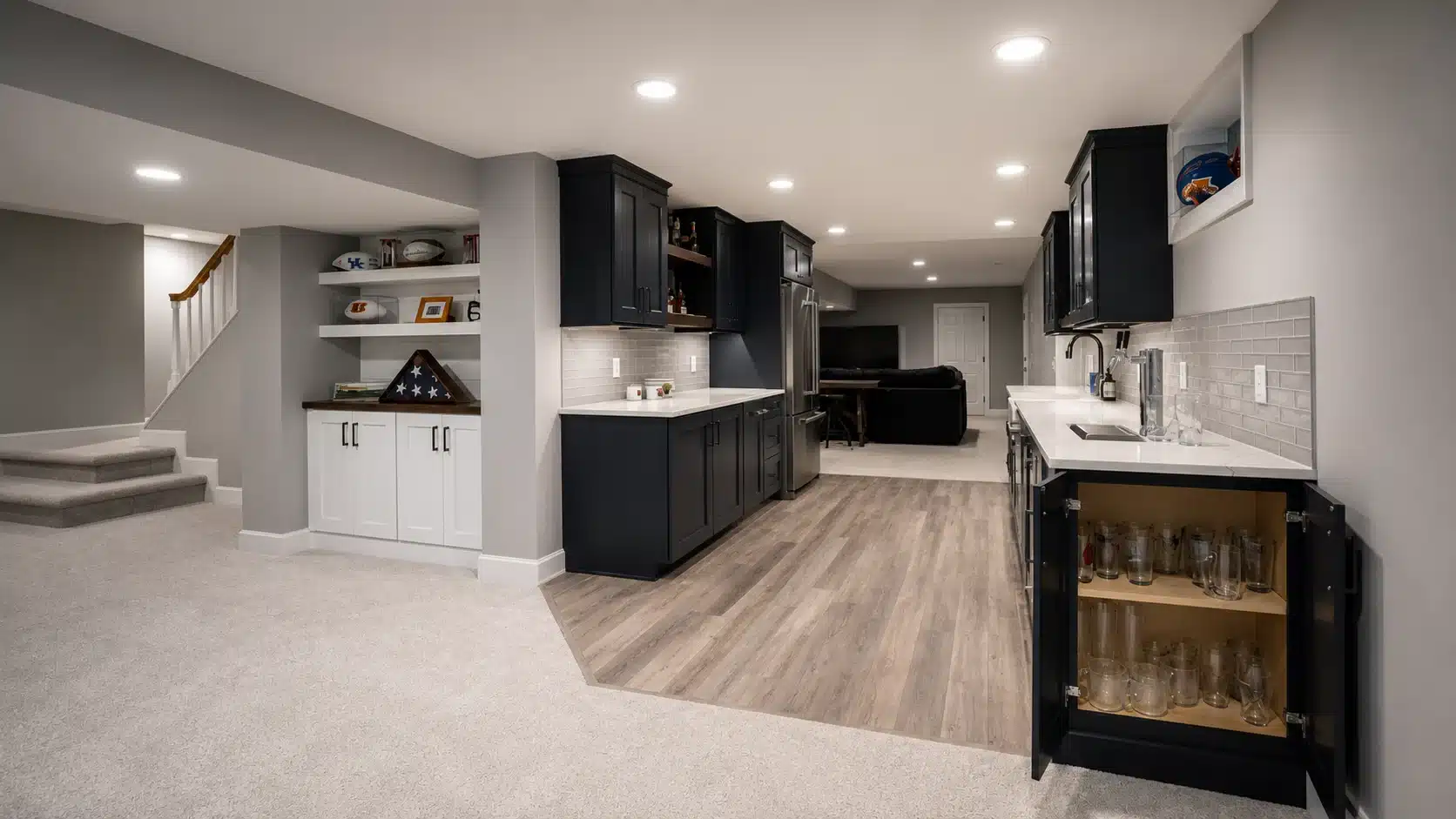
Finishing a basement, it’s one of the most popular projects among homeowners in Quebec. It adds living space, adds value to the home, and when it’s done well, it truly changes a family’s daily life.
But there’s one aspect that many people underestimate: choosing the floor. In a basement, it’s not a cosmetic decision. It’s a decision that can cost you dearly if it’s made poorly — especially in homes in Lévis and the surrounding area, where humidity and freeze-thaw cycles are part of reality.
At Solutions Rénovation Québec (SRQ), a general contractor holding an RBQ licence 5811-7821-01, we have completed hundreds of basement finishes in the region. This guide is what we would explain to any homeowner before starting.
Why choosing the floor is crucial in a basement in Quebec
A basement isn’t the same thing as a living room. The concrete slab is in direct contact with the ground. The air is colder. Humidity is almost always higher. And in Quebec, with our harsh winters and our springs that arrive all at once, temperature variations create particularly demanding conditions for materials.
The problem is that many people choose their basement floor the way they would choose a bedroom floor. And a few years later, they end up with swelling, odours or, in the worst cases, mould under the covering.
Choosing the right material from the start means avoiding this kind of problem. It’s also one of the first things we assess on site before starting a project.
Humidity in basements in Lévis
In homes built between 1950 and 1980 — and there are many in Lévis and in Chaudière-Appalaches — foundations are not insulated according to current standards. Capillary rise is common: water rises through the concrete slab, often without anyone noticing.
Relative humidity in these basements can easily exceed 60%, especially in spring and autumn. The proximity of the St. Lawrence River and the geography of the south shore amplify this phenomenon in several areas. It’s not an exception — it’s the norm in a good portion of the homes we visit.
The risks of a poor floor covering
Installing the wrong type of floor in a damp basement, it may seem harmless at first. For the first few months, everything looks fine. But over time, the material starts to swell, lift and smell.
When we arrive to assess the situation, the homeowner often has to tear everything out and start over. Repairs can easily represent 30 to 50% of the initial budget (reasonable estimate, based on our typical interventions). A poorly informed decision at the start can therefore double the cost of the project.
Simple test to check humidity before installing a floor
Before any installation, we always recommend testing the slab. It’s simple to do yourself.
Polyethylene test recommended by CAA-Québec
Cut a square of polyethylene about 61 × 61 cm. Stick it to the slab with adhesive tape on all sides, without leaving any gaps. Wait 48 to 72 hours. If condensation forms under the plastic, your slab is sweating. This humidity will need to be managed before any installation.
Humidity inspection before renovation
Before choosing a floor, have your basement inspected by a qualified contractor. At SRQ, we offer an on-site visit free of charge and with no obligation. We tell you exactly what we see — not what you want to hear.
📞 Request your free inspection — 418-476-1747
Comparison of the 3 most used floors in basements in Lévis
There are many options on the market, but in the reality of Quebec basements, three types of coatings come up constantly: SPC vinyl, ceramic and carpet. Each has its strengths and limits. Here’s how we compare them, honestly.
SPC vinyl — the most popular choice for basements
SPC vinyl (Stone Plastic Composite) has become, and for good reason, the floor we install most often in finished basements. Its rigid stone composite core makes it 100% water-resistant. It doesn’t swell, doesn’t grow mould, and doesn’t warp with humidity variations.
Installation is floating — which means it isn’t glued directly to the slab. This makes replacement much easier in case of a problem. It’s also a comfortable floor underfoot, with a slight flexibility that ceramic doesn’t offer.
For families, it’s often the best compromise: durable, easy to maintain, and available in a range of finishes that imitate wood or stone very convincingly.
Average cost in Lévis
$8 to $12 per sq ft installed (reasonable estimate depending on products and site complexity)
Ceramic or porcelain — the most durable solution
Ceramic is the benchmark for durability in a basement. It is rot-proof, waterproof, and it tolerates partial flooding very well if you act quickly to dry it. Its lifespan, when properly installed, far exceeds that of any other covering.
It is particularly well suited to basements used as bathroom, laundry room or utility room. In these contexts, it is often the only truly logical choice.
Disadvantages and solutions
The main drawback of ceramic tile in a basement is the cold. An unheated concrete slab underneath, covered with ceramic tile, can be difficult to bear in winter, especially for children playing on the floor.
The solution: an electric heated floor installed under the ceramic tile. It is an addition that significantly improves comfort in the space and remains a reasonable option if your budget allows.
Average cost: $10 to $15 per sq ft (ceramic tile installed, excluding the heated floor)
Carpet — a comfortable but risky option
We understand the appeal of carpet in a basement. It is warm, soft underfoot, and often less expensive to purchase. But in the vast majority of Quebec basements, carpet is not recommended.
Carpet absorbs moisture. It does not release it well. Over time, the underlay and the carpet itself become an ideal environment for mold growth — without anyone noticing, because it happens underneath.
When carpet can be acceptable
There are situations where carpet can work: when the basement is installed on a raised subfloor, when relative humidity is maintained between 30 and 50% with a high-performance dehumidifier, and when the basement is not used as a main room.
Under these conditions, the risk is reduced — but not eliminated. It is rarely recommended as a first choice.
Average cost: $5 to $8 per sq ft installed
Get a quote for your basement floor
Still hesitating between options? That's normal — it really depends on your basement, not just your preferences. Contact SRQ for a precise, on-site quote, with no obligation.
📞 Request your free quote — 418-476-1747
Other essential elements before choosing your floor
Choosing the flooring is important, but it cannot be done outside the overall context of your basement. There are other factors to evaluate beforehand, and that is part of what we look at during a visit with SRQ.
Some of these elements are regulatory — they apply regardless of your budget or preferences. Ignoring them can create problems during a resale or an inspection.
Minimum basement height according to the Quebec Code
For a basement to be considered a livable space, it must meet minimum height standards.
Municipal standard
The general rule requires at least 1 m between the finished floor and the finished ceiling. Installing a raised subfloor or ceramic tile on a mortar bed can reduce this height significantly. This is something we systematically measure before recommending a type of installation.
New radon requirement (2025 Construction Code)
Radon is a natural radioactive gas that accumulates in basements. The new requirements of the 2025 Construction Code in Quebec strengthen obligations on this subject.
Mandatory protection
New constructions and certain renovations must now include a depressurization stack and sealing under the slab to limit radon infiltration. If your basement is not equipped with these protections, now is the right time to do it before installing your floor.
Raised subfloor or direct installation on the slab
A raised subfloor — panels placed on studs or sleepers — creates an air gap between the slab and the flooring. This protects against moisture rising, and in the event of minor flooding, it facilitates drying and replacing the floor.
It is a solution we often integrate into basement finishing projects, particularly when moisture is present or the slab is old. The disadvantage is a loss of 1 to 2 inches of ceiling height — which can be problematic in already low basements.
How much does it cost to finish a basement in Lévis in 2026?
The budget question always comes up early in the conversation, and that's normal. People want to know what to expect before committing.
For a complete basement finishing — partitions, insulation, electrical, plumbing, flooring, ceiling, paint — costs generally range between $70 and $100 per square foot (data from APCHQ and SoumissionRénovation.ca, adapted to the local context). For an average project, this often represents an investment of 55,000 to 60,000 $.
It's a significant budget. That's also why every decision — starting with the floor — must be made with the right information. A poorly chosen floor at the start of a project can generate problems that add to that bill a few years later.
Why choose an RBQ contractor for your basement
Finishing a basement involves electrical work, plumbing, insulation, partitions, and of course the floor. This isn't a project you entrust to just anyone. A general contractor holding a valid RBQ license is responsible for the entire worksite — and that includes compliance with building codes, the quality of subcontractors, and risk management.
At Solutions Rénovation Québec, Marco Savoie oversees each project directly. We don't send a team and disappear. We stay available, we communicate clearly, and we deliver a result we're ready to stand behind with our warranty.
Our method for installing a durable floor
We never start installing a basement floor without having followed a structured process. Improvisation in this kind of project costs the homeowner dearly.
Here's how it works at SRQ:
- Visual inspection and moisture test of the slab and walls
- Polyethylene slab test to detect capillary rise
- Recommendation of the material suited to your specific basement
- Professional installation according to manufacturer and code standards
- Ventilation control to ensure long-term durability
We apply this process just as much for a house in Lévis as for a bungalow in Beauce, à Drummondville or in the Quebec City region.
Compliance and warranty
- RBQ license: 5811-7821-01
- 5-year warranty on labor
- Clean, safe worksite that respects your home
- More than 500 projects completed, average rating of 4,9/5
Free consultation with an RBQ contractor
Before making a decision, talk to someone who has seen hundreds of basements in the region. At SRQ, the consultation is free, with no pressure and no commitment. We give you our honest opinion — even if the answer is to wait.
📞 Schedule your consultation — 418-476-1747
FAQ — Basement flooring in Quebec
What is the best floor for a damp basement?
SPC vinyl is generally the best choice for a damp basement. Its waterproof core resists capillary rise and humidity variations. It doesn't swell, doesn't mold, and installs floating on the slab without glue — which simplifies replacement if necessary.
SPC vinyl or ceramic: which is more durable?
Ceramic has a longer lifespan if properly installed. But in a basement, SPC vinyl is often more practical: it handles minor slab movements better and doesn't need grout joints to maintain. For a bathroom or laundry room, ceramic remains hard to beat.
Can wood be installed in a basement?
Solid wood is not recommended in a Quebec basement. It reacts too much to humidity variations — swelling, warping, lifting. Engineered wood can work in certain very well-controlled basements, but that's an exception, not a rule. We rarely recommend this option.
Why is carpet discouraged in basements?
Carpet absorbs and retains ambient humidity. Over time, the underlay becomes a fertile breeding ground for mold — often without any visible sign on the surface. In homes over 25 years old, with poorly waterproofed foundations, this risk is even more present.
How much does SPC vinyl installation cost in Lévis?
Expect between 8 and 12 $ per square foot installed for quality SPC vinyl, labor included (reasonable estimate). The price varies depending on the area, the slab preparation required, and the product chosen. An on-site quote remains the only way to get an exact figure.
How to avoid mold in a finished basement?
Manage humidity before and after installation. A dehumidifier calibrated to maintain relative humidity between 30 and 50 %, good ventilation, and a choice of waterproof materials are the three pillars. If mold is already present, it must be treated before closing the walls or floor.
Should humidity be tested before renovation?
Yes, always. The polyethylene test is simple, free, and can save you thousands of dollars in repairs. A serious contractor doesn't start a basement floor without having evaluated the slab beforehand.
Is radon a problem in Quebec basements?
Yes. Radon is present in several regions of Quebec, including Chaudière-Appalaches and Beauce. It's an odorless, invisible gas, and potentially dangerous in the long term. Health Canada recommends having your basement tested. The new requirements of the 2025 Construction Code now include mandatory preventive measures in certain situations.
Conclusion — The best floor choice for a durable basement
If you take one thing from this guide: the best floor for your basement is the one that matches your sous-sol spécifique — pas juste le moins cher ou le plus beau sur la tablette du magasin.
En règle générale, le vinyle SPC représente le meilleur compromis entre durabilité, confort et prix pour la majorité des sous-sols au Québec. La céramique est idéale quand vous voulez du long terme et que le froid au sol est géré. Le tapis, on le déconseille dans la plupart des cas — à moins que les conditions soient vraiment contrôlées.
Ce qui fait la différence entre un sous-sol qui tient 20 ans et un qui génère des problèmes dans 5 ans, c’est rarement le matériau lui-même. C’est la préparation, le diagnostic de l’humidité, et la rigueur de l’installation.
Parlez avec un expert SRQ avant de choisir votre plancher
Vous avez un sous-sol à finir ou à rénover à Lévis, Québec, Beauce ou dans les environs? Chez Solutions Rénovation Québec, on commence toujours par une inspection honnête avant de vous recommander quoi que ce soit. C’est gratuit, sans pression, et ça vous évite des décisions coûteuses.
📞 Appelez Marco: 418-476-1747 🌐 renovationsolutionsquebec.ca ✉️ srq.quebec@gmail.com
Licence RBQ 5811-7821-01 — Garantie 5 ans sur la main-d’œuvre — Soumission gratuite sur place