
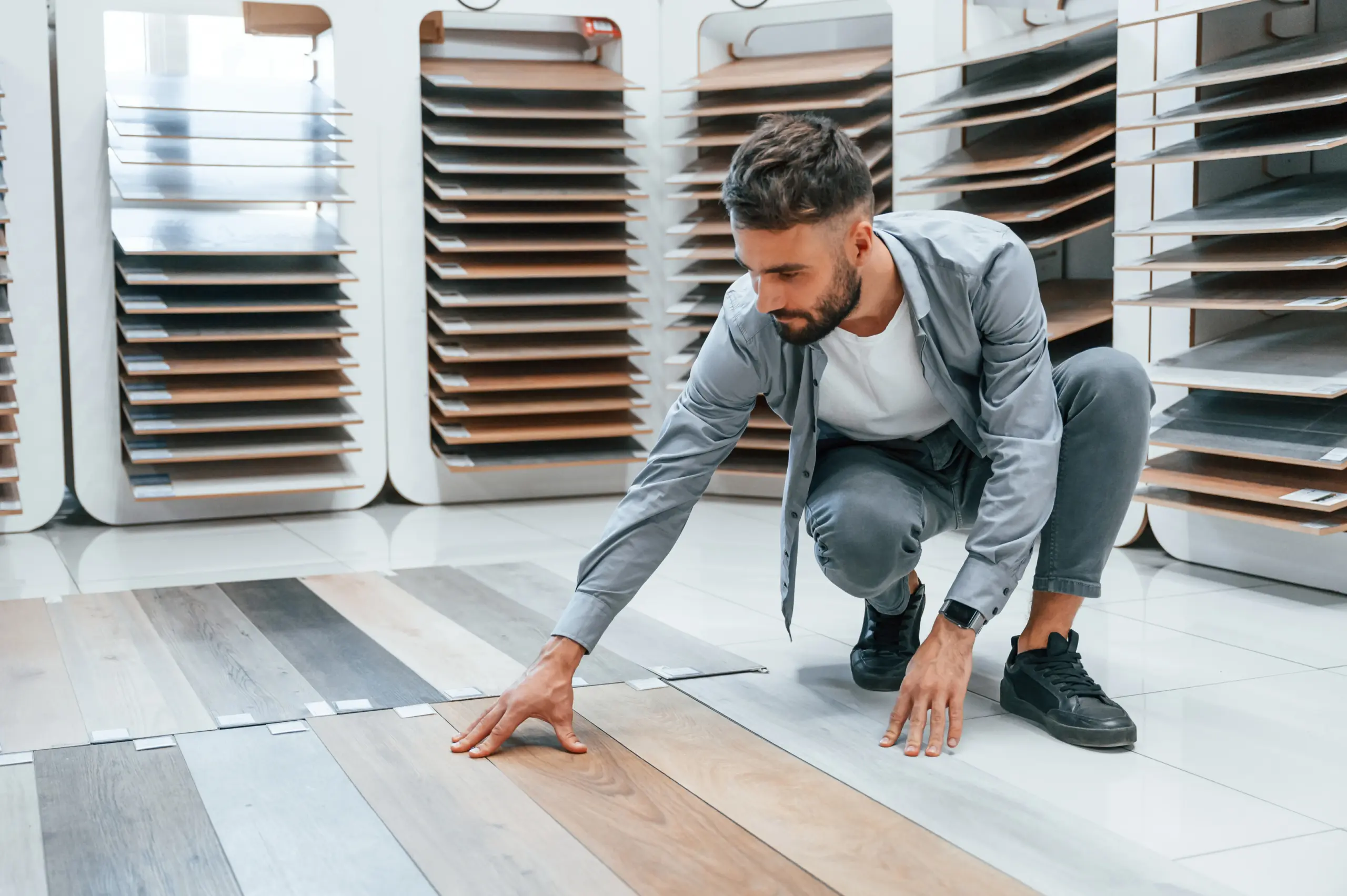
Choosing a siding floor is rarely as simple as choosing the color or finish. In Lévis, there is one variable that changes everything: humidity. Between the Saint Lawrence River just steps away, winters that alternate between freezing and thawing, and basements concrete that breathe humidity six months of the year, a floor that performs well elsewhere can become a problem within a few seasons.
Laminate floating floors and SPC vinyl often look alike. Same plank width, same wood finish, sometimes similar prices. But they behave completely differently when it comes to humidity — and that is where the difference really matters, especially in homes built between the 1970s and 1990s, which make up a large portion of the residential housing stock in Lévis, Charny and Saint-Romuald.
At Solutions Rénovation Québec (SRQ), a licensed RBQ contractor (5811-7821-01), we have been installing both types of flooring for years. We explain the concrete difference — without trying to sell you a particular product, but by giving you the information to make the right choice for your home, your budget and the actual use you make of it.
What is the real difference between a floating floor and SPC vinyl?
Let's start with the most important thing: these are two fundamentally different products in their composition, even if they are installed in a similar way. Understanding what they are made of means understanding why one is better suited to certain situations than the other.
Laminate floating flooring is made of a core of compressed wood fibers, with a decorative layer printed on the surface and a transparent protective layer on top. It is processed wood — and like any wood-derived product, it reacts to humidity. It swells, it warps, it can delaminate if conditions are not right.
SPC vinyl (Stone Plastic Composite) is made from a rigid core composed of limestone and PVC. There is no wood in its composition — which means it does not swell, does not shrink and does not react to humidity in the same way. This is the main distinction, and it has direct consequences on the durability of the product in a Quebec context.
Floating floor — economical and popular
Laminate has long dominated the residential market in Quebec, and for a simple reason: it offers the appearance of hardwood at a fraction of the price. It is available in a variety of finishes, widths and styles, it is relatively easy to install, and its purchase cost is affordable.
Under the right conditions — a dry room, a stable and well-leveled subfloor, a home without humidity problems — laminate can easily last ten to fifteen years. It is a decent product for what it is, provided it is installed under the right conditions.
The problem is that Quebec homes are not always in the «right conditions.» And that is where things get complicated.
Why floating floors can swell in some homes in Lévis
A laminate floor is sensitive to relative humidity — both excess and sudden variations. If humidity rises beneath the floor — whether due to a damp basement, a slow infiltration, condensation on a concrete slab or a minor water damage — the wood fiber core absorbs the humidity and swells. The joints between the planks begin to buckle, the ends lift, and in some cases, the planks never return to their original position even once the humidity is resolved.
In Lévis, with higher ambient humidity due to the proximity of the river and concrete basements that bring up humidity seasonally, this scenario is far from rare. We see it regularly during our assessment visits.
SPC vinyl — designed for Quebec's realities
SPC is the direct answer to the limitations of laminate in humid environments. Its mineral core does not react to water — it can be submerged without swelling, without delaminating, without losing its dimensional integrity. This is a fundamental property that completely changes the durability equation in a Quebec context.
In addition to its water resistance, SPC offers good impact resistance, decent thermal stability against temperature variations, and minimal maintenance. It absorbs footstep sounds better than laminate (depending on the thickness of the integrated underlay), and it is generally more comfortable underfoot.
Why SPC performs better near the Saint Lawrence River
The riverside humidity in Lévis is not just a summer reality. In autumn and spring, temperature variations create condensation-evaporation cycles that continuously affect construction materials. SPC, with its limestone and PVC core, is dimensionally stable under these conditions — it does not «work» with humidity variations the way wood fiber-based products do.
For a home built in the 1980s in Lévis, with an uninsulated concrete basement and a slab that brings up humidity in the spring, SPC is not a luxury — it is the logical product.
Which flooring is the most durable for a home in Lévis?
Durability depends on two factors: the intrinsic quality of the product, and the conditions under which it is installed. A good product poorly installed in an unsuitable environment will not last. And an ordinary product, well installed under the right conditions, can last a very long time.
That said, if we compare the two products under the real conditions of a typical Quebec home, SPC has a structural advantage over floating laminate — particularly with regard to humidity.
Resistance to humidity and infiltrations
Laminate floating floors are not waterproof. Manufacturers are clear about this in their installation guides: water must not sit on the surface, and moisture under the floor must be controlled. In reality, a simple water damage event — an overflowing washing machine, a slowly leaking faucet, an infiltration during heavy rain — can permanently compromise several laminate planks. Manufacturer warranties generally exclude water damage.
SPC vinyl, on the other hand, is 100 % waterproof. It can be cleaned with plenty of water, it resists prolonged splashes, and minor water damage does not compromise the planks themselves. However, it can promote mold under the floor if water accumulates beneath without being able to drain away — which is why subfloor preparation remains essential even with SPC.
Why homes 25+ years old are more at risk
Homes built before the 1990s often have a concrete slab that was never treated to limit capillary rise. Without an adequate vapor barrier, moisture rises from the ground continuously. In these homes, installing laminate in the basement or at ground level is taking a calculated risk that many homeowners regret after their first summer or first rainy spring.
This is exactly the type of situation we assess during an estimate visit — before recommending anything to you.
Impact resistance, children and pets
The wear layer of SPC is generally thicker and more scratch-resistant than that of standard laminate. For a family with young children, pets with claws, or high traffic in common areas, this difference shows over time.
High-end laminate can offer decent resistance, but it remains more susceptible to deep scratches and localized impacts. A falling furniture corner, a toy dragged across the floor, dog claws scratching the same spot — over time, these marks accumulate and affect the overall appearance.
A mid-range quality SPC will often have better practical resistance than a high-end floating floor in intensive family use.
Real lifespan and warranties
A well-installed and well-maintained laminate floor in dry conditions can last from ten to twenty years. A decent quality SPC vinyl, under the same conditions or even in wetter conditions, has an estimated lifespan of twenty to thirty years, sometimes more (reasonable estimate).
The difference in manufacturer warranties reflects this reality: warranties on quality SPC often cover twenty years or more, compared to ten to fifteen years for most residential laminates.
What many homeowners discover too late
Manufacturer warranties have exclusions. Excessive moisture, incorrect installation, absence of a vapor barrier, non-compliant subfloor — in most cases, if the floor swells or warps, the warranty does not apply because the prescribed installation conditions were not met.
This is the most common trap: the homeowner buys a product with a fifteen-year warranty, but the installation was done quickly without testing the subfloor moisture or installing the required membrane. Two winters later, the planks buckle, and the warranty covers nothing.
An installation carried out by a qualified contractor, with a prior moisture check and adequate subfloor preparation, is the only way to ensure the warranty remains valid — and that the floor actually lasts as long as expected.
Not sure what condition your subfloor is in? Have it evaluated before choosing your flooring.
Contact SRQ for a free evaluation → 418-476-1747
What is the best choice for each room in the house?
There is no single answer. The right choice depends on the room, its level of exposure to moisture, daily use, and the existing structure.
Basements and ground floors — SPC advantage
The basement is the most demanding environment for a floor. The concrete slab wicks moisture upward, the temperature can vary significantly between seasons, and the risk of infiltration is higher than on upper floors. In this context, SPC is the most logical choice — its moisture resistance makes it clearly superior to laminate for this application.
On a ground floor over a concrete slab, the reasoning is similar. The slab may look dry to the eye, but a moisture test often reveals a level that exceeds the thresholds tolerated for laminate. SPC, on the other hand, can be installed over a slab with a higher moisture level — provided the manufacturer-recommended vapor barrier is installed.
Why freeze-thaw cycles influence subfloors
The freeze-thaw cycles experienced by homes in Lévis have a direct effect on structures at ground level. Concrete moves, contracts in winter, expands in spring. These movements can create micro-cracks in the slab, level variations, and areas where moisture infiltrates intermittently. A floor that cannot tolerate these seasonal moisture variations is a floor that will cause problems.
Bedrooms and drier spaces
Upstairs bedrooms are generally the most stable spaces in terms of humidity in a house. If the attic is well insulated and ventilation is adequate, humidity is controlled. This is where laminate is at its best — stable conditions, low water circulation, moderate use.
In this context, floating floors can be a very worthwhile choice, especially if budget is a constraint. You don't necessarily need to install SPC throughout the entire house. In dry, low-exposure spaces, laminate does the job correctly at a lower cost.
Entryways and kitchens — watch out for salt and water
The entryway of a home in Lévis in winter is a combat zone. Melting snow, wet boots, de-icing salt tracked in from outside, water accumulating at the base of the door — it's one of the most aggressive environments for a residential floor.
Laminate in a Quebec winter entryway is a high risk. Even with an entry mat, water eventually reaches the planks, seeps into the joints, and swelling gradually sets in. SPC resists this type of exposure without deteriorating.
In kitchen, the risk is different but real: splashes around the sink, spills, frequent water cleaning. SPC is again more appropriate there, both for water resistance and ease of maintenance.
Do you have several rooms to renovate with different needs? We can help you choose the right product for each space — without pressure and without compromising on durability.
Request a free consultation → solutionsrenovationquebec.ca | 418-476-1747
Why installation is as important as the material
It's often said, and it's always true: a good product poorly installed gives a bad result. The opposite is also true — a careful installation, with adequate preparation, can compensate for certain limitations of the material.
The problem is that many homeowners see installation as a secondary step. They invest in the floor, pay attention to the finish and color, then look to save on the installation. That's where the problems begin.
A poorly prepared subfloor can ruin the result
Subfloor flatness is a technical requirement, not a recommendation. SPC and laminate manufacturers specify maximum variation tolerances — generally 3 mm over 1.8 m. If the subfloor exceeds these tolerances, the planks will click, lift at the joints, or create pressure zones that will accelerate wear.
The moisture test is another step that is never skipped. A slab hygrometer measures the actual moisture level of the concrete before anything is installed. If the level exceeds the recommended thresholds, appropriate treatment or a membrane is necessary — whether SPC or laminate is being installed.
Best practices recommended by RBQ professionals
Properly preparing a subfloor means leveling irregularities with an appropriate leveling compound, checking moisture, installing the required membrane or vapor barrier according to the product and application, providing expansion joints in the right places, and letting the material acclimate to room temperature before installation. These are steps that rushed installers regularly skip — and that we systematically apply at SRQ.
Why some floors fail after only a few years
We see floors that are three or four years old and look like ten. Planks lifting at the ends, joints separating, surfaces cracking underfoot. In the vast majority of cases, the problem is not the product — it's the installation.
Untested and untreated subfloor moisture. Planks installed without leaving the required perimeter expansion joints. Inappropriate or missing underlayment. Installation over concrete whose moisture exceeded tolerated thresholds. These errors are invisible once the floor is installed — and they manifest six, twelve, or eighteen months later, often beyond simple recourse deadlines.
Want a floor that truly lasts? Entrust the installation to an RBQ contractor with a labor warranty.
Plan your project with SRQ → 418-476-1747 | srq.quebec@gmail.com
Why several homeowners in Lévis choose SRQ
Floor renovation is a project you live with every day for ten to twenty years. A bad choice, a botched installation, or a warranty that doesn't cover what you thought it did — you pay for that for a long time. That's why choosing the contractor matters as much as choosing the material.
Recommendations adapted to the Quebec climate
At SRQ, we don't suggest a product because it's on sale or because it offers a better margin. We assess your home — the condition of the subfloor, the humidity level, the daily use of the rooms, the age of the structure — and we recommend what will actually hold up in your conditions.
In a house from 1978 at Charny with a semi-buried basement, you don't install laminate on the lower level. In a child's bedroom upstairs in a well-ventilated bungalow, we won't force you to choose SPC if laminate meets the need and the budget is tight. These are honest recommendations, adapted to the reality of each home.
A transparent, no-pressure approach
You receive a detailed quote before the work begins. Materials, quantities, subfloor preparation, labour — everything is itemized and clearly explained. There are no fees added during the project without us having told you about them from the start.
If we discover an issue during preparation — higher humidity than expected, a subfloor that requires more work than the initial estimate — we contact you before going further. You make the decision with all the information in hand.
What sets SRQ apart from improvised installers
SRQ operates under RBQ licence 5811-7821-01, with Marco Savoie directly responsible for every project. Each floor installation is covered by a 5-year labour warranty. With more than 500 projects completed in the Lévis and Chaudière-Appalaches region, we've installed flooring in just about every home configuration you can encounter — from 1970s bungalows to more recent builds, including damp basements and high-traffic spaces.
Our worksites are clean. We protect adjacent areas, we work in order, and we don't leave a worksite open overnight. On delivery day, your floor is ready — and clean.
Do you have a flooring project in Lévis, Charny, Saint-Romuald or in the Quebec City region?
Request your free quote — no obligation → solutionsrenovationquebec.ca | 418-476-1747
Frequently asked questions about floating flooring and SPC vinyl in Lévis
What is the difference between floating flooring and SPC?
Laminate floating flooring has a core of compressed wood fibres covered with a decorative layer and a protective layer. It is sensitive to moisture and can swell with prolonged contact with water. SPC vinyl has a core made of limestone and PVC — it is waterproof, dimensionally stable and does not react to humidity variations. These are two fundamentally different products despite a similar appearance.
Is SPC really worth the extra cost?
In most Quebec homes, and particularly in spaces at risk of humidity (basements, entryways, kitchens), yes. The initial extra cost is offset by a longer lifespan, less maintenance and the absence of any risk of swelling. In dry rooms such as bedrooms, the answer is less clear-cut — laminate may be sufficient if conditions are good.
Which flooring resists humidity best?
SPC vinyl, without hesitation. It is 100 % waterproof in its composition. Laminate, even the «water-resistant» surface versions, remains vulnerable if humidity seeps in through the joints or from underneath.
Can floating flooring be installed in the basement?
Technically yes — some manufacturers allow it provided that the slab's moisture level is within the prescribed limits and that an adequate vapour barrier is installed. In practice, in Lévis, with concrete basements that draw up moisture, it is a risk that few professionals recommend. SPC is a much more suitable option for this application.
What is the lifespan of SPC vinyl?
A decent residential-grade SPC can last from twenty to thirty years with normal maintenance (reasonable estimate). High-end products are often guaranteed twenty years or more by the manufacturer. The actual lifespan depends on the quality of the product, the installation conditions and daily use.
Is a vapour barrier required under SPC flooring?
It depends on the application and the manufacturer. On a concrete slab, a vapour barrier is almost always required or recommended. Some SPC products have an integrated underlay with vapour-barrier properties; others require the addition of a separate membrane. This is a check to be made according to the precise specifications of the chosen product — your contractor must take care of it.
Is SPC cold or noisy?
Compared to hardwood, yes, vinyl is naturally colder underfoot. That said, most current SPCs have an integrated underlay (foam or cork) that improves both thermal comfort and sound absorption. On heated floors, SPC is compatible with the vast majority of systems — an advantage it has over certain types of laminate.
Which flooring to choose for a home in Lévis?
For spaces at ground level or in the basement, and for areas exposed to seasonal humidity: SPC. For upstairs bedrooms in stable conditions: laminate may be suitable if budget is a factor. The best answer comes from an assessment of your subfloor and your specific context — which we do free of charge during an estimate visit.
Do warranties cover water damage?
Most of the time, no — especially for laminate. Manufacturer warranties generally exclude damage caused by excessive humidity, seepage or water damage. For SPC, warranties are generally more extensive, but they still require that the installation was carried out according to the rules. That is why installation by a qualified contractor is important: it protects the validity of your warranty.
Why do business with an RBQ contractor?
A licensed contractor commits their professional liability on every project. For you, that means: an installation that respects the rules of the art, a warranty on the labour, and a possible recourse if something goes wrong. An unlicensed installer, however competent, does not offer you these protections. In the case of flooring — an investment that is lived with daily for fifteen or twenty years — it is a protection that is truly worth it.
Solutions Rénovation Québec — RBQ Licence 5811-7821-01 2552 chemin du Fleuve, Lévis, Québec G6W 1Y3 418-476-1747 | srq.quebec@gmail.com | solutionsrenovationquebec.ca Monday to Friday, 8 a.m. to 5 p.m.