
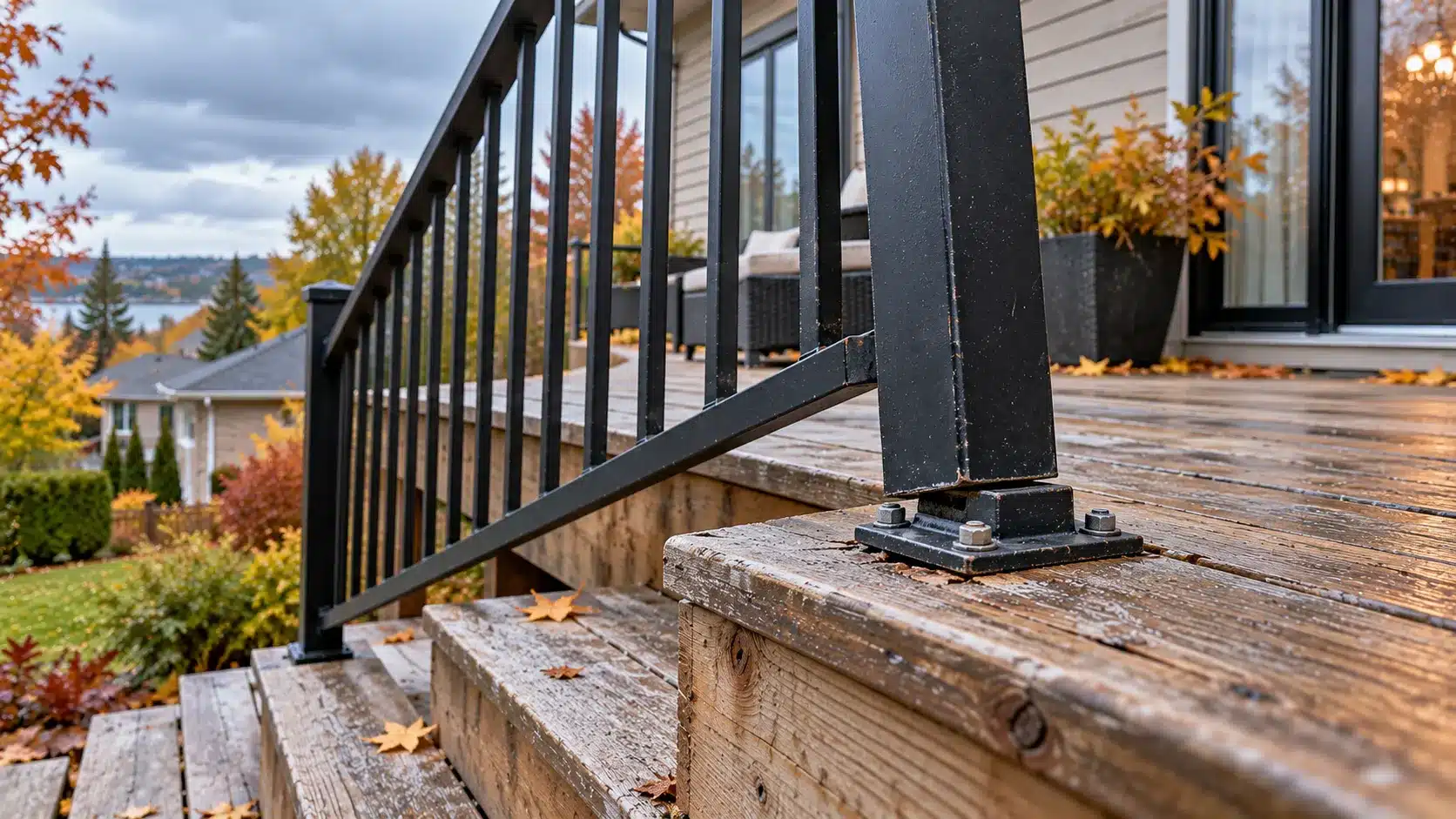
You put your hand on the railing of your staircase or your front porch, and it moves. Not much, but enough to make you frown. The question comes right away: is it dangerous? The short answer: yes, it deserves attention. A railing that moves under light pressure can signal a loose anchor, a degraded fastening or a structural problem — and until it is checked, it is better to avoid relying on it.
No need to panic, but no question of ignoring it either. A railing has a specific role: to support you or prevent a fall. When it moves, it no longer fulfills that role reliably — and it is precisely at the critical moment, when you stumble and grab hold, that it must hold.
In Desjardins, Lévis sector, at Solutions Rénovation Québec (RBQ license 5811-7821-01), we regularly assess and secure ramps and guardrails. In this article, we explain the risks, how to recognize a ramp that needs inspection, and how to decide between repairing and replacing.
An unstable railing: what risks for your family?
A railing that moves is not just a maintenance detail — it is a safety issue for the whole household. The danger is that it gives way at the worst moment.
Imagine: you're going down the stairs, you lose your footing, your reflex is to grab onto the handrail. If it gives way or moves too much, you no longer have support and the fall becomes much more serious. This is true on an interior staircase, on a front porch or on a raised gallery. The people most at risk are children, who lean on and climb them, and seniors, for whom the handrail is an essential support.
It's also important to distinguish between two things that have different roles. The handrail is what you hold onto for support when going up or down stairs. The guardrail is the barrier that prevents falling into the void at the edge of a balcony, a landing or a staircase. Both must be solid. Here's the simple logic: the problem is a ramp that moves; the risk is that it doesn't provide the expected support at the critical moment; the solution is to limit access to the area and have the fastenings and support checked before relying on it again.
How to recognize a railing that should be inspected?
Good news: you can spot the signs of a problematic railing by simple observation, without taking any risk. Important — never test the solidity by hanging from the railing or forcing it. A visual observation, from a reasonable distance, is enough to spot the warning signs.
Here are the signs to watch for:
- Corroded posts that seem to move at their base or that are no longer plumb.
- Corroded screws, bolts or anchor plates that are loose or corroded.
- Of wood that is cracked, softened or damaged by moisture.
- Of rusted metal, damaged welds or fastenings that are coming loose.
- A a guardrail that is separating from the balcony, the landing or the staircase.
If you notice one or more of these signs, your railing deserves an inspection. These visible clues often tell a story: an anchor that has given way, water that has done its work, or a fastening that has worn out over time. Rather than forcing it to «test» it, observe and have it evaluated. It is safer and more reliable — a professional will know where to look and how to check without danger.
Why do railings deteriorate in Quebec?
Our climate is particularly hard on railings, especially outdoors. Repeated freeze-thaw cycles, water that infiltrates the assemblies, de-icing salt and moisture work together to weaken the fastenings and materials over the seasons.
Concretely, water infiltrates around the anchors and joints, freezes, expands, then thaws — this repeated movement loosens the fastenings and cracks the wood. Salt accelerates metal corrosion, especially steel. That's why a ramp that held up well a few years ago can become unstable today.
Houses 25 years and older, numerous in Desjardins and in Lévis, deserve a careful check of their railings — not because their age proves a failure, but because time and climate have had more opportunities to do their work. An original railing on a house from the 1980s has gone through dozens of winters. It is worth taking a look.
What standards apply to railings and guardrails?
A guardrail is not just a question of solidity — it must also meet height and spacing standards to be safe and compliant. These requirements vary depending on the configuration, the fall height and the type of building, so always validate your specific case with the City of Lévis. Here are the benchmarks applicable in Lévis, taken from municipal documentation.
In Lévis, a guardrail is notably required when the difference in level exceeds 600 mm between the walking surface and the adjacent surface. For an exterior guardrail serving a single dwelling, the minimum height is generally 900 mm when the surface is at most 1,800 mm from the finished ground; a height of 1,070 mm may apply in other cases. For stair flights, the height is at least 900 mm, measured at the nosing of the step.
As for spacing, it is a crucial safety standard for children: the openwork parts of a required guardrail must not allow a 100 mm sphere to pass through. In other words, the bars must be close enough that a child cannot pass their head through. A railing with bars that are too far apart — or missing — is not compliant. These specific requirements must be confirmed according to your configuration and municipal rules, but they give a good idea of what matters.
Repairing or replacing an unstable railing: how to decide?
When faced with a ramp that moves, the question arises: repair it or replace it? The answer depends on the condition of the material, the fastenings, the support and the conformity of the installation. Let's look at both scenarios.
When a repair may be enough
In some cases, a targeted repair solves the problem. If the structure of the railing is sound and the issue comes from a loose anchor or a localized part, a professional can correct the fastening, tighten or reinforce the anchor, or replace the affected element.
This is the case when the rest of the ramp — posts, balusters, handrail — is in good condition, and only one specific point has failed. Repairing then costs less than a complete replacement. But be careful: the support (wood, concrete or structure) must also be sound. A tightened anchor in rotten wood won't hold. An assessment determines whether the repair is sufficient.
When should a replacement be considered?
In other situations, replacement is the safe choice. Significant corrosion, degraded or rotten wood, damaged assemblies, or an unsuitable configuration (balusters too far apart, non-compliant height) point toward a replacement rather than a repair.
When several elements are affected, repairing one by one no longer makes sense — it's safer and often more economical to redo it properly. It's also an opportunity to choose a durable material. Powder-coated aluminum (which doesn't rust like steel), galvanized steel and treated wood are options to evaluate based on location, exposure and project requirements. For an exterior ramp in our climate, aluminum is often the most durable choice.
Have your railing evaluated in Desjardins
The right choice depends on the actual condition of your railing and its support. Request an on-site evaluation and a clear quote from Solutions Rénovation Québec — we evaluate before recommending repair or replacement.
How much does repairing or replacing a railing cost?
The cost depends on the scope of the work. A local repair and a complete replacement do not have the same price — and the actual cost varies according to several factors. Here is how to approach it (the amounts below are indicative, not guaranteed rates).
What factors influence the budget?
Several elements determine the cost of a railing project:
- The nature of the work: repair of the fastenings or complete replacement.
- The material and manufacturing complexity (aluminum, galvanized steel, wood).
- The work on the stairs, the landing or the structure of support.
- The length of the ramp, the number of posts and the angles.
- The labor and the applicable regulatory requirements.
- Site access and removal of the old ramp.
A targeted repair of an anchor costs relatively little; a complete replacement of a guardrail of several feet represents a more significant investment. That's why it's important to distinguish between the two and get an estimate adapted to your specific project. An on-site assessment gives the only reliable figure — be wary of a price quoted without having seen the ramp and its support.
Permit in Desjardins: can a ramp be repaired without authorization?
That is a good question, and the answer depends on the nature of the work. You must distinguish between maintenance (tightening, repainting), repair (correcting a fastening, replacing a part) and modification (changing the dimensions, the configuration or the location).
In general, simple maintenance or an identical repair may be less regulated than a modification or replacement that changes the structure. Lévis municipal rules determine what applies, and they may include thresholds or specific conditions. Since these requirements vary and can change, we cannot guarantee an exemption based solely on the cost of the work. The best approach is to confirm directly with the City of Lévis the requirements for your specific project — or let us verify for you. Better to validate before than to correct after.
Why entrust the evaluation to Solutions Rénovation Québec?
An unstable ramp affects safety and, often, compliance. The choice of contractor makes the difference between a ramp that is finally safe and a repair that will not hold.
We operate under RBQ license 5811-7821-01, led by Marco Savoie, as a residential renovation contractor. We have more than 10 years of combined experience, more than 500 completed projects, and we offer a 5-year warranty on labor, according to the applicable conditions. We focus on a free on-site estimate, direct communication and a clean and safe worksite.
A clear process, from diagnosis to work
Our approach is simple and transparent:
- Discussion about the problem and the configuration of your ramp.
- On-site assessment and definition of the required work.
- Transparent quote before the start of work.
- Execution and tidying up of the worksite.
This process ensures you know exactly what will be done, at what price, before we start. For a safety element like a ramp, it is important to deal with people who know the standards and who stand behind their work.
Contact Solutions Rénovation Québec to discuss your ramp and obtain a quote adapted to your situation.
FAQ – Unstable ramps in Desjardins
Is a ramp that moves slightly dangerous?
A noticeable movement justifies a verification. Even slight, it can signal an anchor that is beginning to give way or a support that is deteriorating. Until the cause is clarified, do not continue to rely on the ramp as a reliable support. Have it evaluated rather than assuming that «it will hold.».
What is the regulatory height of a guardrail in Quebec?
In Lévis, for a single-dwelling patio, the minimum height is generally 900 mm when the surface is at most 1,800 mm from the ground, and 1,070 mm in other cases. A guardrail is required as soon as the drop exceeds 600 mm. Validate your specific situation with the City of Lévis.
Is a handrail mandatory on all stairs?
Not in all cases — it depends on the configuration. A handrail helps you support yourself on a staircase, while a guardrail protects against a fall at the edge. Requirements vary according to the number of steps and the type of staircase. An evaluation confirms what applies to your staircase.
Can you simply tighten the bolts of a ramp?
Sometimes, if it's just a loose fastening in a sound support. But tightening doesn't fix a pulled anchor, a deteriorated support or advanced corrosion. If the wood is rotten or the metal is rusted, tightening won't hold. An inspection determines whether it's sufficient or if more work is needed.
Is a permit required to repair a ramp in Lévis?
It depends on the nature of the work. Maintenance or an identical repair may be less regulated than a modification or a replacement. Municipal rules vary and may include conditions. Confirm the requirements for your specific project with the City of Lévis before starting.
Which material best withstands Quebec winters?
Aluminum (especially welded and powder-coated) resists corrosion very well, salt and humidity, with little maintenance. Galvanized steel offers good resistance but is still metal. Treated wood is affordable but requires regular maintenance. For a durable exterior ramp here, aluminum is often the best choice.
Does SRQ offer ramp evaluations in Desjardins?
Yes, we offer a free on-site estimate, with no obligation. We evaluate the condition of your ramp, its anchors and its support, then propose a clear quote for repair or replacement. Contact us to arrange an evaluation adapted to your situation.
How much does replacing a guardrail cost?
The cost depends on the length, the material, the number of posts, the condition of the support, access and regulatory requirements. A local repair costs much less than a complete replacement. For an accurate figure, an on-site evaluation is required — we then provide you with a detailed and transparent quote.
A ramp that moves can be fixed — but it must be checked first
In the end, if your ramp moves when you lean on it in Desjardins, it's not something to take lightly. It might not support you when you need it most — a real safety issue, especially for the children and seniors in the home.
The right approach: avoid relying on it until it’s been checked, spot the signs through simple observation (without forcing it), and have the actual condition of the railing, its anchors and its support assessed. Depending on the diagnosis, a targeted repair may be enough if the structure is sound, or replacement becomes the safe choice if corrosion or deterioration is advanced. And in our climate, aluminum is often the most durable material for an outdoor railing.
We also take the opportunity to make sure the railing meets Lévis standards — height, spacing of the bars, solid anchors. A compliant and well-secured railing means peace of mind for your whole family. An RBQ contractor who evaluates honestly and works by the rules is what turns a worrying railing into reliable support.
Does your railing move in Desjardins or the surrounding area?
Request a free, no-obligation evaluation from Solutions Rénovation Québec or call us at 418-476-1747. We assess the condition of your railing, its anchors and its support, we check compliance with Lévis standards, and we offer you the right solution — repair or replacement — according to RBQ rules, with a warranty, and no obligation.