
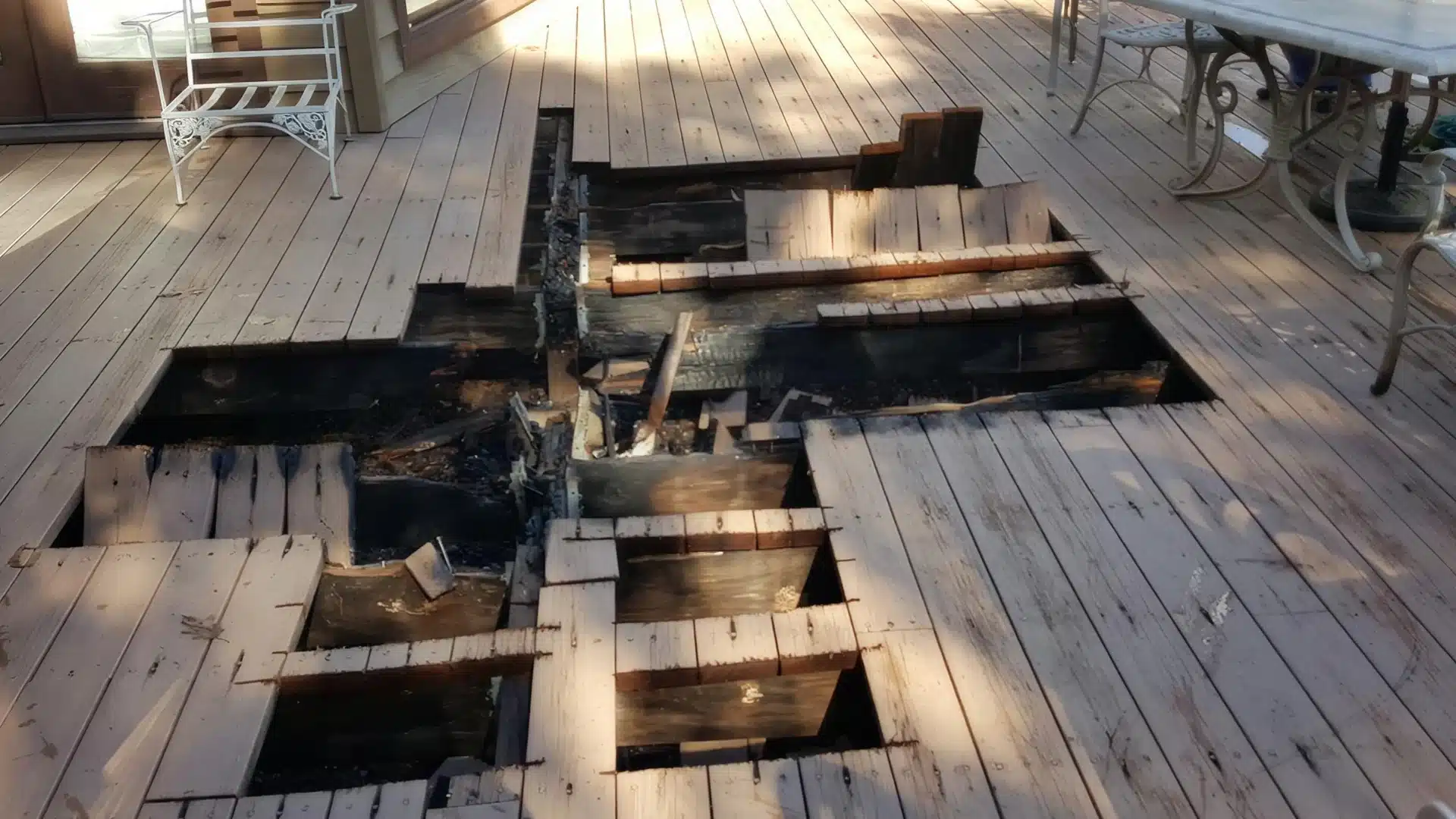
You walk onto your patio and you feel it: it moves, it sways, it «gives» underfoot. The natural reflex is to wonder if it's serious. The honest answer: a patio that moves is not always an emergency, but it should never be ignored.
A movement can be benign — a simple gap to fix — or the symptom of a serious structural problem. And when a patio is raised or hosts people, safety becomes a real issue. Better to understand before continuing to use it as if nothing were wrong.
In Charny, in the Lévis area, the cycles of freeze-thaw and the region's soils put patio foundations to the test. At Solutions Rénovation Québec (RBQ license 5811-7821-01), we inspect and stabilize patios suited to our climate. In this article, we help you assess the risk and know what to do.
Is a patio that moves always dangerous?
Let's start by adding nuance, without minimizing. Not all movements are equal. A slight localized gap does not have the same meaning as a general oscillation of the entire structure.
The question to ask is not only «is it moving?» but «how, where, and since when?» A stable, minor movement may be a simple adjustment to make. A movement that worsens, affects the entire structure, or is accompanied by other signs deserves prompt attention.
What doesn't change is that a patio that moves should never be ignored, especially if it is raised. Height turns discomfort into a real risk of falling or collapse. When in doubt, have it checked.
Movements considered minor
Some movements are relatively benign and often repairable without major work. A slight localized gap at a specific spot, a deck board that moves a little, or a minor vibration on a ground-level patio fall into this category.
These situations often come from play in the fasteners or a poorly secured board. They are generally corrected by tightening, shimming, or reinforcing the affected point. It still needs to be checked, but the issue is moderate.
Movements that indicate a real structural risk
Other movements are alarm signals. A general oscillation of the entire structure, lateral swaying (the «racking» effect), a sagging on one side, or movement of the posts and foundation are concerning.
These signs point to a structural problem — an anchor that has failed, a foundation that has shifted, missing bracing. On a raised patio, this type of movement represents a real safety risk. It is no longer a question of comfort, but of the solidity of the whole. An evaluation is needed without delay.
Accompanying signs to watch for
Movement is often accompanied by other revealing clues. Watch for: posts that are no longer plumb, a patio that leans or is no longer level, cracks in the wood or concrete, corroded connectors or hardware, split or rotten wood, and an unstable guardrail.
The guardrail deserves special mention: on a raised patio, a guardrail that moves is an immediate fall hazard. If you observe one or more of these signs in addition to the movement, it's time to have it inspected before continuing to use the patio.
A raised patio that moves must always be taken seriously
On an elevated structure, the risk is not theoretical. Have the structure and foundations of your patio inspected by Solutions Rénovation Québec — especially if it is raised or if it often hosts people.
Why does a patio become unstable in Charny and Lévis?
Understanding why a patio moves is the first step to fixing it durably. In Charny and Lévis, a few causes come up often. Here they are.
The effect of freeze-thaw on foundations
This is the number one cause in our region. Our repeated freeze-thaw cycles freeze and thaw the ground dozens of times each winter. With each cycle, the soil lifts and then contracts — this is frost heave.
An anchor that does not go below the frost line takes this movement head-on. The soil pushes it up as it freezes, then lets it drop back during thaw. Repeated season after season, this phenomenon destabilizes foundations and makes the patio move. It is the most common mechanism of instability here.
Why foundation depth is decisive
The key is depth. Anchors must go below the frost line — generally around 1.2 to 1.5 m in our region (order of magnitude to be confirmed depending on the terrain and local standards).
Below this line, the soil does not freeze and remains stable all year. An anchor that reaches this depth escapes heaving; an anchor that is too short suffers it. This is why foundation depth is not a detail — it is what determines whether the patio will remain stable over time. A patio that moves very often has foundations that are too shallow.
Original installation problems
Sometimes the problem goes back to construction. A deficient initial installation leaves weaknesses that show up over time.
Common causes: poorly anchored or poorly secured posts, a structure undersized for the load, the absence of bracing (the reinforcements that prevent lateral swaying), and inadequate or insufficient connectors. These installation shortcomings cause a patio to move, sometimes from the very first years. It is a reminder of the importance of construction done by the rules from the start.
Material wear over time
Time also takes its toll. Wood that ages can split, rot, or lose its strength. Hardware can corrode, especially in our humid climate.
This wear gradually weakens the attachment points and load-bearing elements. Rusted connectors, screws that have worked loose, softened wood at the support points: all of this contributes to a patio that becomes unstable over the years. Periodic maintenance and inspection allow you to spot this wear before it becomes a problem.
Each cause requires a different solution
Fixing an unstable patio without knowing the cause is risking having to start over. Request an inspection from Solutions Rénovation Québec — we identify the real cause before proposing a solution.
How do you know if the problem is serious?
You can do an initial assessment yourself, but you need to know where the limits of DIY are. Here is how to see things more clearly.
Basic visual checks
A visual examination already gives you clues. Check the plumb of the posts (are they straight?), the condition of the hardware (corroded? loose?), the presence of cracks in the wood or concrete, and the general condition of the wood (split, soft, rotten?).
Also look at whether the patio is level or whether it leans to one side, and test the solidity of the railing. These basic checks give you an initial idea of the extent of the problem. Our approach always starts from a structured evaluation like this one, taken further.
The signs that call for a professional inspection
Some signs go beyond home diagnosis and require a professional. Significant structural movement, sagging, posts that move or lean, an unstable railing on a raised patio, or a doubt about the load-bearing capacity: so many situations that call for a proper inspection.
The reason is simple: these problems affect safety, and properly assessing a structure requires experience. A professional can judge whether the patio is safe, what needs to be corrected, and how. Faced with these signs, you don't guess — you get it checked.
Why avoid improvised temporary repairs
The temptation, when facing a patio that moves, is the quick «patch»: a shim here, a board screwed there. The problem is that these improvised repairs mask the symptom without fixing the cause.
A temporarily shimmed patio may seem stable for a while, then move again — sometimes more dangerously, because you believe you're safe. If the cause is an undersized anchor or a foundation that has shifted, no shim will fix that. Improvised repairs can even create a false sense of security, which is worse than the visible problem. A proper diagnosis is better.
Can an unstable patio be repaired without rebuilding everything?
Good news: in many cases, yes. An unstable patio doesn't mean demolishing everything. It all depends on the cause and the extent. Let's look at the options.
Possible targeted repairs
Depending on the problem, several targeted interventions can resolve the instability without a full rebuild. Anchors can be reinforced or added, bracing can be added to eliminate lateral sway, corroded connectors can be replaced, or certain posts and structural sections can be consolidated.
These repairs target the precise cause of the movement. If the problem is a lack of bracing, it's added; if it's a weak anchor, it's reinforced. Well targeted, these interventions restore stability at a lower cost than replacement.
When reconstruction becomes necessary
In some cases, repairing is no longer enough. A structure that is too damaged, generally inadequate foundations (too shallow everywhere), extensively rotted wood, or a patio that does not meet safety standards may justify a reconstruction.
When problems are widespread rather than localized, doing it properly becomes more sensible — and safer — than multiplying repairs. A patio whose foundations were never deep enough will keep moving until that aspect is redone. The right choice depends on the actual condition, which an inspection reveals.
The importance of an assessment before choosing
Before deciding between repairing and rebuilding, a diagnosis is needed. It is what determines the exact cause, the extent of the problem and the appropriate solution.
Without this assessment, you risk either under-treating the problem (a repair that won't hold), or over-treating it (rebuilding what could have been repaired). A good assessment allows you to choose the right solution — neither too much nor too little. It's the step that protects both your safety and your budget.
How much does patio stabilization cost in Charny?
The cost depends on the cause and the extent of the problem. Here are some benchmarks, to be taken as orders of magnitude (indicative estimates that vary by case, and not guaranteed rates).
Localized repair
For a targeted repair — reinforcing an anchor, adding bracing, replacing connectors — often expect in the order of $1,000 to $4,000 (indicative estimate), depending on access and scope.
Foundation reinforcement
If the foundations need to be reinforced or redone, particularly with piles driven below the frost line, expect rather a range in the order of $4,000 to $12,000 (indicative estimate), depending on the number of points and site conditions.
Complete reconstruction
If the patio must be rebuilt, the cost approaches that of a new patio and depends on size, materials and structure. A reconstruction can start at several thousand dollars and climb depending on the scope (indicative estimate).
Why waiting often costs more
An ignored unstable patio doesn't repair itself — it gets worse. The movement increases, the wood degrades further, the attachment points weaken, and a repairable problem can become a reconstruction. Add the safety risk, which cannot be quantified. Acting early is almost always cheaper and safer than waiting.
Why entrust the stabilization of your patio to an RBQ contractor?
An unstable patio is a structural and safety issue. The choice of contractor makes the difference between solving the problem and seeing it return — or worse.
Safety and compliance above all
A patio must be solid and safe, especially if it is raised and hosts people. A RBQ contractor designs and repairs in compliance with safety standards and the Construction Code, particularly for guardrails, load-bearing capacity and anchors.
This compliance is not a formality: it is what protects your family and your guests. A patio repaired according to the rules is a patio you can walk on with confidence. That is precisely what we aim for with every intervention.
Expertise adapted to the climate of Charny and Lévis
Our climate imposes its demands: freeze-thaw, humidity, shifting soils. We design our repairs and foundations according to these realities — anchors below the frost line, resistant materials, corrosion-resistant hardware.
This local expertise makes the difference. A patio stabilized without accounting for our climate will move again; a patio repaired for our conditions holds up over time. We know the particularities of Charny and Lévis, and we take them into account.
Our commitments
We operate under RBQ license 5811-7821-01, led by Marco Savoie, with more than 500 projects completed, more than 10 years of combined experience and a 5-year warranty on labour. We focus on a free estimate on site, transparent prices and a clean and safe worksite. These commitments protect you and ensure work done according to the rules.
Have the safety of your patio assessed now
A doubt about the solidity of your patio deserves a check. Request a free, no-obligation estimate from Solutions Rénovation Québec — we assess the safety of your structure before a problem arises.
Myths and realities about a patio that moves
A few preconceived ideas deserve to be corrected. Here is the truth from the fiction.
«A patio that moves a little is normal.»
Reality: slight localized play can be benign, but general oscillation or lateral swaying is not normal. The distinction is important, and when in doubt, have it checked.
«A shim or a screw fixes the problem.»
Reality: an improvised repair masks the symptom without correcting the cause. If the problem comes from the foundations or the anchoring, no shim will fix it durably — and it can create a false sense of security.
«If the patio is still holding up, there's no danger.»
Reality: a patio can seem to be holding up while having a structural problem that is getting worse. The fact that it hasn't collapsed yet doesn't mean it's safe, especially if it's raised.
«Repairing an unstable patio necessarily costs a fortune.»
Reality: many problems are solved by affordable targeted repairs, especially if you act early. It's by waiting that the problem grows — and the bill too.
FAQ – Unstable patio in Charny
Why has my patio only been moving since this winter?
It's often a sign of frost heave. If the anchors don't go below the frost line, the winter freeze-thaw cycles make the ground rise and fall, which destabilizes the structure. A movement that appeared after winter frequently points to this foundation problem.
Is a swaying patio dangerous?
It depends on the type of movement. A slight localized play is less concerning than a general oscillation of the whole structure. On a raised patio, any significant oscillation must be taken seriously because of the risk of falling or collapse. An inspection allows the real danger to be assessed.
How do you know if the foundations are the cause?
The clues: a patio that started moving after a winter, posts that are no longer plumb, one side that is sagging. These signs point to the foundations, often too shallow. A professional inspection confirms whether the anchoring is the cause and at what depth it goes down.
Can it be repaired without rebuilding the patio?
Often, yes. Depending on the cause, the anchors can be reinforced, bracing can be added, connectors can be replaced, or sections can be consolidated. A complete reconstruction is only necessary if the damage is extensive or the foundations are generally inadequate. An assessment determines the right option.
Do piles fix the instability?
Often, yes, when the problem comes from insufficient anchoring. Piles driven below the frost line provide stable anchoring that escapes heave. It's a common and durable solution for stabilizing a patio whose foundations were too shallow.
How much does patio stabilization cost in Charny?
It depends on the cause. As a guide, a localized repair can range from $1,000 to $4,000, and foundation reinforcement from $4,000 to $12,000 (indicative estimates, not guaranteed). An on-site assessment gives a fair cost according to the real condition of your patio.
Is it risky to wait before repairing?
Yes, on two levels. The problem gets worse over time — the movement increases and a repairable patio can become a reconstruction. And there's the safety risk, especially on a raised structure. Acting early is safer and generally less costly.
Is an RBQ contractor necessary for this work?
For structural work affecting stability and safety, it's strongly recommended. A RBQ contractor ensures compliance with the Code, the safety of the guardrails and anchors, and offers a guarantee on the work. For a safety issue, this expertise is valuable.
A patio that moves can be fixed — but it must be diagnosed first
In the end, a patio that moves in Charny deserves attention, without necessarily panicking. A slight play can be a simple repair; a general oscillation, a sagging or an unstable guardrail are more serious signals, especially on a raised patio.
The right approach comes down to three steps: diagnose the real cause, choose between targeted repair and reconstruction depending on the condition, and do the work by the rules for our climate. In our region, freeze-thaw and foundation depth are almost always at the heart of the problem — hence the importance of anchoring below the frost line.
And the issue goes beyond comfort: it's a matter of safety. A well-stabilized patio is a patio on which your family and guests can walk with confidence. Improvised repairs create a false sense of security; a real diagnosis and a compliant repair fix the problem for good.
Does your patio move when you walk on it?
Request a free, no-obligation estimate from Solutions Rénovation Québec or call us at 418-476-1747. We assess the safety and foundations of your patio in Charny, identify the cause of the movement, and propose the appropriate solution — repair or reconstruction — in accordance with RBQ rules, with no obligation.