
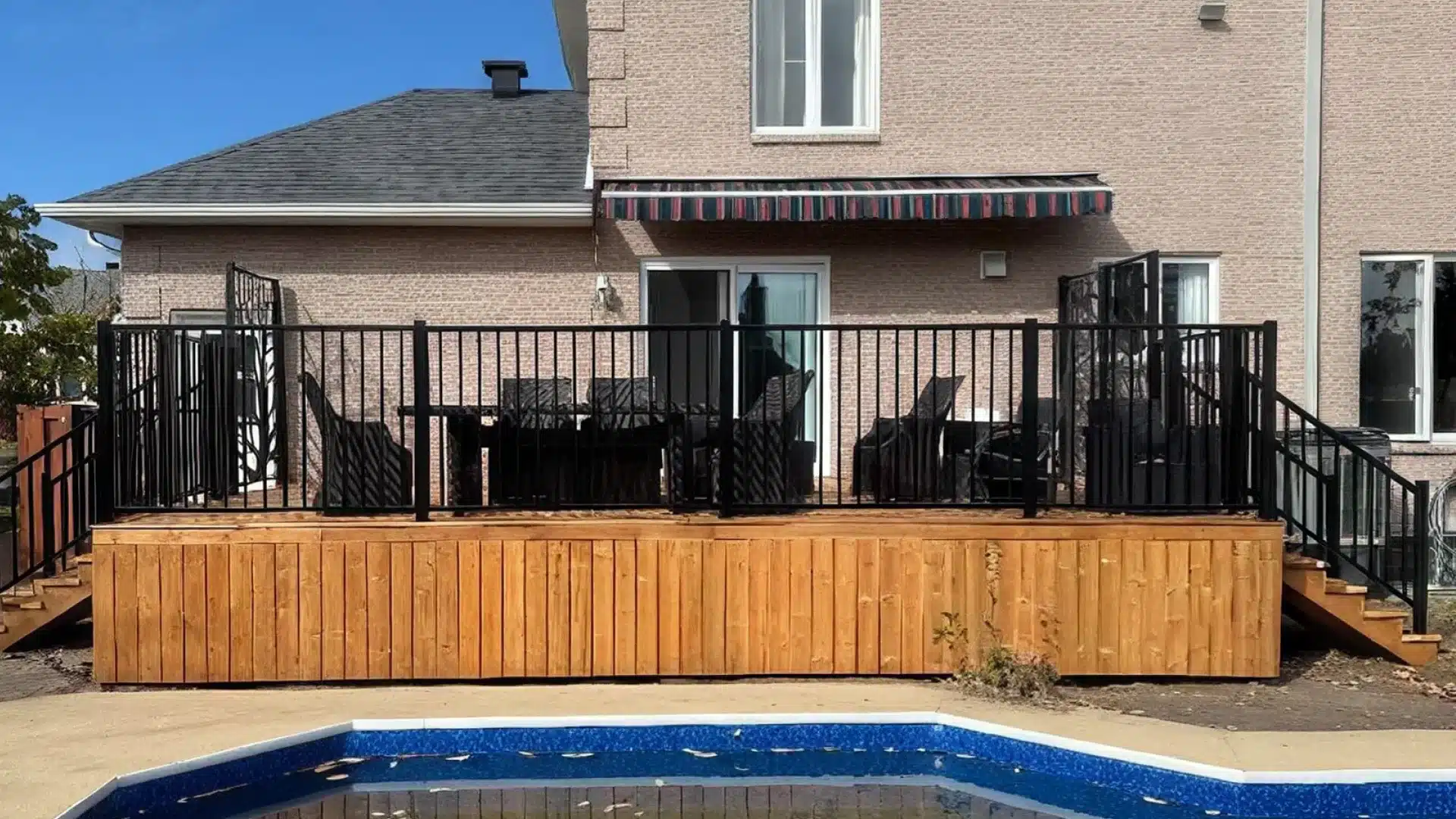
When it comes time to choose a railing for an outdoor staircase, a balcony or a terrace, most homeowners first look at price and appearance. That's normal. But there's a question that should be asked first: will this railing still be solid in 15 years?
À Lévis and throughout the Quebec City region, the climate doesn't forgive. Freeze-thaw cycles, constant humidity, the de-icing salt spread on staircases in winter, all of this attacks fasteners, joints and metals. A railing that seems solid at installation can become dangerous within a few winters if it wasn't chosen and installed for these conditions.
That's where the choice between a welded railing and a bolted railing makes a real difference. Well-installed aluminum railings welded railings last 20 to 30 years without major intervention. Bolted railings, on the other hand, require regular attention to remain safe. This guide explains why, and how to choose what suits your property.
Why the choice of railing type is crucial for your home
A railing is first and foremost a safety element. Not a decoration. And in the single-family homes and bungalows of the Lévis region, many of which are 25, 30 or 40 years old, the original railings have often reached the end of their life without homeowners realizing it.
The problem is that a railing that moves, that rusts or whose fasteners have loosened over time no longer protects anyone. It can even create a false sense of security, someone leans on it in winter on a slippery staircase, and it gives way.
The choice of railing type directly influences three things: immediate safety, resistance to local weather conditions, and what you will have to do, or not do, to maintain it in the years that follow.
The constraints of the Quebec climate
The climate of the Lévis region is particularly demanding for outdoor installations. Temperatures regularly oscillate between -25 °C in January and +30 °C in July. These are variations of 50 to 55 degrees that repeat every year, and that stress all materials, metals, fasteners, joints, anchors.
The de-icing salt used on staircases and driveways aggravates the problem. It accelerates the corrosion of metal fasteners, especially when salt water infiltrates the anchors and freezes deep. This phenomenon is particularly visible on railings installed in areas exposed to wind and street spray.
Humidity, for its part, is constant, spring, summer, fall. It accumulates in the joints, promotes oxidation and, in bolted systems, accelerates the progressive loosening of fasteners.
The risks of a poorly chosen railing
The scenario we see regularly: a bolted railing installed 8 or 10 years ago. Visually, it seems fine. But the screws have gradually loosened under the effect of freeze-thaw cycles, the play in the assemblies has increased, and the structure no longer responds to the loads for which it was designed.
The risk is real, a fall on an outdoor staircase in winter can have serious consequences. And legally, a homeowner whose railing does not comply with Building Code standards can find themselves in a situation of civil liability in the event of an accident.
The solution is a welded aluminum structure. No fasteners to monitor, no mechanical play that accumulates over time, no weak points between segments. Rigidity is structural, it does not depend on the tension of a screw.
Does your current railing seem a little wobbly? Request a free inspection, we come to evaluate the condition of your installation and tell you clearly whether it is still safe or if it needs to be replaced.
Welded railings: maximum strength and durability
A welded railing is a structure whose elements are all assembled by fusion of the metal itself. There are no screws, no bolts, no mechanical connectors between components. The whole forms a single rigid body.
It is this characteristic that explains why welded railings last so long, and why they remain stable well after bolted railings have begun to show signs of fatigue.
How a welded railing works
Aluminum welding consists of locally melting the metal at the junction points to create a permanent bond. Once welded, the railing forms a monolithic structure: the posts, rails and bars become one.
There is no possible movement between components. No mechanical play that accumulates with thermal cycles. No entry point for water in the assemblies. The structure remains identical to itself over time.
Field data confirms it: on well-executed welded aluminum installations, the structural failure rate is less than 5% over 15 years (reasonable estimate based on outdoor renovation experience). This is a reliability that bolted systems cannot match in the Quebec climate context.
Advantages of welded aluminum railings
Aluminum is the metal best suited to Quebec outdoor conditions. It does not rust, it naturally develops an oxide layer that protects it from corrosion without any maintenance. It is light, but structurally strong. And it does not deform under the lateral loads that railings support daily.
Combined with welding, aluminum offers a longevity of 20 to 30 years without major maintenance. No paint to renew, no screws to tighten, no annual anti-corrosion treatment. It is an installation done once, correctly, and that maintains itself.
Increased rigidity is also a measurable advantage. A welded railing absorbs and distributes loads uniformly over its entire length, which reduces local stresses on the anchors and extends their lifespan.
Example of high-end systems: MC Mel
MC Mel products represent what you install when you want the railing to be there in 25 years without having to think about it again. It's welded aluminum, made in Quebec, specifically designed to withstand the climate conditions here.
MC Mel systems incorporate non-slip surfaces on the handrails, a finish that requires no seasonal maintenance, and corrosion resistance that far exceeds what standard railings, bolted or not, can offer. It's the type of product we recommend without hesitation for outdoor stairs, balconies and terraces exposed to the elements in the Lévis and Quebec City region.
Want to know which system suits your stairs or terrace? Request a free estimate, we present the MC Mel options adapted to your configuration and your budget.
Bolted railings: flexibility and economical installation
Bolted railings have their place in certain contexts. You just need to understand what you're getting, and what you're accepting as a compromise, when you choose this type of installation.
How a bolted railing works
In a bolted system, the railing components are mechanically assembled on site using screws or bolts, generally stainless steel. The posts are attached to the existing structure with bolted anchors, and the rails are connected to the posts with mechanical connectors.
Installation is faster and more flexible. You can adjust angles, modify the configuration on site, and replace a defective component without redoing the entire railing. For temporary projects or complex configurations that change frequently, it's a real advantage.
The advantages of bolted railings
The initial cost is generally lower. For a homeowner with a limited budget who needs a functional short-term solution, bolted railings offer an accessible option.
Adjustments are also simpler if the configuration of the staircase or balcony needs to change. The system can be modified, extended, or adapted without having to redo everything. This is an advantage in contexts where additional renovations are planned in the medium term.
The limits in Lévis's climate
This is where the picture becomes less favorable. In the climate context of Lévis and the Quebec City region, bolted systems undergo significant stresses that welded systems do not have to handle.
Each freeze-thaw cycle creates slight expansion and contraction of the metal. On a welded railing, this movement is absorbed by the structure as a single unit. On a bolted railing, each cycle exerts micro-tension on the fasteners, and these tensions accumulate.
The concrete result: wear on joints and fasteners in a bolted system exposed to the Quebec climate can be 15 to 20 % faster over 10 years than in temperate climate conditions (reasonable estimate). An annual inspection is strongly recommended to detect loosening of screws and prevent failures.
Direct comparison: welded vs bolted railings
Here is the essentials side by side, to facilitate your decision.
Strength and structural resistance
Welded railings have significantly superior structural rigidity. In the absence of mechanical connection points, there are no potential weak zones. Lateral loads, those exerted by leaning on or holding the railing on a staircase, are distributed uniformly across the entire structure.
In practice, a welded aluminum railing can support approximately 50 % additional load compared to a comparable bolted railing (reasonable estimate based on performance data of structural aluminum systems). This is a difference that matters, particularly for frequently used staircases and terraces that receive many people.
Maintenance and lifespan
This is where the difference is most marked in daily use.
A aluminum railing A well-installed welded railing requires zero to one intervention in 10 years, essentially occasional cleaning and a visual check of the anchors. Nothing more.
A bolted railing, on the other hand, should be subject to an annual inspection: checking fastener tightness, inspecting joints, treating potential oxidation zones on screws if they are not made of quality stainless steel. This is not heavy maintenance, but it is a regular commitment.
In terms of lifespan, welded railings last 20 to 30 years without major intervention. Bolted railings, in our climate conditions, have a typical lifespan of 10 to 15 years before the fasteners begin to compromise the safety of the installation.
Average costs in Quebec
To have a realistic idea of the budgets involved:
Welded aluminum railings generally range between 150 $ and 250 $ per linear meter, installation included 150 $ and 300 $ per linear meter.
Bolted railings range rather between 100 $ and 200 $ per linear meter for the same region.
The initial difference is real. But over 20 years, taking into account the costs of early replacement of a bolted system, inspections, and periodic adjustments, the welded railing often ends up costing less overall.
Safety standards for guardrails in Quebec
Railings and guardrails residential in Quebec are not just a question of style, they are subject to specific requirements of the Construction Code. And these requirements exist for a good reason.
Height and strength required by the Code
The Quebec Construction Code requires that exterior guardrails on balconies, terraces, and staircases be installed at a height between 34 and 42 inches (approximately 86 to 107 cm) depending on the configuration and the height of the potential fall.
The Régie du bâtiment du Québec (RBQ) oversees compliance with these standards. A guardrail that is too low, too flexible, or poorly anchored does not comply with the Code, and the owner bears the responsibility in the event of an accident. This is not theoretical: claims related to falls involving defective guardrails occur regularly.
Why professional installation is essential
Safety and compliance
A railing can be technically compliant in terms of height but deficient if it is not properly anchored to the structure. The anchoring of a railing post must be designed to withstand specific lateral and vertical loads, and these calculations cannot be improvised.
A licensed RBQ contractor knows how to evaluate the existing structure (concrete, wood, steel) and choose the appropriate type of anchoring for each situation. They also know how to document the work so that you have a record of the installation's compliance, which matters in the event of a resale or insurance claim.
Our team installs railings and guardrails in the Lévis, Quebec, Beauce and Chaudière-Appalaches region for over 10 years. We know the standards, we respect them, and we deliver an installation that can be inspected and verified at any time.
Do you have doubts about the compliance of your current guardrail? Contact us for a consultation, we come to verify on site and tell you exactly where you stand.
Why choose Solutions Rénovation Québec for your railings
We have been installing railings for a long time, on all types of properties in the region. We know what holds up over time here, and we also know what fails prematurely when the wrong choices are made.
RBQ certified contractor
SRQ holds the RBQ license 5811-7821-01, which means that all our installations are carried out according to the standards of the Quebec Construction Code. You can verify our license directly on the Régie du bâtiment website, and we encourage you to do so.
We work cleanly, we respect deadlines, and we don't leave a job half done. That's how we've completed more than 500 projects in the region, and that's how we work every time.
Durable installation adapted to the Lévis climate
We use materials chosen specifically to withstand the region's climatic conditions: welded aluminum, stainless steel anchors, fasteners treated for resistance to salt and humidity. We don't compromise on this, because a railing installed correctly with the right materials is a railing we won't have to replace in 8 years.
We are partners with MC Mel products, made of welded aluminum, manufactured for the Quebec market, which meets the requirements of the local climate and integrates well with the aesthetics of single-family homes and bungalows in the region.
A simple and transparent process
Here's how it works with us:
- On-site inspection and free quote, with no obligation
- Choice of model according to your configuration, your style and your budget
- Professional installation, compliant with RBQ standards
- Final inspection, we don't leave the site until everything is perfect
No surprises on the invoice. No sloppy work. And a 5-year warranty on labor on all our installations.
Ready to have a railing that will last? Request a free quote or call us at 418-476-1747, Monday to Friday, 8 a.m. to 5 p.m.
FAQ, Railings and guardrails in Quebec
Which railing is the most durable in Quebec?
In Quebec's climatic context, welded aluminum railings are the most durable. Their monolithic structure, with no mechanical fasteners between components, better withstands freeze-thaw cycles, humidity and de-icing salt. A well-executed welded installation lasts 20 to 30 years without major intervention, which bolted systems cannot match in our climatic conditions.
Are welded railings really maintenance-free?
Practically, yes. Aluminum does not rust; it naturally develops a protective layer that preserves it from corrosion without any treatment. A welded aluminum railing requires no paint, no rustproofing, and no retightening of fasteners. Occasional cleaning with water and an annual visual check of the anchors are sufficient. That's the real long-term advantage.
How much does an aluminum railing cost in Lévis?
Welded aluminum railings generally range between 150 $ and 250 $ per linear meter, installation included. Bolted railings cost between 100 $ and 200 $ per linear meter (reasonable estimates for the Lévis-Quebec region in 2025-2026). These prices vary according to the complexity of the configuration, the model chosen and the anchoring conditions. An on-site quote will give you a precise figure.
Are bolted railings safe?
Yes, provided they are correctly installed and regularly inspected. The problem is that mechanical fasteners gradually loosen under the effect of Quebec's thermal cycles. Without annual inspection, a bolted railing can become insufficiently rigid without it being visible to the eye. If you have a bolted railing, have it checked every spring; it's a simple precaution that can prevent an accident.
Do you need an RBQ contractor to install a railing?
For outdoor installations on residential balconies, stairs or terraces, yes, especially when the anchors touch the building structure. The Quebec Construction Code governs this work, and an RBQ licensed contractor ensures that the installation meets height, load and fastening requirements. Without a license, you have no recourse in the event of a problem, and your insurance may refuse to cover a claim related to a non-compliant installation.
Do aluminum railings rust?
No. Aluminum does not rust in the chemical sense of the term. It develops a thin layer of alumina on the surface that naturally protects it from corrosion, without any intervention. This is one of the main reasons why aluminum is the most recommended material for outdoor railings in Quebec. MC Mel products, for example, are guaranteed rust-free and require no surface treatment over time.
How long does a railing installation take?
For a standard installation, a front staircase or a normal-sized balcony, allow 1 to 2 days of work. For larger terraces or complex configurations with multiple levels and angles, it can take up to 3 to 4 days. We give you a precise schedule at the time of the quote, and we respect that schedule.
Can an old railing be replaced without changing the staircase?
In the vast majority of cases, yes. We evaluate the existing anchors during the inspection: if they are in good condition and the structure is sound, we install the new railing on the existing anchor points or adapt them without touching the staircase structure. This is often the most economical and least intrusive solution. We tell you clearly what is possible during the on-site visit.
Solutions Rénovation Québec (SRQ), RBQ-certified general contractor RBQ license: 5811-7821-01 2552 chemin du Fleuve, Lévis, Québec, G6W 1Y3 Tel.: 418-476-1747 | renovationsolutionsquebec.ca Areas served: Lévis, Québec, Beauce, Chaudière-Appalaches, Centre-du-Québec, Mauricie, Estrie