
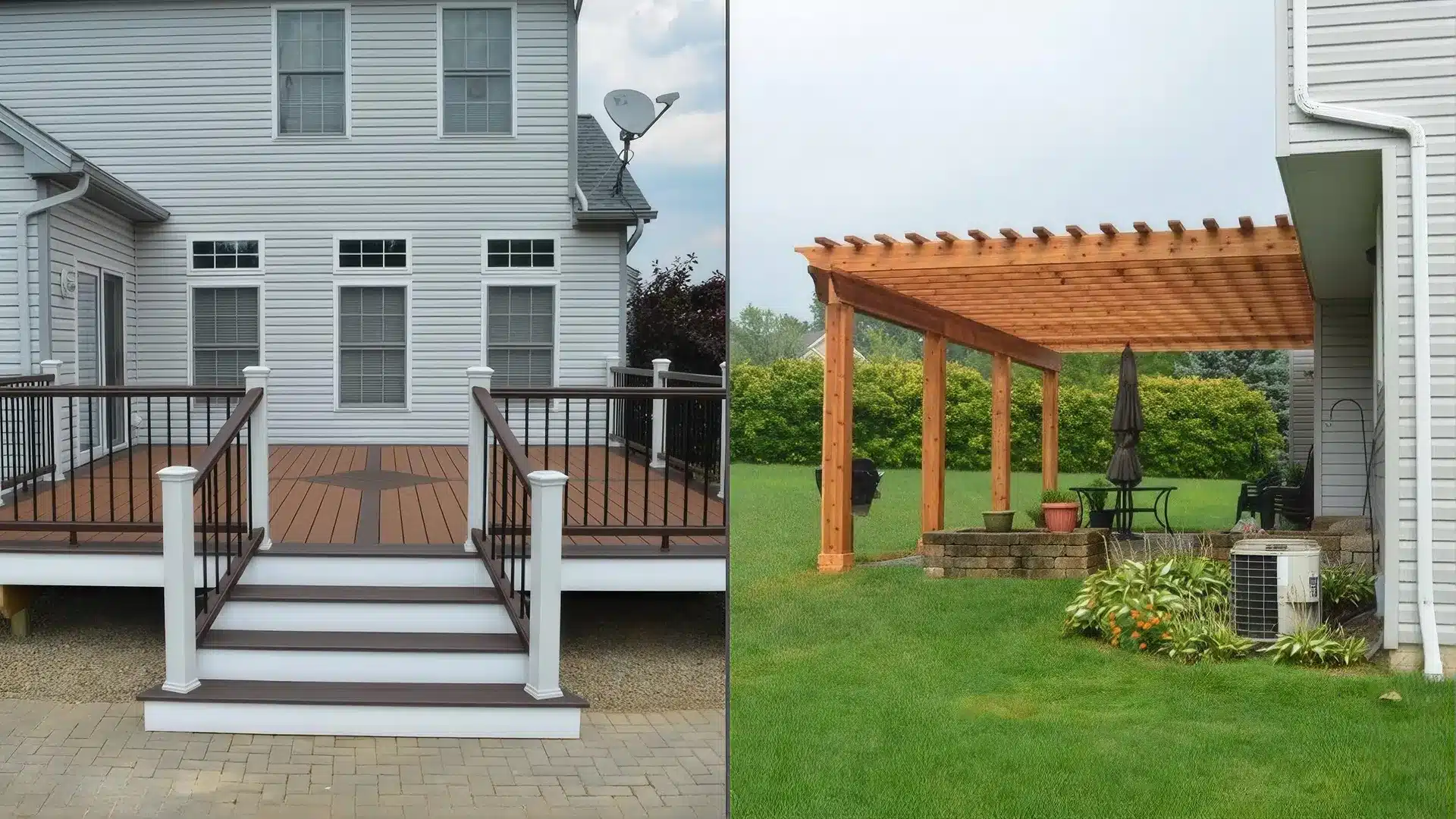
The short answer: it depends on your terrain, not your budget. A sloped or clayey terrain pushes toward patio on pilings; a flat, well-drained terrain is well suited to a ground-level patio.
It's often the opposite reflex that we see: people choose based on price, then adapt to the terrain. That's the mistake that leads to patios that shift, sink or crack after a few winters.
At Solutions Rénovation Québec (RBQ license 5811-7821-01), we've been building patios in the Desjardins sector and the greater Lévis area for years, always starting from the terrain. In this article, we compare the two options to help you make the right choice.
Why is choosing the type of patio crucial in Desjardins?
The type of patio isn't just a question of appearance or cost. It's first and foremost a question of compatibility with your soil and your drainage. A patio well adapted to the terrain lasts for decades; a poorly adapted patio becomes a recurring problem.
In our climate, where the ground freezes and thaws dozens of times each winter, this compatibility is even more decisive. It's what decides whether your patio stays level or starts to tilt.
That's why we always insist on analyzing the terrain before any decision. It's the step that avoids unpleasant surprises.
The realities of residential terrains in the Desjardins sector
The terrains in the Desjardins sector, as elsewhere in Lévis, are varied. You find clayey soils, slopes of varying steepness and backyards where water tends to accumulate.
These realities directly influence the choice of patio. A clayey soil retains water and moves more with freeze-thaw. A slope complicates the installation of a ground-level patio. Poor drainage management, and it's water that dictates the lifespan of your structure.
The consequences of a poor choice of structure
When the patio isn't adapted to the terrain, the problems eventually surface. The problem : a patio poorly adapted to the soil and drainage. The risk : sinking, movement, cracks and instability over the seasons.
Our solution : a prior analysis of the site — soil, slope, drainage — before recommending anything. The proof : it's this terrain methodology, combined with RBQ compliance, that we apply to every project. A patio that tilts after two winters is almost always a patio whose terrain wasn't evaluated from the start.
Have your terrain evaluated before building
Before choosing between pilings and ground-level, know what your terrain allows. Request a consultation with Solutions Rénovation Québec — we evaluate your soil and your drainage, and we guide you toward the right option.
What is a patio on pilings?
A patio on pilings is a raised structure, supported by posts anchored deep in the ground — most often screw piles. The patio doesn't rest on the ground, it is carried above it.
This approach changes everything in terms of stability, especially in our climate. Let's see how it works.
How it works and structure
The principle is simple: steel piles are screwed deep into the ground, and the patio structure rests on them. The deep anchoring ensures stability, regardless of what happens at the surface.
That's what allows a patio on pilings to stay level even when the ground freezes, thaws and moves around it. The structure is tied to a stable anchoring point, below the zone of movement.
The importance of the frost line in Quebec
This is where it all plays out. The frost line — the depth at which the ground freezes — is generally around 1.2 to 1.5 m in our region (order of magnitude to be confirmed depending on the terrain and local standards).
The piles must go below this line, into the soil that doesn't freeze and remains stable. An anchoring that stops above it would suffer frost heave, which pushes the structure upward. Respecting this depth, in accordance with the Construction Code, is what guarantees winter stability.
The advantages of a patio on pilings
The big advantage is adaptability to the terrain. A patio on pilings can be installed on a slope or a clayey soil where a ground-level patio would be problematic. It doesn't depend on flat terrain.
It also offers better drainage : water circulates freely under the structure instead of accumulating. And depending on the configuration, it can open up a beautiful view and create a pleasant raised space.
In terms of durability, deep anchoring translates into increased longevity. Well designed, a patio on pilings goes through winters without moving, where a poorly anchored structure becomes unstable.
The limits to consider
Let's be honest about the constraints. A patio on pilings generally costs more than a ground-level patio, due to the anchoring work and the raised structure.
It also more often requires a permit, and as soon as it's raised, guardrails become mandatory for safety. These are elements to plan for from the design stage, both for the budget and for compliance.
Get an estimate for a patio on pilings
Curious to know what a patio on pilings would represent at your place? Request a quote from Solutions Rénovation Québec — detailed and transparent, according to your terrain.
What is a ground-level patio?
A ground-level patio, as its name suggests, rests directly on the ground — often on a base of compacted gravel, slabs or pavers. No raised structure, no deep posts.
It is the most economical and fastest option, provided the terrain is suitable. Let's see when it's the right choice.
How does a ground-level patio work?
A ground-level patio rests on a well-prepared base: the ground is excavated, a gravel foundation is installed, compacted, then the chosen surface is laid. The quality of this base determines the lifespan of the patio.
Everything depends on soil preparation and water management. A poorly compacted base or neglected drainage, and the patio will move with freeze-thaw cycles.
Ideal conditions for a durable installation
A ground-level patio performs best on flat terrain, with effective drainage and a well-compacted base. These three conditions combined make for a durable, worry-free patio. If the terrain is sloped, clay-heavy or poorly drained, a ground-level patio becomes risky — that's where pilings gain the advantage.
The advantages of a ground-level patio
The first advantage is the reduced budget. Without a raised structure or deep posts, the cost is generally lower than a patio on pilings.
The second is the speed of installation. On suitable terrain, a ground-level patio is built faster. Maintenance is also simplified, with no complex structure to monitor.
Finally, regulations are often lighter for a ground-level patio at grade, with no mandatory guardrails. This simplifies the process in many cases.
The risks when drainage is insufficient
The Achilles' heel of a ground-level patio is water. The problem : an accumulation of water under or around the patio, due to inadequate drainage.
The risk : frost heave. Water that accumulates freezes, expands and pushes the patio upward, unevenly. The result is a patio that undulates or becomes unstable. Our solution : a correction of drainage and adequate leveling before installation. The proof : these are the good ground practices applied so that water drains away instead of stagnating.
Full comparison: patio on pilings or ground-level patio?
To decide well, let's compare the two options on the criteria that really matter.
Detailed comparison table
| Criteria | Ground-level patio | Patio on pilings |
| Cost | Lower | Higher |
| Durability | Good (if terrain suitable) | Excellent |
| Drainage | Depends on preparation | Excellent (raised structure) |
| Permit | Often simplified | More often required |
| Frost adaptation | Vulnerable if poorly drained | Excellent (deep anchoring) |
| Maintenance | Simple | Moderate |
| Property value | Good | High |
| Timelines | Fast | Moderate |
Which patio for your type of terrain?
Sloped terrain
On a sloped terrain, a patio on pilings is almost always necessary. It allows you to create a level surface without having to grade the terrain, and it adapts to the elevation change where a ground-level patio would be complicated and costly to level.
Clay-heavy terrain
Clay soils retain water and move a lot with freeze-thaw. The patio on pilings, anchored below the frost line, escapes these surface movements. It is generally the safest choice on this type of soil.
Flat and well-drained terrain
On flat terrain with good drainage, the ground-level patio is often the logical choice: more economical, fast, and just as durable when conditions are good. Why pay for pilings if the terrain doesn't require them?
Which patio according to your budget?
The budget obviously comes into play. As an indication, a ground-level patio often falls within a range of about 4,500 $ to 15,000 $, while a patio on pilings falls more between 5,500 $ and 18,000 $ or more (reasonable estimates that vary according to size, materials and terrain).
That said, the cheapest at the start is not always the most economical in the long term. A ground-level patio poorly suited to difficult terrain will cost dearly in corrections. The right calculation is the cost over the service life, not just the starting price.
Receive a recommendation adapted to your terrain
The right choice depends on your specific situation. Request a consultation with Solutions Rénovation Québec — we evaluate your terrain and recommend the option that holds up at your place.
Standards, permits and requirements to respect in Lévis
Before building, you need to know the rules. A patio often involves permit, safety and structural capacity requirements.
Note: requirements vary according to the project and zoning, and can change. Always validate your situation with the City of Lévis before starting.
When is a permit required?
Several patios require a permit, especially if they are raised, attached to the house or of good size. A patio on pilings falls more often into this category than a small ground-level patio at grade.
A ground-level patio at grade can sometimes be exempted, but it is not guaranteed. The best is to check from the start to avoid a notice of non-compliance after the fact.
Raised patio and guardrails
As soon as a patio is raised, guardrails become a framed safety issue: height, spacing of bars, resistance. These elements must respect the standards to protect occupants. This is a central point for patios on pilings.
Construction Code requirements
The Construction Code governs the solidity of a patio, regardless of type. The structure must support the snow loads of our region and offer sufficient load-bearing capacity.
Occupant safety is at the heart of these requirements. An undersized structure is a real risk under the weight of snow. Designing for real loads is not optional — it is what makes the patio safe and compliant.
Why work with an RBQ contractor?
An RBQ contractor knows these standards and designs your patio so that it is compliant from the start. We operate under RBQ license 5811-7821-01, led by Marco Savoie.
Concretely, this means we manage compliance, we reduce the risks of costly error, and we document the project. This documentation and this compliance protect you — at inspection, with your insurer and at resale.
How does SRQ determine the best type of patio?
Our approach is methodical, because the right choice depends on facts, not impressions. Here is how we proceed.
Each step aims to deliver a patio adapted to your terrain, compliant and durable.
Step 1 – Analysis of terrain and drainage
Everything starts with the terrain. We evaluate the type of soil, the slope, and especially the drainage. It is this analysis that determines whether your terrain calls for a ground-level patio or one on pilings.
We don't guess: we observe the real conditions. This is the step that avoids 90 % of future problems, because it adapts the structure to the reality of the site.
Step 2 – Design and choice of materials
We then design the patio according to the terrain, the snow load and your needs. This is also where we choose the materials.
Treated wood is affordable and warm, but requires maintenance. Composite resists humidity better and requires little maintenance, for a higher initial cost. Aluminum, particularly for guardrails and structures, does not rust and lasts a long time. We recommend what suits your project, your budget and our climate.
Step 3 – Compliant construction and clean finish
Construction is done according to the rules: adequate anchoring, structure sized for the loads, managed drainage. Clean and organized site, from start to finish.
We finish with careful finishing and a complete cleaning. We leave, you enjoy your patio — without damage to pick up after our passage.
Why do homeowners choose SRQ?
When you entrust a structural project, here is what we put on the table:
- RBQ license 5811-7821-01 — a licensed and compliant contractor, led by Marco Savoie.
- 5-year warranty on labor — we stand behind our work over time.
- More than 500 projects completed — concrete experience, not promises.
- Complete project management — from the first call to delivery, we take care of everything.
- Clean and organized site — we respect your property.
- Total cost transparency — the agreed price is the price paid.
These commitments reduce the risk for you. It's what you would look for yourself before entrusting a structure that must hold up under the snow.
Schedule your free evaluation visit
The best way to know which patio suits your land is to have it evaluated. Schedule your free evaluation with SRQ — we come to you, with no obligation.
Myths and realities about patios in Quebec
A few misconceptions circulate. Let's sort out what's true from what's false.
Myth 1 – A ground-level patio is always the cheapest
False in the long term. A ground-level patio costs less upfront, but on difficult terrain — slope, clay, poor drainage — the necessary corrections can end up costing more than well-built pilings from the start.
Myth 2 – Pilings never move
False if the anchoring is poorly done. Piles are only stable if they go below the frost line. A pile that's too short will suffer heaving like any other poorly anchored foundation. It's the depth that creates stability, not the pile itself.
Myth 3 – No permit is required
False in many cases. A raised patio or one of significant size often requires a permit. Assuming otherwise exposes you to a notice of non-compliance. Always check with the City of Lévis.
Myth 4 – All terrain suits both options
False. Sloped or clayey terrain is poorly suited to a ground-level patio, and forcing an unsuitable structure onto it leads to problems. The terrain must guide the choice, not the other way around.
FAQ – Patio on pilings vs ground-level in Desjardins
What is the best choice for sloped terrain?
A patio on pilings, almost always. It allows you to create a level surface without terracing the land and adapts to the elevation change. A ground-level patio on a slope would require costly leveling work and would be more vulnerable.
Do screw piles withstand Quebec frost?
Yes, provided they are anchored below the frost line — generally around 1.2 to 1.5 m in our region. At that depth, the soil doesn't freeze and remains stable, which protects the structure from frost heaving.
Does a ground-level patio require a permit in Lévis?
A ground-level patio at grade level can sometimes be exempt, but it's not guaranteed. As soon as the size or configuration changes things, a permit may be required. Check your specific case with the City of Lévis.
Which option lasts the longest?
A patio on pilings generally offers the best longevity, thanks to its deep anchoring and superior drainage. That said, a well-designed ground-level patio on adequate terrain can also last many years. A well-thought-out system often lasts 15 to 25 years and more (reasonable estimate).
What is the average cost of a patio on pilings?
As a guideline, expect in the order of $5,500 to $18,000 or more depending on size, materials and terrain (reasonable estimate). An accurate quote requires an on-site evaluation, because the terrain greatly influences the anchoring cost.
Is composite preferable to treated wood?
For durability and maintenance, often yes. Composite resists moisture better, doesn't rot and requires little maintenance. Treated wood is more affordable and warmer, but requires regular maintenance in our climate.
Can I build a patio in winter?
It's possible, especially with screw piles that install in frozen ground without waiting for concrete to cure. Snow and ice do, however, complicate access to the site. An evaluation confirms feasibility in your case.
How can drainage problems be avoided?
By evaluating drainage before construction and correcting what needs to be corrected: drainage slope, well-compacted base, surface water management. For a ground-level patio, this is critical; for a patio on pilings, the raised structure helps naturally.
Which patio offers the best resale value?
Both add value when well built. A well-designed patio on pilings, especially on a beautiful lot, can offer superior appeal. What matters is that the patio is compliant, solid and suited to the terrain — a patio that shifts becomes, on the contrary, a nuisance at resale.
Conclusion – Which patio to choose for your property in Desjardins?
In the end, the right choice comes down to your terrain. Sloped or clayey terrain calls for a patio on pilings, anchored below the frost line to remain stable. Flat, well-drained terrain is well suited to a ground-level patio, which is more economical and just as durable under those conditions.
In both cases, drainage and freeze-thaw cycles must guide the decision, not just the budget. Our climate is demanding, and a patio poorly suited to the terrain always ends up showing it.
That's why professional analysis makes all the difference. An RBQ contractor who evaluates the soil, drainage and slope before recommending a structure is what turns a patio project into a lasting investment rather than a source of problems.
Request your personalized quote from Solutions Rénovation Québec or call us at 418-476-1747. We evaluate your property in Desjardins, advise you honestly, and offer you the patio that truly suits your property — with no obligation.