
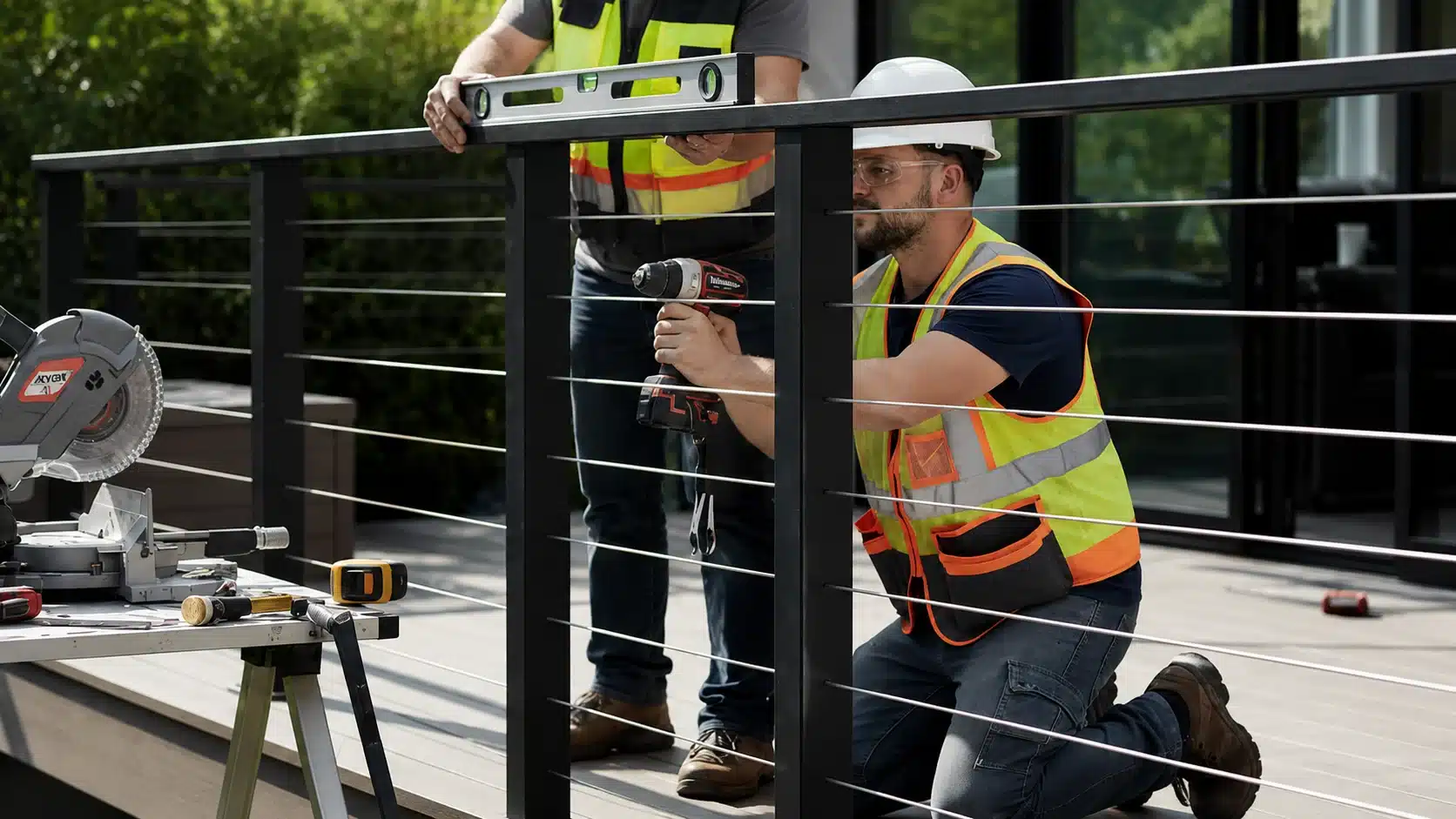
Aluminum railings are gaining ground in Québec, and for good reason. Owners who have had them installed are looking for a solution that stands up to time without requiring special attention from one season to the next. And the question we are regularly asked is this: does it really hold up after a few winters?
It's a good question, especially in an area like Saint-Jean-Chrysostome, where the proximity of the river, snow accumulation and repeated freeze-thaw cycles put outdoor materials to the test year after year. A railing that seems solid in October can tell a different story in April, after three months of frost, salt and humidity.
The short answer: quality aluminum railings , installed correctly, last 20 to 30 years without major maintenance. But there is an important nuance between «aluminum» as a general category and what MC Mel products actually offer in the local climate context. That's what we're going to explain.
Why Quebec winters really test the durability of railings
You can't talk about outdoor railings in Quebec without talking about the climate. It's the number one factor that determines how long an installation will last, and what condition it will be in after 5, 10 or 15 years.
The problem with ordinary materials is that they degrade gradually without it showing in daily use. Corrosion starts in the fasteners. Joints open slightly. Paint chips on anchor zones. And one January morning, the railing moves when you lean on it.
Aluminum generally resists 20 to 30% better against winter corrosion than steel (reasonable estimate based on material performance data in northern climate conditions). But this resistance depends on the quality of the metal, the assembly method, and how the fasteners were chosen and installed.
The specific climate challenges of Saint-Jean-Chrysostome
Saint-Jean-Chrysostome is part of Lévis, and Lévis, means the river. River humidity is constant for much of the year. In winter, it combines with precipitation and freeze cycles to create particularly aggressive conditions for anything exposed outdoors.
Snow accumulates against the railing posts. The salt spread on steps and driveways comes into contact with fasteners and anchor bases. When snow melts during the day and refreezes at night, water seeps into the smallest gaps, and in mechanical fasteners, it causes invisible but cumulative damage.
This phenomenon is particularly visible on painted wood railings and on steel railings without adequate surface treatment. After two or three winters, the deterioration becomes obvious. On quality aluminum railings, this same process plays out differently, and the results after two years of use confirm it.
Common problems observed after a few winters
What we see most often during our inspections of existing railings in the Lévis and Saint-Jean-Chrysostome area is the combination of two problems: corrosion of fasteners, and the gradual weakening of mechanical assemblies.
A fastener that begins to rust loses its load-bearing cross-section. A bolted assembly that has undergone 50 freeze-thaw cycles develops mechanical play that the installer did not anticipate. The risk is an unstable railing, and an unstable railing on an outdoor staircase in winter is a real fall hazard.
On welded aluminum installations with properly sized stainless steel fasteners, the structural failure rate is less than 5% over 10 to 15 years (reasonable estimate based on field experience in outdoor railing installation in Quebec). That's the difference that choosing the right product, installed the right way, makes.
Does your current railing have a few winters behind it and you're no longer sure of its condition? Request a free inspection, we come to evaluate the installation on site and tell you clearly whether it is still safe.
MC Mel Railings: what changes after 2 years of use
MC Mel railings are products manufactured specifically for the Quebec market. This is not generic imported aluminum; it is a system designed to withstand the climate conditions here, with an estimated lifespan of approximately 30 years without paint or major repair.
After two years of use in conditions like those of Saint-Jean-Chrysostome, two full winters with frost, salt, repeated thaws and river humidity, here is what owners observe, and what our teams note during site follow-ups.
What owners notice after two winters
The first observation is the absence of visible corrosion. No rust on the posts, no stains on the handrails, no degradation of the finish at anchor points. The aluminum has done its job; the natural oxide layer that forms on the surface protects the metal without intervention.
The second observation is stability. No movement in the structure, no play in the assemblies. Owners who previously had wood or steel railings often make the comparison: with the old systems, you had to tighten something or patch something every spring. With MC Mel, there is nothing to do.
Cleaning is occasional, a rinse with a garden hose in spring to remove salt and sand residue. That is literally all an MC Mel railing requires as maintenance. Over 10 years, we're talking about zero to one maintenance intervention (reasonable estimate). That's a reality, not a sales pitch.
Difference between premium aluminum and low-end aluminum
Not all aluminum products are created equal, and it's important to understand this before you start shopping. The difference between an MC Mel ramp and an entry-level product can be measured across three dimensions.
The thickness of the metal, first. Thinner aluminum deforms more easily under lateral loads and suffers more wear at stress points. MC Mel products use a metal thickness calibrated for the loads that ramps are subjected to in real-world use.
The welds, next. On MC Mel systems, welds are made at the factory under controlled conditions. The quality of a factory weld is not comparable to a job-site weld — the parameters are controlled, and the result is uniform along the entire length of the ramp.
The anti-corrosion finish, finally. Premium aluminum receives a surface treatment that strengthens the natural protective layer and improves resistance to chemical agents, including de-icing salt. It's this combination of factors that explains the difference in durability between products, not just the brand on the box.
Want to see the available models and understand what suits your staircase or balcony? Contact us for a consultation, we present the options and explain what matches your situation.
RBQ standards for ramps and guardrails in Quebec
A ramp is a safety device. The Quebec Construction Code is clear on this, and the requirements that apply are not optional.
Required height and safety for guardrails
The Quebec Construction Code, overseen by the Régie du bâtiment du Québec, requires that exterior residential guardrails be installed at a height between 36 and 42 inches (approximately 91 to 107 cm) depending on the potential fall height and the installation configuration. The spacing between balusters must not exceed 4 inches (approximately 10 cm) to prevent a child from passing through.
These standards exist for a concrete reason: accidents related to falls on balconies and exterior stairs are a documented reality in Quebec, especially in winter when surfaces are slippery and people rely more heavily on railings.
Why professional installation is essential
A railing may have the right dimensions and be made with the best materials, but if it is not anchored correctly, it does not protect. The anchoring of an exterior railing must be designed to withstand specific lateral and vertical loads, according to the requirements of the Construction Code.
A licensed RBQ contractor knows these requirements. They know how to assess the structure to which the railing will be attached, concrete, treated wood, slab, and choose the appropriate type of anchoring for each situation. They also know how to size the fasteners so that the structure holds under a sudden impact load, not just under a static load.
Risks of non-compliant installation
A poorly anchored railing may seem stable during installation and begin to deteriorate after the first freeze-thaw cycle. Frost expands the water that has infiltrated the anchoring, gradually loosens the fastener, and after two or three winters, the post has play. This process is insidious because it is not always visible from the outside.
From a legal standpoint, an owner whose railing causes an accident because it did not comply with the standards of the Construction Code may find themselves in a situation of civil liability. Home insurance may refuse to cover the loss if the work was not carried out by a licensed contractor. This is not theoretical, it is the type of situation that a professional helps you avoid.
Do you have doubts about the compliance of your current guardrail? Contact us for an on-site verification, we assess the installation and tell you exactly where you stand in relation to the standards.
How much do aluminum railings cost in Quebec?
The budget question always comes up, and that is legitimate. Here is what we observe on the market in the Lévis and Saint-Jean-Chrysostome area.
The budget question is legitimate, and the honest answer is that the options vary enough to adapt to most situations. For standard aluminum railings, prices generally range between, installation included 150 $ and 300 $ per linear meter. For MC Mel systems specifically, expect between 200 $ and 250 $ per linear meter depending on the configuration and finishes chosen.
These prices vary according to several factors: the type of staircase or balcony, the complexity of the installation (angles, landings, custom configurations), and the anchoring requirements depending on the existing structure.
Why aluminum costs more than wood initially
The comparison with wood comes up often. A treated wood railing does indeed cost less to purchase and install initially. But wood requires maintenance: paint or stain every two to three years, replacement of sections that rot, hardware to tighten or replace.
Aluminum costs more to purchase, and after that, practically nothing. No painting, no treatment, no repairs related to corrosion or rot. It is a mathematical reality: the higher initial cost is offset by the absence of recurring expenses over the life of the product.
Real cost over 20 years
Over 20 years, the comparison is clear. A quality aluminum railing requires occasional cleaning and possibly a verification of the anchorings. A wood railing requires, over the same period, several cycles of painting or staining, occasional repairs, and often a partial or complete replacement before the end of the 20 years.
When you add up the labor and material costs for wood maintenance over 20 years, the initial price gap between the two options often reverses in favor of aluminum. This is the economic argument behind choosing a premium product from the start.
Do you want a precise figure for your project? Request a personalized estimate, we come to measure your configuration on site and provide you with a detailed quote with no obligation.
Why choose Solutions Rénovation Québec for your railings
We have been installing railings in the Lévis and Saint-Jean-Chrysostome area for more than 10 years. We know the local climate conditions, the types of structures found in homes here, and the products that truly last over time.
Certified residential contractor
Solutions Rénovation Québec holds the RBQ license 5811-7821-01. All our installations are carried out in accordance with the Quebec Construction Code, regulatory height, baluster spacing, structural anchorings. Our license is verifiable directly on the Régie du bâtiment du Québec website, and we encourage you to do so.
Our clients give us an average rating of 4.9 out of 5. It is not because we promise a lot, it is because we deliver what we promise, every time.
Expertise in exterior railing installation in Quebec
We work with MC Mel products because they are what best meets the conditions here. Welded aluminum, anti-corrosion finish, non-slip surfaces on the handrails, stainless steel anchorings, it is a complete system that was designed for Quebec, not adapted after the fact.
With over 500 projects completed in the region, including exterior stairs, balconies, terraces and patios, we have experience with the varied configurations found in bungalows, single-family homes and properties 25 years and older in the Lévis area.
SRQ Process
Here is how each railing project unfolds with us:
- Site inspection: we assess the existing structure, the possible anchorings, and the configuration requirements
- Transparent quote: detailed pricing, no surprises
- Manufacturing and installation: MC Mel products, stainless steel anchors, installation compliant with RBQ standards
- Final inspection: we check stability, height and compliance before leaving the site
Guarantee for 5 years on labor on all our installations. If something goes wrong within 5 years, we come back.
Ready to install ramps that will last? Request a free quote or call us at 418-476-1747, Monday to Friday, 8 a.m. to 5 p.m.
FAQ: Aluminum ramps in Quebec
Do aluminum railings rust in Quebec?
No. Aluminum does not rust; it is a fundamental chemical property of the metal. It develops a thin layer of alumina on its surface that naturally protects it from corrosion, without any treatment. This protection regenerates itself if the surface is scratched. This is one of the main reasons why aluminum is the material best suited to outdoor installations in the Quebec climate, where salt, humidity and freeze-thaw cycles accelerate the degradation of other metals.
How long do MC Mel railings last?
MC Mel welded aluminum railings have an estimated lifespan of approximately 30 years without major maintenance (reasonable estimate). This longevity is the result of the combination of the quality of the metal, factory welds and the anti-corrosion finish. In the climatic conditions of Saint-Jean-Chrysostome and the Lévis region, installations that are 15 years old are still in perfect structural and aesthetic condition.
Are aluminum railings really maintenance-free?
Practically, yes, with one nuance. Aluminum requires no paint, no stain, no anti-corrosion treatment. An occasional rinse in the spring to remove salt and sand residue is recommended, and an annual visual check of the anchors is a good habit. But we are talking about zero to one maintenance intervention per decade (reasonable estimate), not a regular maintenance program like with wood or painted steel.
What railing height is required in Quebec?
The Quebec Construction Code, under the supervision of the Régie du bâtiment du Québec, requires a height of 36 to 42 inches (approximately 91 to 107 cm) for exterior residential railings, depending on the potential fall height and the configuration of the installation. The spacing between balusters must not exceed 4 inches (10 cm). These standards are verified during every installation we carry out.
How much does an aluminum railing cost in Lévis?
In the Lévis and Saint-Jean-Chrysostome region, aluminum railings generally range between For standard aluminum railings, prices generally range between, installation included (reasonable estimate for 2025-2026). MC Mel systems range between 200 $ and 250 $ per linear meter depending on the configuration. These prices vary according to the complexity of the installation, the type of existing structure and the finishes chosen. An on-site quote will give you a precise figure for your project.
Can an aluminum railing be installed on an existing balcony?
In the vast majority of cases, yes. During the inspection, we assess whether the balcony structure is able to receive the required anchors, concrete, treated wood joists, or other. If the existing structure is sound, an MC Mel railing can be installed without touching the rest of the balcony. If structural problems are detected during the inspection, we inform you before starting anything.
Are aluminum railings safe in winter?
Yes, and they are particularly safe when they incorporate anti-slip surfaces on the handrails, as is the case with MC Mel systems. Aluminum does not become slippery with frost in the same way as certain painted metals or aged wood. Stainless steel anchors maintain their rigidity even after repeated freeze-thaw cycles. This is one of the concrete advantages of these products in a climatic context like that of Saint-Jean-Chrysostome.
Do you need an RBQ contractor to install a railing?
Yes, as soon as the anchors touch the building structure, which is the case for practically all outdoor installations on stairs, residential balconies and terraces. A licensed RBQ contractor ensures that the installation complies with the Construction Code, that the anchors are correctly sized, and that the height and spacing of the balusters are compliant. Without a license, you have no recourse in the event of a problem, and your home insurance may refuse a claim related to a non-compliant installation.
Solutions Rénovation Québec (SRQ), RBQ-certified general contractor RBQ license: 5811-7821-01 2552 chemin du Fleuve, Lévis, Québec, G6W 1Y3 Tel.: 418-476-1747 | renovationsolutionsquebec.ca Areas served : Lévis, Quebec, Beauce, Chaudière-Appalaches, Centre-du-Québec, Mauricie, Estrie