
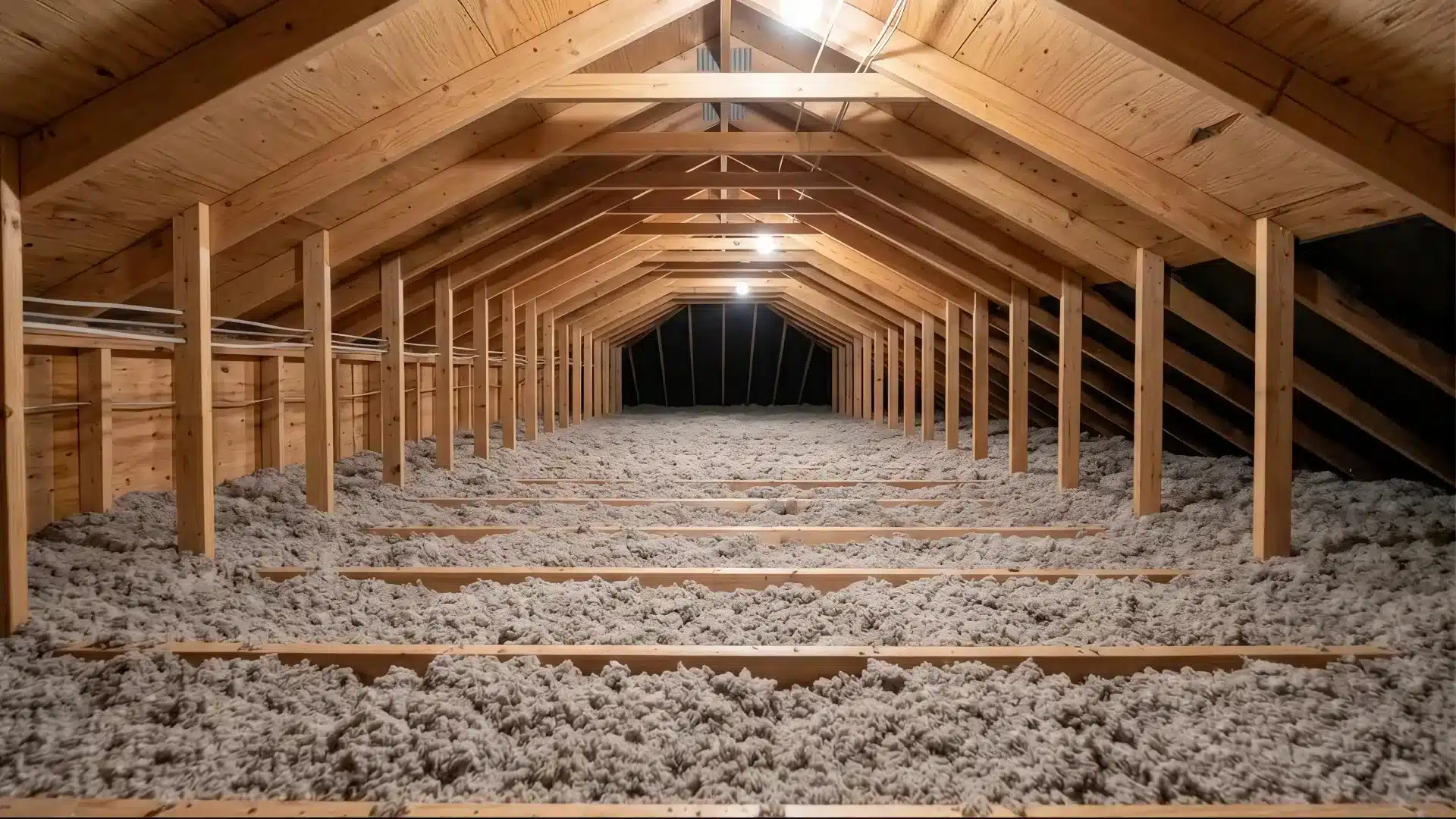
You heat, you heat, and yet some rooms stay cold, the floors are freezing and the energy bill climbs. You wonder if your insulation is the cause. The short answer: yes, an insulation settled or degraded insulation is a frequent cause of cold and heat loss — but it is not always the only one.
Insulation that has sagged over the years loses its effectiveness, because it is the air trapped in the material that insulates. When it settles, it lets the cold through. But before replacing everything, the diagnosis must be confirmed: sometimes the problem comes rather from air tightness, ventilation or humidity.
In Saint-Jean-Chrysostome, in the Lévis area, our harsh winters do not forgive deficient insulation. At Solutions Rénovation Québec (RBQ licence 5811-7821-01), we assess and improve the insulation of local homes. In this article, we help you understand whether your insulation is really the cause and what to do.
Can settled insulation really cause heat loss?
The answer is yes, and the principle is simple to understand. Insulation does not block the cold by magic — it works thanks to the still air it traps. It is this air that slows the passage of heat.
When insulation settles, compresses or degrades, it loses this trapped air. Its insulating value — its thermal resistance, or R-value — decreases accordingly. Wool that has sagged by half no longer insulates as it did on the first day, far from it.
The result is felt daily: heat loss, cold zones, a home that is harder to heat. But be careful not to blame insulation too quickly. Other factors — air leaks, thermal bridges, ventilation — can cause the same symptoms. Hence the importance of a good diagnosis before acting.
How insulation loses its effectiveness
Insulation degrades in several ways. Settling is the most common: over time, some materials sag under their own weight or under the effect of vibrations. Compression also reduces thickness where the insulation is crushed.
Add to this moisture damage — wet insulation loses its insulating power and can become contaminated — as well as aging of the material and intrusions by animals or insects that displace and compress the insulation. Each of these phenomena reduces the real R-value of your insulation, sometimes well below what it should be.
The signs that reveal deficient insulation
Several clues point to an insulation problem. Cold rooms or temperature differences from one room to another, cold floors, drafts, and a high heating bill are frequent signals.
Winter reveals other clues: ice dams on the roof (a sign of heat escaping through the roof), condensation, or frost patches. An attic or crawlspace whose insulation appears visibly sagged and thin is a direct sign. If you have several of these symptoms, your insulation deserves an assessment.
Are your rooms cold despite the heating?
Persistent cold despite good heating is not normal. Have your insulation assessed by Solutions Rénovation Québec — we confirm whether it is the cause before undertaking any work.
Why does insulation degrade over time in Lévis?
Insulation does not last forever, especially in our climate. In Saint-Jean-Chrysostome and in Lévis, a few factors accelerate its degradation. Here they are.
The effect of the Quebec climate
Our climate is demanding on a home's envelope. The marked temperature differences between the heated interior and the freezing exterior, combined with freeze-thaw cycles, create difficult conditions.
These variations encourage air movement and moisture migration within the assemblies. Insulation subjected to these cycles season after season can degrade faster than elsewhere. Our climate stresses the building envelope intensely — insulation bears the cost over time.
The role of humidity and condensation
Humidity is the enemy of insulation. When indoor humidity migrates to cold zones and condenses there, it wets the insulation. Wet insulation loses its effectiveness and can encourage mould.
Why condensation worsens settling
Condensation creates a vicious circle. Wet insulation becomes heavier, which accentuates settling; settled insulation insulates less, which cools surfaces further; these cold surfaces encourage more condensation. And so on. Poor management of humidity and ventilation, or an inadequate vapour barrier, feeds this cycle. This is why addressing humidity is often part of the solution — not just replacing the insulation.
Houses built before 1990
The older homes are particularly affected. Built according to less demanding insulation standards than today's, they often have aging, settled, or simply insufficient insulation by current standards.
Deficient air tightness is frequently added to the problem. In Lévis's housing stock, rich in homes from that era, these issues are common. The good news is that improving the insulation of these homes often provides an appreciable gain in comfort and efficiency.
Every home loses its heat differently
Two neighbouring homes can have very different weaknesses. Request a diagnosis from Solutions Rénovation Québec — we identify where your home loses its heat before proposing a solution.
Is it really the insulation… or another problem?
Here is a point too many people skip: the cold does not always come from the insulation itself. Sometimes adding insulation will fix nothing, because the real problem is elsewhere. Making the right diagnosis avoids unnecessary work.
Air leaks and airtightness
A house can be well insulated and still cold if it is not airtight. The air leaks — around windows, doors, electrical outlets, duct penetrations, the attic access hatch — let cold air in and heat escape.
Airtightness is as important as insulation, sometimes more. A small air leak can cancel out the effect of good insulation. That is why both are always considered: improving airtightness is often the most cost-effective intervention, even before adding insulation.
Thermal bridges
Thermal bridges are areas where heat passes more easily through the building envelope — often at structural elements, junctions, or poorly insulated areas. They are «highways» for the cold.
These weak points create localized cold surfaces, heat loss, and sometimes condensation. Adding insulation elsewhere does not necessarily correct them. Identifying the thermal bridges is part of a good assessment, because they can explain cold spots even in an insulated house.
Why a diagnosis is essential before replacing insulation
All of this leads to a clear principle: diagnose before replacing. Replacing insulation when the real problem is an air leak or a thermal bridge means spending without solving the cold.
An assessment makes it possible to distinguish what falls under insulation, air sealing, ventilation or humidity — and therefore to target the right intervention. This is what avoids unnecessary work and guarantees that your money actually solves the problem. The diagnosis is what transforms an expense into a profitable investment.
Should you replace or add insulation?
Once the diagnosis is done, the question becomes: add, replace, or improve air sealing? The answer depends on the condition of the existing insulation. Let's look at the cases.
When adding insulation is enough
In some cases, you can simply add insulation over the existing layer. This is possible when the insulation in place is dry, sound and clean, but simply insufficient in thickness.
Blowing additional insulation into the attic, for example, is a common and effective intervention when the existing insulation is in good condition but too thin. This increases the R-value without removing everything. It is often the most economical option — provided the existing insulation is truly sound.
When a full replacement is recommended
In other cases, adding is not enough — you need to remove and replace. This is the case when the insulation is wet, contaminated by mold, heavily compacted, or damaged by animals.
Adding insulation over wet or moldy insulation would only trap the problem. The affected insulation is then removed, the cause is corrected (humidity, intrusion), and then the area is properly re-insulated. It is more work, but it is the only real solution when the existing insulation is compromised. An assessment determines which case you are in.
Choosing materials: blown-in wool, rock wool, urethane
The choice of material depends on the application and the objectives. Blown-in wool (cellulose or fiberglass) is well suited to attics and allows large areas to be covered efficiently. Rock wool offers good thermal resistance, excellent fire performance and good moisture tolerance — a popular choice in several applications.
Sprayed urethane (foam) offers both a high R-value and air sealing in a single product, making it a high-performance solution for certain areas, although at a higher cost. Each material has its strengths depending on the location and budget. We recommend the right product for the right application, rather than a one-size-fits-all solution. The best choice depends on your house, the area to be insulated and your efficiency objectives.
A good diagnosis avoids unnecessary expenses
Add or replace: the right choice depends on the actual condition. Request an assessment from Solutions Rénovation Québec — we recommend the intervention that truly solves the problem.
How much does improving insulation cost in Saint-Jean-Chrysostome?
The cost depends on the area to be insulated, the material and the scope of the work. Here are some benchmarks, to be taken as orders of magnitude (indicative estimates that vary by case, and not guaranteed rates).
Adding insulation in the attic
Blowing additional insulation into the attic is often the most economical intervention. Generally expect in the order of $1,500 to $4,500 (indicative estimate), depending on the surface area and the thickness added.
Full re-insulation
A more complete re-insulation — removal of compromised insulation, correction of the cause, re-insulation, air sealing improvements — falls more in a range of the order of $5,000 to $15,000 and more (indicative estimate), depending on the areas affected and the materials.
Return on investment
Insulation is one of the renovations with the best return, because it pays back every year. Improved insulation reduces heat loss, therefore heating bills, and improves daily comfort — fewer cold spots, fewer drafts.
In the long term, these energy savings offset part of the cost of the work, in addition to increasing the value of the house. It is an investment that works for you season after season, unlike a purely aesthetic renovation.
Grants available in Quebec
Good news: assistance programs exist for energy efficiency work, including insulation. Programs like Rénoclimat and other initiatives can support eligible work and reduce your net cost.
Important: programs, their criteria and their amounts change, so always verify current eligibility with the organizations concerned before planning. Combining an insulation improvement with a grant can make the project significantly more affordable. It is worth checking before you start.
Why entrust your insulation work to an RBQ contractor in Lévis?
Insulation affects comfort, energy efficiency and the health of the building. The choice of contractor makes the difference between a real gain and a poorly targeted expense.
An approach based on diagnosis
Our priority is to find the real cause of the cold before acting. We assess the insulation, air sealing, thermal bridges, ventilation and humidity. We then propose the intervention that solves the problem, not a generic solution.
This approach avoids spending in the wrong place. Sometimes, improving air sealing costs less and solves more than adding insulation. A good diagnosis is what guarantees that your investment bears fruit.
Expertise adapted to the Québec climate
Our climate imposes its requirements: moisture management, vapour barrier, ventilation, in addition to insulation itself. We design our interventions taking these realities into account, to avoid condensation and mold problems.
Insulation installed without managing humidity can create more problems than it solves. We know these challenges specific to our winters and we work accordingly, for a durable and healthy solution.
Our commitments
We operate under RBQ license 5811-7821-01, led by Marco Savoie, with more than 500 projects completed, more than 10 years of combined experience and a 5-year warranty on labor. We focus on a free estimate, transparent pricing and a clean worksite. These commitments protect you and ensure work done by the rules.
Have a more comfortable winter and reduce your bills
Better comfort and reduced bills start with a diagnosis. Request a free, no-obligation estimate from Solutions Rénovation Québec — for a warmer and more efficient home.
Myths and realities about insulation
A few preconceived ideas deserve to be corrected. Here is the truth from the fiction.
«More insulation is always better.»
Reality: adding insulation only helps if insulation is the real problem. If the cold comes from air leaks or thermal bridges, more insulation won't fix much. Diagnosis comes before quantity.
« My insulation is fine, it's been there forever. »
Reality: old insulation can be compacted, damp or insufficient by current standards. The fact that it has been in place for a long time does not mean it still performs. It deserves to be evaluated.
« Insulation doesn't degrade. »
Reality: it settles, compresses, absorbs moisture and ages. Its actual performance can be well below its original value after years. It is a material that changes with time and conditions.
« It's just a matter of comfort, not money. »
Reality: deficient insulation drives up heating bills every winter. Improving it is an investment that reduces costs year after year — it's not just a matter of comfort.
FAQ – Compacted insulation in Saint-Jean-Chrysostome
How do I know if my insulation is compacted?
The signs: cold rooms, freezing floors, a high heating bill, ice dams in winter. In the attic, visibly sagging and thin insulation is a direct sign. A professional evaluation confirms the actual thickness and performance of your insulation.
Is compacted insulation really the cause of my cold?
Often, yes, but not always. The cold can also come from air leaks, thermal bridges or a ventilation problem. That's why a diagnosis is essential before replacing the insulation: it allows you to target the real cause and avoid unnecessary work.
Is it better to add or replace the insulation?
It depends on the condition of the existing insulation. If the insulation is dry, sound but insufficient, you can often add more on top. If it is damp, moldy, heavily compacted or damaged, it must be removed and replaced. An evaluation determines the right option.
Which insulation is best for the climate in Lévis?
It depends on the area and the goals. Blown-in wool works well for attics, rock wool offers good thermal and fire performance, and sprayed urethane combines high R-value and airtightness. Each material has its strengths — the right choice depends on your home and your budget.
Can moisture damage insulation?
Yes, a lot. Damp insulation loses its effectiveness, compacts further and can promote mold. That's why moisture and ventilation must be managed at the same time as the insulation. Adding insulation over a damp area without fixing the cause only makes things worse.
How much does improving insulation cost?
As a guideline, adding insulation in the attic can range between $1,500 and $4,500, and a complete re-insulation between $5,000 and $15,000 and more (indicative estimates, not guaranteed). The cost depends on the areas, materials and scope. An evaluation gives a fair price.
Are there subsidies for insulation in Quebec?
Yes, programs like Rénoclimat and other energy efficiency initiatives can support eligible insulation work. Criteria and amounts change, so check current eligibility with the organizations concerned. A subsidy can significantly reduce the net cost of your work.
Is an RBQ contractor necessary for this work?
For effective and durable insulation, expertise makes the difference. A RBQ contractor diagnoses the real cause of the cold, manages moisture and ventilation, and installs the insulation by the rules. This avoids problems with condensation and ensures that the work actually solves the problem.
A cold house can be fixed — but it starts with the right diagnosis
In the end, compacted insulation is indeed a frequent cause of cold and heat loss in Saint-Jean-Chrysostome. Insulation that has sagged over the years no longer insulates like it did on the first day, and it shows in both comfort and the bill.
But insulation is not always the only culprit. Air leaks, thermal bridges and ventilation or moisture problems can cause the same symptoms. That's why diagnosis always comes before the work: it allows you to target the real cause and avoid spending in the wrong place.
And when you aim right, insulation is one of the best possible investments: it improves comfort right away and reduces heating bills every winter, year after year. With the subsidies available for energy efficiency, it's often the right time to act. In our Lévis winters, a well-insulated and well-sealed house makes all the difference.
Are you cold despite the heating in Saint-Jean-Chrysostome or Lévis?
Request a free, no-obligation estimate from Solutions Rénovation Québec or call us at 418-476-1747. We evaluate your insulation, your airtightness and your heat loss, and we offer you the solution that will make your home warmer and more efficient — in accordance with the rules of the RBQ, with no obligation.