
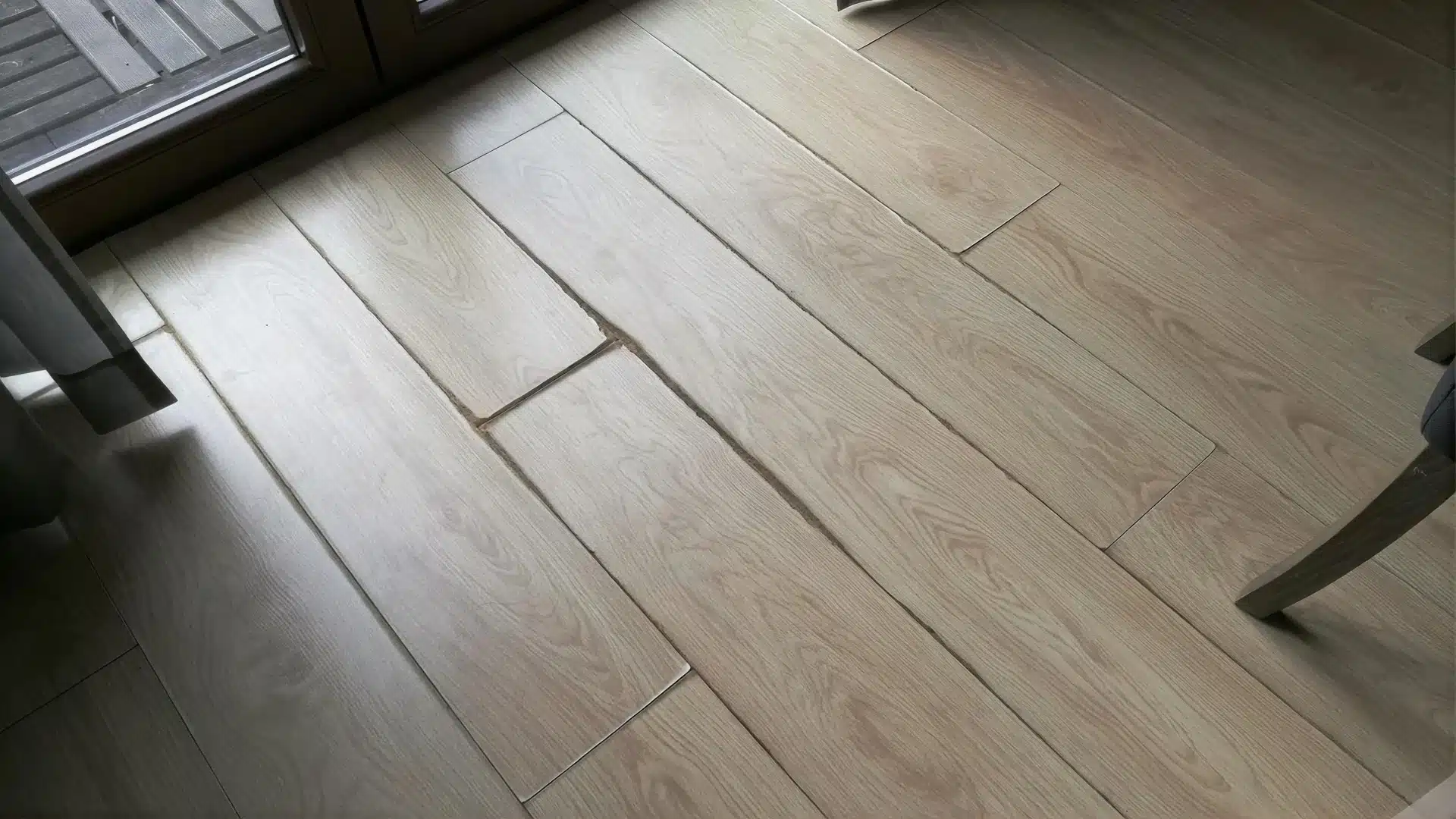
You had a beautiful new floor installed, and now after a few months, it's buckling. Bumps, joints opening up, planks lifting. It's frustrating, and it's legitimate to wonder: is this normal, and above all, what are my options?
In Saint-Jean-Chrysostome, in the Lévis area, the region's humidity often plays a role in this kind of problem. The good news is that you have options — but they rest on one thing: proper documentation and proper diagnosis.
At Solutions Rénovation Québec (RBQ license 5811-7821-01), we install floors suited to our climate and we understand what causes these deformations. In this article, we explain your options and how to protect your investment.
Note: we are contractors, not lawyers. This article presents information in a general way; for legal advice on your situation, consult the relevant organizations or a legal professional.
Is a floor that buckles after 6 months normal?
Let's be clear: no, it's generally not normal. A properly installed floor, with the right materials and good preparation, should not buckle after only six months. It's a sign that there's a problem somewhere.
However, we need to nuance this. All floors «move» a little — wood and certain materials react to variations in humidity and temperature, with slight seasonal movements. That's normal and subtle.
Buckling is different. It involves visible and persistent deformations: bumps, planks lifting, joints spreading apart. It's not a natural movement, it's a defect to be understood.
Hence the importance of acting quickly. The sooner you document, the easier it is to protect your options and prevent the problem from getting worse. Waiting never works in your favor.
The symptoms that indicate a real problem
Some signs don't lie. Bumps or ripples in the floor, joints opening between planks, visible lifting, pronounced creaking when walking: these are symptoms of a real problem.
These signs can appear on different types of floors — floating, hardwood, vinyl, laminate — and each reacts somewhat differently. But in all cases, pronounced buckling after a few months indicates that something went wrong, often on the humidity or installation side.
The risks if the problem is ignored
Ignoring a floor that's buckling means letting the problem get worse. The deformation worsens, and the water or humidity responsible continues its work.
This can lead to wider infiltration, mold development under the floor, and deterioration of the subfloor itself. A surface problem then becomes a more costly structural problem. Acting early limits the damage — and the bill.
The most common mistakes made by homeowners
When facing a floor that's buckling, certain reactions harm your options. The first mistake is waiting and hoping it will settle back — it generally doesn't settle back, and the delay can weaken your claim.
The second is attempting a DIY repair before any expert assessment, which can erase evidence of the problem. The third is removing the floor without documentation or proof, which deprives you of the elements needed to support a claim. Before acting, document.
The sooner the problem is documented, the easier it is to protect your options and your investment.
Documentation is your best protection. Have your floor inspected by Solutions Rénovation Québec — a clear diagnosis helps you understand the cause and support your efforts.
Why does a floor buckle in Saint-Jean-Chrysostome?
Understanding the cause is essential, both for the repair and for your options. In Saint-Jean-Chrysostome, several factors can be at play, and humidity often comes first.
The humidity specific to the Lévis area
The Lévis region, with its proximity to the Saint Lawrence River, experiences high humidity and marked seasonal variations. Relative humidity rises and falls with the seasons, and floors react to it.
A floor installed without accounting for this humidity can absorb water, swell and deform. It's an important regional factor: what would work in a dry climate can cause problems here. The humidity of our area must be taken into account from the moment of installation.
Problems related to the subfloor
Often, the real cause is hidden beneath the visible floor. A damp subfloor transmits its humidity to the covering, which swells. A poorly leveled subfloor creates tensions that deform the planks.
The absence of an appropriate vapor barrier or insufficient ventilation can also let humidity accumulate. The floor you see buckling is sometimes only the symptom of a deeper problem at the support level. That's why you need to look underneath.
The role of freeze-thaw
Our freeze-thaw cycles add another factor. They promote infiltration and structural movements, and can transmit humidity from the foundation to the floors, especially on the ground floor above a basement or a damp crawl space. The foundation's humidity then rises and affects the covering. It's an indirect but real mechanism in our climate.
Installation errors
Sometimes, the cause is the installation itself. Three errors come up often: the absence or insufficiency of expansion joints (the floor has no room to move and lifts), a lack of acclimation of materials before installation (they adjust afterward, once installed), and inadequate preparation of the support. These installation errors are a frequent cause of buckling — and they directly affect the question of responsibility.
Before replacing your floor, identify the true cause to avoid the problem coming back.
Replacing without diagnosing is risking having to start over. Request a diagnosis from Solutions Rénovation Québec — we find the real cause before proposing a solution.
Who is responsible: the manufacturer or the contractor?
This is the question that determines your recourse. The answer depends on the cause of the problem — and sometimes, responsibility is shared. Let's see how it works.
The applicable warranties
Several warranties may apply to your situation. First, there is the legal warranty, provided by law, which protects against defects and flaws. Then there is the contractual warranty, the one your contractor or the manufacturer offers according to the contract.
These warranties cover different things: the manufacturer's warranty generally covers materials, while the contractor's covers the installation. Understanding which one applies depends on the cause of the buckling — defective material or faulty installation.
What the regulations provide
In Quebec, the framework includes the Building Act and the obligations related to the RBQ license, as well as the contractor's contractual obligations. A contractor has a responsibility regarding the quality and conformity of their work. The specific details of your rights depend on your contract and your situation — this is a point to validate with the competent organizations, such as the Office de la protection du consommateur or the RBQ.
When responsibility is shared
Often, reality is nuanced. The manufacturer may be at fault if the material was defective; the installer, if the installation did not comply with the rules of the art or if the moisture of the substrate was not verified before installation.
And sometimes, it is the humidity of the house — independent of both — that is at fault. This is precisely why an independent expertise is useful: it objectively determines the cause, which makes it possible to establish who is responsible for what. Without this diagnosis, responsibility remains unclear.
When to call on an inspector
An independent inspector or expert becomes valuable when the cause is not obvious or a dispute is taking shape. He produces an objective report: moisture measurements, condition of the subfloor, analysis of causes, verification of the conformity of the installation.
This report constitutes solid proof to support your steps, whether it is a claim with the contractor, the manufacturer, or a more formal recourse. It is often the element that makes the difference in a file.
What recourses do you have?
Let's get to the concrete. If your floor is buckling, here is the procedure to follow to assert your rights, step by step.
Step 1: Document the problem
Everything starts with documentation. Take photos and videos of the buckling, gather your invoices, your contract and any communication related to the work. The more complete your file is, the stronger your position is. Do it as soon as you notice the problem.
Step 2: Written notice to the contractor
Then, communicate in writing with your contractor to report the problem. A written notice — letter or email — clearly describing the defect and dated is important. It establishes that you reported the problem within a reasonable time.
Keep a factual tone: describe what you observe, when it appeared, and request an intervention. Most serious contractors will want to resolve the situation. It is often at this step that it gets resolved, without conflict.
Why keep all communications
Keep every exchange — emails, letters, messages, call notes. These communications constitute valuable proof if the file moves toward mediation or a claim. They show your good faith, the deadlines, and what was agreed or not. A well-kept file is worth gold in a dispute.
Step 3: Have an expertise carried out
If the problem is not resolved amicably, an independent expertise is required. The expert measures the moisture, examines the subfloor, determines the causes and verifies the conformity of the installation.
This objective report is decisive: it establishes where the problem comes from, and therefore who is responsible for it. It is the key piece to support a recourse, because it replaces assumptions with facts.
Step 4: The possible recourses
If dialogue fails, several recourses exist. The RBQ may be concerned for questions related to the license and the obligations of the contractor. The Office de la protection du consommateur informs on your rights and the steps. Mediation sometimes allows settling without going further. And as a last resort, the court — including the small claims division for eligible amounts.
Each path has its conditions and its deadlines. This is where a notice to the competent organizations, or to a legal professional, helps you choose the right approach for your situation.
An independent expertise can often settle a dispute before it becomes a legal conflict.
An objective report often changes the situation. Discuss your situation with Solutions Rénovation Québec — we help you understand the cause to guide your steps.
How much does the repair cost?
The question of cost depends on the cause and the extent of the problem. Here are benchmarks, to be taken as orders of magnitude (reasonable estimates that vary depending on the case).
Localized repair
If only part of the floor is affected and the cause is resolved, a localized repair is often around 8 $ to 25 $ per square foot (reasonable estimate), depending on the material and access.
Complete replacement
If the buckling is generalized or the substrate is affected, a replacement complete can be between 5,000 $ and 15,000 $ (reasonable estimate), depending on the surface area and the type of floor.
Why the source must be corrected
Regardless of the option, the source must first be corrected — the moisture, the subfloor, the installation. Repairing or replacing without resolving the cause is guaranteeing a recurrence: the new floor will buckle in turn. Correcting the cause is not optional.
Why a temporary repair often costs more
A surface repair that ignores the cause seems economical, but it often leads to a future replacement — and sometimes to a loss of warranty if the rules were not followed. In the end, the «cheap right away» comes back more expensive. Doing it right once, by tackling the cause, remains the best calculation.
How to avoid this happening again?
Whether it is your current floor or a future one, prevention rests on a few principles. Here they are.
Control humidity
Humidity is the number one factor. Controlling the relative humidity of the house, maintaining good ventilation and checking the rates with a hygrometer before and after installation is the basis. An environment at the right humidity level protects the floor.
Properly prepare the subfloor
A floor is only worth the substrate on which it rests. The subfloor must be well leveled, dry, and equipped with a vapor barrier appropriate if needed. This preparation prevents most buckling problems.
Good practices before installation
Three practices are essential before laying a floor: acclimating the materials (letting them adjust to the humidity and temperature of the house before installation), an inspection of the substrate and humidity, and reliable humidity measurements before starting. These steps, often rushed, are precisely what prevents buckling. You don't install until the conditions are right.
Choosing a RBQ contractor
Finally, the choice of contractor matters. A RBQ contractor offers guarantees, experience and an obligation of compliance. He knows the best practices for acclimation, preparation and installation suited to our climate. It is your best protection against buckling — and against disputes.
A subfloor check before installation costs much less than a full replacement a few months later.
Prevention is always cheaper than redoing the work. Request a preventive inspection from Solutions Rénovation Québec before your next flooring installation.
Why choose Solutions Rénovation Québec?
A buckling floor involves moisture, the subfloor and the quality of the installation. The choice of contractor makes the difference between a floor that lasts and a problem that keeps coming back.
An approach based on diagnosis
Our priority is to find the real cause before acting. We inspect, we analyze, and we propose lasting solutions rather than surface fixes. Addressing the source is the only way to avoid recurrence.
Installations adapted to the Québec climate
We install floors taking our climate into account: moisture, freeze-thaw, seasonal variations. We respect the acclimation of materials and the preparation of the substrate, for floors that hold up in our conditions.
Our commitments
We operate under RBQ license 5811-7821-01, led by Marco Savoie, with a 5-year warranty on labour and more than 500 projects completed. We focus on a detailed quote, a clean worksite and transparent prices. These commitments protect you and ensure work done by the rules.
Regions served
We install and repair floors in Saint-Jean-Chrysostome and throughout Lévis, where the region's humidity often influences how coverings behave. We also serve the greater region: Québec, la Beauce, la Chaudière-Appalaches, Drummondville, Trois-Rivières, Sherbrooke, Victoriaville, Montmagny and Plessisville.
Throughout this territory, we find the same realities: river humidity, seasonal variations and homes 25 years and older. Our expertise adapts to each sector and each home.
FAQ – Buckling floor in Saint-Jean-Chrysostome
Is my buckling floor covered by a warranty?
Possibly, depending on the cause and the applicable warranties. A manufacturer's warranty may cover a defective material, the contractor's warranty a deficient installation, and the legal warranty certain defects. The exact coverage depends on your contract and the cause. An expert assessment helps determine which one applies.
How long do I have to make a claim?
Time limits vary depending on the type of warranty and the remedy. That is precisely why you must act quickly: reporting the problem in writing as soon as you notice it protects your rights. To find out the specific time limits applicable to your situation, consult the Office de la protection du consommateur or a legal professional.
Can I repair the floor myself before an expert assessment?
It is better to avoid doing so. Repairing or removing the floor before an expert assessment can erase the evidence of the problem and weaken your remedies. First document (photos, videos), report in writing, and have the cause evaluated before any intervention.
How can I tell if moisture is responsible?
Through measurements. A hygrometer and an evaluation of the subfloor make it possible to check the moisture levels of the air and materials. A high level at the substrate often points to moisture as the cause. A professional expert assessment confirms the diagnosis objectively.
Who pays if the problem comes from the materials?
If the expert assessment establishes that the material was defective, the manufacturer's warranty is generally at issue. If it is the installation, it is rather the contractor. Hence the importance of an objective diagnosis: it determines the cause, and therefore the responsibility. Without it, the question remains open.
Is an independent expert assessment necessary?
It is strongly recommended as soon as a dispute is emerging or the cause is not clear. An independent report provides objective proof of the causes, which greatly facilitates any claim or process. It is often the determining element of a case.
Can the RBQ intervene in my case?
The RBQ oversees the licenses and obligations of contractors, and may be involved for certain aspects related to compliance and the work of a licensed contractor. To find out if and how the RBQ can intervene in your case, contact it directly to learn about the applicable procedures.
How can I prevent my new floor from buckling again?
By correcting the cause first, then by following good practices: moisture control, preparation and drying of the subfloor, acclimation of materials, adequate expansion joints, and installation by a RBQ contractor. It is this rigour that prevents the problem from coming back.
Conclusion – A buckling floor is not inevitable, but a signal to be addressed
In the end, a floor that buckles after only a few months should not be considered normal. It is a defect to be understood and corrected, not a simple inevitability to be accepted. And you have remedies to assert your rights.
The essential thing is to document the problem quickly to preserve these remedies: photos, written notice, and above all an expert assessment that establishes the cause. Correcting only the symptoms, without addressing the source — moisture, subfloor, installation — almost always leads to repeated repairs.
A professional inspection makes it possible to identify the true cause and protect your investment, whether to support a remedy or to lay a new floor that will last. In our humid climate, this diagnosis makes all the difference.
Is your floor buckling in Saint-Jean-Chrysostome or in Lévis? Request a no-obligation inspection with Solutions Rénovation Québec or call us at 418-476-1747 to obtain a precise diagnosis and a lasting solution, compliant with RBQ requirements — with no commitment.