
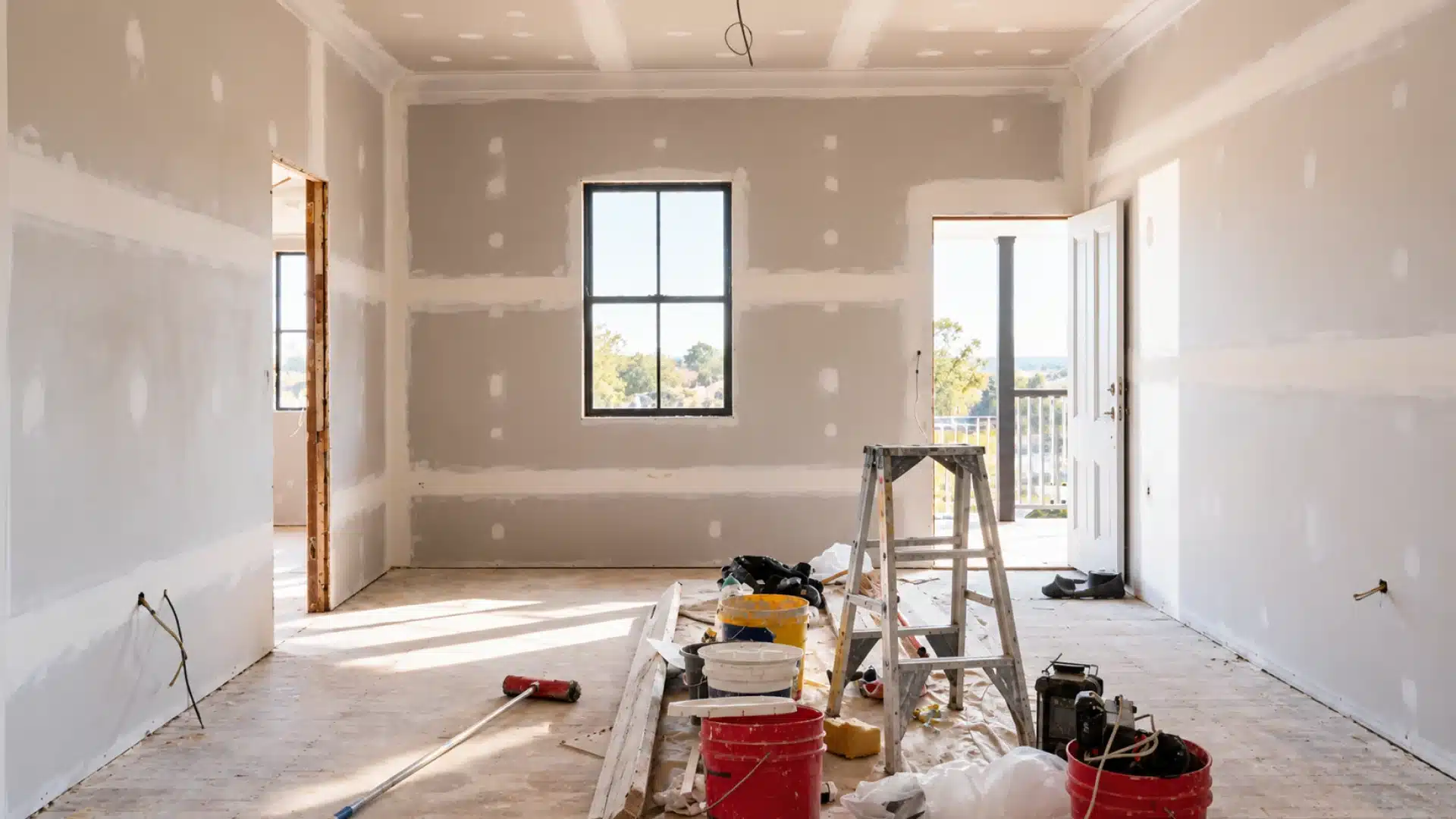
It’s a situation no one wants to go through, and yet it happens more often than you’d think. Work has started, you’ve paid deposits, and then nothing. The contractor no longer answers the phone, no longer shows up, leaves a half-finished job site. Panic sets in, and that’s normal.
Breathe. You have recourse, and there’s a process to follow. The key is to act methodically: document, secure, verify your rights, then regain control of the project.
In Lévis, at Solutions Rénovation Québec (RBQ licence 5811-7821-01), we regularly take over job sites abandoned by others. In this article, we explain what to do, step by step, to protect your rights and get your work completed properly.
Note: we are contractors, not lawyers. This article presents information in a general way; for legal advice tailored to your situation, consult the Office de la protection du consommateur, the RBQ or a legal professional.
A contractor who disappears: how common is it?
You are not alone, and it’s not your fault. Job site abandonment is a reality in the renovation, industry, and it affects cautious homeowners as well as less informed ones. Feeling cheated or naive is understandable, but it doesn’t help — better to switch to solution mode.
Situations vary. Sometimes the contractor disappears completely after collecting a deposit. Sometimes he leaves a job site half finished and becomes unreachable. Sometimes the work is botched and he refuses to come back and fix it. In all cases, you end up with a blocked project and money committed.
The good news is that these situations have solutions. Recourse exists, and an abandoned job site can be taken over and completed properly. What matters now is to react the right way, without rushing but without waiting either.
The most common scenarios
Job site abandonment takes several forms. The classic scenario: a large deposit paid, then the contractor vanishes without having (or barely) started. Another: work begun then left in limbo, with a contractor who no longer responds.
We also see poorly executed work that the contractor refuses to correct, or a job site that drags on indefinitely under false promises until de facto abandonment. In some cases, the contractor ceases operations or goes bankrupt. Each scenario has its nuances, but the approach to protect yourself remains similar.
Why you shouldn’t panic… but should act quickly
You need to find the right balance: don’t give in to panic, but don’t stay passive either. Panic leads to bad decisions — hiring the first person who comes along, signing anything, or worse, doing nothing.
But waiting also has a cost. A job site left open can deteriorate: bad weather, infiltration, exposed materials, unprotected structure. And when it comes to your recourse, acting within a reasonable timeframe is important to preserve your rights. The right approach is to react in an orderly and rapid way: document, secure, verify, then resume the project.
Your job site is at a standstill and the contractor no longer responds?
The first step is to regain control with a clear plan. Contact Solutions Rénovation Québec — we can assess your abandoned job site and help you see what comes next.
The first things to do immediately
When facing a contractor who disappears, the first actions matter a lot. They protect your rights and your property. Here’s what to do, in order.
Gather and secure all documents
Your file is your protection. Gather everything: the contract, invoices and receipts, proof of payment (statements, cheques), quotes, emails, texts and all communication with the contractor.
Add the contractor’s contact information and RBQ licence number if he has one. These documents establish what was agreed, what you paid, and what was supposed to be delivered. The more complete your file, the stronger your position for what follows. Keep it all in a safe place, in digital form if possible.
Document the actual state of the job site
Next, document precisely where the work stands. Take detailed photos and videos of the job site’s condition: what is done, what is not, what is poorly done.
This dated documentation is valuable. It objectively establishes the real progress at the time of abandonment, which will be useful for any claim and for assessing what remains to be done. Also note the key dates: start of work, last presence of the contractor, last communications. This factual portrait is the basis for everything that follows.
Why documentation is your best protection
We insist on this because it’s decisive: without documentation, your position weakens enormously. With a complete file — contract, payments, dated photos, communications — you can demonstrate what was paid, what was delivered, and the gap between the two.
This evidence supports any step: claim, complaint, mediation or more formal recourse. It also protects against contradictory versions. A solid file is what makes the difference between enduring the situation and asserting your rights. Take the time to build it properly right now.
Secure the job site to avoid further damage
An abandoned job site is vulnerable. Depending on the state of the work, it must be secured to prevent the situation from getting worse: protect open areas against bad weather, tarp what needs to be tarped, secure unfinished electrical or plumbing installations, and prevent infiltration.
A job site left exposed can suffer water damage, freezing or vandalism that make the bill worse. Protecting your property is one of the first actions. If you cannot do it yourself safely, a contractor can help you make the site safe quickly.
Secure your site before the damage gets worse
An open site exposed to the weather means a bill that climbs. Contact Solutions Rénovation Québec — we can help secure your site and assess the next steps.
Verify the RBQ licence and your protections
An essential step, often overlooked: verifying your contractor's RBQ status. It partly determines your protections and your recourses.
How to check if the contractor holds a valid licence
The RBQ (Régie du bâtiment du Québec) offers a public register of licence holders. You can check whether your contractor holds a licence, whether it is valid, and for which categories of work.
This verification is simple and free, and ideally it should have been done before hiring the contractor — but it is never too late to do it. It tells you whether you were dealing with a licensed or unlicensed contractor, which influences your protections and your steps. Consult the RBQ register to obtain this official information.
What the RBQ licence implies in terms of protections
An RBQ-licensed contractor is subject to obligations: competence, compliance, and respect for regulations. The licence also implies certain liability requirements.
Doing business with a licensed contractor gives you access to recourses with the RBQ, which can intervene on questions related to the licence and the contractor's obligations. Conversely, an unlicensed contractor leaves you with fewer regulated protections — which does not deprive you of all recourse, but complicates the process. This is why the RBQ verification is an important step in your file.
The possible recourses depending on your situation
Depending on your situation, several avenues exist. The RBQ may be involved for the failings of a licensed contractor. The Office de la protection du consommateur (OPC) informs you about your rights and the applicable steps. A formal complaint can be filed with the competent organizations.
On the resolution side, mediation sometimes makes it possible to settle without a prolonged conflict, and as a last resort, there are the courts — including the division of small claims for eligible amounts. Depending on the contractor's situation (bankruptcy, insolvency), other steps may apply. Each avenue has its conditions and its deadlines. To choose the right one, inform yourself with the OPC, the RBQ or a legal professional — that is what will guide you precisely according to your case.
What are your recourses to recover your money?
It is often the most painful question: «Will I see my money again?» The answer is nuanced, but avenues exist. Here is how to approach recovery.
Amicable steps
Before formal recourses, people often attempt an amicable settlement — even if the contractor is difficult to reach. A formal written notice, describing the situation and your demands, sent to their last known address, establishes your good-faith approach and can unblock the situation.
This notice, often called a formal demand letter, describes the facts, what was agreed, what was not delivered, and what you are demanding (finish, correct, or refund). Keep a copy and proof of sending. Sometimes, a formal step is enough to obtain a reaction. If not, it constitutes a useful step before going further.
Formal recourses
If the amicable approach fails, it is time for formal recourses. Depending on your situation, this can include a complaint with the RBQ (for a licensed contractor), support from the OPC, mediation, or a claim before the courts — particularly small claims for amounts that are eligible.
If the contractor is bankrupt or insolvent, the process is different and you must find out about the recourses applicable in that context. The reality is that recovering your money is not always simple or guaranteed, especially if the contractor has disappeared or no longer has assets. But asserting your rights remains important, and a legal professional can help you assess the real chances according to your case.
Why consult the right organizations
Faced with this complexity, relying on the right organizations makes the difference. The OPC informs you about your consumer rights and the steps. The RBQ handles questions related to licences and contractors. A legal professional can assess your precise situation and advise you on the best strategy.
These resources prevent you from navigating a complex process alone. They help you understand your real options, the applicable deadlines and the chances of success. Our role, as contractors, is to help you finish the work correctly — not to replace this legal advice, but to guide you toward the right resources.
How to get the work finished correctly?
Beyond the question of money, there is a concrete reality: your work must be finished. This is often the practical priority. Here is how to take over an abandoned site according to the rules.
Have the real state of the work assessed
Before taking over, a precise picture is needed. A qualified contractor assesses what was done, the quality of that work, what remains to be done, and above all what must be checked or redone.
This step is crucial, because an abandoned site sometimes hides problems: non-compliant work, poorly done elements, or non-compliance with standards. In particular, we check compliance (structure, plumbing, electricity as applicable) before continuing. Taking over without this assessment means risking building on doubtful foundations. An honest diagnosis establishes a solid starting point.
Taking over a site left by another contractor
Taking over another's work requires a particular approach. You cannot just «continue» — you must first understand what was done and ensure that it is compliant before going further.
Our approach: assess, check compliance, correct what must be corrected, then finish properly. We also document the state at the time of takeover, which can serve your claim file against the previous contractor. The goal is to deliver you a finished, compliant and safe project — as if it had been done well from the start. This is work we do regularly.
Why an RBQ contractor changes everything in these situations
In an abandonment situation, calling on an RBQ contractor provides guarantees that may have been missing at the start. An RBQ licence (ours: 5811-7821-01) means competence, compliance and responsibility. Added to this are a guarantee on the work, insurance, and a clear contract.
These elements protect you for the rest of the project. After a bad experience, this is exactly what you need: a contractor who is accountable for their work, with clear commitments. This time, you are starting on solid foundations. This is what transforms a stressful situation into a project that is finally well managed.
Have your site taken over by a reliable team
After an abandonment, you deserve a partner you can count on. Contact Solutions Rénovation Québec — we assess your site and finish it according to the rules, with a guarantee.
How to avoid this happening again?
Once the crisis has passed, it is worth drawing lessons for the future. Here is how to better protect yourself during a future project.
Check the licence and references before hiring
The first protection is checking upfront. Before hiring a contractor: verify their RBQ licence in the public register, ask for references and talk to former clients, check their reputation, and make sure they have insurance and a valid business number.
These simple checks eliminate a good portion of the risks. A licensed contractor, with verifiable references and an established reputation, is much less likely to disappear. Taking the time to verify before signing is your best insurance against an unpleasant surprise.
Require a clear contract and progressive payments
The contract and payment structure are your contractual protections. Require a detailed written contract: description of the work, materials, schedule, price, and conditions.
Above all, be wary of an excessive deposit. A schedule of progressive payments, tied to the actual progress of the work, protects you. You only pay for what is done. It is a sound practice that we apply and that you should require from any contractor. A serious contractor has no problem with payments tied to progress — it is rather the opposite that should raise alarm.
Red flags to watch for
Certain signs should put you on your guard even before signing. Watch for: a request for an abnormally high deposit, a reluctance to provide a written contract or a licence number, a price significantly lower than other bids (too good to be true), pressure to sign quickly, and a marked preference for cash payment without an invoice.
Difficult or evasive communication from the start is also a bad sign. These signals do not guarantee a problem, but they justify caution. Trusting your instinct and checking further is often what prevents bad experiences.
How much does it cost to take over an abandoned construction site in Lévis?
The question of cost is tricky here, because an abandoned construction site often holds surprises. Here's how to approach the budget, with indicative benchmarks.
What influences the cost of taking over
Several factors determine the cost of taking over: the actual progress of the work, the quality of what has been done, what must be verified, corrected or redone, the compliance of existing work, and what remains to be completed.
A well-advanced and well-done construction site costs less to take over than a botched site that must be partly undone. Unfortunately, part of the existing work sometimes has to be redone for compliance or quality reasons — which adds to the cost. That's why an on-site assessment is essential for an accurate figure. Every situation is unique.
Why a precise assessment is essential
Rather than estimating blindly, we always proceed with a detailed assessment of the construction site. It establishes the real state, what is salvageable, what must be redone, and the cost to complete it properly.
This assessment gives you a clear and transparent picture, with no bad surprises along the way. It also serves your claim file against the previous contractor, by documenting the state at the time of takeover. You receive a detailed quote, with transparent prices and no hidden fees — the actual costs depend entirely on the state of your construction site and are established after assessment.
Get a transparent assessment of your construction site
A clear picture is what allows you to decide with peace of mind. Request an assessment from Solutions Rénovation Québec — detailed, transparent, with no obligation.
Why choose Solutions Rénovation Québec to take over your project?
Taking over an abandoned construction site requires experience and trust — especially after a bad experience. Here's what we bring.
Expertise in taking over construction sites
We regularly take over sites left by others. We know how to assess the real state of the work, identify compliance issues, correct what needs to be corrected and finish properly. This type of situation, we know it.
This experience counts, because an abandoned construction site is not a new project — you have to work with what exists, the good and the not-so-good. We approach each takeover with an honest diagnosis and a clear plan to deliver a finished and compliant project.
Transparency and clear communication
After being left in the dark by a contractor, you need the opposite: clarity. We focus on continuous communication, a detailed quote, transparent prices and a realistic timeline.
You know at every step where your project stands, what is done and what is coming. No false promises, no grey areas. This transparency is the foundation for rebuilding trust after a bad experience — and that's exactly what we offer you.
Our commitments
We operate under license RBQ 5811-7821-01, led by Marco Savoie, with more than 500 projects completed, more than 10 years of combined experience and a 5-year warranty on labour. We focus on a clear contract, payments tied to progress, a clean site and zero hidden fees. These commitments protect you — and give you, this time, a reliable partner.
Take back control of your project with a trusted team
You deserve to see your project finally completed, properly. Contact Solutions Rénovation Québec or call us at 418-476-1747 — we're here to take over your construction site and bring it to completion.
Myths and realities about contractors who disappear
A few preconceived ideas deserve to be corrected. Here is the truth from the fiction.
«If I've paid, I can't do anything anymore.»
Reality: you have recourse, even after paying. Documentation, formal notice, complaint to the competent organizations, mediation, courts: several avenues exist. Getting your money back is not always simple, but asserting your rights remains possible.
«An abandoned construction site means everything has to be started over.»
Reality: not necessarily. Depending on progress and quality, a good part of the work may be salvageable. An assessment determines what is good, what must be corrected and what remains to be done. Starting everything over is not always necessary.
«Checking the RBQ license is complicated.»
Reality: it's simple and free. The RBQ's public register lets you check in a few minutes whether a contractor holds a valid license. It's a basic check that protects a lot — to be done before hiring, ideally.
«All contractors are alike.»
Reality: no. An RBQ-licensed contractor, with references, a clear contract and progressive payments, offers protections that a dubious contractor does not have. Upfront checks make a real difference on risk.
FAQ – Contractor who disappears in Lévis
What should I do first if my contractor disappears?
Gather and secure all your documents (contract, payments, communications), document the state of the construction site with dated photos and videos, and secure the site against bad weather. Then check their RBQ license and inform yourself of your recourses with the OPC or the RBQ. Acting in an orderly way protects your rights.
How do I check a contractor's RBQ license?
The RBQ offers a public online register where you can check for free whether a contractor holds a valid license and for which categories of work. Consult the Régie du bâtiment du Québec register to obtain this official information. It's simple and quick.
Can I get my money back?
It's possible, but not always simple or guaranteed, especially if the contractor has disappeared or no longer has assets. The steps include formal notice, a complaint to the competent organizations, mediation and the courts. A legal professional or the OPC can assess your real chances according to your situation.
Can another contractor take over the construction site?
Yes, this is a common situation. A qualified contractor assesses the state of the work, verifies compliance, corrects what needs to be corrected and completes the project. It is important that the new contractor documents the condition at the time of resumption, which can also serve your file against the previous contractor.
Do I need to file a complaint with the RBQ?
If the contractor was licensed, the RBQ may be involved for breaches related to the licence and the contractor's obligations. Filing a complaint can be part of your steps. Contact the RBQ to find out the process applicable to your situation. The OPC can also inform you of your rights.
How much time do I have to act?
The time limits vary depending on the type of recourse. This is why you must act within a reasonable time: documenting early and starting your steps quickly protects your rights. To find out the specific time limits applicable to your situation, inquire with the OPC or a legal professional.
How can I avoid this problem in the future?
Check the RBQ licence and references before hiring, require a detailed written contract, refuse excessive deposits in favour of payments tied to progress, and be wary of warning signs (price too low, pressure to sign, reluctance to provide a contract). These precautions greatly reduce the risk.
Can SRQ take over a project started by someone else?
Yes, it's something we do regularly. We assess the actual state of the work, we verify compliance, we correct what needs to be corrected and we finish the project by the rules, with a warranty. We also document the state at the time of takeover, which can be useful for your file. The goal: to deliver a finished and compliant project.
An abandoned project can be taken over — with method and the right partner
In the end, if your contractor has disappeared mid-project in Lévis, the situation is stressful but not without a solution. The key is to act methodically rather than in a panic: document your file, secure the site, verify the RBQ licence and your recourses, then take over the project properly.
Remember that you have rights and resources. The OPC, the RBQ and, if needed, a legal professional can guide you on recovering your money and the formal steps. Recovering the sums paid is not always simple, but asserting your rights remains important — and a well-documented file is your best protection.
And on a practical level, an abandoned project can be taken over and finished properly. An RBQ contractor who honestly assesses what exists, corrects what needs to be corrected and delivers a compliant project with a warranty is what transforms a bad experience into a finally successful project. This time, on solid foundations.
Is your project at a standstill in Lévis?
Request a free, no-obligation evaluation from Solutions Rénovation Québec or call us at 418-476-1747. We assess your abandoned project, we help you understand what comes next, and we finish your work according to RBQ rules, with a warranty — so that you finally regain control of your project.