
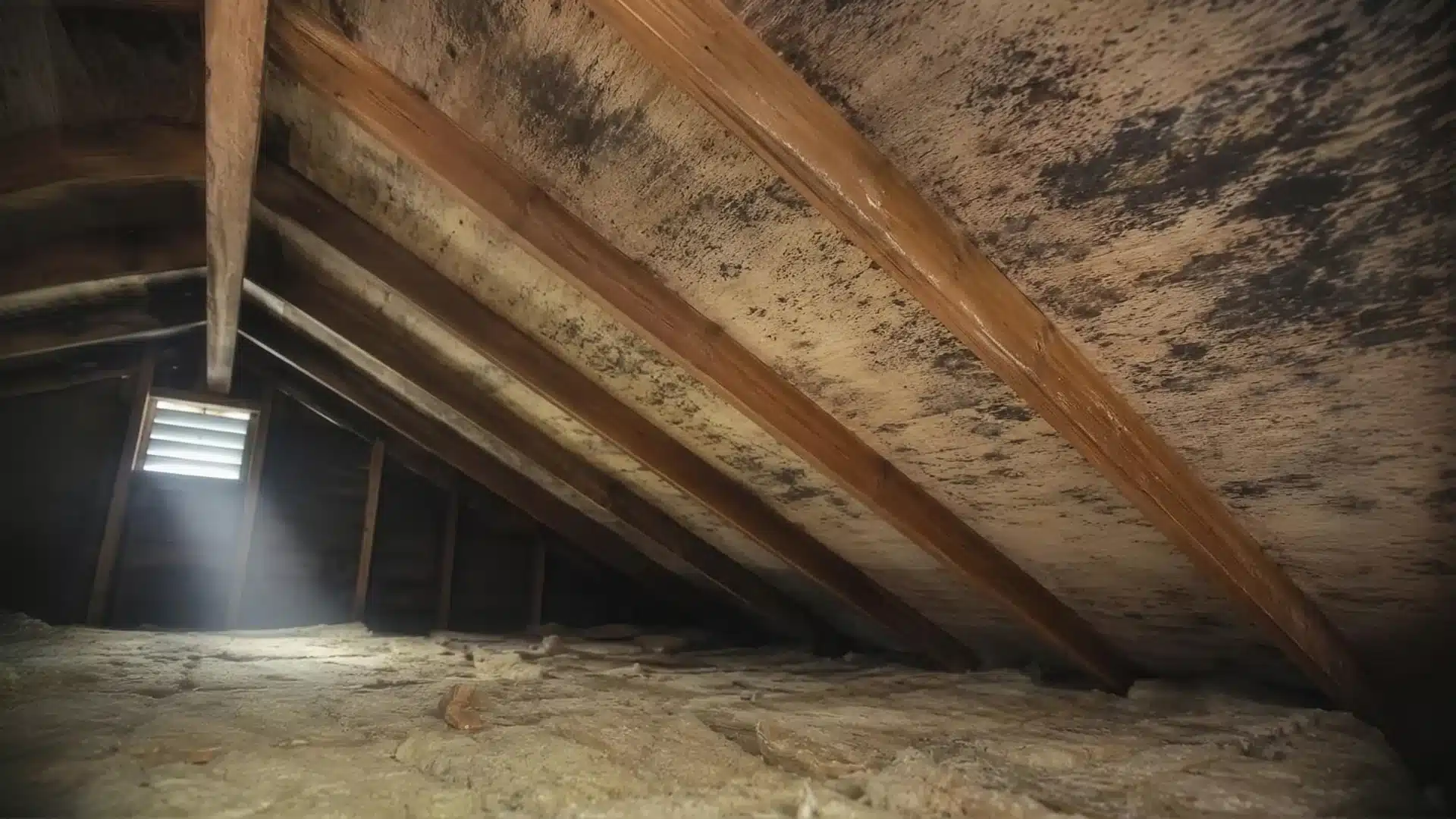
We rarely think about our attic. It's the space above our heads, which we visit twice a year. Yet what happens there can affect the air that your whole family breathes — especially when mold takes hold.
The question that many parents in Lévis are asking is legitimate: «Mold mold in the attic, is it dangerous for my children, for us?» The honest answer: it can affect health, especially for vulnerable people, and it deserves to be taken seriously — without panicking.
At Solutions Rénovation Québec (RBQ license 5811-7821-01), we diagnose and decontaminate attics in the region. In this article, we focus on what matters most to you: the health risks, who is most at risk, and when to act.
This article is for informational purposes and does not replace medical advice. For any health concerns, consult a health professional.
Can mold in the attic affect my family's health?
Let's start with the heart of the matter. Yes, mold can affect the indoor air quality and, by the same token, the health of the occupants. This is not an exaggeration, but it is also not a reason to give in to panic.
The principle is simple: mold releases spores and compounds into the air. When these particles circulate in the house, some people react to them — allergies, irritations, respiratory symptoms. The extent of the reaction varies greatly from one person to another.
What makes the attic concerning is precisely that we forget about it. A problem can develop there for a long time before we notice it, while affecting the air below. That's why it's worth taking a look from time to time — and acting as soon as a problem is spotted.
How attic mold affects the air throughout the whole house
One might think that an attic is isolated from the rest of the house. In reality, air circulates between floors more than we think. Natural air movements, leaks around the access hatch, light fixtures or ducts, and the stack effect (hot air rising) can bring particles down from the attic into the living space.
Result: spores and compounds from attic mold can end up in the air you breathe every day. It's not systematic or massive, but it's a real pathway. This is one of the reasons why an attic problem isn't just an attic matter — it affects the entire house.
Symptoms frequently associated with exposure
Exposure to mold is associated with various symptoms, especially in sensitive people. The most common: allergy symptoms (sneezing, runny or stuffy nose, irritated eyes), throat or airway irritations, coughing, and worsening of asthma in people who suffer from it.
Some people also report headaches or fatigue related to a damp and moldy environment. These symptoms are not specific to mold — they can have other causes — but if they worsen at home and improve when you leave, it's worth paying attention to. If in doubt, a health professional is the right reference.
Are you worried about the air quality in your home?
Peace of mind starts with a diagnosis. Have your attic inspected by Solutions Rénovation Québec — we identify the problem to protect your home's air.
Who is most at risk in your household?
Not everyone reacts the same way to mold. Some people are more sensitive, and it's important to know this to assess the urgency of acting in your home.
The most vulnerable people
Certain populations are generally more sensitive to the health effects of mold. Children, whose respiratory systems are still developing, are at the top of the list. Seniors, often more fragile, are also more at risk.
Add to that people with asthma or allergies, in whom mold can trigger or worsen symptoms, and immunocompromised people or those with pre-existing respiratory conditions. If your household includes one or more of these people, a mold problem deserves even faster attention. Vulnerability varies, but it guides the urgency to act.
Why prolonged exposure is more concerning
An important point: it's not so much brief, one-time exposure that is worrying, but prolonged exposure. Living for months or years in an environment where mold is active, with excessive humidity, increases the risk of chronic symptoms.
This is precisely the trap of the attic: the problem develops slowly, without being seen, and exposure can last a long time before we react. That's why public health authorities insist on the importance of acting quickly as soon as mold growth is observed, rather than letting it drag on. Correcting early limits the duration of exposure — and the risk.
What public health authorities recommend
Generally speaking, public health authorities such as Santé Québec and Health Canada recommend a consistent approach to mold. The central principle: you must not live with mold. You correct the source of humidity and clean or have the mold cleaned as soon as it is observed.
They insist that the priority is to act on the cause (humidity) and eliminate the mold, rather than trying at all costs to identify the exact species through analyses. For significant contamination, professional intervention is advised, both to properly assess the extent and to intervene safely. And for specific health concerns, a health professional remains the reference. The idea to remember: act, without panicking, but without waiting.
Why are Lévis attics prone to mold?
Attics in Lévis combine conditions that promote mold. Understanding these factors helps to understand why the problem is common here — and why vigilance is called for.
Regional humidity and climate
The proximity of the St. Lawrence River brings high humidity to the region. This humid air finds its way into homes and migrates to attics, where it meets cold surfaces in winter.
This meeting between humid air and cold surfaces causes condensation — the fuel of mold. Our harsh winters and freeze-thaw cycles amplify the phenomenon: the gap between the heated interior and the icy underside of the roof promotes condensation, even frost. Our climate creates a favorable terrain, which makes ventilation and humidity management all the more important.
Poorly ventilated attics
The most determining factor is often ventilation. An attic needs continuous air circulation to evacuate humidity. When this ventilation is lacking — blocked soffits, insufficient vents, air inlets obstructed by insulation — humidity accumulates and stagnates.
Deficient insulation or a deficient vapor barrier also lets more humidity migrate from the house to the attic. Combine a poorly ventilated attic, deficient sealing and regional humidity, and you get the perfect conditions for mold. In older homes in Lévis, often designed according to old standards, these issues are common.
Every house has its weak points
The causes vary from one house to another. Request an assessment from Solutions Rénovation Québec — we identify what makes your attic prone to mold.
How do you know if your attic has a problem?
You don't need to be an expert to spot the first signs. Here's what to watch for — and where the limits of self-inspection are.
Visible and olfactory signs
Several clues reveal a moisture or mold problem in the attic. On the visible side: black, green or whitish spots on the framing lumber or roof plywood, darkened or stained wood, condensation or frost on the underside of the roof in winter, damp or sagging insulation, and rusted nails.
On the olfactory side: a musty or stuffy smell, sometimes noticeable even without visible mold. This smell is often the first sign, before anything can be seen. If you notice one or more of these signs, your attic deserves a more thorough inspection.
Clues in the rest of the house
The problem does not always show up in the attic itself. Sometimes it is clues in the house that raise the alarm: a musty smell that seems to come from above, allergy or respiratory symptoms that worsen at home, or signs of moisture on the ceiling of the upper floor.
These indirect clues are worth investigating in the attic. A link between health symptoms that worsen in your home and a damp attic should not be overlooked. Listening to these signals is sometimes what makes it possible to spot a hidden problem.
When to consult a professional
Self-inspection has its limits, and you need to know when to hand things over. Consulting a professional is recommended when the contamination seems significant or widespread, when the attic is difficult or dangerous to access, when vulnerable occupants show symptoms, or when the cause is uncertain.
A professional inspection makes it possible to assess the real extent, identify the cause (ventilation, infiltration, airtightness) and determine whether decontamination is necessary. For health concerns, a health professional is the right reference. When in serious doubt, it is better to have it assessed than to assume.
Can you clean it yourself or is professional decontamination required?
This is a common question, and the answer depends on the extent of the problem. Let's look at when DIY is feasible and when it is not.
The limits of home cleaning
For a very small surface area, careful cleaning can sometimes be enough. But home cleaning has real limits that you need to know.
The main risk is dispersing spores throughout the house by cleaning without containment — this can make the contamination worse instead of fixing it. Add to that the risk of missing the cause (ongoing moisture, mold returns), the difficulty of safely accessing certain areas of the attic, and exposure to spores without adequate protection. For significant contamination or in an attic that is hard to access, DIY is not the right approach.
When professional decontamination is necessary
The professional decontamination is required in several situations: widespread contamination, a insulation or an affected structure, the presence of vulnerable occupants, or an attic that is difficult to access.
A professional intervention ensures adequate containment to avoid dispersing spores, safe removal of contaminated materials, specialized cleaning, and above all correction of the cause to prevent recurrence. All in compliance with safety standards — RBQ, sanitation, and workplace safety rules (CNESST). For a serious problem, this approach protects both your health and that of the workers.
The importance of correcting the cause, not just the symptoms
Here is the most important principle: cleaning mold without correcting the cause is a waste of effort. As long as excessive moisture persists — whether it comes from ventilation or an infiltration — the mold will return.
That is why a real solution always addresses the source: improving ventilation, correcting insulation and airtightness, repairing any infiltration. Cleaning is only half the work; preventing recurrence is the other half, the most important one in the long term. Fixing the cause is what durably protects your family's health.
Protect your family's health with an adequate intervention
A healthy attic means healthier air for everyone. Request a consultation with Solutions Rénovation Québec — we fix the cause to protect your home.
How SRQ protects your household's health
Our approach targets both air quality and the durability of the solution. Here is how we proceed for a moldy attic.
An inspection focused on cause and safety
We start with a complete inspection, oriented toward two objectives: identifying the real cause (ventilation, infiltration, airtightness) and assessing the extent to protect the occupants' health. We measure humidity, and examine the framing, insulation and ventilation.
This diagnosis allows us to propose an adapted intervention, neither exaggerated nor insufficient. Understanding the cause is the basis of a solution that truly protects your indoor air.
Decontamination compliant with standards
When decontamination is necessary, we carry it out in compliance with standards — containment to avoid dispersing spores, safe removal of contaminated materials, specialized cleaning, drying. We work according to the rules of the RBQ, sanitation and workplace safety (CNESST).
These procedures protect occupants during and after the work, as well as the workers. Decontamination directly affects air quality, so we do not take shortcuts. It is a matter of health.
Prevent to protect durably
Our ultimate goal is that the problem does not come back. We correct the cause: improved ventilation, insulation and airtightness of the ceiling, repair of infiltrations. An attic that stays dry is an attic that will not become moldy again.
We operate under license RBQ 5811-7821-01, led by Marco Savoie, with over 500 projects completed, more than 10 years of combined experience and a 5-year warranty on labour. We focus on a free estimate, transparent pricing and a clean worksite. These commitments ensure work done by the rules, in service of your home's health.
Breathe healthier air at home
Your family's air quality is worth a real diagnosis. Request a free, no-obligation estimate from Solutions Rénovation Québec.
How much does an intervention for a moldy attic in Lévis cost?
The cost depends on the cause and the scope. Here are some benchmarks, to be taken as rough estimates (indicative estimates that vary by case, and not guaranteed rates).
A inspection professional is often around 300 $ to 800 $. The correction of ventilation and insulation is generally between 2,000 $ and 8,000 $, depending on the remediation. A decontamination with major work — removal of contaminated insulation, correction of infiltration, affected framing — can reach 8,000 $ to 25,000 $ and more (indicative estimates).
A word on the savings of acting early: an ignored attic problem gets worse, mold spreads, wood deteriorates, and your family's exposure continues. From both a health and a financial standpoint, acting quickly is almost always the best choice. An inspection establishes a precise cost for your situation.
Myths and realities about mold and health
A few preconceived ideas deserve to be corrected. Here is the truth from the fiction.
«A little mold in the attic can't affect my health.»
Reality: mold can affect the air quality of the entire house, and sensitive people can feel its effects. Even «a little» deserves to be corrected, especially since the problem worsens over time.
«If I don't see the mold, there's no risk.»
Reality: a musty smell or symptoms that worsen at home can signal a problem even without visible mold. The absence of visible stains does not guarantee the absence of a problem.
«You have to identify the mold species before acting.»
Reality: public health authorities mainly recommend acting on the cause and eliminating the mold, rather than trying at all costs to identify the species. The priority is to correct the humidity and clean.
«Cleaning the stains is enough to protect my family.»
Reality: cleaning without correcting the cause (humidity, ventilation, infiltration) only postpones the problem. The mold comes back, and so does the exposure. Real protection involves correcting the source.
FAQ – Attic mold and health in Lévis
Is attic mold dangerous for children?
Children are among those more sensitive to the effects of mold, because their respiratory system is still developing. Exposure can promote allergies, irritation or respiratory symptoms in the most sensitive. This is a reason to act quickly. For any health concern, consult a health professional.
What symptoms can indicate exposure to mold?
Frequently associated symptoms include sneezing, runny or stuffy nose, irritated eyes and throat, coughing, and worsening of asthma in people who suffer from it. These symptoms are not specific, but if they improve when you leave the house, it's worth paying attention to them.
Should the air in the house be tested?
Sometimes it's useful — particularly to assess the extent of a contamination. But public health authorities mainly insist on the importance of acting on the cause (humidity) and eliminating the mold, rather than testing at all costs. A professional inspection will tell you whether testing is relevant in your case.
Can we continue living in the house during the work?
It depends on the extent and nature of the work. Professional decontamination with containment is specifically intended to protect occupants. In some cases, special precautions are recommended. The contractor and, if needed, a health professional can advise you according to your situation.
How much does attic decontamination cost?
As an indication, an inspection is around 300 $ to 800 $, correction of ventilation and insulation between 2,000 $ and 8,000 $, and decontamination with major work between 8,000 $ and 25,000 $ and more (indicative estimates, not guaranteed). An inspection provides a precise cost according to your situation.
Can mold come back after cleaning?
Yes, if the cause is not corrected. As long as excessive humidity persists — poor ventilation or infiltration — the mold will return. That's why a real solution corrects the source and reinforces the attic (ventilation, insulation, waterproofing), not just the surface stains.
How can I protect my family's health in the long term?
By correcting the cause to prevent mold from returning, and by maintaining a dry, well-ventilated attic. Good ventilation, insulation and adequate ceiling waterproofing keep humidity under control. A healthy attic durably protects the air quality your family breathes.
Is an RBQ contractor necessary?
For serious contamination, it is strongly recommended. An RBQ contractor diagnoses the cause, works in compliance with safety standards, corrects the source and offers a warranty. For an issue that affects your family's health, this professional and safe approach makes a real difference.
Your family's health starts with healthy air — and a healthy attic
Ultimately, attic mold is not just a building problem: it's an issue that can affect the air your whole family breathes. It can affect health, especially of vulnerable people — children, seniors, asthmatics, immunocompromised people — and prolonged exposure is more concerning than brief exposure.
The message from public health authorities is both clear and reassuring: you shouldn't live with mold, but you shouldn't panic either. You act on the cause, you eliminate the mold, and for significant contamination, you call in professionals. The priority is to correct the humidity — not to identify the species at all costs.
And above all, remember that cleaning alone is never enough: without correcting the cause, the mold returns, and your family's exposure with it. A real solution tackles the source — ventilation, insulation, waterproofing, infiltration — for a healthy and lasting attic. That's what protects your household's health over the long term.
Are you worried about air quality because of your attic?
Request a free, no-obligation inspection from Solutions Rénovation Québec or call us at 418-476-1747. We identify the cause, fix the problem according to RBQ standards, and protect the air your family breathes — with no commitment.
This article is for informational purposes and does not replace medical advice. If occupants show health symptoms, consult a health professional or your region's public health resources.