
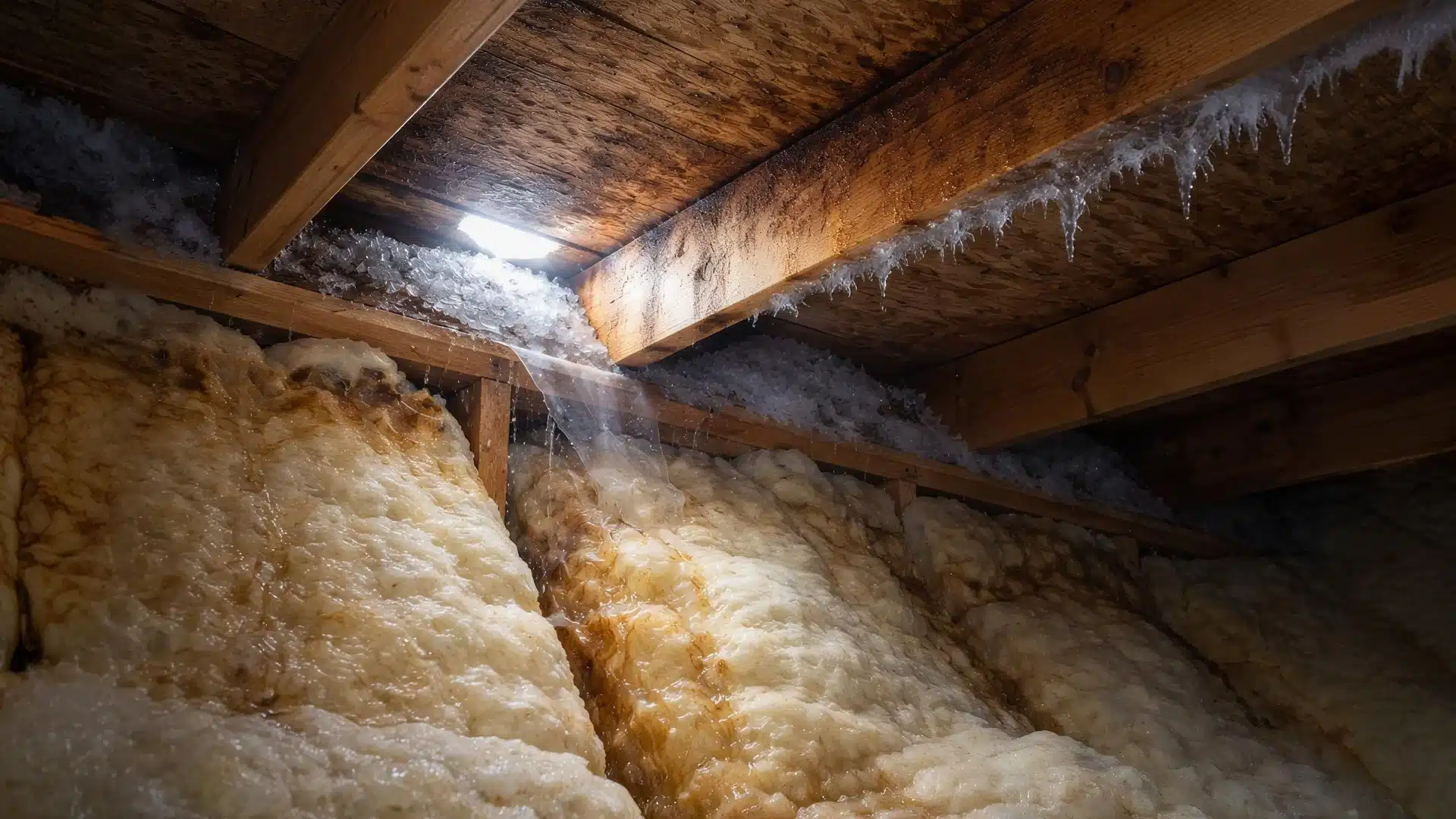
You go up to the attic in the middle of winter and discover frost on the underside of the roof, nails covered in ice, or water beading on the wood. In spring, these areas become black stains of mold. This is no coincidence: winter is the season when attic problems form the most, due to a specific phenomenon — condensation.
The good news is that this mechanism can be understood and corrected. Once you know why frost sets in during winter, you can fix the problem at its source.
In Vieux-Lévis, with its old houses and the humidity from the river, this winter problem is common. At Solutions Rénovation Québec (RBQ license 5811-7821-01), we have been diagnosing and correcting these issues for years. In this article, we focus on the link between winter, condensation, frost and attic mold.
This article is for informational purposes and does not replace medical advice. For any health concerns related to mold, consult a health professional.
Why does attic mold appear mainly in winter?
Many homeowners discover mold in their attic in spring, but the problem actually formed during winter. Understanding why sheds light on the entire solution.
The mechanism of winter condensation
The principle is physics and fairly simple. The warm air in the house contains moisture. This lighter air rises and can reach the attic through the smallest leaks. Up there, in winter, it meets the underside of the roof, which is freezing cold.
When warm, humid air touches a cold surface, the moisture it contains condenses — exactly like fog on a cold window. In an attic, this condensation deposits on the framing wood and the plywood of the roof. In extreme cold, it freezes outright and forms frost. It is this cycle, repeated all winter, that wets the wood and prepares the ground for mold.
The role of frost and spring thaw
Winter installs the frost; spring reveals the damage. During the cold months, moisture accumulates as frost and ice on the attic surfaces. You don't always see an active problem at that time — just ice.
Then comes the thaw. The frost melts, the water soaks into the wood and insulation, and the moisture remains. With spring warming, this humid environment becomes ideal for mold, which then develops rapidly. This is why so many people discover a moldy attic in spring: the problem was brewing under the frost all winter. The cause is winter-related, even if the symptom appears later.
Why this cycle repeats every year
Without correction, this cycle starts again every winter. As long as the humid air from the house rises toward a cold, poorly ventilated attic, condensation reforms, frost returns, and mold resumes at thaw.
It is a self-perpetuating circle that worsens over the years: wood already stained retains moisture better, wet insulation insulates less, and the problem worsens season after season. Cleaning the stains in spring without correcting the winter cause solves nothing — the frost will return the following winter. This is why you must address the mechanism, not just the traces it leaves.
Have you seen frost or stains in your attic?
Winter frost and spring stains are two faces of the same problem. Have your attic inspected by Solutions Rénovation Québec — we identify the cause before the next winter.
Where does the moisture that freezes in your attic come from?
Attic frost comes from moisture rising from the house and/or water entering through the roof. Identifying the source is essential to correct the problem. Let's look at the two main origins.
Moisture rising from the house
The first source is the humid air from your living space migrating to the attic. This air becomes loaded with moisture daily: cooking, showers, drying, breathing, plants. Normally, this moisture should be evacuated by the house's ventilation.
The problem occurs when this humid air escapes toward the attic through leaks — around the access hatch, recessed light fixtures, conduit and plumbing passages, or through a poorly sealed ceiling. Once in the cold attic, this moisture condenses and freezes. The more air leaks there are and the more humid the house is, the more moisture the attic receives to freeze. This is often the main source of frost.
Roof infiltrations
The second source is water entering directly through the roof. An aging roof, damaged shingles, defective flashing or poorly sealed penetrations can let water through — rain, melted snow.
In winter, a particular phenomenon adds to this: ice dams. We'll come back to this below, but the idea is that ice forces meltwater to back up under the shingles and infiltrate. Unlike condensation, which is widespread, an infiltration often leaves localized traces around the entry point. Both sources can coexist, which sometimes complicates the diagnosis. Hence the importance of an evaluation that checks both.
The link with ice dams
The ice dams deserve an explanation, because they connect everything. They form when heat escaping into the attic warms the roof and melts the snow. The meltwater flows toward the roof edge — which is colder — where it refreezes, forming an ice dam.
This dam blocks the flow of water, which accumulates and eventually backs up under the shingles and infiltrates. The key point is that ice dams are often caused by the same problem as condensation: an attic that is too warm and poorly ventilated, due to air leaks and inadequate insulation. Fixing the cause — keeping the attic cold and dry — therefore addresses both problems at once. This is why diagnosis is central.
Condensation or infiltration: diagnosis makes the difference
Treating the wrong source means guaranteeing a recurrence. Request a diagnosis from Solutions Rénovation Québec — we identify where the humidity in your attic is really coming from.
Why are attics in Old Lévis so vulnerable in winter?
Old Lévis combines conditions that make attics particularly susceptible to winter problems. Understanding these factors helps grasp the scope of the risk.
River humidity and harsh winters
The proximity of the Saint Lawrence River brings high ambient humidity year-round. This humid air increases the moisture load in homes, and therefore the amount of moisture likely to rise into the attic and freeze there.
Combine that with our harsh winters and their long periods of extreme cold, and you get ideal conditions for winter condensation: lots of humidity on one side, very cold surfaces on the other. The spring freeze-thaw cycles then melt the frost that has accumulated, triggering mold. Our climate creates exactly the scenario conducive to this problem. It's an important regional factor.
Old houses and their era-specific insulation
Old Lévis is known for its old houses with undeniable charm — but these houses often have attics designed to outdated standards. Aging or insufficient insulation, poor air sealing, missing vapour barrier, inadequate ventilation: all factors that promote winter condensation.
An older house often lets more warm, humid air rise into the attic, while ventilating it poorly. The result: more condensation, more frost, more risk of mould. These houses deserve to have these issues corrected while respecting their character. It's work that combines good modern practices with respect for older buildings.
An older attic requires a tailored approach
The character homes of Old Lévis deserve careful expertise. Request an assessment from Solutions Rénovation Québec — we fix the problem without altering your home.
How do you break the winter condensation cycle?
Good news: this cycle can be broken. The solution rests on three levers that work together — air sealing, insulation, and ventilation. Let's see how.
Seal the air leaks between the house and the attic
The first intervention, often the most cost-effective, is to cut off humidity at the source. We seal the air leaks through which warm, humid air from the house rises into the attic: access hatch, recessed light fixtures, conduit and plumbing penetrations, ceiling joints.
By preventing this humid air from reaching the cold attic, we directly reduce condensation. Less humidity rising means less frost forming. This air sealing of the ceiling is often the most effective step to break the cycle. That's where we start.
Improve ceiling insulation
Ceiling insulation plays a dual role. First, it keeps heat in the house — so the attic stays colder, which reduces snow melt and ice dams. Second, good insulation, combined with air sealing, limits moisture transfer to the attic.
The goal is to properly separate the heated space of the house from the cold attic. We want heat to stay below and the attic to stay cold and dry. Adequate ceiling insulation contributes to this balance. Care must be taken, however, not to block ventilation while insulating — a technical point we handle with care.
The importance of balanced ventilation
The third lever is attic ventilation. An attic needs continuous air circulation to evacuate any residual humidity and stay cold. This ventilation relies on a balance: air inlets at the bottom (soffits) and outlets at the top (roof vents or ridge vents).
Fresh air enters from the bottom, circulates, and evacuates humid air through the top. When this balance is broken — blocked soffits, insufficient vents, insulation obstructing air inlets — humidity stagnates and condenses. Well-balanced ventilation evacuates humidity before it freezes. Combined with air sealing and insulation, it completes the system that keeps the attic healthy. The three levers work together — one without the others is not enough.
Will fixing this problem make my house colder?
It's a common concern: «If I ventilate and air out my attic, will my house be colder?» The reassuring answer: no, done properly, it's quite the opposite. Let's see why.
Attic ventilation and home comfort
There is an essential distinction to understand: the ventilated attic and the heated living space are two separate zones. We want the attic to be cold and well ventilated, and the house to stay warm. The two do not contradict each other — quite the contrary.
Ventilation concerns the attic, above your ceiling insulation, not your living spaces. When ceiling insulation and air sealing are good, heat stays in the house while the attic dries out above. Ventilating the attic therefore has no negative effect on your comfort. Done properly, it resolves humidity without affecting your heating.
Why a cold attic is a healthy attic
Here's the counter-intuitive point: a cold attic is a healthy attic, in winter. One might think the attic needs to be warmed to prevent frost — it's the opposite.
A cold, well-ventilated attic does not create condensation, because its temperature is close to that of the outside: there is no large gap between warm humid air and a cold surface that causes fogging. It's a lukewarm, humid, poorly ventilated attic that poses a problem. The goal is therefore to keep the attic cold (thanks to ceiling insulation and air sealing) and dry (thanks to ventilation). This simultaneously reduces condensation AND ice dams. A cold, dry attic is the key to a healthy attic in winter.
A healthy attic without sacrificing your comfort
We can fix the problem while keeping your house nice and warm. Request a consultation with Solutions Rénovation Québec — we aim for a cold, dry attic, and a comfortable house.
How SRQ treats an attic mouldy from condensation
Treating an attic mouldy from condensation means fixing the winter mechanism at the source. Here is our approach.
Step 1: Inspection and diagnosis
We start with a complete inspection: assessment of ceiling air sealing, insulation, ventilation, search for air leaks and signs of infiltration, humidity measurement, examination of the framing. We determine whether the problem comes from condensation, infiltration, or both. This diagnosis guides everything that follows.
Step 2: Safe decontamination
When there is mould, we treat it methodically: containment of the area to avoid dispersing spores, removal of contaminated materials (affected insulation), specialized cleaning and drying.
We work in compliance with applicable standards — RBQ, sanitation, and workplace safety rules (CNESST) — to protect occupants and workers. Poorly done cleaning can disperse spores throughout the house, so these procedures are not optional. Decontamination affects air quality.
Step 3: Correct the cause for the following winter
This is the decisive step: making sure the frost does not come back next winter. We seal air leaks in the ceiling, improve insulation and airtightness, and restore a balanced ventilation (soffits and vents), and we repair any roof infiltration.
By addressing the condensation mechanism, we break the cycle that was repeating every winter. The attic stays cold and dry, condensation no longer forms, and mold no longer has the conditions to return. This is what distinguishes a real solution from a simple spring cleaning. We fix the problem for good.
A healthy attic protects your entire home
Correcting the winter cause means protecting the air and the structure for years. Request an estimate from Solutions Rénovation Québec — we tackle the mechanism, not just the stains.
How much does correcting a moldy attic in Vieux-Lévis cost?
The cost depends on the cause and the scope. Here are some benchmarks, to be taken as rough estimates (indicative estimates that vary by case, and not guaranteed rates).
A inspection professional is often around 300 $ to 800 $. The correction of airtightness, ventilation and insulation is generally between 2,000 $ and 8,000 $, depending on the necessary corrective measures. A decontamination with major work — removal of contaminated insulation, repair of infiltration, affected framing — can reach 8,000 $ to 25,000 $ and more (indicative estimates).
A word on the savings of acting early: each winter that passes without correction worsens the problem. The frost returns, the wood degrades, wet insulation loses its effectiveness, and mold gains ground. Correcting the winter cause before it affects the structure costs far less than waiting. An inspection allows for establishing a precise cost for your situation.
Myths and realities about winter attic mold
A few preconceived ideas deserve to be corrected. Here is the truth from the fiction.
«Frost in the attic is normal in winter.»
Reality: a little occasional frost can happen, but recurring and abundant frost signals a condensation problem to correct. This frost melts in spring and feeds the mold. It should not be trivialized.
«You need to heat the attic to prevent frost.»
Reality: it's the opposite. An attic should stay cold and dry. Frost comes from the warm, humid air rising from the house — the solution is to block this air (air sealing) and ventilate, not to heat the attic.
«Cleaning the stains in spring solves the problem.»
Reality: cleaning without correcting the winter cause does nothing. The frost will return the following winter, and the mold the spring after. You need to break the cycle by addressing the condensation.
«Ventilating my attic will cool my house.»
Reality: no, if the ceiling is well insulated and sealed. The ventilated attic and the heated space are two separate zones. Heat stays in the house and the attic above is dried out.
FAQ – Moldy attic in winter in Vieux-Lévis
Why is there frost in my attic in winter?
Frost comes from the warm, humid air from the house rising into the attic through air leaks, then condensing and freezing on contact with the cold roof surfaces. The more humid the house and the more leaks there are, the more frost forms. It's a condensation problem to correct.
Why do I only discover the mold in spring?
Because the problem forms in winter but reveals itself during the thaw. The frost accumulated all winter melts in spring, soaks into the wood and insulation, and the resulting humid environment allows mold to develop quickly. The cause is winter-related, even if the symptom appears in spring.
Should you heat or ventilate the attic?
Ventilate, not heat. A healthy attic is cold and dry. You want to keep heat in the house (ceiling insulation and air sealing) and dry out the attic through good ventilation. Heating the attic would only make things worse. A cold, well-ventilated attic does not create condensation.
Are ice dams linked to attic mold?
Often, yes — they frequently have the same cause. An attic that is too warm and poorly ventilated melts the snow, which creates ice dams AND promotes condensation. Correcting the cause (keeping the attic cold and dry) addresses both problems at the same time.
Is it dangerous for your health?
Mold can affect indoor air quality and cause allergies, irritations or respiratory symptoms, especially in sensitive people. Public health authorities recommend acting as soon as there is visible growth. For personalized health advice, consult a health professional.
How much does correcting a moldy attic cost?
As a guideline, an inspection is around 300 $ to 800 $, air sealing, ventilation and insulation correction between 2,000 $ and 8,000 $, and decontamination with major work between 8,000 $ and 25,000 $ and more (indicative estimates, not guaranteed). An inspection provides a precise cost according to your situation.
How to prevent frost from returning every winter?
By breaking the cycle at the source: sealing ceiling air leaks, improving insulation and air sealing, restoring balanced ventilation (soffits and vents), and repairing any infiltration. It's this combination that prevents condensation from reforming the following winter.
Is an RBQ contractor necessary?
For durable and safe work, it is strongly recommended. A moldy attic involves several trades — air sealing, insulation, ventilation, roofing, decontamination. A RBQ contractor diagnoses the real cause, coordinates everything, complies with safety standards and offers a warranty on the work.
A moldy attic in winter is solved by addressing the condensation
In the end, winter attic mold in Vieux-Lévis is not inevitable — it's the result of a precise mechanism that can be corrected. The warm, humid air from the house rises into the attic, condenses and freezes on contact with cold surfaces, then melts in spring feeding the mold. This cycle repeats every winter as long as it isn't broken.
The solution relies on three levers working together: sealing the air leaks of the ceiling to cut off humidity at the source, insulating well to keep the attic cold, and ventilating to dry it out. And rest assured: fixing this problem does not cool your house — on the contrary, a cold and dry attic is a healthy attic, while keeping your living space nice and warm.
Above all, remember that cleaning the stains in spring does nothing if the winter cause remains. The frost will return the following winter. In our Lévis winters, addressing the condensation mechanism — air sealing, insulation, ventilation — is what durably protects your attic, your roof structure and your home's air.
Do you have frost or mold in your attic in Vieux-Lévis?
Request a free, no-obligation inspection from Solutions Rénovation Québec or call us at 418-476-1747. We identify the cause of the condensation, correct the mechanism according to the rules of the RBQ, and break the cycle so the frost doesn't return next winter — with no obligation.
This article is for informational purposes and does not replace medical advice. If occupants show health symptoms, consult a health professional.