
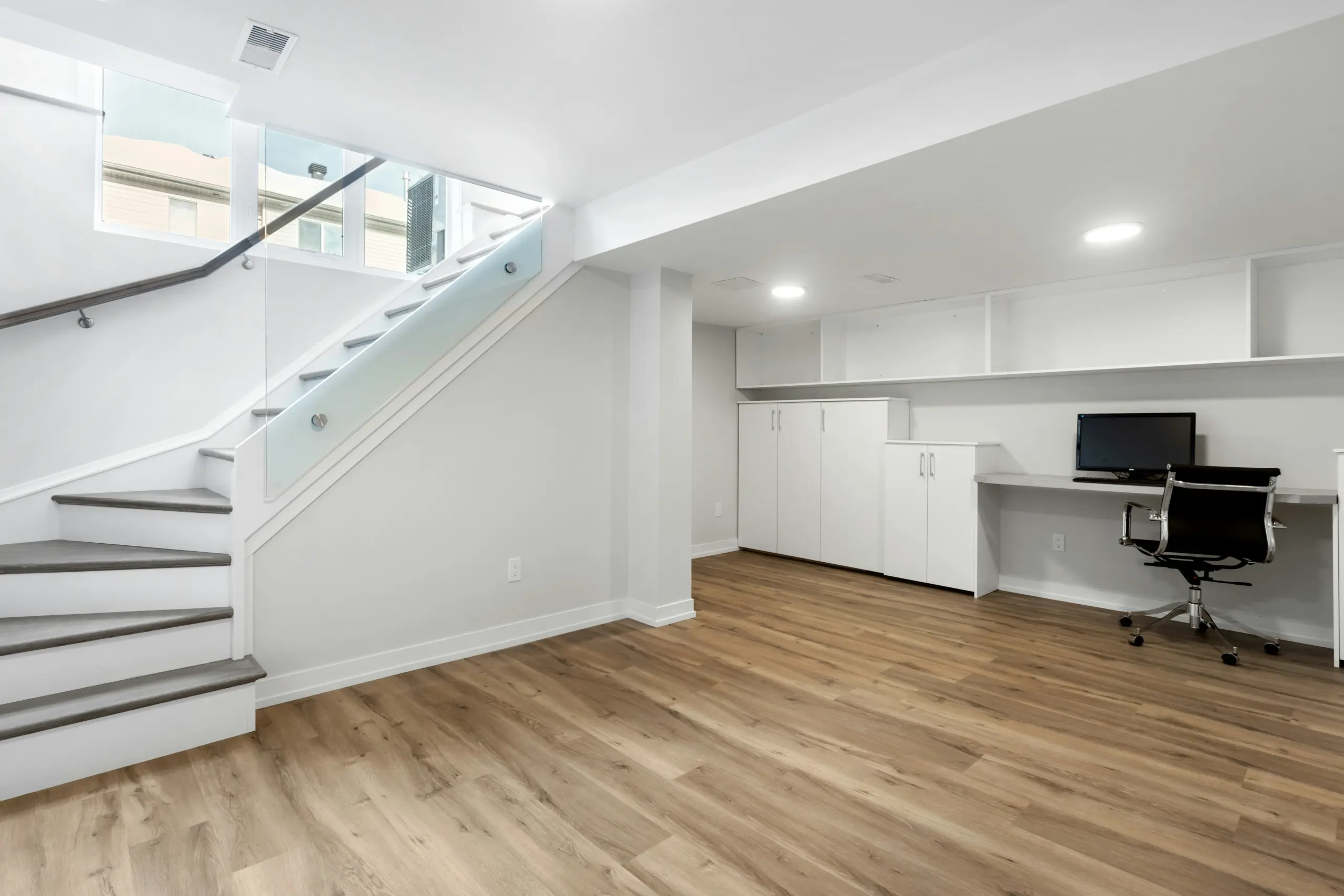
It’s a situation we hear often: the thermostat is turned all the way up, the furnace runs non-stop, but the basement stays cold, uncomfortable, and sometimes damp. The floor is freezing, the air is heavy, and the Hydro-Québec bill climbs month after month without comfort following.
In the Lévis region, this problem particularly affects houses built between 1950 and 1980. These bungalows and single-family homes were built at a time when foundation insulation standards were either nonexistent or far below what is required today. Heating does not solve a thermal envelope problem — it only compensates temporarily, at great expense.
Why does a basement stay cold despite the heating?
Many homeowners think that by adding a heating appliance or turning up the thermostat, they will solve the problem. In reality, heating a poorly insulated basement is like trying to keep a glass of water hot with a hole in the bottom. As long as the thermal envelope is not corrected, heat continues to escape — and you continue paying to produce it in pure loss.
Heat losses through the thermal envelope of a poorly insulated house can represent up to 75 % of heating expenses (reasonable estimate according to data from the energy renovation industry). In an untreated basement, foundation walls and rim joists are often the main leakage areas.
Understanding where the problem comes from is the first step to fixing it effectively.
Thermal bridges in foundations
A thermal bridge is an area in a house’s envelope where thermal resistance is significantly lower than elsewhere — a place where heat escapes more easily to the outside. In Quebec basements, the critical areas are well known: concrete foundation walls, rim joists, and the junctions between the foundation and the floor structure.
In the bungalows of the 60s to 80s found in abundance in Lévis, Saint-Nicolas and Charny, the rim joists — those horizontal pieces of wood that rest directly on top of the foundation — are often completely exposed. They create a continuous uninsulated band all around the basement, where heat leaks directly to the outside.
Impact of freeze-thaw on foundations in Lévis
The repeated freeze-thaw cycles of our climate create micro-cracks in foundation concrete over time. These cracks, even minimal, increase the permeability of walls to cold and moisture. In an already uninsulated foundation wall, each winter slightly worsens the situation — and the feeling of cold gradually intensifies from one year to the next.
Moisture and condensation in the basement
Cold air holds less moisture than warm air. When warm, humid air from the house comes into contact with cold basement surfaces — concrete walls, floor, joists — it cools and releases its moisture as condensation. Result: damp surfaces, a feeling of heavy cold air, and an environment conducive to problems.
Capillary rise worsens the phenomenon. Foundation concrete absorbs moisture from the ground continuously. Without an effective barrier, this moisture migrates inward, keeps the walls constantly cold and damp, and makes heating even more ineffective. It’s a vicious circle that insulation alone cannot always correct — sometimes moisture control must also be addressed in parallel.
Health and structural risks
A chronically damp and cold basement is an environment favorable to mold. It can settle into existing insulation, behind drywall panels, and under floor coverings — often without being visible. The air quality of the entire house suffers, and material degradation accelerates. It’s a health problem as much as a comfort problem.
Insufficient or poorly installed insulation
Even in houses where insulation has already been installed, we often see installations that no longer perform — compacted and damp fiberglass that has lost much of its R-value, poorly sealed rigid foam that allows air infiltration, or materials simply too thin for our climate conditions.
Rock wool, fiberglass and sprayed polyurethane foam do not have the same characteristics. Rock wool resists moisture well and maintains its performance over time. Fiberglass is more economical to purchase, but it loses effectiveness if it absorbs moisture. Sprayed foam offers the best air tightness, but its cost is higher — it is often used in combination with other materials.
Minimum requirements of the Quebec Construction Code
The Construction Code requires a minimum R-value of R-17 for foundation walls and R-24.5 for rim joists in new construction in Quebec. Many existing houses in the Lévis region are well below these values — which largely explains their thermal discomfort and high energy consumption.
Don’t know where your basement loses the most heat? Request a free insulation diagnosis from SRQ — we identify thermal bridges and problem areas before proposing anything to you.
How to correct a cold basement in Quebec
There is no universal solution. What works depends on the condition of your foundation, the moisture level, the materials already in place, and the available height in the basement. But there are approaches that have proven themselves in our climate conditions, and that the SRQ team regularly applies to homes in the region.
Well-done insulation can reduce the heating bill by 20 to 30 % depending on the starting condition of the house (reasonable estimate based on Rénoclimat and industry data). It's a concrete return on investment — not just a question of comfort.
Foundation wall insulation
The most effective approach for interior foundation walls is the installation of semi-rigid rock wool panels fixed directly against the concrete, followed by a wood frame and a gypsum board finish. This method creates a continuous thermal barrier, without leaving thermal bridges at the fastening points.
Rock wool is our material of choice for foundation walls. It resists moisture without losing its R-value, it doesn't mold, and it offers interesting fire resistance. Unlike loose-fill or flexible panel fiberglass, it keeps its shape and properties over time.
Advantages of rock wool in the basement
Rock wool is hydrophobic — it repels water rather than absorbing it. Even in a variable-humidity environment like a Quebec basement, it maintains its thermal performance. It is also non-combustible, which is an advantage in a space that often contains the furnace and water heater.
Rim joist insulation
Rim joists are often the most neglected area — and yet one of the most important to correct. It's a continuous band of exposed wood, in direct contact with the exterior, that runs all around the basement perimeter. Without insulation, it's a highway for the cold.
Sprayed polyurethane foam applied directly to the rim joists is very effective for this area: it creates a continuous layer that eliminates air infiltration in addition to providing thermal insulation. It's work that is done quickly and has an immediate impact on comfort.
Mineral wool + sprayed foam combination
For projects where budget is a factor, a combination is often used: thin-layer sprayed foam for air sealing on the joists, followed by mineral wool panels to complete the required R-value. This approach offers an excellent performance-cost ratio for existing basement renovations.
Sealing and moisture control
Insulating without controlling moisture sometimes makes the problem worse. If moisture continues to migrate through the foundation and meets a cold surface behind the insulation, condensation forms there — and mold follows. That's why moisture control is an integral part of a well-planned insulation project.
Depending on the situation, a waterproofing treatment on the concrete walls, an interior perimeter drain, or a properly positioned vapor barrier may be recommended. These are not options — they are essential components of a healthy basement.
Why the vapor barrier must be installed on the warm side
The vapour barrier must always be installed on the warm side of the insulation — that is, on the interior side, toward the heated space. If poorly positioned, it can trap moisture inside the insulation and create exactly the problem it is supposed to prevent. This is a technical detail with significant long-term consequences.
Are you ready to fix your basement once and for all? Request your insulation quote from SRQ — we offer a solution tailored to your home, not a generic package.
How much does basement insulation cost in Lévis?
It's often the first question we get asked — and it's a good question. Here are the realistic ranges for the most common insulation work in the region.
The final cost depends on the basement area, the condition of the existing walls, the materials chosen, and whether preparatory work is needed — such as moisture treatment or foundation crack repair.
Average material costs
For semi-rigid rock wool panels, expect generally between $1.50 and $3.00 per square foot for the material alone, before installation (reasonable estimate, 2025). For rim joists treated with spray foam, a complete project typically ranges between $5,000 and $8,000 for a standard basement, including labour (reasonable estimate).
A complete basement insulation project — foundation walls, rim joists, vapour barrier — represents an investment that generally pays for itself within a few years thanks to savings on your Hydro-Québec bill. And when you factor in available subsidies, the math becomes even more attractive.
Subsidies available in Quebec
The Rénoclimat program from Hydro-Québec offers financial assistance to homeowners who improve the energy efficiency of their home. Foundation insulation is one of the eligible measures under the program.
Financial assistance for basement insulation
Depending on the work carried out and the level of energy performance improvement, rebates can reach up to $2,500 (according to the Rénoclimat program parameters in effect in 2025). To be eligible, the work must generally be carried out by a recognized contractor — which SRQ can confirm for you during the consultation.
Want to know if you're eligible for available subsidies? Contact us for a consultation — we explain the process clearly, without jargon.
Why trust Solutions Rénovation Québec (SRQ)
RBQ expertise and field experience
At SRQ, we've been working on basements in homes across Lévis, Québec, Beauce and Chaudière-Appalaches for over ten years. We've seen every type of foundation, every moisture level, and every insulation mistake made in renovations — the ones we fix, and the ones we avoid from the start.
Marco Savoie, RBQ-licensed general contractor (5811-7821-01), leads each project with an approach that always begins with an honest diagnosis. We don't recommend work that isn't necessary. We don't sell insulation like we'd sell a car. We explain what's happening in your home, and what the best solution is for your specific house.
A clear process for your renovations
Too often, homeowners embark on work without having a complete picture of what lies ahead. At SRQ, we structure each project to eliminate surprises.
Project steps
- Inspection and diagnosis — on-site visit, assessment of thermal bridges, moisture test
- Transparent quote — all line items detailed, materials and labour separated
- Work and insulation — execution according to RBQ standards, quality materials
- Final cleaning — site delivered clean, work documented
Warranty and customer satisfaction
All our insulation work is covered by our 5-year warranty on labor. Not just on materials — on what we did. We have completed over 500 residential projects in the region, with an average rating of 4.9/5 from our clients.
Tired of a cold basement and a Hydro bill that keeps climbing? Schedule your basement inspection with SRQ — 418-476-1747, Monday to Friday, 8 a.m. to 5 p.m.
FAQ
Why is my basement colder than the rest of the house?
Because foundation walls and rim joists generally don't have sufficient thermal break between the inside and the outside. Concrete conducts cold easily, and in older homes, there is often no insulation to prevent it.
Is it normal to have a cold basement in winter?
No — it's common, but not normal. A well-insulated basement can maintain a comfortable temperature without overheating the rest of the house. If your basement is consistently 5 degrees or more colder, it's a sign that the thermal envelope needs to be corrected.
Which insulation is best for a basement in Quebec?
Semi-rigid rock wool for foundation walls, combined with spray foam on the rim joists. This combination offers high thermal resistance, good moisture management, and long-term durability in our climate conditions.
Is rock wool better than fiberglass?
For a basement, generally yes. Rock wool resists moisture without losing its R-value, doesn't settle over time, and doesn't support mold growth. Fiberglass is less expensive to purchase, but can lose efficiency if it ends up in a damp environment.
Can insulation reduce my electricity bill?
Yes, significantly. Full basement insulation can reduce heating costs by 20 to 30 % depending on the home's starting condition (reasonable estimate). Over several years, the return on investment is concrete and measurable.
How long does insulation work take?
For a standard basement, insulating walls and rim joists generally takes 3 to 5 business days. This can vary if preparatory work is needed — moisture treatment, crack repair, or demolition of an old installation.
Should I insulate the interior or exterior of the foundation?
In most existing residential renovations, interior insulation is more practical and less expensive. Exterior insulation is more thermally efficient, but it involves significant excavation work. For an already-built home, interior is the most common choice — and very effective when done properly.
Can insulation prevent mold?
It can contribute to it, but only if the moisture source is also addressed. Properly installed insulation, with adequate vapor control, reduces condensation on cold surfaces — which decreases the risk of mold. If moisture comes from infiltration or capillary rise, those problems must be resolved in parallel.
Conclusion — Turning up the heat doesn't fix an insulation problem
A cold basement is rarely a heating problem. It's almost always a thermal envelope problem — uninsulated walls, exposed rim joists, or an aging installation that no longer does its job.
The good news is that it can be fixed. And once it's done correctly, the results are immediate: more comfort, lower bills, and a basement you can truly use year-round.
At SRQ, we always start by understanding what's happening in your home before recommending anything. That's how we've worked from the beginning.
Tired of heating for nothing? Contact Solutions Rénovation Québec today — free diagnosis, detailed quote, zero pressure. 418-476-1747.