
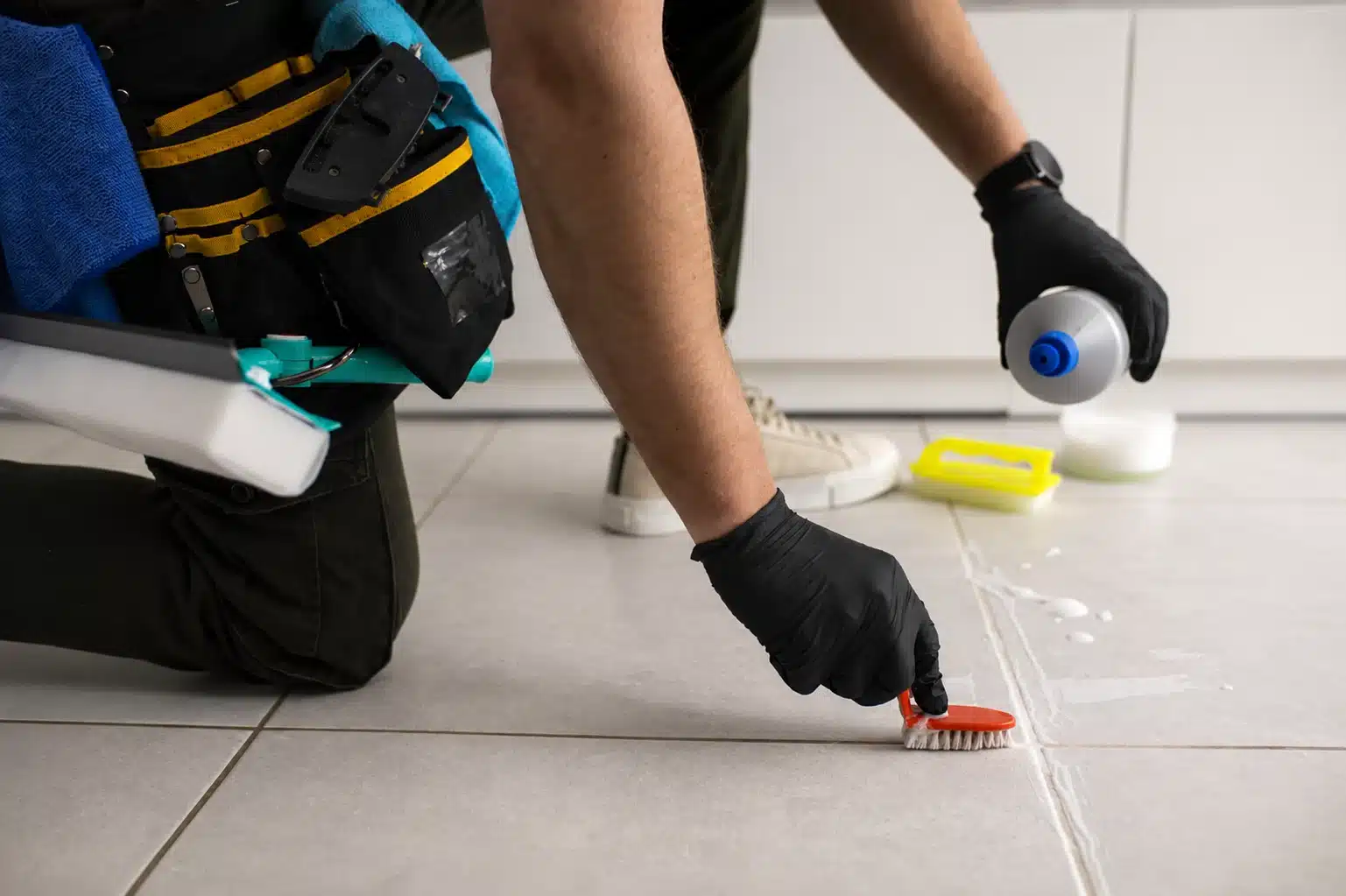
It’s one of the complaints we hear most often when visiting a bathroom in Quebec. The grout looked good at installation, maybe even for a year or two. Then gradually, it began to darken. Today, it’s dark gray, almost black in places — and no matter how many times you scrub it, it looks the same again within a few weeks.
What we’re actually seeing is almost always mold. Not ordinary dirt, not limescale, but microscopic fungi that grow in an environment that’s too humid. The good news is that it’s fixable. The less good news is that scrubbing harder doesn’t fix anything if you don’t address the source of the problem.
At Solutions Rénovation Québec (SRQ), a licensed RBQ contractor (5811-7821-01) based in Lévis, we regularly work in bathrooms where mold has settled into the grout, under the tile, or behind the walls. Most of the time, the problem comes from a combination of insufficient ventilation, poorly suited materials, and curative maintenance that never addressed the real cause.
Here’s what’s really happening — and how to fix it once and for all.
Why does ceramic tile grout turn black?
Mold doesn’t appear by chance. It settles where conditions are favorable: high humidity, lack of air circulation, and a porous surface to cling to. The grout between ceramic tiles checks all these boxes.
In a bathroom typical one, each shower generates a significant amount of water vapor. If this vapor isn’t evacuated quickly and efficiently, it condenses on cold surfaces — walls, ceiling, grout — and moisture settles there. Within a few hours, the spores naturally present in the air find exactly what they need to multiply.
Excessive humidity is the number one cause
Mold develops significantly when the relative humidity level persistently exceeds 60%. In a poorly ventilated bathroom, this threshold is reached within minutes after a shower starts — and can take hours to drop back down if the air doesn’t circulate.
The problem isn’t the shower itself. The problem is the humidity that remains trapped in the room. The water that evaporates has to go somewhere. If it doesn’t exit through a working exhaust fan, it settles on the grout, penetrates the grout, and creates the ideal conditions for a mold colony.
Why Lévis’s climate makes the problem worse
In Lévis, there’s an additional layer to the problem. Ambient humidity is structurally higher than elsewhere due to the proximity of the St. Lawrence River. In winter, homes are sealed tightly — which is necessary for heating, but which concentrates indoor humidity.
In bungalows built before 1990, insulation and ventilation were often not designed to current standards. These homes breathe poorly, accumulate humidity in service rooms, and see mold appear on grout much faster than in recent constructions.
Insufficient ventilation promotes blackened grout
A bathroom fan that doesn’t work properly — or worse, that isn’t connected to the exterior — doesn’t evacuate humidity. It just moves it a little. The vapor-laden air stays in the room, circulates, and eventually condenses where surfaces are coldest.
Many homeowners have an exhaust fan that runs, but that is either undersized for the bathroom’s square footage, or connected to a duct that vents into the attic rather than to the exterior. In both cases, the result is the same: humidity stays in the house and the grout turns black.
RBQ requirements for wet rooms
The Construction Code of Quebec requires that bathrooms be mechanically ventilated with exhaust to the exterior of the building. This isn’t a recommendation, it’s an obligation. An exhaust fan that discharges air into an unheated space or into a crawl space is not compliant — and in practice, it doesn’t solve the humidity problem. A compliant installation, verified by an RBQ contractor, is the foundation of a bathroom that will stay healthy over the long term.
Water infiltration and poorly installed grout
There’s another common scenario we often see in homes 20 years and older: grout that lets water through. Not visibly and suddenly, but slowly, through micro-cracks in the grout or a silicone seal that has come loose around the bathtub or shower.
This water infiltrates the structure — under the tile, into the gypsum or cement board, behind the wall. It stagnates where you can’t see it, and mold settles deep inside. The grout turns black on the surface, but the real problem is hidden behind.
Difference between cementitious grout and epoxy grout
Most bathrooms in Quebec are grouted with a standard cementitious grout. This material is porous by nature. It absorbs humidity, retains soap residue, and offers an ideal surface for mold. It can be sealed, but the sealer degrades over time and must be reapplied regularly.
Epoxy grout, on the other hand, is non-porous and resistant to chemicals and humidity. Once cured, it doesn’t retain water, doesn’t stain easily, and resists mold durably. It’s harder to work with during installation, but in a wet area like a shower or bath, it’s often the best long-term investment.
Why cleaning alone almost never solves the problem
We understand the logic: the grout is black, we grab a strong product, we scrub, and it turns light again. It works — for a few weeks. Then the process starts over. And homeowners find themselves in an endless maintenance cycle that never really solves anything.
This cycle, we see it constantly. People who have tried four or five different products over several years, who have scrubbed dozens of times, and whose grout is still black — sometimes worse than before because the grout has been partially abraded by repeated cleaning.
Myth — «Bleach will solve the problem permanently»
Bleach kills mold on the surface. That's true. But it doesn't penetrate deep into porous grout, and it doesn't act on the spores lodged inside the grout structure. Within a few weeks, if the moisture is still there, the remaining spores — or those carried by the air — recolonize exactly the same areas.
In addition, repeated use of bleach on cementitious grout can chemically damage it, making it even more porous, and accelerate long-term degradation. It's the opposite of what we're trying to achieve.
Why grout turns black again after a few months
If moisture isn't controlled and ventilation is still insufficient, mold inevitably returns. It's a matter of conditions, not cleaning products. As long as water vapor isn't properly evacuated after each shower, spores will find a place to grow.
In some cases, a slow leak behind the wall or under the tub creates permanent moisture that even good ventilation can't counteract. Here, cleaning the grout becomes completely useless — water feeds the mold from the inside, without interruption.
Have you been cleaning the same grout for two years? It's time to find the real source of the problem.
Contact SRQ for a no-obligation inspection → 418-476-1747
How to sustainably prevent moldy grout in a Quebec bathroom
The sustainable solution starts with an honest diagnosis. Not with a miracle product, not with a layer of anti-mold paint, and not with more aggressive cleaning. We identify the source — poorly managed humidity, inadequate ventilation, water infiltration, poor materials — and we fix it properly.
Install genuinely effective ventilation
A good bathroom exhaust fan must be sized according to the room's square footage, connected directly to the outside via an airtight duct, and used for at least 20 minutes after each shower ends. All three conditions are necessary — if even one is missing, the ventilation is suboptimal.
A timer or built-in hygrometer allows the extraction to be automated. The device activates when humidity rises above a certain threshold and stops when it returns to normal — without depending on each family member's habits. It's a simple installation that concretely changes the humidity dynamics in the room.
For homes where humidity is a more general problem, a heat recovery ventilation system (HRV) can be considered. It's a more comprehensive solution that regulates humidity throughout the entire home, not just the bathroom.
Signs that a fan is insufficient
The mirror stays fogged for more than five minutes after you get out of the shower. The ceiling accumulates condensation. There's a persistent musty smell even when the bathroom is clean. These three signals clearly indicate that the air isn't circulating fast enough. The fan in place — if there is one — isn't doing its job properly, or isn't powerful enough for the room's volume.
Use the right materials for wet areas
In areas directly exposed to water — shower floor, around the bathtub, between the joists and the wall — 100 % silicone is the only material to use for movement joints. Not grout, not multi-purpose caulk. Quality silicone stays flexible, waterproof and mold-resistant over the long term.
For joints between tiles in a shower stall or on a wet floor, epoxy grout is the most resistant solution. It does not retain moisture, does not feed mold, and keeps its appearance far longer than cementitious grout, even when well sealed.
Why SRQ recommends certain solutions based on the age of the house
In a 1975 or 1985 bungalow, you don't work the same way as in a recent construction. Structures absorb moisture differently, the substrates under the ceramic may be regular drywall rather than water-resistant board, and the condition of the waterproofing membrane — if it exists — may be uncertain.
Before choosing materials, we check what's happening behind. It's this preliminary diagnosis that avoids installing beautiful new joints on a structure already compromised by moisture.
Fix hidden problems before redoing the joints
If mold is recurring despite regular maintenance, you need to consider that it exists beyond what you see. Mold that systematically returns to the same spot often indicates a structural problem — standing water behind the wall, missing membrane, slow plumbing leak.
In that case, redoing the surface joints is a waste of money. Water will continue to feed the mold from the inside, and the new joints will blacken as quickly as the old ones. The right sequence is: inspect, fix the source, treat if necessary, then renovate.
If significant mold contamination is discovered behind the walls, decontamination by qualified individuals is required before any renovation. This is a service SRQ offers as part of its bathroom renovation projects.
Want an honest assessment of your situation, with no pressure?
Schedule a consultation with SRQ → solutionsrenovationquebec.ca | 418-476-1747
When should you replace the joints or completely renovate the bathroom?
There is a threshold beyond which re-grouting or simply replacing the silicone is no longer enough. It's not always easy to determine on your own — and we understand that homeowners hesitate to call a contractor to hear that they need a complete renovation. We give you the concrete indicators.
The signs that simple cleaning is no longer enough
The joints are cracked or crumbling in places — once the grout loses its physical integrity, it no longer protects anything and lets water in freely. The silicone around the bathtub or shower has come loose, yellowed, or shows mold traces that won't go away. There is a damp or musty smell that persists even after cleaning.
When you press on the shower walls and they feel soft or flexible, that's an alarm signal. It indicates that the substrate behind the ceramic has absorbed water and is probably compromised. At this stage, you no longer repair the joints — you redo the affected section in depth.
Average costs in Quebec in 2026
Re-grouting a standard shower, with no structural problem behind, generally falls between 400 $ and 900 $ depending on the surface area and the type of grout chosen (reasonable estimate). If you add the replacement of the perimeter silicone, expect 100 $ to 250 $ more (reasonable estimate).
A complete bathroom renovation — including removal of the existing ceramic, verification and correction of the substrate, installation of a waterproof membrane, new ceramic and joints, and correction of ventilation — generally falls between 8,000 $ and 20,000 $ depending on the surface area, the materials chosen and the condition of the existing structure (reasonable estimate). It's a significant investment, but it's also the only way to get a durable result in a bathroom with structural problems.
Why repairing early often costs less
A cracked joint that lets water through for two years potentially means saturated drywall, a compromised wood floor, and in some cases mold that has spread through several layers of materials. What would have cost a few hundred dollars to fix in time can easily become a $5,000 $ to $15,000 $ project once secondary damage is included.
We see this regularly — homeowners who put off the repair because it seemed small, and who end up with a major renovation because the water had time to work behind.
Ready to fix the problem once and for all?
Request your free quote → solutionsrenovationquebec.ca | 418-476-1747
Why choose SRQ to fix a moisture or moldy joint problem?
A blackened joint problem is often the visible symptom of a broader problem: inadequate ventilation, water infiltration, unsuitable materials, or compromised structure. Fixing it correctly requires diagnosis, not just execution.
An approach focused on durability and prevention
At SRQ, we don't install new joints over an unresolved problem. We start by understanding what's really happening in the bathroom: the state of the ventilation, the presence of a waterproof membrane, the condition of the substrate behind the ceramic, and the evolution of moisture in the room.
The materials we choose are selected for the real conditions of the house — not to minimize installation cost. In a Quebec bathroom that will see ten more winters, we prefer to use the right products from the start.
Renovations that reflect the realities of Quebec
Homes in Lévis and the Chaudière-Appalaches region have their own particularities. Bungalows built between the 1960s and 1990s often have ventilation that has never been updated. Some still have exhaust fans that vent into the attic. Others have deficient insulation around wet areas, which creates thermal bridges and condensation in places that are difficult to reach.
We take all of this into account before proposing a solution. The goal is for the renovation to hold up under our climate conditions — freeze-thaw, winter humidity, aging homes — not just under ideal conditions.
What distinguishes SRQ from improvised contractors
The difference comes down to a few concrete elements. SRQ operates under RBQ license 5811-7821-01, under the direct responsibility of Marco Savoie. Every project is covered by a 5-year labour warranty. With over 500 projects completed in the region, we have seen just about every possible bathroom configuration — and we know what to look for before starting.
Our worksites are clean and organized. We protect adjacent areas, we work in order, and we do a final review before leaving. There are no hidden fees, no surprises during the project. The quote we give you at the start is what we bill at the end.
Are you in Lévis, Charny, Saint-Romuald or the surrounding area? Request your estimate visit — it's free, there's no pressure, and it gives you a clear picture of your situation.
Contact SRQ → 418-476-1747 | srq.quebec@gmail.com | solutionsrenovationquebec.ca
Frequently asked questions about blackened ceramic tile grout
Why does my grout turn black despite cleaning?
Because cleaning eliminates mold on the surface, but not the conditions that cause it to appear. If humidity remains high after every shower and ventilation is insufficient, spores will recolonize the grout within a few weeks. The durable solution involves correcting the source — ventilation, materials, or water infiltration — not a more aggressive cleaning routine.
Is it dangerous for your health?
Some molds produce mycotoxins that can cause respiratory irritation, allergies or more serious reactions in sensitive individuals, children and the elderly. Visible mold in grout can indicate more significant contamination behind the walls — and that is where the concentration of spores in the air can become genuinely concerning for indoor air quality.
Is vinegar or bleach enough?
They can temporarily reduce visible mold. But neither one solves a persistent humidity problem. Bleach does not penetrate deeply into porous grout, and vinegar, although less aggressive on the material, has limited effectiveness against well-established mold. If the grout turns black again in less than two months despite these treatments, it's a sign that you need to look further.
When should grout be redone?
When the grout is cracked, crumbling or has lost its waterproofing. When the perimeter silicone is peeling, yellowed or contaminated deep down. Or when mold keeps coming back in the same spot despite good ventilation — which suggests water infiltration behind the surface.
Is epoxy grout worth the cost?
In areas directly exposed to water — shower, around the bathtub, bathroom floor — yes, without hesitation. Epoxy grout is non-porous, does not absorb moisture, resists chemicals and does not feed mold. It costs more to install, but it lasts much longer and requires no sealer or special maintenance.
Is this a common problem in Lévis?
Yes, particularly in homes built before the 2000s. Riverside humidity, long winters when homes are sealed tight, and often outdated ventilation systems create conditions favorable to mold in damp rooms. It's one of the most frequent problems we see during our inspection visits in the region.
Can poor ventilation cause mold?
It's actually the most frequent cause. Without effective evacuation of humid air after a shower, the relative humidity level in the bathroom can exceed 80 or 90 % for hours. That's well beyond the 60 % threshold at which mold actively develops. A properly sized fan, vented to the outside and used 20 minutes after each shower, radically changes the situation.
Should all the tile be replaced?
Not necessarily. If the tile itself is in good condition and well adhered, and the problem is limited to the joints, a complete regrouting may be enough — provided the source of humidity is addressed at the same time. If the structure behind is compromised or if water has penetrated the substrate, a partial or complete removal will be necessary before properly reinstalling everything.
How much does regrouting cost?
Generally speaking, regrouting a standard shower ranges between 400 $ and 900 $ depending on the configuration and materials (reasonable estimate). This price may vary if repairs to the substrate are necessary or if epoxy grout is chosen. An on-site estimate visit is the only way to get an accurate and honest figure.
When should you call an RBQ contractor?
As soon as mold returns despite your efforts. As soon as you suspect water infiltration behind the walls. As soon as the joints are cracked, the walls are shifting under pressure or there is a persistent odor. A licensed RBQ contractor can inspect, diagnose and propose a suitable solution — and guarantee the work performed.
Solutions Rénovation Québec — RBQ Licence 5811-7821-01 2552 chemin du Fleuve, Lévis, Québec G6W 1Y3 418-476-1747 | srq.quebec@gmail.com | solutionsrenovationquebec.ca Monday to Friday, 8 a.m. to 5 p.m.