
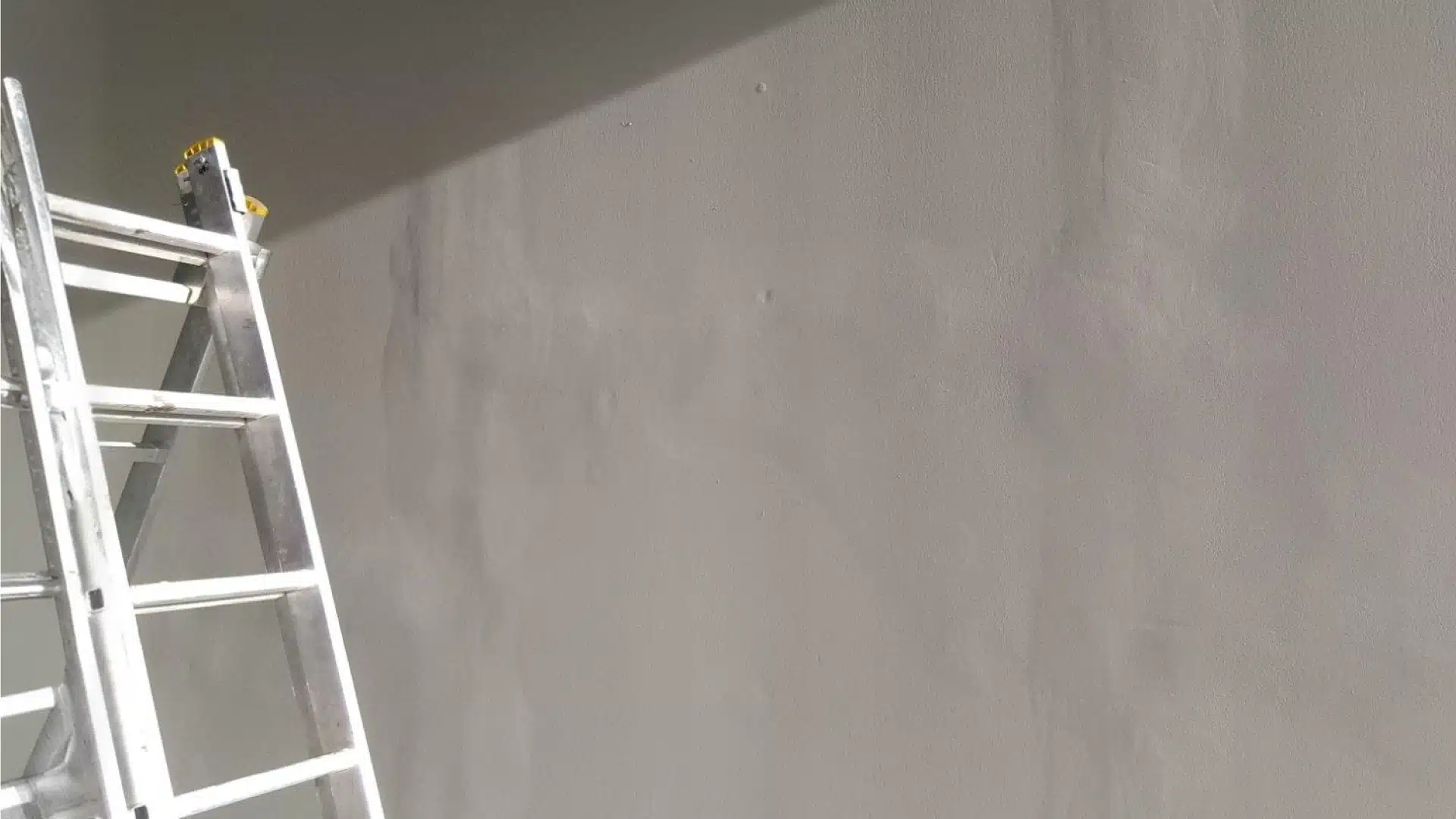
You have just had new drywall installed, and at the first good raking light, the verdict is in: bumps, joints that stand out, ripples, visible screw heads. It's disappointing, and it's legitimate to wonder why. The short answer: a well-done drywall wall should be smooth and uniform — bumps almost always betray a problem with preparation, installation or finishing.
The good news is that most of these defects can be corrected. But you still need to understand where they come from to prevent them from returning after the repair.
In Saint-Henri, in the Lévis area, the region's humidity and seasonal variations can also play a role. At Solutions Rénovation Québec (RBQ license 5811-7821-01), we install and repair drywall with careful finishing. In this article, we explain the causes of bumps and how to achieve a truly smooth finish.
Is bumpy drywall normal after installation?
Let's be clear: no, new drywall should not be bumpy. Well-done work gives a smooth, flat and uniform surface, with no protruding joints or visible screw heads. Bumps are a sign that something was lacking.
That said, it's important to qualify this depending on the light. Some small defects only appear under very specific raking light — a side window at sunset, for example. This is what is called «critical lighting,» and it can reveal minor imperfections that would not otherwise be seen.
The distinction is important: a generally smooth surface with very slight variations visible only at an extreme angle is one thing. Pronounced bumps, prominent joints or ripples visible to the naked eye are another. The latter indicate a real finishing problem to be corrected.
The most common visible defects
Certain defects often recur on poorly finished drywall. Joints that stand out (too much compound or poorly spread), visible or «popping» screw heads, bumps and hollows, ripples, paper tape that lifts or blisters.
We also see abrupt transitions between sheets, uneven sanding, or non-uniform texture. Each of these defects has a specific cause related to installation or finishing. Recognizing them helps to understand what went wrong — and how to correct it properly.
When should you worry?
Not all defects are equal. A purely aesthetic issue — slight finishing imperfections — is corrected by surface treatment and has no long-term consequence.
Other signs deserve more attention, because they can point to an underlying problem: bumps accompanied by cracks, signs of humidity, drywall that warps, or defects that worsen over time. Here, it's no longer just about finishing — there may be a structural, humidity or installation problem to address. An evaluation helps distinguish the cosmetic from the structural.
Aesthetic bumps or a more serious problem?
Before simply sanding again, it's better to know what you're dealing with. Have your drywall evaluated by Solutions Rénovation Québec — especially if the bumps are accompanied by cracks or signs of humidity.
Why does drywall become bumpy?
Bumps don't come out of nowhere. They have specific causes, spread across installation, finishing, the substrate and sometimes humidity. Let's look at the main ones.
Poor preparation or installation of the sheets
Some of the defects come from the installation stage. Inadequate spacing between sheets, improper screwing (screws driven too deep that tear the paper, or not enough), or poorly aligned sheets create irregularities from the start.
Insufficient fastening to the studs also leaves play, which promotes movement and defects. These installation errors then carry through to the entire finish: a poorly installed panel is difficult to make perfectly smooth. The quality of the final result is largely decided at this stage.
Problems related to joint taping
Joint taping (the «tape and mud») is the most decisive step for a smooth finish — and the most demanding in terms of skill. This is often where bumps are born.
The classic mistakes: too much joint compound applied at once, an insufficient number of coats, incomplete drying between coats, poorly applied paper tape, or poor feathering (the gradual thinning of the compound toward the edges). Each of these mistakes leaves a visible trace. Good joint taping requires patience and technique — it's a trade in itself.
Why sanding and finishing are decisive
Sanding is the last line of defense for a smooth finish. Uneven, insufficient or overly aggressive sanding ruins the work of the previous steps.
Too little sanding leaves the bumps; too much sanding gouges the surface or exposes the paper. Uniform sanding, with good lighting to spot defects, makes all the difference. It's a step that is never rushed, because it is what reveals — or masks — the quality of the finish. Raking light during sanding helps to track down every imperfection.
The impact of humidity and temperature variations
Our climate can also play a role. Significant variations in humidity and temperature affect joint compound, especially during drying. A compound that dries poorly — in a room that is too humid, too cold or poorly ventilated — does not harden uniformly.
In Saint-Henri and Lévis, the region's humidity and seasonal swings can contribute to these defects if installation conditions are not controlled. A well-managed job site takes ambient temperature and humidity into account so that the compound dries properly. It's a factor that is often overlooked, but real in our climate.
Each cause requires a different correction
Resanding without understanding the cause is risking the bumps coming back. Request an inspection from Solutions Rénovation Québec — the real origin of the defects is identified before correcting them.
Can bumps hide a more serious problem?
Most of the time, a bumpy drywall is a finishing problem. But not always. You need to know how to recognize the cases where the bump is the symptom of something else.
When the surface reveals a structural issue
Some bumps betray a problem under the drywall rather than a finishing defect. A movement of the structure, twisted or misaligned studs, an issue at the ceiling or framing level can deform the surface.
In these cases, the bump follows a defect in the substrate, not the compound. Resanding would fix nothing, because the problem is behind the drywall. This is why an evaluation that goes beyond the surface is sometimes necessary — to verify that the structure and framing are sound before correcting the finish.
The role of humidity in Lévis homes
Humidity deserves particular attention in our homes. An infiltration, condensation or excessive humidity can cause the drywall to swell or deform, creating bumps or ripples.
Why an inspection is sometimes necessary
When bumps are accompanied by signs of humidity — stains, warping drywall, moldy smell — the source must be found before repairing. Correcting the finish without addressing the humidity guarantees a recurrence: the drywall will bump again, and a mold problem can develop behind. An inspection allows verifying whether there is a humidity cause to treat first. You never close a wall on an active humidity problem.
Can a bumpy drywall be corrected without redoing everything?
Good news: in most cases, yes. A bumpy drywall is generally corrected without demolishing the walls. It all depends on the extent and the cause. Let's look at the options.
The possible corrections
For finishing defects, several targeted corrections deliver excellent results. Joint compound can be re-applied, additional coats of compound added to level, sanded uniformly, a skim coat applied (a thin layer of compound over the entire surface to even it out), or a uniform texture redone.
These interventions restore a smooth finish without replacing the drywall. The skim coat, in particular, is an effective technique for evening out an irregular surface. Done well, these corrections produce a wall that looks new — because aesthetically, it is.
When partial replacement is preferable
In some cases, it's better to replace a section. Drywall damaged by moisture, a poorly installed or overly warped sheet, or an underlying structural problem may justify a partial replacement rather than a simple surface repair.
When the panel itself is the issue — swollen, torn, poorly secured — sanding isn't enough. The affected section is removed, whatever is behind it is corrected as needed, and it is reinstalled properly. It's more work, but sometimes it's the only real solution. An assessment determines whether surface repair is sufficient or whether replacement is necessary.
Why surface preparation is essential before painting
Here's a point many people overlook: paint doesn't hide drywall defects — it reveals them. A bumpy painted surface stays bumpy, and lighting makes every imperfection stand out even more.
That's why surface preparation must be complete before painting: smooth finish, uniform sanding, appropriate primer. A good primer evens out absorption and prepares the surface for a flawless finish. Painting over poorly finished drywall wastes paint and locks in the defects. The quality of the finish is decided before the first roller stroke.
A professional finish makes all the difference
Drywall is a trade where detail shows. Request a quote from Solutions Rénovation Québec — defects are corrected and a surface ready to paint is delivered, truly smooth.
How much does repairing bumpy drywall cost in Saint-Henri?
The cost depends on the extent of the defects and the surface area to be treated. Here are some benchmarks, to be taken as rough estimates (indicative estimates that vary by case, and not guaranteed rates).
Localized repair
To correct isolated defects — redoing a few joints, leveling bumps, sanding an area — expect often in the range of 300 $ to 1,500 $ (indicative estimate), depending on the extent and access.
Complete finishing redo
For a complete redo — skim coat over an entire room, general refinishing of walls and ceilings — expect rather a range in the order of 1,500 $ to 5,000 $ and up (indicative estimate), depending on the area and the desired level of finish.
What influences the price
Several factors affect the bill: the area affected, the extent of the defects, the number of coats required, the presence of a moisture or structural problem to correct, the desired level of finish (a high-end finish requires more work), and accessibility. A slightly irregular wall costs little to repair; an entire room to refinish with a flawless finish requires more. That's why the actual condition is assessed before providing a quote.
Why entrust your drywall work to an RBQ contractor in Lévis?
Drywall looks simple, but a truly smooth finish requires experience. The choice of contractor makes the difference between a flawless wall and bumps that come back.
Finishing, a skill often underestimated
Installing a sheet of drywall, almost anyone can do it. Finishing it perfectly is another trade. Joint compound application, feathering, uniform sanding, managing drying conditions: these are skills acquired through experience.
That's precisely where the difference between an amateur wall and a professional wall is decided. A smooth, uniform finish that holds up under all lighting can't be improvised. This expertise is brought to every project, because we know that drywall is what you see first in a room.
An approach adapted to the Quebec climate
Our climate influences the drying of compound and the behavior of drywall. Ambient humidity and temperature are taken into account so the compound dries properly, and methods suited to our conditions are chosen.
This attention prevents many defects related to poorly controlled drying. Drywall finished under the right conditions stays smooth over time; drywall finished hastily in a room that's too humid can develop problems. We know these realities and work accordingly.
Our commitments
We operate under RBQ license 5811-7821-01, led by Marco Savoie, with more than 500 projects completed, more than 10 years of combined experience and a 5-year warranty on labor. We focus on a free estimate, transparent pricing and a clean worksite. These commitments protect you and ensure work done by the rules.
Get a flawless finish the first time
A beautiful wall starts with careful finishing. Request a free, no-obligation estimate from Solutions Rénovation Québec — a surface ready to paint is delivered, up to standard.
Myths and realities about bumpy drywall
A few preconceived ideas deserve to be corrected. Here is the truth from the fiction.
«Paint will hide the bumps.»
Reality: it's the opposite. Paint, especially under raking light, reveals defects instead of hiding them. Bumpy drywall must be corrected before painting, never masked by color.
«Bumpy drywall is just cosmetic.»
Reality: most of the time, yes — but bumps with cracks, moisture or warping can signal a structural or moisture problem. It must be checked before concluding it's purely cosmetic.
«Sanding is always enough.»
Reality: sanding corrects certain defects, but not those coming from the substrate, a poorly installed panel or moisture. Depending on the cause, joints sometimes need to be redone, a skim coat applied or a section replaced.
«Anyone can finish drywall.»
Reality: installing drywall is accessible, but finishing it perfectly is a skill. Joint compound application and uniform sanding require experience — that's what distinguishes an amateur wall from a professional wall.
FAQ – Bumpy drywall in Saint-Henri
Why does my new drywall have bumps?
Most often due to the finishing: too much joint compound, poorly done taping, uneven sanding, or poorly installed sheets. Sometimes humidity or a substrate problem is the cause. A well-finished drywall should be smooth — bumps reveal a missed step.
Will the bumps disappear with paint?
No, on the contrary. Paint reveals defects rather than hiding them, especially under raking light. The drywall must be corrected — redoing joints, skim coat, sanding — and properly primed before painting to achieve a flawless finish.
How can you tell if the problem is structural?
The clues: bumps accompanied by cracks, drywall that warps, signs of moisture, or defects that worsen over time. If the bump follows a defect in the substrate (twisted stud, structural movement), sanding alone won't be enough. An inspection allows you to check what is happening behind.
Can it be repaired without redoing the entire wall?
In most cases, yes. The joints can be redone, a skim coat applied, sanded and refinished without replacing the drywall. Partial replacement is only necessary if a panel is damaged by moisture, too deformed, or if there is a structural problem behind it.
What is a skim coat?
It is the application of a thin layer of joint compound over the entire surface, to even it out and eliminate irregularities. It is an effective technique for restoring a smooth finish to a bumpy wall without replacing it. Done properly, it provides a surface ready to paint, uniform under all lighting.
How much does repairing bumpy drywall cost?
As a guideline, a localized repair can range between $300 and $1,500, and a complete refinishing between $1,500 and $5,000 and more (indicative estimates, not guaranteed). The cost depends on the surface area, the extent of the defects and the level of finish. An evaluation provides a fair price.
Can moisture cause bumps?
Yes. An infiltration, condensation or excessive humidity can cause drywall to swell or deform. If the bumps are accompanied by signs of moisture, the source must be addressed before repairing — otherwise the problem returns, and mold can develop behind.
Is an RBQ contractor necessary for this work?
It is not mandatory for small touch-ups, but for a professional and durable finish, experience makes all the difference. A RBQ contractor master of joint taping, sanding and drying management, and offers a guarantee. For a truly smooth finish, it's worth the investment.
Bumpy drywall can be fixed — but it starts with the right diagnosis
Ultimately, bumpy drywall after installation is not normal, but it's not inevitable either. In the vast majority of cases, it's a finishing problem that can be corrected without redoing everything — redoing joints, skim coat, uniform sanding and good preparation before painting.
The key is to understand the cause before repairing. Most bumps come from installation or finishing, but some hide a substrate or moisture problem — especially in our homes in Lévis exposed to seasonal variations. Correcting the surface without addressing a moisture cause guarantees a recurrence.
And remember this: paint never hides defects, it reveals them. A truly smooth finish is decided before the first roller stroke, in the quality of the drywall finishing. It's a know-how that makes all the difference between an ordinary wall and an impeccable wall.
Is your drywall bumpy in Saint-Henri or Lévis?
Request a free, no-obligation estimate from Solutions Rénovation Québec or call us at 418-476-1747. We evaluate your walls, identify the cause of the bumps, and deliver a smooth finish ready to paint, in accordance with RBQ rules — with no obligation.