
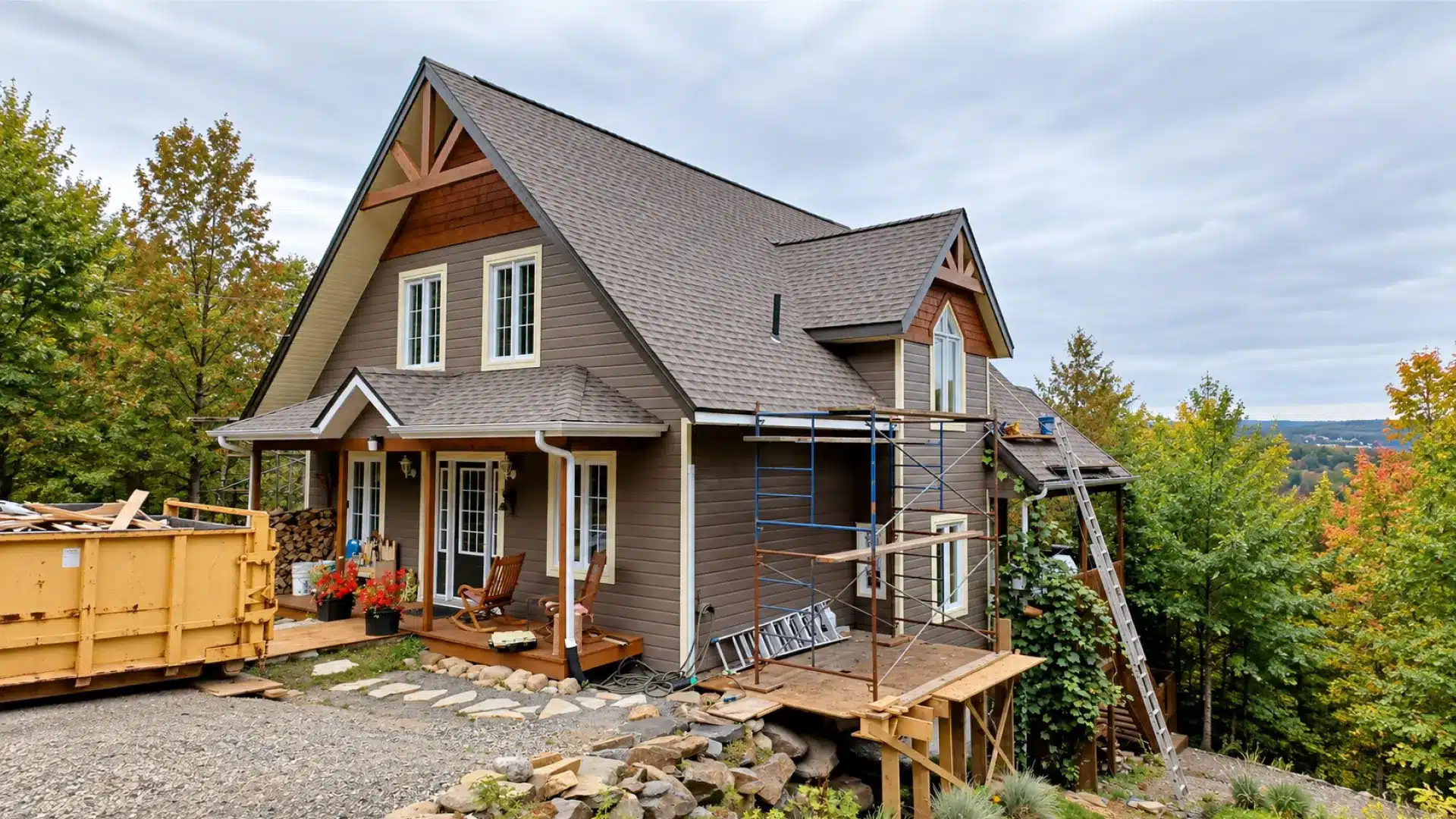
For several years now, one word keeps coming up in conversations among property owners in Lévis: the moratorium. Many are worried: «Does this mean I can't do anything anymore on my property?» The short, reassuring answer: no, the vast majority of residential renovations remain permitted.
The moratorium is primarily aimed at curbing new developments that would overload wastewater treatment plants. A renovation that does not add to this load — redoing a kitchen, a roof, a basement — is generally not affected in the same way.
At Solutions Rénovation Québec (RBQ license 5811-7821-01), we support owners of bungalows and homes 25 years and older in this regulatory context. In this article, we untangle what the moratorium really changes for your projects — and what it does not change.
Note: municipal rules evolve. The information below reflects the known state of the file; always validate your specific case with the City of Lévis before undertaking work.
The construction moratorium in Lévis: what exactly is it?
The Lévis moratorium is not a general ban on renovating. It is a targeted measure, linked to a very specific issue: the capacity of wastewater treatment plants.
The high number of new constructions has put pressure on the wastewater treatment plants in the Desjardins and Saint-Nicolas sectors, which forced the City to adopt a moratorium. In other words, the City grew quickly, and the wastewater infrastructure reached its limit.
The moratorium affects a large part of the territory. Growth has placed significant pressure on the stations serving the sectors of Lévis, Pintendre, Charny, Saint-Nicolas, Saint-Rédempteur and a portion of Saint-Étienne-de-Lauzon. The City specifies, however, that public infrastructure is not included: permits may be granted for hospitals, schools, early childhood centers or social housing.
The objective is clear: avoid overloading an already strained system, while the necessary work is carried out. This is why the measure mainly targets new developments that would add load to wastewater — not the maintenance of existing homes.
Why the moratorium does not mean a complete halt to renovations
Here is the most important point for property owners: a distinction must be made between new construction and the renovation of an existing home. The moratorium targets the former, not the latter.
The regulations prohibit certain projects likely to create needs exceeding the capacity of the wastewater treatment stations in Desjardins and Saint-Nicolas. The key is this notion of additional load on wastewater. An interior transformation or a renovation that does not add a new »door» or wastewater flow does not create this excess need. The City has also relaxed its measure in this regard: it is notably possible to rebuild a main building that does not require an increase in the quantity of wastewater flows and loads.
The main dates to remember
Here are the milestones in the file. The moratorium was decreed on November 29, 2024, over two-thirds of the City's territory. On March 24, 2025, the City announced relaxations, governed by provisional regulations. These provisional regulations are a temporary measure, with a maximum duration of two years, which may be repealed or renewed as needed.
Going forward, the City's plan provides for a possible renewal of the moratorium, with an end envisioned around November 2028, and upgrade work on the stations that would continue until approximately 2029. These deadlines may change depending on the progress of the work, so they should be confirmed with the City.
Is your property in an affected sector? Have your project's eligibility verified free of charge.
The best way to know is to verify. Request a consultation with Solutions Rénovation Québec — we help you see whether your project is affected and validate your situation before investing.
Which renovation projects generally remain permitted?
This is the question everyone is asking. The good news is that most common renovations are not affected by the moratorium, because they do not increase the load on wastewater.
Let's look at what generally goes through without a problem, and what requires a more thorough verification.
Renovations usually little affected
The majority of improvement projects on an existing home do not create new wastewater needs. Redoing a kitchen or a bathroom (without adding new installations that significantly increase the load), finishing a basement, replacing a roof, changing the windows, redoing the exterior cladding, improving insulation, painting, installing new floors: these are maintenance and modernization work, not development.
A patio that does not increase the hydraulic load also falls into this category. These renovations aim to improve and protect a home that already exists, without adding pressure on infrastructure. They generally remain possible — but a municipal permit may still be required depending on the nature of the work, as under normal circumstances.
Projects that may require a more in-depth analysis
Some projects, however, deserve careful verification, because they could increase the load on wastewater. This is the case for an extension, the addition of a dwelling, an intergenerational dwelling, or the conversion of a building.
These projects often add new plumbing fixtures or new dwelling units, which is precisely what the moratorium governs. That doesn't mean they are automatically refused — but they require a case-by-case analysis.
Why each file is evaluated individually
The moratorium does not work with ready-made answers. The City's director general also indicated that there could be particular exception cases, examined each time a file is submitted.
That is why the urban planning, zoning, permit and compliance of your specific project must be verified individually. Two similar projects can have different answers depending on their sector and their real impact on wastewater. Hence the importance of validating your case rather than assuming.
How to know if your project is affected?
Rather than relying on a general impression, a few concrete checks will tell you where you stand. This is the step to take before investing a cent.
Here's how to proceed — and the mistakes to avoid.
The essential checks before investing
First, identify your sector. The City of Lévis provides an interactive map : if your building or your land is in a blue zone, it is covered by the interim regulations. That's the starting point.
Next, you need to check the zoning, the permit requirements and, depending on the project, the need for an authorization certificate and plans. An RBQ contractor can support you in these steps and help you understand what applies to your case. This upfront verification avoids unpleasant surprises and allows you to plan on a solid basis.
Common mistakes made by homeowners
The most common mistake is starting work without a permit, assuming that «it should be fine.» Even outside the moratorium, many types of work require a permit, and skipping this step exposes you to notices of non-compliance.
The other mistake is interpreting the moratorium too broadly — either by thinking that everything is prohibited and unnecessarily postponing permitted work, or by assuming that nothing applies and forgetting municipal requirements. The reality is nuanced: neither a total freeze nor an absence of rules. The right approach is to verify your specific situation.
Get an assessment of your project before submitting your permit application.
A well-prepared project goes through more smoothly. Have your project evaluated by Solutions Rénovation Québec before submitting your application — we help you put together a compliant and complete file.
The impacts of the moratorium on homeowners in Lévis
The moratorium has concrete effects, but not the ones people often imagine. It mainly slows new development, while pushing many homeowners to rethink their current home.
Let's look at both sides.
Postponed projects
The projects actually affected are those that add load to wastewater: major expansions , new construction, duplexes, and accessory dwelling units. For these projects in the targeted sectors, the moratorium imposes a pause or an in-depth analysis.
This postponement is frustrating for those who had these plans, we understand. But it only concerns a portion of residential projects — and often, there are ways to achieve similar goals differently.
Why many homeowners are now choosing to renovate
Faced with the moratorium, many homeowners are making a smart choice: rather than expanding or moving, they renovate what they already have. And that works out well, because it's often the best investment anyway.
Modernizing your home, optimizing existing space, improving value and energy efficiency, extending the building's lifespan: these goals can be achieved without adding load to wastewater. The moratorium then becomes a trigger to invest wisely in your current property.
Transform rather than expand
The key idea is to transform instead of expanding. An unfinished basement becomes a complete living space. A rethought interior layout frees up space you thought you lacked. Underused rooms find a new purpose.
This interior optimization often allows you to get what you were looking for — more space, more comfort — without building a new «door» or touching wastewater. It's a concrete and permitted response to the current context.
The advantages of investing in renovation despite the moratorium
Far from being a pure constraint, the current context is a good opportunity to focus on the work that really matters. Here's why renovating now makes sense.
Work that protects your investment
Some renovations shouldn't wait, moratorium or not. These are the ones that protect the house: roofing, insulation, moisture management, siding, foundations, and drainage.
In our climate, freeze-thaw cycles and moisture constantly attack the building envelope. An ignored infiltration or deficient insulation costs more and more over time. These types of work preserve your home's value and prevent major damage — it's the kind of investment that pays off by avoiding losses.
The renovations offering the best return on investment
Other renovations improve both your daily life and the property's value. The kitchen and bathroom are classics that appeal to buyers and enhance a home's appeal.
Energy efficiency improvements offer a double advantage: more comfort and lasting savings on bills. And a nice patio or deck adds a appreciated outdoor living space. Well chosen, these projects combine immediate pleasure and long-term value.
Grants still available
Good news: assistance programs still exist for certain types of work, particularly in energy efficiency. Programs like Rénoclimat and other initiatives can support eligible renovations.
Important: programs and their criteria change, so verify current eligibility with the organizations concerned. Combining a useful renovation with government assistance can reduce the net cost of work like insulation. It's worth checking before you start.
Take advantage of the moratorium to modernize your property rather than postponing your projects.
The right time to improve your home is often now. Discuss your project with Solutions Rénovation Québec — we help you target the renovations that truly add value.
Myths or realities?
The moratorium has generated its share of false beliefs. Let's sort out fact from fiction.
«The moratorium blocks all renovations.»
False. The moratorium targets projects that increase the load on wastewater, especially new construction and expansions. The vast majority of renovations to an existing home are not affected in the same way.
«No permits are being issued in Lévis.»
False. The City continues to issue permits, including for renovations and public infrastructure. The moratorium regulates certain specific projects; it does not freeze all activity.
«All exterior work is prohibited.»
False. Roofing, siding, windows, and a patio that does not increase the hydraulic load generally remain possible. These are maintenance work, not development that adds to wastewater.
«Homes automatically lose value.»
False. On the contrary, in a context where new supply is constrained, existing homes that are well maintained and renovated retain all their appeal. An investment in your property remains relevant.
«Waiting for the end of the moratorium is always the best strategy.»
False. Postponing essential work — a roof, insulation — to wait lets problems get worse. And most renovations are permitted right now. Waiting often has no advantage.
Why call on an RBQ contractor during this period?
In a changing regulatory context, a contractor who knows the local rules becomes a valuable ally. They help you avoid missteps and help you move forward with peace of mind.
The regulatory support offered by SRQ
We know the Lévis context and we follow the evolution of the rules. Concretely, we analyze your project to see if it is affected by the moratorium, we ensure its compliance, we help prepare the necessary documents and we facilitate communication with the municipality.
This support saves you time and reduces the risk of submitting a project that will be refused. You start off on the right foot, with a solid file.
Planning that reduces risks
Good planning protects your budget and your timeline. By clarifying from the start what is permitted, what requires a permit and how to proceed, we avoid unpleasant surprises along the way.
This complete management — from budget to compliance — allows you to move forward with confidence, knowing that your project respects the rules in force.
The advantages of working with Solutions Rénovation Québec
We operate under RBQ licence 5811-7821-01, led by Marco Savoie, with a 5-year warranty on labour and more than 500 projects completed. We focus on transparent prices, a clean worksite and clear communication. In a context where compliance matters more than ever, these commitments make a real difference.
Discuss your project with an RBQ contractor before committing to significant expenses.
Good advice upfront is worth its weight in gold. Talk to a contractor from Solutions Rénovation Québec before committing to expenses — we make sure your project is on the right track.
How SRQ helps homeowners affected by the moratorium
Our role is to help you bring your project to life while respecting current rules. Here is how we support homeowners in this context.
We start with a preliminary verification of your project, to find out if it is affected by the moratorium. If an expansion turns out to be blocked, we explore alternative renovation solutions and focus on optimizing existing spaces — transform rather than expand.
We can also plan the work in phases, support you in the permit procedures, and ensure compliance with municipal requirements at each step. All with materials suited to our Quebec climate, for renovations that last. The goal: that you move forward, despite the context, on solid and compliant foundations.
FAQ – Construction and renovation moratorium in Lévis
Does the Lévis moratorium prohibit all renovations?
No. The moratorium mainly targets projects that increase the load on wastewater, such as new construction and expansions. The vast majority of renovations to an existing home — kitchen, bathroom, basement, roof — are not affected in the same way. Validate your specific case with the City.
Which sectors are currently affected?
The moratorium affects a large part of the territory, including sectors served by the Desjardins and Saint-Nicolas stations — namely Lévis, Pintendre, Charny, Saint-Nicolas, Saint-Rédempteur and a portion of Saint-Étienne-de-Lauzon. The City offers an interactive map to check if your lot is affected.
Can I redo my kitchen or my bathroom?
Generally yes. Redoing a kitchen or a bathroom in an existing home is renovation work that usually does not add significant load to wastewater. A municipal permit may be required depending on the work, but these projects generally remain possible.
Can I build a patio during the moratorium?
Generally yes. A patio that does not increase the hydraulic load is not affected by the moratorium, which targets wastewater. A permit may be required depending on the size and configuration of the patio, as in normal times. Check with the City of Lévis.
Is an expansion still possible?
It depends. An expansion that increases the load on wastewater may be affected by the moratorium in the sectors concerned. Each file is evaluated individually, and exceptions are examined on a case-by-case basis. A verification with the City is essential.
Do I need a permit for my project?
Often yes, moratorium or not. Several types of work — structure, expansion, certain exterior work — require a permit in normal times. The moratorium adds a layer of verification for projects affecting wastewater. The best approach is to validate each project with the City.
Does the moratorium influence the value of my property?
Not negatively, in general. In a context where the supply of new construction is slowed, well-maintained existing homes retain all their appeal. Renovating your property remains a relevant investment for its value.
How can Solutions Rénovation Québec help me?
We check if your project is affected by the moratorium, we propose compliant solutions (including the optimization of existing spaces), we support you in the permit procedures, and we carry out your work in compliance with municipal rules. All under RBQ licence, with warranty.
Get a free quote and discover which renovations are possible for your property in Lévis.
Conclusion – The moratorium slows development, not your renovation project
In the end, the Lévis moratorium is far less restrictive than one might think for a homeowner. It aims to protect wastewater infrastructure by slowing new developments — not to prevent the maintenance and modernization of existing homes.
The vast majority of renovations remain permitted: kitchen, bathroom, basement, roofing, insulation, siding, patio without additional load. The key is to verify your specific case with the City and to distinguish what increases the load on wastewater from what does not.
And in this context, transforming rather than expanding often becomes the winning strategy. An RBQ contractor who knows the local rules helps you move forward with peace of mind, target the right work and stay compliant. The moratorium is not a reason to postpone — it is often a good opportunity to invest wisely in your current home.
Request your free quote from Solutions Rénovation Québec or call us at 418-476-1747. We check what is possible for your property in Lévis, we advise you honestly, and we support you in a compliant project — with no obligation.