
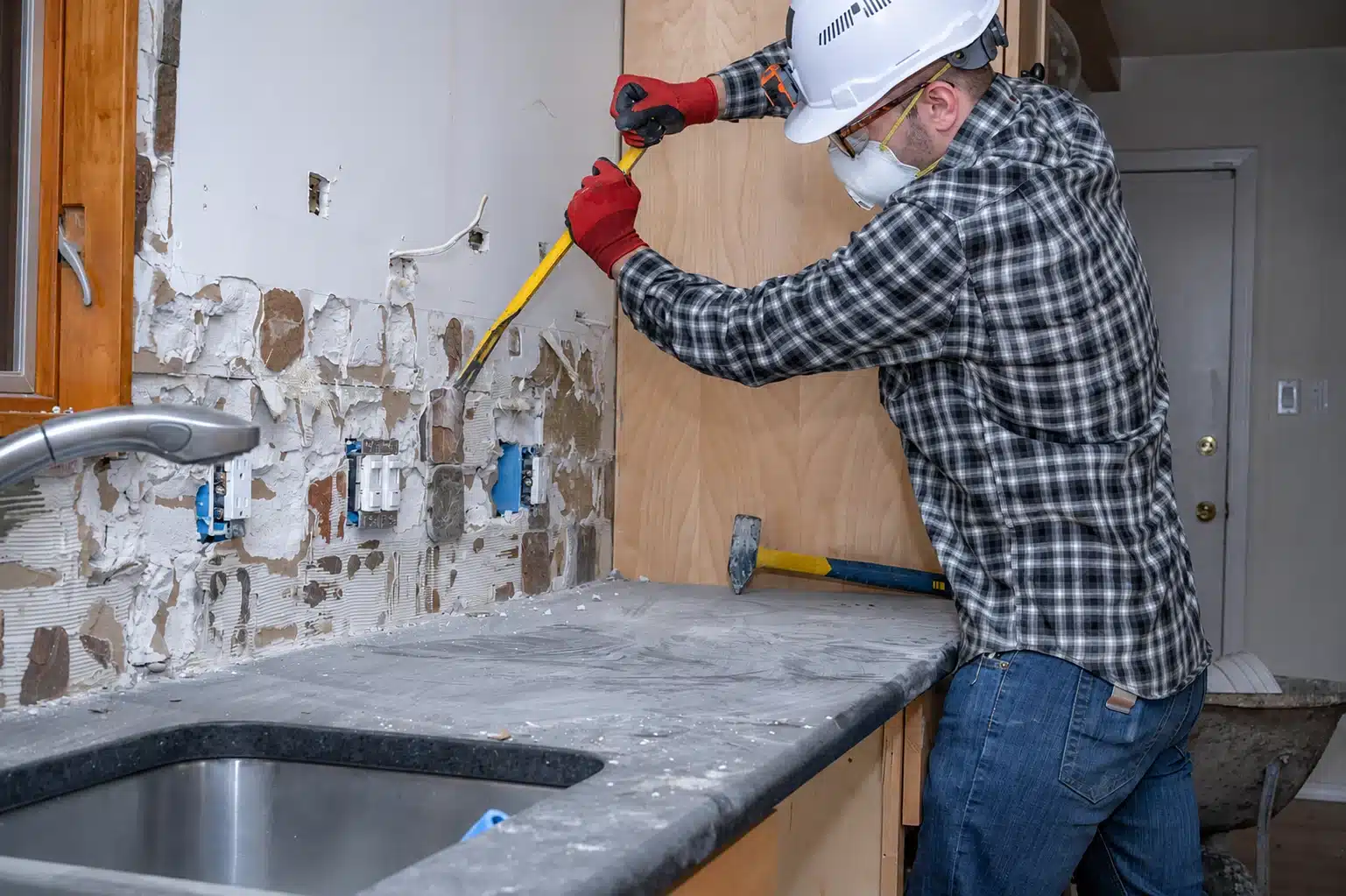
A kitchen backsplash that starts to peel off after a few months is disappointing — especially when the renovation has just been done. Tiles that warp slightly, corners that give way, grout that cracks: this is not normal wear and tear. It is almost always the sign of an installation that was not done correctly from the start.
In kitchens of homes built between 1950 and 1980 — and there are many in the Lévis area — walls are often made of old drywall or plaster, two substrates that require serious preparation before receiving ceramic tile. Add cooking steam that accumulates daily, sometimes insufficient ventilation, and a quick installation without a waterproof membrane, and you have the ideal conditions for a backsplash that fails in less than a year.
The most common causes of a kitchen backsplash that peels off
Peeling is always a symptom. The real cause is almost always hidden behind the wall — in the preparation of the substrate, the type of adhesive used, or the absence of protection against moisture. Identifying the right cause is what distinguishes a lasting repair from a job that will need to be redone in two years.
Here is what is most often found when inspecting a defective backsplash in the Lévis area.
Poor wall preparation — inadequate substrate
This is the number one cause. In quickly renovated kitchens, the tiler often installs the ceramic directly on the existing wall without checking the condition of the substrate. A standard drywall or old plaster wall does not offer a sufficiently stable surface to hold ceramic tile long term — especially in an area exposed to heat and steam.
If the surface is not perfectly flat and level, the mortar does not apply uniformly. Areas remain with little or no adhesion — and that is where the tiles start to fail first. A wall that has not been primed or treated before installation makes the problem even worse.
Professional preparation standards
An adequate substrate for a kitchen backsplash is ideally a cement board or a fiber cement board — stable materials, not sensitive to moisture, and designed to receive mortar. Before any installation, the flatness of the wall must be checked and corrected. A gap of more than 3 mm over a 1.8-meter straightedge is generally unacceptable for a professional installation. This is not a step that can be skipped to save time.
Absence of a waterproof membrane behind the backsplash
Ceramic tile, in itself, is not completely waterproof. Water and steam can pass through the joints and accumulate behind the tiles if no barrier is provided. In an active kitchen — where you boil, sauté, and use the sink continuously — the amount of steam circulating is considerable.
Without a waterproof membrane, this moisture migrates behind the backsplash, softens the mortar over time, and causes the progressive detachment of the tiles. It is a slow process that can take six months to a year before becoming visible — but which is practically inevitable without adequate protection.
Quebec Construction Code requirement (2025)
Updates to the Quebec Construction Code specify that a waterproof membrane is required behind ceramic coverings in wet areas. For a kitchen backsplash, this membrane must extend to a minimum of 8 meters above the countertop. This is a basic requirement — not an option reserved for high-end installations.
Wrong type of adhesive or thinset mortar
Not all mortars are equal. A standard unmodified mortar can work in dry conditions — but in a kitchen, where temperature and humidity variations are daily, it loses its adhesion over time. A modified thinset mortar, with polymer additives, is formulated specifically to maintain its adhesion in variable humidity and heat conditions.
We still see too many backsplashes installed with generic construction adhesives or low-end mortars bought at big-box stores. The result holds for a few months — then the tiles start to sound hollow when tapped, a sign that adhesion is lost.
Moisture and cooking steam in Lévis kitchens
Quebec winters create a particular situation in kitchens: very cold outdoor air contrasts with the heat and humidity generated by cooking. This temperature difference promotes condensation on cold surfaces — including behind the backsplash if the exterior wall is poorly insulated.
An undersized or poorly maintained range hood makes the problem even worse. If ventilation does not effectively capture cooking steam, this moisture deposits on all kitchen surfaces — walls, cabinets, and backsplash included. On an already fragile installation, this is often the factor that precipitates the detachment.
Installation too quick or DIY without experience
DIY videos give the impression that installing a ceramic backsplash is simple. And it is — in appearance. But the details that make an installation last require experience: acclimating materials before installation, expansion joints at corners and junctions, respecting drying time between steps, and selecting the right product for each surface.
A backsplash installed in one day on an unprepared wall with adhesive bought on sale can look beautiful on the day of finishing. A year later, the tiles start to show.
Is your backsplash showing signs of peeling? Request an inspection from SRQ — we identify the real cause before proposing anything to you.
How much does it cost to repair a kitchen backsplash in Lévis?
The cost depends on the extent of the damage and what needs to be corrected upstream. Here are the realistic ranges for projects of this type in the region.
For a new backsplash installation in a standard kitchen, expect between 800 and 2,000 $ depending on the surface area and the materials chosen (reasonable estimate, 2025). Materials alone vary from 1 to 15 $ per square foot depending on the type of ceramic or porcelain selected, and labor is generally between 7 and 15 $ per square foot for a professional installation including substrate preparation.
For a complete repair of an existing backsplash — removing tiles, correcting the substrate, installing a membrane, and reinstalling a new covering — the budget generally ranges between 1,200 and 3,000 $ (reasonable estimate), depending on the surface area and the corrections needed on the wall.
Why repairing a backsplash can cost more than installing a new one
Removing an existing backsplash takes time and can damage the existing substrate. If there is moisture behind the tiles, the wall must be treated, the surface properly dried, and sometimes a section of drywall or plaster must be replaced before anything can be installed. These preparatory steps have a cost — and this is exactly what should have been done during the first installation.
When should the backsplash be completely replaced?
When several tiles are detached or sound hollow over a large area, when traces of mold are visible in the joints or corners, or when the inspection reveals that moisture has reached the substrate behind the tiles. In these cases, re-gluing a few individual tiles is not a solution — it is postponing the problem for a few months.
The durable solution: a backsplash installed according to RBQ standards
Repairing a backsplash correctly does not start with choosing new tiles. It starts with understanding why the old ones failed — and ensuring that the conditions of the next installation do not reproduce the same mistakes.
The SRQ process for repairing a defective backsplash
Every backsplash repair project at SRQ follows the same logic: we inspect before installing. We assess the condition of the substrate, measure the moisture level behind the existing covering, check the kitchen ventilation, and precisely identify what caused the detachment.
Next, we propose a solution adapted to the actual situation — not a generic solution copied from another project. Substrate preparation comes first: sanding, leveling, and installation of a cement board if the existing wall cannot serve as an adequate base. The decoupling membrane is installed next, followed by modified thinset mortar and the new ceramic tile.
Materials used by SRQ
For kitchen backsplashes, low water absorption porcelain is preferred — a dense material that resists steam and splashes well. The mortar used is an ANSI-compliant modified thinset, formulated for wet areas. The decoupling membrane is systematically integrated in areas exposed to moisture, regardless of what the client sees or does not see on the surface.
Why porcelain is often preferable in the kitchen
Porcelain has a very low water absorption rate — generally less than 0.5%. Compared to standard ceramic tile which can absorb up to 3% of its weight in water, porcelain is significantly more resistant in a variable humidity environment like an active kitchen. It is also denser and more durable against impacts and daily scratches.
Want a backsplash installed to last? Request a kitchen inspection with SRQ — free diagnosis, transparent quote, installation according to standards.
How to prevent your backsplash from detaching again
The 5 best practices used by professionals
A backsplash that lasts in a Quebec kitchen relies on five non-negotiable elements. A waterproofing or decoupling membrane installed behind the tiles in all wet areas. A stable, flat substrate properly prepared before installation. A modified thinset mortar suited to steam zones. Joints sealed with waterproof grout, regularly maintained. And effective kitchen ventilation — a range hood that truly captures steam at the source, not just the odor.
Common mistakes made by homeowners
The three mistakes most often seen on DIY installations: low-grade adhesive bought to save a few dollars upfront, a wall installed directly without any surface preparation, and joints left without sealant for months after installation. Each of these mistakes, taken individually, can be enough to compromise a backsplash in less than a year. Combined, they almost guarantee detachment.
Why choose Solutions Rénovation Québec (SRQ)
RBQ-licensed contractor specializing in interior renovation
At SRQ, we have been doing kitchen renovations in Lévis, Québec, Beauce and surrounding regions for over ten years. We have installed enough ceramic tile to know exactly what makes an installation last — and what condemns it from the start.
Marco Savoie, RBQ-licensed general contractor (5811-7821-01), ensures that every kitchen renovation project complies with current standards. We don't install tile on an inadequate substrate to go faster. We don't skip the membrane step to save on materials. These are the details that make the difference between work that lasts and work that needs to be redone.
Clear and transparent process
At SRQ, the process is the same for every project, big or small: detailed quote with all items itemized, clear planning of the steps, installation according to standards, and delivery with a clean worksite. No surprises on the final invoice. No sloppy work at the end of the project.
Warranty and customer satisfaction
All our ceramic tile installation and kitchen renovation work is covered by a 5-year warranty on labor. We have completed more than 500 residential projects in the region with a average rating of 4.9/5 of our clients — a result that holds up because we do things right the first time.
Is your backsplash causing you problems? Request your quote from Solutions Rénovation Québec — 418-476-1747, Monday to Friday, 8 a.m. to 5 p.m.
FAQ — Kitchen backsplash detaching
Why is my backsplash detaching after only one year?
Because the installation did not follow the essential preparation steps — inadequate substrate, absence of membrane, wrong type of mortar, or all three at once. A backsplash properly installed according to the rules of the art easily lasts twenty years without problems.
Can moisture cause ceramic tile to detach?
Yes, directly. Cooking steam and splashes infiltrate through the joints, soften the mortar over time, and gradually break the adhesion between the tiles and the wall. Without a waterproofing membrane, this process is inevitable in an active kitchen.
Can the tiles simply be re-glued?
For one or two isolated tiles on a sound substrate, yes — a targeted re-gluing can work. But if several tiles are detached or if the cause is moisture behind the wall, re-gluing without correcting the underlying problem won't last. The same cause will produce the same result.
How much does it cost to redo a kitchen backsplash?
Between $800 and $2,000 for a standard installation, and between $1,200 and $3,000 for a complete repair including substrate correction and membrane installation (reasonable estimate, 2025). The cost varies depending on the surface area and the condition of the existing wall.
Ceramic or porcelain: which choice for the kitchen?
Porcelain is generally recommended for kitchen backsplashes. Its water absorption rate is very low, which makes it more resistant to steam and splashes. It is also denser and more durable for daily use.
Is a waterproof membrane mandatory?
According to the 2025 Quebec Construction Code, yes — in areas exposed to moisture, a waterproof membrane is required behind ceramic coverings. Even without a regulatory obligation in certain cases, it is a step that no serious installer should skip in a kitchen.
Is it covered by the contractor's warranty?
If the work was done by a licensed RBQ contractor who offers a warranty on labour, yes — premature detachment should be covered. This is one of the reasons why choosing a licensed contractor with a written warranty is so important. At SRQ, our 5-year labour warranty covers exactly this type of situation.
How long does a well-installed backsplash last?
A porcelain backsplash installed on a proper substrate, with a waterproofing membrane and modified thinset mortar, can last twenty to thirty years without detaching — even in a very active kitchen. The lifespan depends directly on the quality of the initial installation.
Conclusion — A backsplash that holds up starts with an installation that follows the steps
A kitchen backsplash that detaches after a year is not a matter of luck or tile quality. It is almost always a matter of preparation — an untreated substrate, an unsuitable mortar, a missing membrane. Avoidable mistakes that are expensive to fix after the fact.
The good news is that it can be fixed. And once it is done correctly, with the right materials and the right methods, a backsplash should never be a concern again.
Is your backsplash causing problems? Contact Solutions Rénovation Québec for a free diagnosis — we find the cause, we clearly explain the solution to you, and we give you a detailed quote with no obligation. 418-476-1747.