
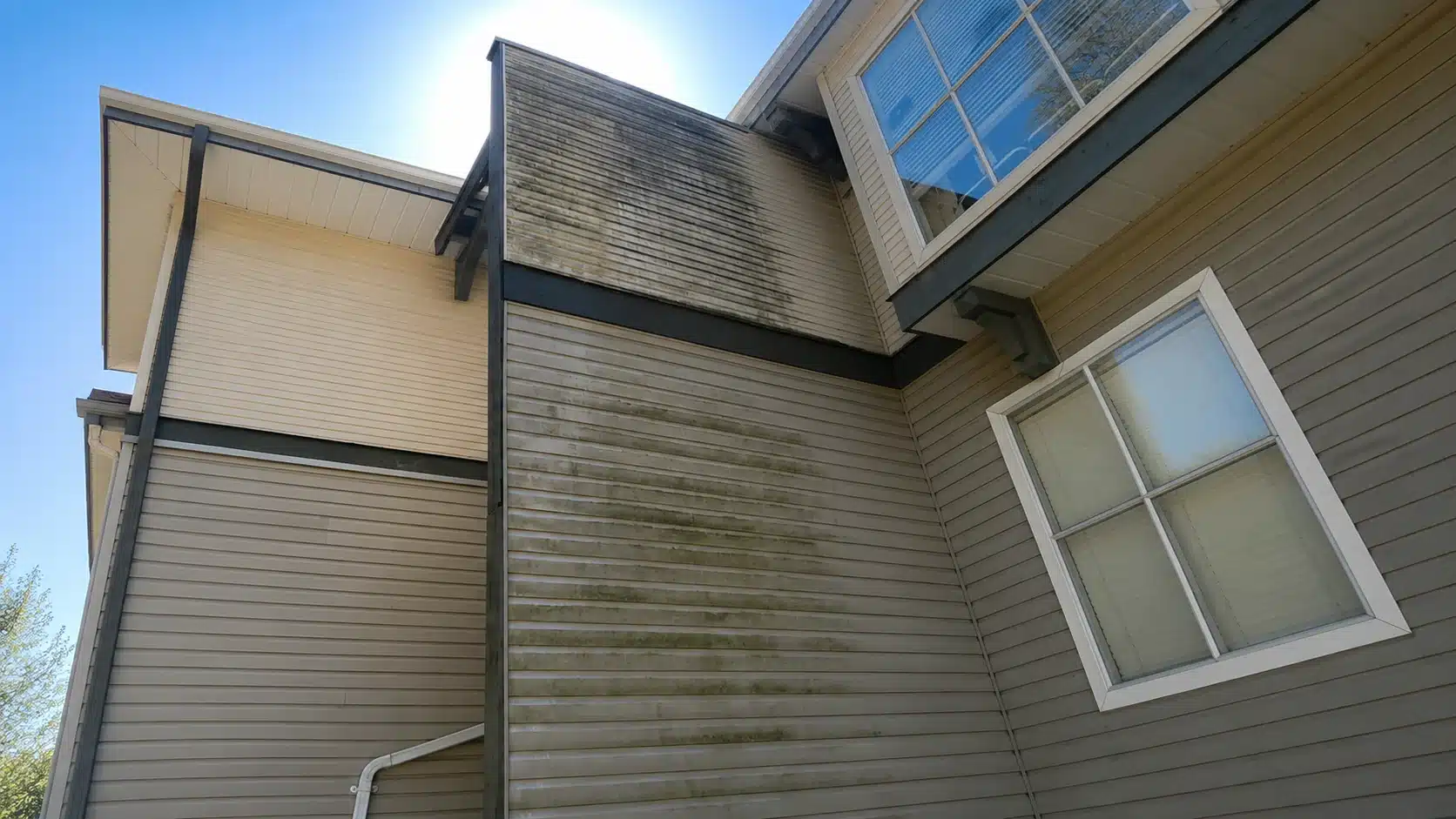
A vinyl siding that fades in five years is not normal. Yet it's a problem we see regularly in the Saint-Henri area and across the entire South Shore of Quebec — particularly on south-facing walls, where the sun beats directly during the long summer days.
Discoloration is not just an aesthetic problem. It indicates that the material is degrading — and in some cases, that it is beginning to lose its protective properties. For owners of homes 25 years and older in the Lévis area, this is a signal not to be ignored. At Solutions Rénovation Québec (SRQ), we have been inspecting and replacing exterior siding in the region for over ten years. Here is what we observe in the field.
Why vinyl siding can lose its color so quickly
Vinyl discoloration is not random. It almost always follows the same logic: a material of insufficient quality, exposed to particularly demanding climatic conditions, without the necessary protections. Understanding the causes helps avoid repeating the same mistakes during replacement.
Sun exposure on south-facing walls in Saint-Henri
South-facing walls receive intense UV radiation during the Quebec summer months — and in Quebec, summer UV intensity is higher than one might intuitively think for our latitude. On a well-exposed south wall, discoloration can progress 30 to 50 % faster than on a north or shaded wall (reasonable estimate based on industry observations).
The Saint-Henri area, with its wide-open streets and single-family homes with shallow roof overhangs, offers little natural shade on the walls. The walls are exposed directly from morning to early evening. On vinyl whose pigments are not UV-stabilized, this level of exposure is enough to cause visible discoloration in three to five years.
The quality of the vinyl originally installed
Not all vinyl siding behaves the same way under the sun. The fundamental difference lies in the concentration and type of pigments used — and in the presence or absence of UV stabilizers integrated into the material's composition.
Entry-level vinyl contains less concentrated pigments and little UV protection. It may look identical to a premium product at installation — but after a few seasons, the difference becomes obvious. Recognized brands in our market, such as Kaycan or Gentek, offer lines with explicit color warranties and formulations designed for northern climates. Vinyl bought at a discount without documentation on pigments is often the direct source of premature discoloration.
The freeze-thaw cycles of the Quebec climate
The Lévis region experiences approximately 65 freeze-thaw cycles per year (reasonable estimate based on historical climate data). Each cycle causes the vinyl to expand and then contract. On a quality material, these variations are absorbed without issue. On low-end or aging vinyl, these repeated stresses gradually weaken the molecular structure of the material — which accelerates surface degradation and discoloration.
This is why siding can seem acceptable after two or three years, then visibly degrade more rapidly in the following years. The weakening accumulates to a breaking point.
Discolored siding: a simple aesthetic problem or a real risk?
The honest answer is that it depends on the degree of degradation. In the early stages, discoloration is primarily aesthetic. But if it is advanced, it can indicate that the material has lost some of its mechanical properties — and at that point, the risks become concrete.
Impact on home value
A home's exterior appearance is the first impression during a visit or an evaluation. Faded, stained, or unevenly discolored siding visually ages the entire property — even if the rest is in perfect condition. For owners considering a resale in the coming years, discolored siding can affect the perception of value disproportionately compared to the actual cost of a replacement.
Risk of infiltration if the vinyl weakens
Vinyl that has lost its original properties can develop microcracks — often invisible to the naked eye — that allow water to infiltrate behind the siding. If ventilation behind the siding is insufficient, this moisture cannot escape properly. It accumulates against the wood or exterior gypsum sheathing, which can lead to rot, mold, and progressive structural damage.
This is rare in cases of simple surface discoloration — but that is exactly why a professional inspection is worth doing when the siding shows signs of advanced aging.
Does your siding show signs of discoloration or degradation? Request a façade inspection with SRQ — we assess the actual condition of your siding before recommending anything.
Can discolored siding be repaired?
It's often the first question one asks. The short answer: vinyl discoloration is generally permanent and irreparable without replacement.
Cleaning or painting: why it's not a durable solution
Cleaning discolored siding can slightly improve the appearance by removing surface deposits — but it does not restore the original color. Vinyl discoloration is caused by chemical degradation of pigments under the effect of UV. This process is irreversible. Painting on vinyl exists, but it requires rigorous preparation, a specific product, and professional application — and even under the best conditions, it does not last as long as replacement with quality vinyl.
Partial or complete replacement of the siding
If the discoloration is localized to a single south-facing wall, a partial replacement may seem economically attractive. The problem: finding a vinyl whose color exactly matches the existing one is very difficult — shades vary between manufacturing batches, and the old siding has changed tint over time. A partial replacement is often obviously visible, which sometimes creates a result visually worse than the original problem.
Average cost in Saint-Henri and Lévis
For a repair or partial wall replacement, costs generally range between 8,000 and 15,000 $ depending on the surface area and materials. A complete siding replacement on a standard single-family home is between 18,000 and 30,000 $ (reasonable estimate based on SRQ projects in the region, 2025). These figures vary depending on the home's surface area, the accessibility of the walls, and the type of vinyl selected.
Are you evaluating your options for your siding? Get a detailed estimate from SRQ — we present the options clearly, with the real costs for your specific home.
How to prevent your siding from fading too quickly
If you are replacing your siding or renovating a new property, the choices you make now determine the lifespan and appearance of your cladding for the next twenty years.
Choosing a superior-quality vinyl
A premium vinyl is first and foremost a different composition: pigments in higher concentration, UV stabilizers integrated throughout the thickness of the material, and an explicit color warranty from the manufacturer. Some products offer color warranties of 10 to 25 years depending on the ranges. This is not just a marketing argument — it is the difference between a material designed to last and one that gives up after five summers.
Opting for colors suited to the Quebec climate
Dark colors absorb more solar heat — which accelerates pigment degradation and increases thermal stress on the material. Light tones and off-whites generally perform better in durability on highly exposed walls. This is not an absolute rule, but it is a factor to consider when choosing a color, particularly for south-facing walls.
Installing a ventilation system behind the siding
Well-ventilated siding lasts longer. The air gap behind the cladding allows moisture to escape, reduces thermal cycles in the material, and prevents condensation buildup against the substrate.
Quebec Construction Code standards
The Quebec Construction Code specifies ventilation requirements for exterior cladding, including an adequate air gap behind the siding in compliant constructions. An installation carried out by an RBQ contractor ensures that these requirements are met — which is not always the case in installations done quickly or without regulatory expertise.
How an RBQ contractor diagnoses siding discoloration
Complete façade inspection
A professional inspection of faded siding is not limited to noting the color. We assess the sun exposure of each façade, the physical condition of the vinyl — flexibility, presence of microcracks, thermal deformation —, the condition of the ventilation behind the cladding, and the condition of the substrate if sections must be removed for verification.
Verification of the manufacturer's warranty
Depending on the brand and year of installation, your current siding may still be under the manufacturer's warranty for discoloration. Some manufacturers offer color warranties of 10 to 25 years on their premium lines — but claiming this warranty requires documentation and sometimes a claims process that requires a professional contact. This is something we can help you verify during the inspection.
Report and replacement options
Following the inspection, we present you with a clear picture of the condition of your siding, replacement options that match your home and your budget, and recommendations for premium vinyl suited to your sun exposure. No pressure to sign — just the information you need to make a good decision.
Do you want a professional's opinion on your siding before deciding? Talk to an SRQ exterior cladding expert — free visit, no obligation.
Why trust Solutions Rénovation Québec (SRQ)
At SRQ, we have been installing and replacing exterior cladding on residential homes in Lévis, Saint-Henri, Beauce and throughout the Chaudière-Appalaches region for over ten years. We know the homes in our region — their original materials, their sun exposures, and the products that truly hold up in our climate conditions.
Marco Savoie, RBQ-licensed general contractor (5811-7821-01), ensures that each exterior cladding project complies with current installation standards and that the chosen materials are suited to the reality of each façade. We don't install the same vinyl on an exposed south façade as on a shaded north façade — because the requirements are not the same.
Clear process for your work
Our approach is predictable and transparent at every step. Complete façade inspection and diagnosis, detailed quote with all line items, installation according to RBQ standards with the right materials, and delivery of a clean worksite with documentation of the work and warranties.
Book your siding inspection in Saint-Henri
Are you concerned about your siding? Contact Solutions Rénovation Québec for a free inspection — we travel to Saint-Henri, Lévis and all surrounding regions. 418-476-1747, Monday to Friday, 8 a.m. to 5 p.m.
FAQ — Faded vinyl siding in Quebec
Why does my vinyl siding fade in the sun?
Because UV rays degrade the vinyl's pigments over time. On a low-end product without UV stabilizers, this process accelerates considerably — particularly on highly exposed south façades like those found in Saint-Henri.
How long does vinyl siding color last?
On premium vinyl with UV stabilizers and a manufacturer's warranty, the color can last 20 to 30 years without significant discoloration. On an entry-level product exposed to the south, discoloration can become visible in 3 to 7 years (reasonable estimate).
Can faded vinyl siding be repainted?
Technically, yes — with a paint designed specifically for vinyl and rigorous preparation. But durability remains limited compared to replacement, and the final result is rarely as clean or durable as new quality siding.
What is the cost to replace siding in Lévis?
Between $18,000 and $30,000 for a complete replacement on a standard single-family home (reasonable estimate, 2025). For a partial replacement of a single façade, costs vary between $8,000 and $15,000 depending on the surface area.
Does the manufacturer's warranty cover discoloration?
On premium products, yes — color warranties of 10 to 25 years are common among recognized manufacturers. But warranty conditions vary, and non-compliant installation can void coverage. This is why installation by an RBQ contractor is important.
Do dark colors fade faster?
Generally, yes. Dark colors absorb more heat, which increases thermal stress on the material and accelerates pigment degradation. On a highly exposed south façade, light tones offer better durability.
Is a permit required to change siding in Lévis?
In most cases, replacing exterior cladding identically does not require a permit. But if structural modifications are involved or if the property is in an area with aesthetic restrictions, a permit may be required. Your RBQ contractor can verify these requirements for you.
How to choose quality vinyl?
Look for a product with an explicit manufacturer's color warranty, UV stabilizers integrated into the composition, and sufficient thickness — generally 0.044 inch or more for quality residential lines. Recognized brands offer detailed technical data sheets. An experienced contractor can guide you toward products that have proven themselves in our specific climate conditions.
Conclusion — Faded siding is often a sign that it's time to invest in the right quality this time
Siding that fades after five years is disappointing — but it's also an opportunity to correct course. Choosing premium vinyl with UV stabilizers, having it installed according to standards, and ensuring adequate ventilation behind the cladding: these are the three decisions that make the difference between siding that lasts twenty years and one that starts fading again in five.
At SRQ, we make these choices with you — not in your place, but by clearly explaining what is worth it and why.
Your façade deserves a professional inspection before any decision. Contact Solutions Rénovation Québec today — free diagnosis, clear quote, 5-year guaranteed installation. 418-476-1747.