
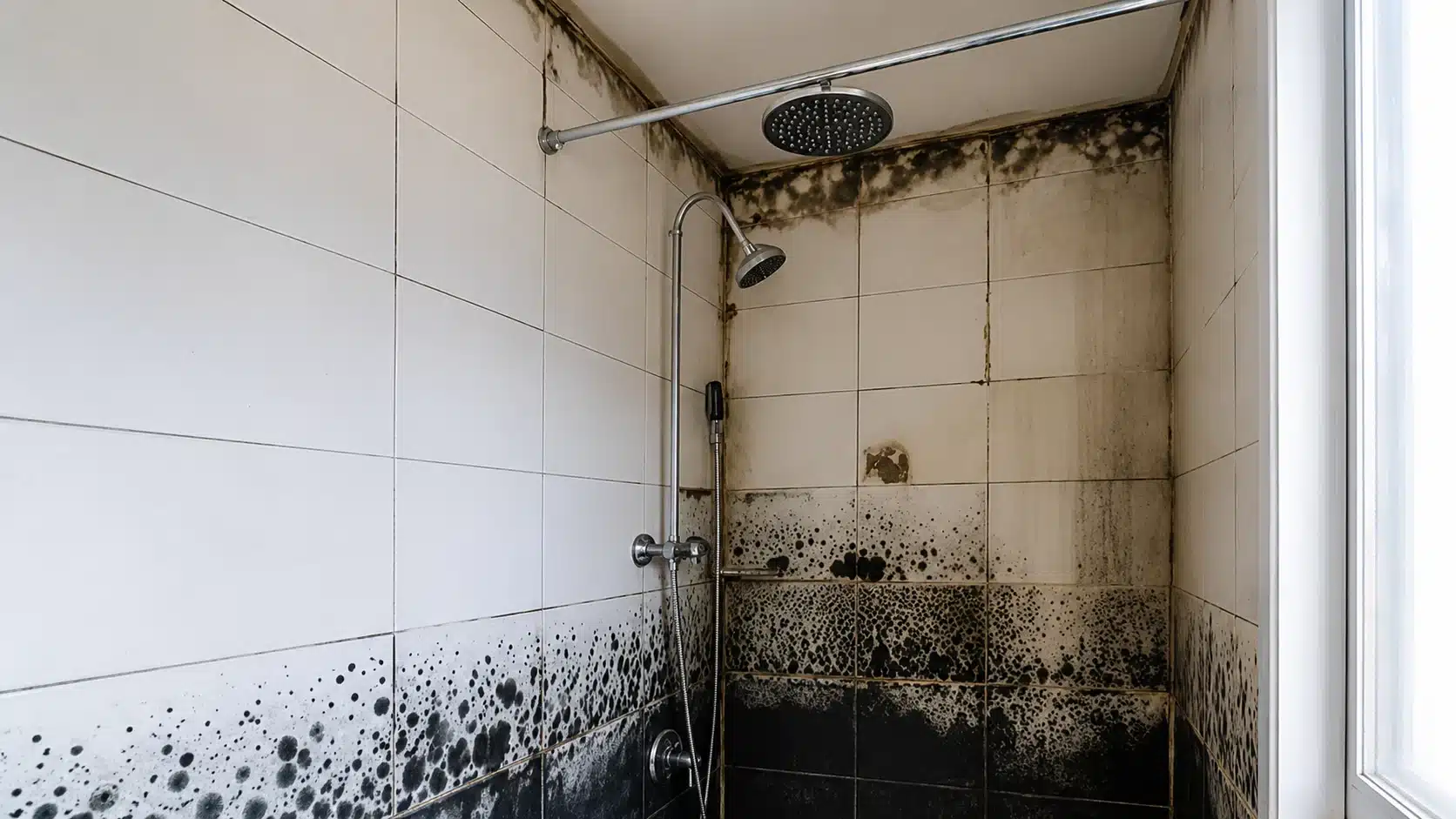
You scrubbed the grout, applied the bleach, rinsed everything — and two days later, the musty smell was back. It's frustrating, and it's also a signal you can't ignore.
A persistent smell almost always means the source of the problem isn't on the surface. It's hidden — behind a wall, under the floor, in the cavity around the shower. And as long as the source isn't addressed, the smell returns, the spores multiply, and the damage progresses silently.
In Lévis, the situation is amplified by the proximity of the St. Lawrence River. Riverside humidity, long winters and significant temperature variations create conditions that put poorly ventilated bathrooms to the test — especially in homes 25 years and older.
At Solutions Rénovation Québec (SRQ), we regularly deal with this type of situation: inspection, diagnosis, decontamination and full renovation if necessary. We are RBQ licensed contractors (license 5811-7821-01) and we explain here what is really happening in your bathroom.
Do you have a persistent smell? Contact SRQ for a no-obligation inspection
Why does a musty smell return even after cleaning?
The natural reflex is to clean harder. More bleach, more often. And it works — for a few days. Then the smell returns, sometimes more intense than before.
It's not because you're cleaning poorly. It's because the problem isn't where you're looking.
Cleaning eliminates the symptoms, not the source
Bleach neutralizes mold on the surface. But if moisture continues to seep behind the tiles, into the drywall, or under the wooden floor, the spores quickly regenerate. You're cleaning the visible part of a problem that continues to grow in the cavities you can't see.
Mold needs two things to survive: organic matter (wood, drywall, paper) and moisture. Both are present in abundance in a poorly ventilated bathroom. As long as the moisture remains trapped, the problem doesn't go away.
Why water and moisture remain trapped
Each shower generates a significant amount of water vapor. If this vapor cannot be effectively evacuated to the outside, it condenses on cold surfaces — walls, mirror, ceiling — and gradually seeps into porous materials. The drywall, grout joints and wood behind the cladding absorb this moisture without it being visible.
Over time, these materials remain chronically damp, even between showers. This is what creates the ideal conditions for mold.
The invisible signs of a more serious problem
Some signs are subtle but telling: paint that swells slightly at the bottom of a wall, grout joints that darken despite regular cleaning, a floor that begins to give way underfoot near the shower. These are clues that moisture has already reached the materials behind the surface — and that the problem goes beyond simple household maintenance.
Bathrooms in older homes are more vulnerable
Homes built before the 1990s were not designed with today's waterproofing and ventilation standards. This isn't a construction defect for the era — it's simply that requirements have evolved.
Common problems in homes 25+ years old
In a typical bungalow in Lévis or Charny built in the 1970s, the bathroom may have ventilation that simply blows into the crawl space or into the attic — instead of being evacuated directly to the outside. Standard drywall (not moisture-resistant) was often used everywhere, including in the shower. And there is sometimes no vapor barrier behind the ceramic cladding.
These are configurations that were acceptable at the time, but that today create chronic moisture problems.
The effect of Lévis's climate and the St. Lawrence River
Lévis is a city built along the river. Ambient humidity there is naturally higher than in more continental regions, especially in spring and fall. Freeze-thaw cycles create pressure and temperature variations that promote condensation in walls and cavities.
Combined with deficient ventilation, this climatic context turns an ordinary bathroom into an environment conducive to mold — even if the home appears to be in good overall condition.
Do you suspect a moisture problem behind your walls? Have the source checked before the mold spreads
The most common causes of musty smells in a bathroom
There is rarely a single cause. In general, it's a combination of factors that reinforce each other. Here is what we most often find during our inspections in the Lévis region.
Inadequate ventilation is often the main cause
It's the number one problem we diagnose in bathrooms of homes 25 years and older. The exhaust fan is either absent, undersized, or connected to the wrong place.
A fan that makes noise isn't necessarily a fan that works well. If the extracted air doesn't exit directly to the outside of the building, the vapor is simply moved to another unheated space — and the problem continues.
What the Building Code requires in Quebec
The National Building Code and RBQ requirements are clear: a bathroom must be mechanically ventilated with direct evacuation to the outside. Not into the attic. Not into the crawl space. To the outside, with a minimum flow rate adapted to the surface area.
Many homeowners don't know this, and many installations made before the 2000s do not meet these requirements. It's not a fault — it's simply that regulations have evolved.
Why opening a window isn't enough in Quebec
In summer, opening the window for a few minutes after a shower can help. But in Quebec, windows stay closed for a good part of the year — and it's precisely in winter that relative humidity in homes is most problematic. A functional exhaust fan, running during and after each shower, is the only reliable solution in our climate.
Hidden humidity behind walls or under the floor
This is where many homeowners are caught off guard. The bathroom looks normal to the naked eye, but behind the ceramic tile or under the floating floor, moisture has been accumulating for months — sometimes years.
A tile that sounds hollow, a joint that's coming loose, a floor that «flexes» slightly: these are possible entry points for water. Once inside the cavity, moisture generally cannot escape on its own.
Infiltration coming from the basement or foundations
In homes with a basement, moisture can also rise by capillary action through the foundations or concrete slabs. If your basement smells musty or if the foundation walls show traces of efflorescence (a whitish powder), it's a sign that rising damp may be contributing to the problem on the upper floor.
A French drain in poor condition or a deficient waterproofing membrane can also create infiltration that indirectly reaches the wet rooms of the house. Learn more about our water infiltration repair services
Slow and hard-to-detect plumbing leaks
An active leak is visible. But a slow leak — a fitting that seeps slightly, a seal around the bathtub that lets a trickle of water through with each use — can go unnoticed for months.
How small leaks create big consequences
Water that slowly seeps behind the bathtub or under the toilet gradually saturates the drywall, the structural wood and the subfloor. These materials stay permanently damp. Mold sets in, odors appear, and when the extent of the damage is finally discovered, everything often has to be opened up to replace the contaminated materials.
It's a problem that can be avoided with regular inspection of visible joints and plumbing connections.
Do you want to know where the humidity in your home is coming from? Request a complete assessment with SRQ
What are the risks of letting a musty smell persist?
We understand the temptation to wait. The problem seems manageable, the work is intimidating, and life goes on. But leaving a chronic moisture situation without intervention has concrete consequences — on health, on the structure of the house, and on its value.
The possible impacts on family health
Mold releases spores into the ambient air. These spores are inhaled by all occupants of the house, and their impact on health varies according to individual sensitivity — but no one is completely unaffected.
The most frequent symptoms are respiratory tract irritation, recurring headaches, worsening of allergy or asthma symptoms, and a general fatigue that is difficult to explain.
The most vulnerable groups
Young children, the elderly, and those who suffer from asthma or respiratory allergies are particularly at risk. Their immune or respiratory system reacts more strongly to prolonged exposure to mold spores — even at concentrations that do not cause immediate symptoms in a healthy adult.
Santé Québec's recommendations
Santé Québec recommends maintaining a relative humidity level between 30% and 50% in indoor spaces. Above 60%, conditions become favorable for mold proliferation. In the event of visible mold presence or persistent odors, the agency recommends quickly drying surfaces and correcting the source of moisture — not just cleaning the affected surface.
Structural damage can become costly
Chronic moisture doesn't just feed mold — it deteriorates building materials. Drywall disintegrates. Wood softens, swells, and begins to rot. Floor joists and wall studs lose their mechanical strength.
What happens when moisture remains behind the walls
Once structural wood is affected, the repair goes beyond simple cleaning. Walls must be opened, contaminated materials removed, exposed wood treated, and rebuilt. What would have cost a few hundred dollars in early intervention can easily climb to several thousand dollars when the situation is left to deteriorate.
Spores also spread to adjacent spaces — a problem localized in the bathroom can reach the hallway wall or the neighboring bedroom if you wait too long.
The consequences on property value
A potential buyer who smells a musty odor while visiting a property will immediately question the extent of the problem. And in the context of a pre-purchase inspection, a building inspector who identifies excessive moisture or traces of mold will mention it in their report.
What buyers notice immediately
An odor, even a slight one. Stains on the ceiling or at the bottom of walls. A noisy bathroom fan running in vain. These are warning signals that lower offers or cause transactions to fall through — even when the house is otherwise in good condition.
Fixing the problem before selling is protecting your investment. And fixing the problem now is protecting your family while you live there.
Have the problem inspected and corrected before it affects your home and your health
How does SRQ durably resolve mold and moisture problems?
We don't show up with a jug of product and paint over the problem. Everything starts with understanding what is really happening — because a poorly targeted intervention solves nothing in the long term.
Complete diagnosis before the work
Before touching anything, we inspect. We look at the state of the ventilation, we check whether it exhausts properly to the outside, we look for signs of infiltration or plumbing leaks, and we assess the visible and probable extent of the contaminated areas.
Why identifying the source is essential
Decontaminating without correcting the source is useless. Mold returns in the following weeks because the conditions that created it have not changed. We take the time to understand before acting — and we explain what we found, clearly, before proposing anything to you.
Safe and compliant decontamination
When mold is confirmed, the intervention must be done in a way that does not spread spores throughout the rest of the house. This is not work done by leaving all the doors open and working without precautions.
The procedures used by SRQ
We work with containment of the affected area to isolate spores, removal of contaminated materials (drywall, insulation, wood if necessary), treatment of exposed surfaces, and complete drying before any reconstruction. Removed materials are disposed of appropriately — they do not pass through the clean rooms of the house.
The standards and best practices applied
Our interventions comply with the established best practices for mold decontamination in residential settings in Quebec. The safety of occupants and workers is non-negotiable — and RBQ compliance applies to the entire intervention. Learn more about our decontamination service
Modernizing the bathroom to prevent recurrence
Once the area is sanitized and the damaged materials replaced, we work to correct the conditions that caused the problem. Because decontamination without improvement of the existing systems is work that will have to be redone.
Solutions recommended by SRQ
- High-performance and compliant exhaust fans: correctly sized for the bathroom area, vented directly to the outside, with a timer or built-in humidity sensor if the budget allows.
- Waterproof membranes: behind and under the ceramic tile in the shower and around the bathtub, to prevent water from reaching the materials behind.
- Moisture-resistant materials: moisture-resistant drywall, cement-fiber or construction panels suitable for wet rooms — never standard drywall in an area exposed to water or steam.
- Optimized ventilation: sometimes, this requires rerouting the ventilation duct so it follows a shorter, better-insulated path to the outside.
Warranty, transparency and peace of mind
All our renovation and decontamination work is carried out by a trained team, under the responsibility of Marco Savoie, licensed RBQ contractor (5811-7821-01). Each project is covered by a 5-year warranty on labor.
What distinguishes SRQ from improvised contractors
A contractor without an RBQ license is not able to offer you the same legal protections. If a problem arises after the work, you often have no concrete recourse. With SRQ, you have a written quote with the details of the work, a firm price with no surprises, and a real warranty on what we did.
Our worksites are clean and safe. We protect adjacent spaces, we clean up as we leave, and we communicate with you throughout the work — not just at the beginning and the end.
Get a clear quote for your bathroom in Lévis
How can future mold odors be prevented?
Once the problem is resolved, a few simple habits and a little attention can prevent it from coming back. It’s not complicated — but it does require consistency.
Using the exhaust fan correctly
The most common mistake is turning off the fan as soon as you step out of the shower. Water vapor is still in the room — it hasn’t been evacuated yet.
The 20-minute rule after each shower
Let the fan run for at least 20 minutes after the shower ends. This is the time needed to evacuate most of the accumulated vapor and begin drying the surfaces. Installing a timer on the exhaust fan is the simplest way to adopt this habit without thinking about it.
Monitoring the humidity level in the home
A hygrometer (thermometer with humidity measurement) costs less than 30 dollars at any hardware store. Placed in the bathroom or the adjacent hallway, it gives you a quick reading of the situation.
Recommended levels in Quebec
Santé Québec and specialized organizations recommend maintaining relative humidity between 30 % and 50 % in living spaces. In winter in Quebec, levels often drop below 30 % in well-heated homes — which can cause other problems, such as drying out woodwork. The ideal is to stay within the range, without excess in either direction.
If your bathroom regularly exceeds 70 % humidity long after the shower, it’s a signal that ventilation isn’t doing its job.
Have signs of humidity inspected quickly
Grout that turns black, a tile that starts to come loose, a slight odor after a long absence — these are not things to put off until later. A quick inspection at this stage costs little and can identify a problem before it becomes major.
Why acting early costs less
We’ve seen it with roof infiltrations, and it’s true here too: early intervention costs a fraction of what a full renovation forced by structural damage costs. Two hours of inspection now can prevent two weeks of work in six months.
Schedule a preventive inspection with SRQ
Why do Lévis homeowners trust SRQ?
For more than 10 years, we’ve been working with homeowners in the Lévis region — Charny, Saint-Romuald, Pintendre, the older sectors near the river. We know the homes here, the local climate conditions, and the problems that come up most often in this corner of Quebec.
Expertise adapted to Québec's climatic realities
Lévis’s riverside humidity, long winters, 1970s bungalows with their original ventilation — we work in that context year-round. Our recommendations take these realities into account, not just generic solutions that work in another market.
More than 500 residential projects completed
This figure represents as many real-life situations in the field, diagnoses made, and homeowners who were able to get back a healthy home. Every project taught us something — and it’s this cumulative experience that we put at your service when we step into your bathroom.
Human and transparent support
We explain what we find. We give you the options, with the advantages and limits of each. We provide a detailed quote before starting — and we honor that price. No fees that appear along the way, no decisions made for you without consulting you.
Talk to an SRQ specialist today
Frequently asked questions about mold odors in a bathroom
Why does my bathroom smell bad even after cleaning?
Because surface cleaning doesn’t address the source of the problem. If moisture is trapped behind the walls, under the floor, or in porous materials, mold continues to grow where no cleaning product can reach. The odor returns because active spores are inside the materials — not just on the surface.
Does a moldy odor always mean mold?
Not necessarily visible mold, but yes, in almost all cases, a persistent odor indicates the presence of spores or decomposing organic materials in a humid environment. It’s rarely a false positive — and it always deserves an investigation.
What humidity level is considered too high in Quebec?
Santé Québec recommends maintaining relative humidity between 30 % and 50 % in living spaces. Beyond 60 % for an extended period, conditions become favorable for mold. In a bathroom, spikes to 80–90 % during and just after the shower are normal — provided that ventilation brings the level back to acceptable levels within the next 20 to 30 minutes.
Is it dangerous for children or the elderly?
Yes, more so than for healthy adults. Young children and the elderly have immune and respiratory systems that react more strongly to exposure to mold spores. Symptoms can include repeated respiratory infections, allergic reactions, and worsening of conditions such as asthma. If these groups live in the home, the intervention should not be postponed.
How can I tell if my bathroom fan is working poorly?
Quick test: hold a paper tissue in front of the fan grille while it’s running. If it isn’t drawn toward the grille, the airflow is insufficient. Another sign: if your mirror stays fogged 30 minutes after the shower despite the fan running, evacuation isn’t happening properly. A noisy fan isn’t necessarily an efficient fan.
Can a dehumidifier solve the problem?
A dehumidifier can help control the ambient humidity in a room, but it does not address the source of the problem. If mold is already established in the materials, or if a plumbing leak is constantly feeding the humidity, a dehumidifier will not change anything in the long term. It is a supplementary tool, not a solution.
How much does mold decontamination cost in Lévis?
The cost depends on the extent of the damage, the materials affected and the reconstruction work required. A targeted intervention in a limited area can range between $800 and $2,500. If the drywall, flooring or structural elements need to be partially replaced, the cost will be higher. An on-site inspection is necessary to get a real figure — and this visit is free at SRQ. (reasonable estimate, 2026)
Should drywall affected by humidity be replaced?
In most cases, yes. Drywall saturated with humidity loses its structural strength and remains a fertile substrate for mold even after drying. A slightly affected area can sometimes be dried and treated if the intervention is quick, but drywall that has been wet repeatedly or for an extended period should generally be removed and replaced with a moisture-resistant material.
When should you call an RBQ contractor?
As soon as the smell persists despite regular cleaning, a stain appears on a wall or ceiling, materials begin to warp or peel, or you suspect a leak behind a wall. The longer you wait, the more the damage progresses — and the more extensive the necessary work will be.
Does insurance cover mold-related damage?
It depends on the circumstances and your policy. Damage caused by a sudden and accidental cause (pipe burst, unexpected water damage) is generally covered if you acted quickly. Problems caused by a lack of maintenance or a known and untreated situation are usually excluded. Call your insurer as soon as you identify a problem and document the situation well — an inspection carried out by an RBQ contractor can help you establish the timeline.
Solutions Rénovation Québec — RBQ Licence 5811-7821-01 2552 chemin du Fleuve, Lévis, Québec, G6W 1Y3 📞 418-476-1747 | srq.quebec@gmail.com Monday to Friday, 8 a.m. – 5 p.m. renovationsolutionsquebec.ca