
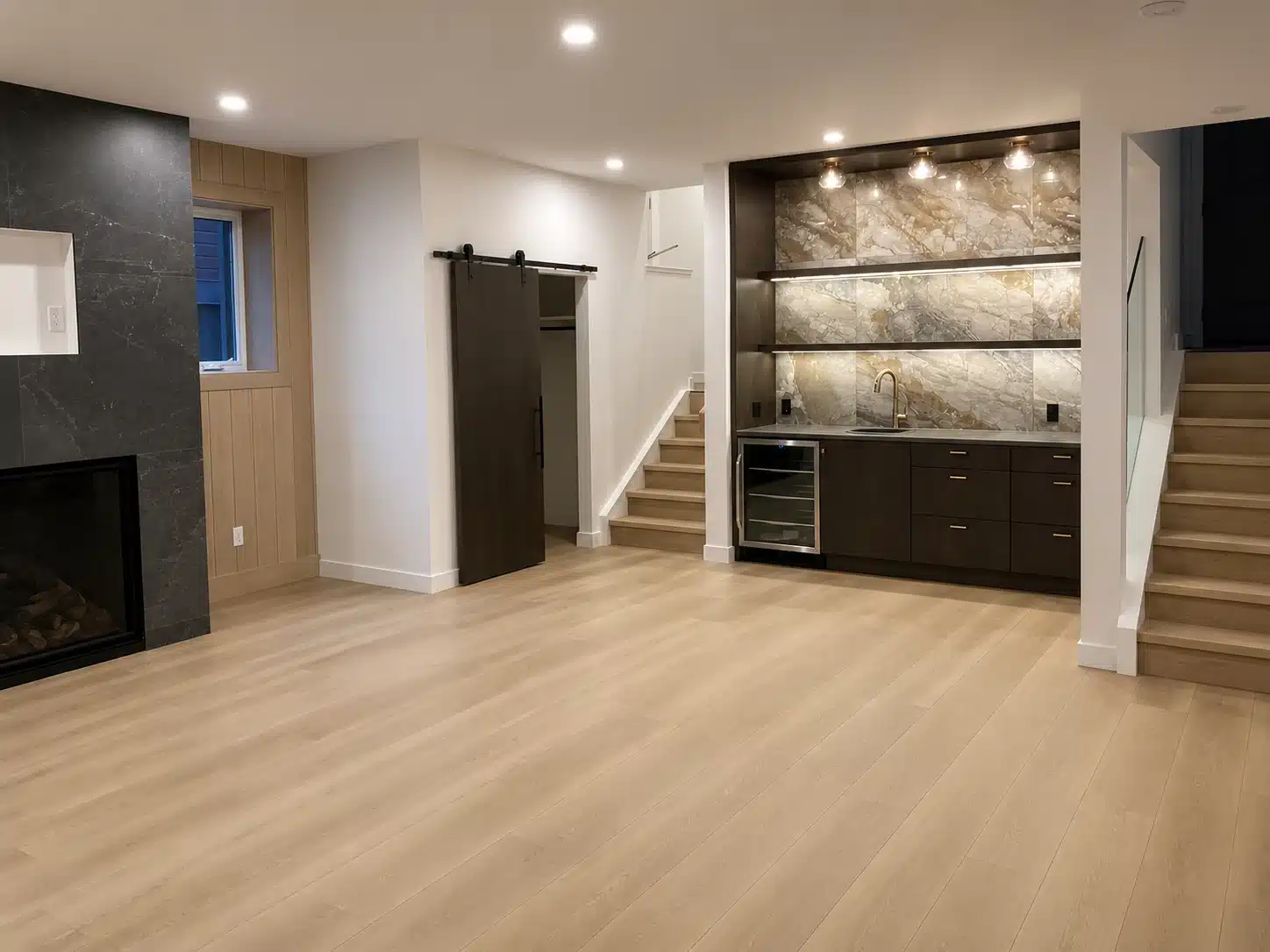
A finished basement is often one of the biggest projects in a home. More space for the family, a playroom, a home office — the reasons are plenty. But even before thinking about wall color or furniture, there's one decision that will determine everything: the choice of flooring.
In the Lévis area and throughout Chaudière-Appalaches, basements present particular challenges. Humidity, capillary rise, freeze-thaw cycles — all of this puts materials to the test. Choosing the wrong covering means risking having to redo everything within five years. At Solutions Rénovation Québec (SRQ), we've seen this more than once. That's why we're explaining here how to make the right choice from the start.
Why flooring choice is critical in a Quebec basement
A basement is not the same thing as a room on the ground floor. The environment is fundamentally different — cooler, more humid, often more subject to variations. What you install on that concrete slab must be able to withstand these conditions, year after year.
Materials that perform well upstairs can completely fail downstairs. And when that happens, repairs cost dearly — not just in materials, but in time, inconvenience, and sometimes in health.
Humidity and capillary rise in Lévis basements
The concrete slab absorbs moisture. That's its nature. In homes built between 1950 and 1980 — and there are many in the Lévis, Saint-Nicolas and Saint-Romuald area — insulation under the slab is often nonexistent or insufficient.
The region receives approximately 900 mm of precipitation per year (reasonable estimate based on historical climate data for the region). In summer, when warm, humid air enters a cooler basement, condensation forms directly on the concrete and on the materials placed on top. If your covering isn't designed for this, you're going to have problems.
The consequences of a bad flooring choice
We've seen it on dozens of job sites: a homeowner installs floating wood or carpet in their basement to save money, and three years later, they call us because it smells moldy and the planks are warped.
The problem is that it costs much more to fix than to prevent. Removing a swollen floor, treating mold, reinstalling all the covering — this can represent 30 to 50 % of the project's initial budget (reasonable estimate). Not to mention the risks to indoor air quality.
Simple test to check humidity before installation
Before installing anything on your slab, take the time to check its moisture level. It's a step we systematically perform during our inspections at SRQ.
Recommended method (inspired by industry standards)
Cut a square of polyethylene approximately 61 × 61 cm. Tape it to the slab with airtight adhesive tape on all sides. Leave it in place for 48 to 72 hours. If you find condensation under the plastic, your slab has active moisture. In this case, the choice of covering — and surface preparation — become even more important.
The best floors for a finished basement in Lévis
There are several options on the market. Some are well suited to our Quebec basements, others much less so. Here's what we really recommend, and why.
SPC Vinyl (Stone Plastic Composite) — the most popular choice
SPC vinyl has become our main recommendation for the vast majority of basements. And it's not a trend — it's a matter of real performance under high humidity conditions.
SPC is composed of a limestone and PVC core. It is 100 % waterproof. Unlike ordinary floating vinyl, it doesn't swell, doesn't warp, and doesn't react to the seasonal humidity variations we experience here in Quebec. It's also denser and more stable underfoot — which makes it comfortable even in a cold room.
Maintenance is minimal: a damp mop is enough. And installation is relatively quick, which limits job site time.
Average installed cost in Lévis
Expect between 8 and 12 $ per square foot, all included (materials + installation, reasonable estimate based on SRQ projects in 2025–2026). It's the best quality-durability-cost ratio for a standard residential basement.
Ceramic or porcelain — maximum durability
Ceramic is the most durable choice you can make in a basement. It is completely waterproof, rot-proof, and can last several decades without issue. In high-traffic areas — hallway, basement bathroom, secondary entrance — it's often the best long-term choice.
Porcelain, in particular, is even denser than standard ceramic. It resists impacts and wear better. For a basement that will serve as an active family room, it's a serious option.
Main drawback
Ceramic is cold underfoot — especially in winter, when the basement floor is already naturally cool. The solution is to integrate an electric radiant floor heating system during installation. It adds to the budget, but it completely changes the comfort of the room.
Average cost: 10 to 15 $ per square foot installed (reasonable estimate, variable depending on complexity and tile format).
Carpet — a solution to avoid in most basements
Carpet seems like a good idea: it's economical, it's soft, it visually warms the room. But in a Quebec basement, it's rarely the right choice.
Carpet absorbs ambient humidity. Over time, the underlay retains moisture, and this creates an ideal environment for mold — even if you don't see anything on the surface. The «basement» smell that many people know is often that.
When carpet can be acceptable
There are cases where carpet can work: if you have a well-ventilated raised subfloor, a vapor barrier under the structure, and a functional dehumidification system that keeps relative humidity below 50 % year-round. It's possible, but it requires rigorous installation.
Average cost: 5 to 8 $ per installed square foot (reasonable estimate). But if the environment isn't well controlled, it's money poorly invested.
Are you hesitating between two options for your basement? Contact us for a free quote — we'll clearly explain what suits your home.
Other factors to consider before choosing your flooring
Flooring is important, but it's not the only variable in the equation. There are other technical elements that directly influence the success of your finished basement project.
Minimum basement height according to the Quebec Code
Before adding a raised subfloor or a finished slab, check your available height. Losing two inches in an already low basement is significant.
Standard in effect
The Quebec Construction Code requires a minimum height of 1 metres between the finished floor and the finished ceiling for a space to be considered habitable. If your basement does not reach this height after installation, some work may not be compliant.
New radon requirement (2025 Construction Code)
Since the updates to the Construction Code, radon protection is now better regulated for new construction and major renovations. Radon is a natural radioactive gas that infiltrates through the slab and foundations — and Quebec is not exempt from risk zones.
Required protection
The new requirements include a waterproof membrane under the slab and a depressurization pipe allowing the gas to be evacuated if high levels are detected. This is an aspect your contractor must know about and integrate into the planning.
Raised subfloor or floor directly on the slab
Installing directly on the slab is possible with certain materials such as SPC vinyl or ceramic. But a raised subfloor — a lightweight structure that lifts the flooring off the slab — offers better protection against rising moisture and makes replacement easier in case of a problem or flooding.
The downside is that you lose about 1 to 2 inches of height. If your basement is already at the limit of the standard, this is a factor to weigh seriously before deciding.
How much does a finished basement floor cost in Lévis in 2026?
The cost of the floor alone is one thing. But if you plan to finish your entire basement — partitions, insulation, electrical, plumbing, finishing — the picture is different.
For a complete basement finishing project in the Lévis area, costs generally run around 70 to 100 $ per square foot (reasonable estimate based on current projects in 2025–2026). An average basement of 550 to 600 square feet therefore represents an investment of around 55,000 to 60,000 $, depending on the complexity of the work.
This is a serious budget. That is exactly why we recommend choosing your materials carefully from the start — because a mistake at this stage can be very expensive to correct.
Before you get started, have your project costed out precisely. Request your free quote here — no obligation, no hidden fees.
Why use an RBQ contractor for a basement
A finished basement is more than a floor and walls. There is often electrical to relocate, plumbing to plan, insulation to correct, and sometimes moisture or mould problems to resolve before even starting. Entrusting this to someone who is not licensed is taking a significant risk — for the quality of the work, but also for your home insurance and the eventual resale of your property.
At SRQ, we are a licensed RBQ general contractor (licence 5811-7821-01). We manage the project from start to finish: planning, coordination of trades, site management, clean delivery. You don't have to juggle five different subcontractors.
Our approach for finished basements
Every project begins with a complete inspection: we check the moisture of the slab, analyze the existing drainage, and identify potential risks before recommending anything.
Then, we choose materials based on your specific basement — not according to what is on sale or what is easiest to install. Installation is done according to the rules of the art, with a clean and safe site at every stage.
Warranty and compliance
All our work is covered by a 5-year warranty on labor. We work in compliance with RBQ standards and the Quebec Construction Code. And when we hand you the keys, it's clean — no debris, no half-finished work.
Get a free quote for your basement in Lévis
Call us at 418-476-1747 or fill out our online form for a free visit and a detailed quote. We answer Monday to Friday, from 8 a.m. to 5 p.m.
FAQ
What is the best flooring for a damp basement?
SPC vinyl is the best option in the vast majority of cases. It is waterproof, stable, and designed to withstand humidity variations. For very damp basements, a prior inspection of the slab is essential before any installation.
Is SPC vinyl better than ordinary floating vinyl?
Yes, clearly. Standard floating vinyl has a compressed wood fibre core that can swell and warp in the presence of moisture. SPC has a stone composite core — it does not react to water. For a basement, it's the difference between an installation that lasts and one that fails after two or three years.
Is ceramic too cold for a basement?
It can be, especially in winter. But with an electric radiant floor heating system installed under the ceramic, comfort is excellent. It's an additional investment, but it completely transforms the experience of the room.
Can wood be installed in a basement?
We strongly advise against it in Quebec basements. Wood, even treated, is sensitive to moisture. Seasonal variations — and we have big ones here — cause the wood to move. In the long term, it is almost always a source of problems: swelling, cracks, mould underneath.
How much does it cost to finish a basement in Lévis?
A complete project — insulation, partitions, electrical, plumbing, flooring, finishing — generally runs around 55,000 to 60,000 $ for a standard basement (reasonable estimate for the Lévis area in 2026). The cost varies depending on the surface area, complexity, and materials chosen.
How to prevent mold in a renovated basement?
You have to tackle the problem at the source: control moisture before finishing. This involves proper exterior drainage, an adequate vapor barrier, waterproof materials, and often a permanent dehumidifier. If mold is already present, it must be properly decontaminated before starting the work.
Is radon testing mandatory?
There is no legal obligation to test for radon for current homeowners, but the new 2025 construction standards require preventive measures in new construction and major renovations. For an existing home in a risk zone, a radon test (available at low cost) remains strongly recommended before finishing a basement.
Conclusion — The right floor for a durable basement in Lévis
There is no universal answer, but there are clearly good and bad choices for our Quebec basements. SPC vinyl offers the best combination of water resistance, comfort, and cost for the majority of projects. Ceramic is an excellent option when durability is the priority and a heated floor is planned. Carpet, except under very controlled conditions, remains a risky solution in our climate.
What makes the difference between a basement that lasts and one that causes headaches is rarely the choice of flooring alone. It's all the preparation upstream: slab inspection, moisture management, the right subfloor, materials suited to the context. That's exactly what we do at SRQ, and have been for over ten years.
Talk to an RBQ contractor before starting your work
Before buying a single material, call us. We visit your basement, assess the situation, and give you a clear, detailed, no-obligation quote. Contact Solutions Rénovation Québec today — 418-476-1747.