
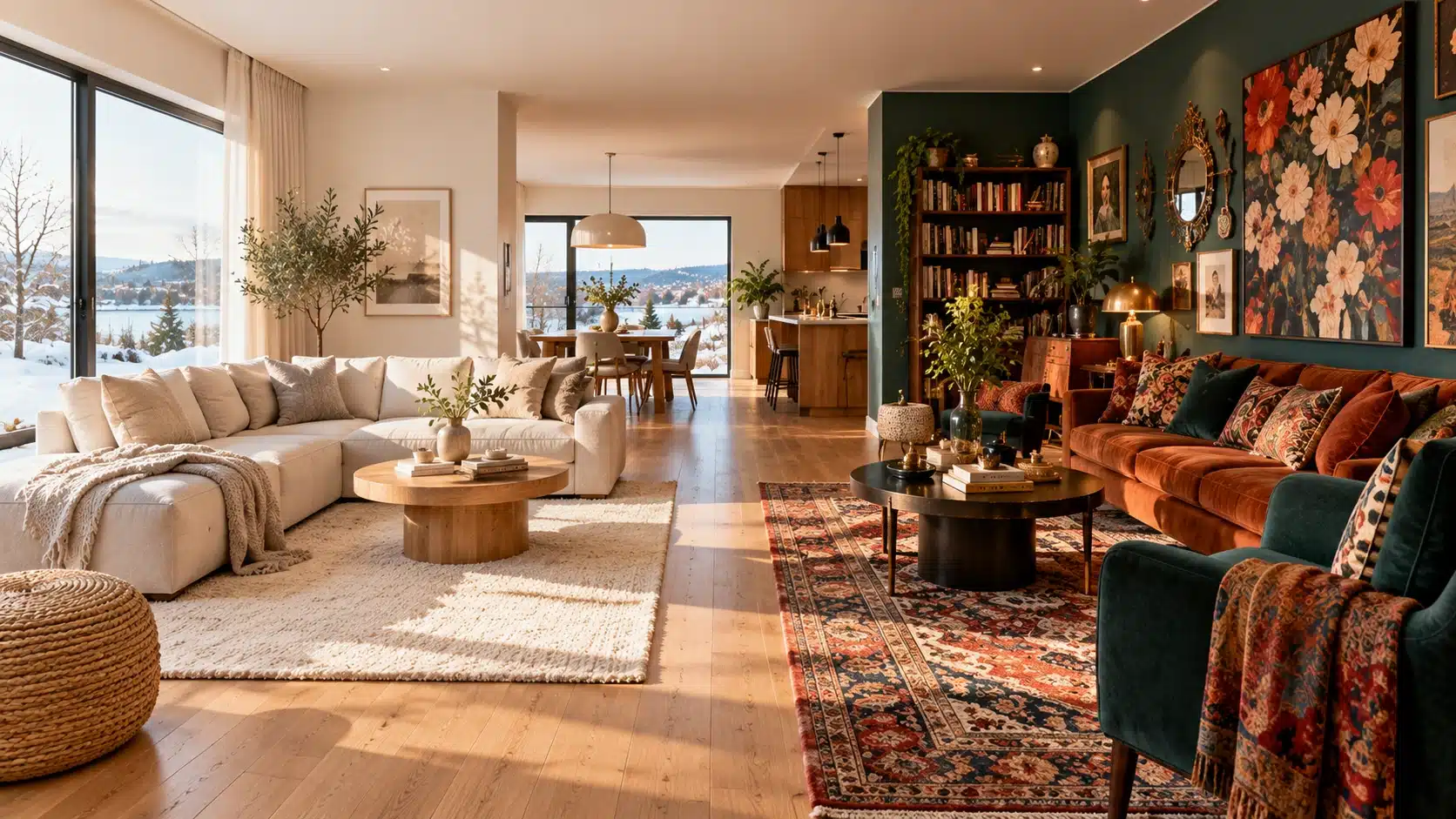
You’re renovating, you’re redecorating, and two major trends are competing in your head: clean minimalism or character-filled maximalism? It’s a real style dilemma, and the good news is that there’s no wrong answer — just the one that feels like you and suits your home.
Interior design has evolved, too. We’re far from the cold, clinical minimalism of a few years ago. Today, both trends are warming up: minimalism is becoming warm, maximalism is becoming thoughtful. What matters is choosing based on your lifestyle, your light, and your budget.
At Solutions Rénovation Québec (RBQ licence 5811-7821-01), we help homeowners in Lévis to translate their inspirations into concrete and durable renovations. In this article, we compare the two styles and help you find the one that suits you.
Minimalism or maximalism: what are the differences?
Before choosing, you need to understand what each style offers. These aren’t just looks — they’re two philosophies of space and of life at home.
Minimalism is based on the idea of «less, but better»: clean spaces, clean lines, few objects but carefully chosen. The effect is calming, airy, orderly. Maximalism, by contrast, celebrates thoughtful abundance: colors, textures, objects that tell a story. The effect is rich, personal, alive.
But beware of caricatures. Minimalism isn’t necessarily cold and empty — in its modern version, it’s warm. And maximalism isn’t disorder — true maximalism is curated, composed with intention. It’s precisely this distinction between successful versions and failed versions that makes all the difference. Let’s look at both styles in their best version.
Warm minimalism: simplicity and comfort
Warm minimalism — close to the Japandi style — is the welcoming version of minimalism. We keep the clean look, but we add warmth.
The palette relies on off-whites, beiges, taupes, and earthy tones, rather than clinical white. Materials play a key role: natural wood, linen, stone, soft textures that warm the atmosphere. Furniture is functional and spaces remain visually uncluttered, with integrated storage solutions that hide disorder.
In a Quebec home, lighting becomes central. With our darker winters, good lighting — natural and artificial, well thought out — prevents minimalism from turning cold. It's a style that breathes, soothes and highlights quality rather than quantity. Ideal for those who love calm and order.
Is minimalism suitable for homes in Lévis?
Minimalism adapts very well to our homes, provided you take our light into account. The trap to avoid: a palette that’s too cold in poorly lit rooms, especially in winter. A bluish white in a north-facing living room can quickly look dull and icy.
The solution is to warm things up with textures and wood: a warm wood floor, linen textiles, touches of earthy tones. We adapt colours to the natural winter light — warm neutrals rather than cold ones. And in bungalows and small spaces, minimalism shines precisely because it maximizes the feeling of space and preserves functionality. Done well, it makes a small home feel bigger and more serene.
Curated maximalism: personality and character
Curated maximalism is the art of embracing your personality in your decor — without falling into clutter. It’s a style with character that tells who you are.
There you'll find bolder colours, patterns, and objects that have meaning — souvenirs, inherited pieces, favourites. Successful maximalism combines vintage and contemporary, mixing eras with intention. An accent wall (accent wall), artworks, carefully chosen accessories create points of interest.
The secret to successful maximalism is coherence. Despite the abundance, a coherent palette ties the whole together and avoids chaos. You also need to manage circulation and storage so that visual richness doesn’t become clutter. Well mastered, maximalism creates a warm, unique interior that’s impossible to reproduce — because it feels like you. It’s the choice of those who love surrounding themselves with what they love.
Define your stylistic direction
Before choosing materials, it’s worth clarifying what feels like you. Discuss your project with Solutions Rénovation Québec — we help you define a direction that suits your lifestyle and your home.
Which style best suits your home in Lévis?
The best style isn’t a question of trend — it’s a question of fit with your home and your life. Several factors come into play.
The size, ceiling height, and brightness of your rooms guide the choice. The number of occupants, your storage needs, the presence of children or pets, and the daily use of each space also count. Finally, the existing architecture of your home and the scope of the planned renovation play a role.
A style that ignores these realities, no matter how beautiful it looks on Pinterest, won’t work in daily life. Let’s look at how to adapt the choice to different types of homes in Lévis.
For a bungalow or a home 25 years or older
The bungalows and older homes of Lévis often have their own character — particular proportions, sometimes period architectural details. The right style respects and highlights these characteristics rather than fighting them.
If a room is dark — common in older homes — we rebalance it with appropriate colors and lighting, rather than accentuating the darkness. Contemporary elements can be combined with existing details for a harmonious blend. And storage deserves particular attention, as these homes often lack it. Whether you lean toward minimalism or maximalism, adapting to your home's particularities is the key to a successful result.
For a family home or an open space
In a family home or open-concept space, visual continuity becomes important. When the kitchen, dining room and living room are seen at a single glance, there needs to be coherence between the spaces.
We often use a common palette with differentiated accents to link rooms while giving them personality. On the practical side, we favour resistant and easy-to-maintain surfaces — essential with children or pets. The golden rule: never let trend harm functionality. A beautiful minimalist kitchen with a countertop that stains at the slightest contact, or a maximalist living room impossible to keep tidy, won't hold up in daily life. Style must serve your life, not complicate it.
Minimalism, maximalism or a mix of both?
Good news: you don't have to choose a camp. Hybrid style is a flexible and increasingly popular option. The idea: a neutral and clean base, enhanced with colorful accessories or textured materials.
This approach offers the best of both worlds. The durable and timeless base (walls, floors, cabinets) remains understated, while decorative elements — cushions, artworks, objects — bring personality. The huge advantage: you can modify the decorative elements without fully renovating, according to your desires or the seasons. It's also the wisest choice budget-wise: you invest durably in the base, and have fun with the rest. Prioritizing durable decisions over temporary trends is often the best strategy.
Comparison: materials, maintenance and budget
Beyond aesthetics, you need to think about materials, maintenance and budget. These practical aspects determine whether your style will last over time. Here's how the two trends compare.
| Criteria | Warm minimalism | Curated maximalism |
| Palette | Warm neutrals, natural tones | Colors, patterns, contrasts |
| Materials | Wood, linen, stone, understated surfaces | Mix of textures and finishes |
| Maintenance | Depends on surfaces and storage | Depends on the number of textures and elements |
| Adaptability | Easily modifiable base | More expressive, requires coherent planning |
| Budgetary risk | Expensive high-end materials | Accumulation of finishes or custom work |
This table shows that each style has its strengths and budgetary pitfalls. None is inherently superior — it all depends on your priorities and your execution.
Is minimalism necessarily less expensive?
It's a persistent misconception: minimalism = economical. In reality, no. Cost depends on materials, labor and the level of customization, not on the style itself.
Successful minimalism often relies on quality: understated but well-crafted cabinets made with high-end materials, clean but noble surfaces. Integrated storage and custom finishes — essential for hiding clutter and maintaining the clean look — can drive up the budget. Conversely, maximalism can be built with affordable vintage finds. In short, we compare options based on durability and quality, not on appearance alone. Style doesn't determine price — material choices do.
How to invest in a sustainable style?
Regardless of style, the goal is an interior you'll love for a long time without breaking the bank. A few principles help you invest wisely.
Choose materials suited to the real use of each room — not just the look. Evaluate maintenance, durability and availability of replacement parts before buying. Avoid prematurely replacing elements that are still functional just to follow a trend — it's wasteful. And a good tip: test a colour or texture in a single room before generalizing it to the whole house. It avoids costly regrets. A durable style is a style that ages well, not a style that dates in two years.
Plan a renovation coherent with your budget
The right style is the one that respects your budget and your lifestyle. Request a consultation with Solutions Rénovation Québec — we discuss your priorities, materials and necessary work.
Turning a chosen style into concrete work
A Pinterest inspiration is all well and good, but it needs to be translated into real work. Let's look at which work truly shapes the style of an interior — and when it becomes more than just a matter of decor.
The work that truly influences style
Certain work has a major impact on the style of a room. Painting and color choices, first — it's the most visible change for the budget. Floors and transitions between rooms create continuity or rupture.
Kitchen cabinets and storage solutions define both look and functionality. Drywall, moldings and finishes provide character (or clean lines). Lighting and space organization completely transform the ambiance. And reconfiguring a kitchen, bathroom or basement can redefine an entire space. It's this work, more than accessories, that durably anchors a style in your home.
When does an RBQ license become relevant?
A distinction must be made between decor and real work. Choosing colors, changing accessories, rearranging furniture — these are decorative decisions that don't require an RBQ license.
However, as soon as you touch the structure, electrical, plumbing, or undertake certain renovation work, it becomes another matter. These works require a verification of applicable requirements and, depending on the project, permits. A wall you knock down to create an open area, a kitchen you reconfigure with plumbing relocation: that's no longer decor, it's renovation that must be done by the rules. A beautiful style doesn't guarantee technical compliance — that's where an RBQ contractor comes in. We always confirm the necessary permits according to the nature and scope of the project.
Have your inspiration translated into a work plan
Inspiration becomes a concrete project with the right support. Discuss your project with Solutions Rénovation Québec — we connect your inspirations to a scope of work, materials and a realistic budget.
Why choose Solutions Rénovation Québec?
Translating a style into a successful renovation requires planning and expertise. The choice of contractor makes the difference between well-executed inspiration and a disappointing result.
A structured and transparent process
Our process is clear: detailed quote, planning, execution, verification, clean delivery. We manage the project directly, with clear communication and detailed pricing. We can also coordinate both interior and exterior work, for a coherent result.
This structure lets you know at every step where your project stands, and to see your inspiration take shape without unpleasant surprises. That's what turns a style idea into a lasting reality.
Expertise adapted to your home
We know the homes of Lévis, Québec, Beauce and the regions we serve — their particularities, their light, their constraints. We adapt recommendations to your specific home rather than applying a generic recipe.
We operate under RBQ license 5811-7821-01, led by Marco Savoie, with over 500 projects completed, over 10 years of combined experience and a 5-year warranty on labor, according to applicable conditions. We focus on durability, coherence between style and work, and a clean worksite. These commitments ensure work that lives up to your vision.
Discuss your project with SRQ
Ready to bring your style to life? Request a free, no-obligation quote from Solutions Rénovation Québec — we plan a sustainable renovation coherent with your vision.
Myths and realities about design trends
A few preconceived ideas deserve to be corrected. Here is the truth from the fiction.
«Minimalism is always less expensive.»
Reality: not necessarily. High-end materials and custom storage — often essential to successful minimalism — can drive up costs. Price depends on materials and labor, not on style.
«Maximalism is a messy room.»
Reality: curated maximalism relies on coherent selection and composition. It’s the art of assembling with intention, not accumulating at random. Done well, it’s rich and harmonious, not chaotic.
« A trend guarantees better resale value. »
Reality: preferences vary from one buyer to another, and no trend guarantees a return. It’s mainly functional, well-executed work — kitchen, bathroom, maintenance — that counts at resale.
« You have to renovate the whole house in a single style. »
Reality: a progressive approach, room by room, lets you test your choices and better control your budget. You can evolve, adjust, and avoid the costly regrets of a total transformation all at once.
FAQ – Minimalism, maximalism and renovation in Lévis
What is the difference between warm minimalism and curated maximalism?
Warm minimalism focuses on clean lines and simplicity, warmed by neutral tones, wood and soft textures. Curated maximalism celebrates thoughtful abundance: colors, patterns and personal objects, assembled with coherence. One soothes, the other expresses personality — both can be warm and successful.
Which style suits a small house or a bungalow?
Warm minimalism often works well in small spaces, because it maximizes the feeling of space and calm. But a well-balanced maximalism can also give character to a small space. The important thing is to respect proportions and not overload. A hybrid style is often the ideal compromise.
Does minimalism cost less when renovating?
Not necessarily. The cost depends on materials, labor, and the level of customization, not the style. Quality minimalism, with integrated storage and custom finishes, can be expensive. Conversely, maximalism can be built with affordable finds.
What colors warm up a poorly lit room in winter?
Warm neutrals — off-whites, beiges, taupes, earthy tones — rather than cold or bluish whites. Natural wood, warm textiles like linen, and good lighting (natural and artificial) also help enormously. The goal is to avoid the cold and dull effect in our dark winter rooms.
How do you mix contemporary furniture with vintage elements?
It's the heart of successful curated maximalism. The key is a coherent palette that links eras, and a balance between pieces. A striking vintage piece is paired with more understated contemporary elements, to create a dialogue rather than a clutter. Color consistency unifies the whole.
What materials are easy to maintain in a family home?
For a family, we favour resistant and washable surfaces: durable floors (like SPC vinyl), resistant countertops (quartz), washable paints. These practical choices allow you to have style without sacrificing ease of daily maintenance, with children or pets.
What work requires the intervention of an RBQ contractor?
Simple decorative choices (colours, accessories) don't require them. But work touching the structure, electrical, plumbing, or certain renovation work require a verification of requirements and sometimes permits. An RBQ contractor ensures that this work is compliant and safe, beyond simple aesthetics.
Does SRQ carry out interior renovations in Lévis?
Yes. We carry out interior renovations — kitchen, bathroom, basement, floors, painting, finishing — in Lévis and the greater region (Quebec, Beauce, Chaudière-Appalaches, Centre-du-Québec, Mauricie, Estrie). We help you translate your style into concrete, durable, and well-executed work.
The right style is the one that resembles you and that lasts
In the end, between minimalism and maximalism, there is no universal winner — there is the style that suits you and that fits your home. Warm minimalism soothes and refines; curated maximalism expresses your personality. Both, in their best version, are warm and successful.
The real secret is to adapt the style to your reality: your light (especially Quebec winters), your space, your lifestyle, your budget. And don't forget the hybrid option — a durable and neutral base, enhanced with personal elements that you can evolve without renovating everything. It's often the wisest and most flexible choice.
Finally, a style only becomes reality through well-done work. Painting, floors, cabinets, finishes — they are what anchor your style in your home. And as soon as it touches structure or systems, an RBQ contractor ensures that the result is as solid as it is beautiful. Choose a style that will please you for a long time, and have it executed by people who know how to make it happen.
Ready to give your home in Lévis a new style?
Request a free, no-obligation quote from Solutions Rénovation Québec or call us at 418-476-1747. Show us your photos, your inspirations, your dimensions, and your priorities — we help you transform your vision into a concrete, durable, and well-executed renovation, in accordance with RBQ rules, with no commitment.