
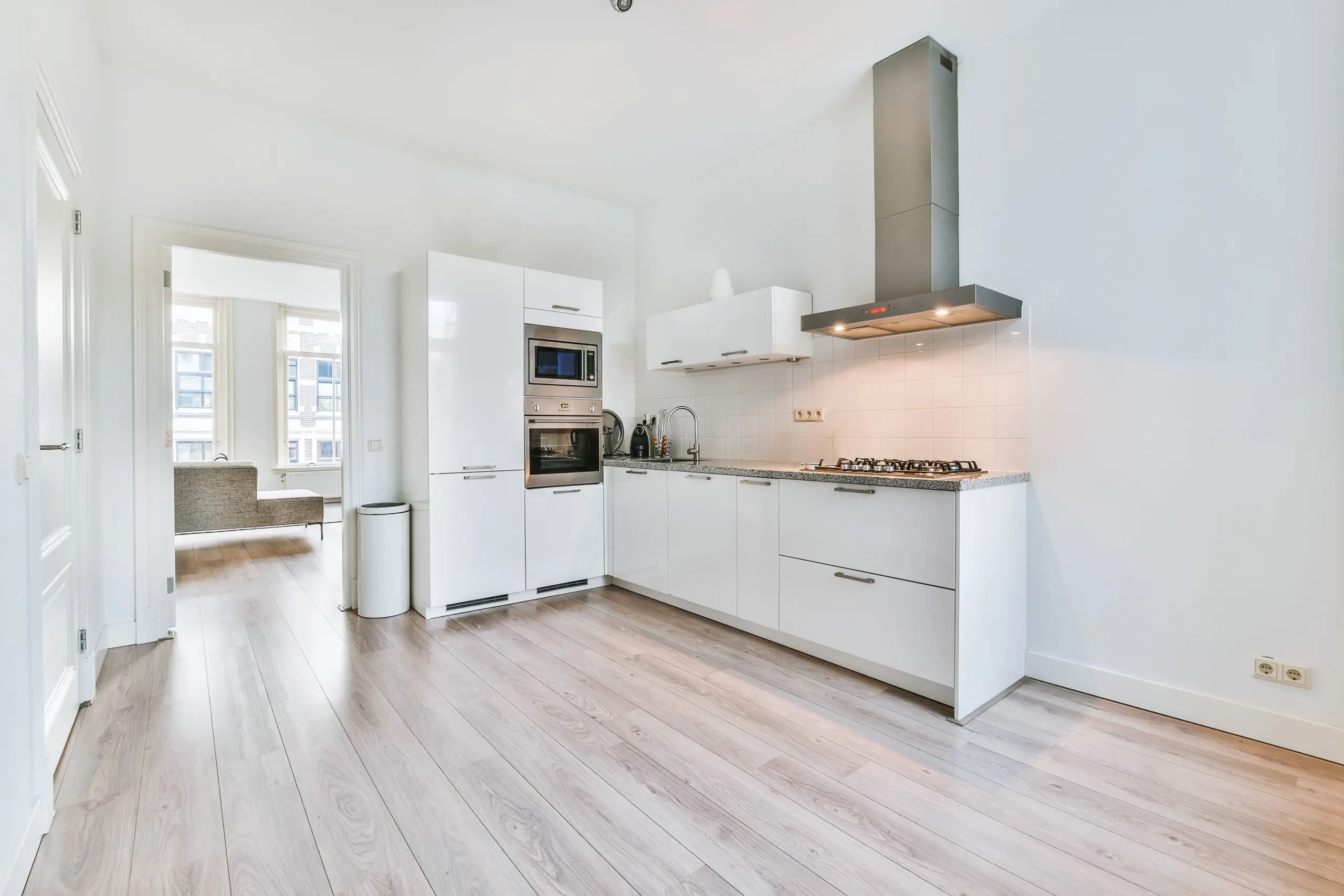
The kitchen is the room that lives the most in a family home. That's where it all happens: rushed mornings, school lunches, wet feet coming in from the snow, juice spills, chairs pulled across the floor without a second thought. And that's often where we realize, afterward, that the flooring chosen doesn't keep its promises.
Choosing a kitchen floor in Lévis isn't just a question of style or budget. It's a question of real durability under the conditions of your home, your family, and the climate we live in here. The humidity of the St. Lawrence River, the salt and snow brought in during winter, homes built between the 1970s and 1990s that have their own subfloor challenges — all of this goes into the equation.
At Solutions Rénovation Québec (SRQ), a licensed RBQ contractor (5811-7821-01), we've been renovating kitchens in the Lévis and Chaudière-Appalaches region for years. Here we give you an honest comparison of the three most common materials — ceramic, hardwood and SPC vinyl — to help you make the right choice based on your family's reality, not just what's trendy.
What type of floor best withstands the reality of Quebec families?
Before comparing materials, we need to name what a family kitchen floor is subjected to every day. It's rarely what the brochures show. The reality is closer to a playground than to a model home.
An active family kitchen means constant traffic from the stove to the table, splashes around the sink and stove, wet boots taken off in the adjacent entryway, children dragging chairs, pets whose claws work silently on the surface. And in Lévis, you add winter entries with their doses of salt and humidity.
The challenges of a family kitchen in Lévis
The kitchen floor of a family home in Lévis must handle two types of stress: intensive daily use and the climatic constraints of the region. It's not the same wear profile as a seldom-used hallway or an adult's bedroom.
Humidity is the most often underestimated factor. A kitchen generates steam during cooking, water around the sink, frequent spills. In Lévis homes built before the 2000s, subfloors weren't always designed with current humidity management standards. Result: a material that tolerates water poorly can start causing problems well before the end of its theoretical lifespan.
Why the Quebec climate accelerates the wear of certain materials
Quebec's freeze-thaw cycles don't stay outside. They influence the structures of homes — seasonal movements of the slab concrete, variations in relative humidity between the very dry winter (central heating) and the humid spring. These variations make materials work. A product that doesn't tolerate dimensional changes will warp, crack or delaminate much faster than expected under these conditions.
Why many homeowners regret their first choice
What we often hear during our visits: «I chose the floor because it looked nice in the store.» Or again: «It was the cheapest, I thought it would do the job just the same.» A few years later, the floor swells, scratches too easily, or requires maintenance that nobody wanted.
Regret almost always comes from a choice made solely on price or appearance, without considering the real use and the conditions of the home. A floor that has to be replaced after five years ultimately costs more than a product better suited from the start.
Want to avoid starting over in three years? Have your kitchen evaluated before choosing a material.
Contact SRQ for a free consultation → 418-476-1747
Ceramic — the durable choice for heavily used kitchens
Ceramic and porcelain have something few other materials have: a lifespan that can easily exceed twenty to fifty years if properly installed and well maintained. In a high-traffic kitchen, that's a strong argument.
The advantages of ceramic in a family kitchen
Ceramic is impermeable on the surface. Splashes of water, sauce, fruit juice — it wipes clean without leaving a trace and without the material itself suffering. For a kitchen that sees a lot of activity around the sink and stove, that's a fundamental quality.
Its resistance to wear is also remarkable. A good-quality ceramic — particularly porcelain, denser than standard ceramic — resists scratches, light impacts and high traffic for decades. In homes where you don't want to worry about the floor for twenty years, it's often the first choice we retain.
Why the quality of the grout and installation is essential
The ceramic itself is impermeable. Its joints, however, are not — unless an epoxy grout is used or the cementitious grout is properly sealed and maintained. A cracked or porous kitchen joint is a doorway for water, grease, and mold. Installation must be done rigorously: underlying waterproofing membrane in risk areas, grout suited to the use, quality silicone at the perimeter. Beautiful ceramic on a botched installation is a problem that manifests itself later.
The often-forgotten drawbacks
Ceramic is cold. In a Quebec winter, in the morning, you feel it. For families where children play on the floor, or for adults who spend long hours standing while cooking, this hardness and coldness can become uncomfortable over the long term.
Another point less often mentioned: objects that fall on ceramic generally don't survive. Glasses, plates, phones — the hard surface doesn't forgive. And if a tile takes a significant impact, it can crack — which requires a spot replacement, not always simple if the ceramic is discontinued.
In what types of homes ceramic works best
Ceramic is particularly well suited to large, high-traffic kitchens, to families with young children who need a surface that's easy to clean thoroughly, and to homes equipped with radiant floor heating — which solves the winter cold problem in one stroke. In Lévis bungalows with a well-insulated ground floor and a stable slab, it's often the most durable solution over the very long term.
Hardwood — warm and elegant, but more sensitive
Hardwood has an appeal that ceramic and vinyl can't really reproduce: it's alive, warm underfoot, and it ages with a certain grace if you take care of it. In a kitchen, it divides — some love it, others categorically avoid it. Both positions have their reasons.
Why many homeowners still love wood
A hardwood floor in a kitchen brings something no other material really provides: character and visual warmth. It warms the space, pairs well with a wide variety of styles, and contributes to the perceived value of the home at resale.
For families living in a home where natural, warm style is important, and who are ready for the maintenance it requires, wood remains a valid choice — under the right conditions.
Solid wood vs engineered wood in Quebec
Solid wood is the most beautiful, but also the most sensitive to humidity variations. In a Quebec kitchen, the dry cycles in winter and wetter ones in spring make it work — it contracts, expands, and can crack or lift if the installation or conditions aren't ideal.
Engineered wood — a layer of hardwood glued to a multilayer backing — offers better dimensional stability. It tolerates humidity variations better than solid wood, while retaining the appearance and warmth of natural wood. In a Quebec kitchen, if you absolutely want wood, engineered wood is what we recommend in the vast majority of cases.
The limits of wood in an active kitchen
Wood scratches. Not necessarily dramatically in everyday use, but pet claws, chairs moved without felt pads, pebbles brought in under soles — all of this accumulates and eventually marks the surface. These marks are part of the natural aging of wood, which some find charming and others find neglected.
Water is the main enemy. A spill left too long, water that regularly accumulates in front of the sink, or dishes that overflow slightly — all of this can stain, warp, or locally swell the planks. Wood around a kitchen sink requires constant vigilance. It's a commitment some families are ready to make, others not.
When wood remains a good choice despite everything
If your kitchen is moderately used, the room's ventilation is good, you don't have pets with claws, and you're comfortable with regular maintenance — oiling, occasional sanding, joint upkeep — wood can last several decades and stay magnificent. In a high-end home in Lévis where natural aesthetics are a priority, it's still a defensible choice with the right precautions at installation.
Unsure if wood suits your kitchen? We can analyze your situation before you commit.
Talk to an SRQ specialist → solutionsrenovationquebec.ca | 418-476-1747
SPC vinyl — the best balance for many families in Lévis
SPC (Stone Plastic Composite) has gradually established itself in the Quebec residential market for a concrete reason: it meets most of the needs of an active family without the major compromises of ceramic or wood. It isn't perfect, but in many kitchens we see in Lévis, it's the most logical solution.
Why SPC is gaining popularity in Quebec
Its rigid core made of limestone and PVC makes it 100 % waterproof — not just on the surface, like ceramic, but throughout its entire thickness. A spill, water around the sink, wet feet — none of this compromises the material. It doesn't swell, doesn't warp, and doesn't react to humidity the same way wood or laminate does.
It is also more comfortable than ceramic underfoot — less cold, less hard, with an underlay that better absorbs sound impacts and walking comfort. For someone who spends a lot of time standing in the kitchen, this difference is really felt at the end of the day.
Why SPC performs well near the St. Lawrence River
The higher ambient humidity in Lévis, seasonal variations in temperature and relative humidity, and concrete subfloors that release moisture in the spring — SPC tolerates all of this without issue. Its dimensional stability under variable conditions is a quality directly useful in the Quebec context. The material doesn't move with the seasons — it stays in place.
The best compromise between budget, comfort and durability
A quality SPC vinyl suitable for residential use, installed by a qualified contractor, has an estimated lifespan of twenty to thirty years (reasonable estimate). Its installation cost is generally lower than that of ceramic, and significantly less demanding in maintenance than wood.
Daily maintenance comes down to sweeping and occasional damp cleaning. No sealer to reapply, no sanding, no annual treatment. For a busy family that doesn't want to manage kitchen floor maintenance on top of everything else, it's a real advantage.
Mistakes to avoid with SPC
SPC is not infallible. A poorly leveled subfloor will create pressure zones on the planks, creaking when walking, and accelerated wear at the joints. A poor-quality product — wear layer too thin, unstable core — can scratch quickly or lose its dimensional stability after a few winters.
That's why product choice and subfloor preparation are as important as the material itself. A cheap SPC poorly installed is no better than laminate under the same conditions — it will just discourage you in a different way.
Why an RBQ installation changes everything
A qualified RBQ contractor will test the subfloor's moisture before laying anything. They will level irregularities, install the membrane or underlay prescribed by the manufacturer, respect perimeter expansion joints, and deliver a floor whose installation is covered by a labor warranty. This is not a minor step — it's what makes the difference between a floor that lasts twenty years and a floor that causes problems after three winters.
Do you want to compare the options for your kitchen with someone who actually installs them?
Schedule a consultation with SRQ → solutionsrenovationquebec.ca | 418-476-1747
Which material to choose according to your family's reality?
The honest answer is that it depends. It depends on your home, your family, your budget, and what you're prepared to maintain. Here's how we approach this question during an evaluation at a homeowner's property.
For families with children or pets
In this context, the priority is practical resistance and ease of maintenance. Can it be cleaned thoroughly without special precautions? Does it resist scratches and frequent impacts? Does it withstand daily humidity without damage?
Ceramic and SPC both meet these criteria. The main difference: ceramic is harder (therefore colder and less comfortable over long periods of standing), and a cracked tile requires a spot repair. SPC is more comfortable and more flexible to maintain. For the majority of active families with young children or pets, SPC is generally the most logical solution — less demanding, just as water-resistant, and softer day to day.
For older homes in Lévis
Bungalows and single-family homes built before 1990 in Lévis often raise hidden moisture issues. The subfloor wasn't necessarily designed with current standards. The concrete slab can release moisture seasonally. Kitchen ventilation is sometimes insufficient.
In this type of home, hardwood is rarely the first choice we recommend for the kitchen — the risks of swelling or warping are too high if humidity isn't perfectly controlled. Between ceramic and SPC, SPC tolerates subfloor humidity variations better — which often makes it the safest option for this type of property. Ceramic remains valid, but it requires a more rigorous installation (membrane, grout type) to perform durably.
For homeowners who want to maximize value
If resale value and long-term appearance are priorities, ceramic or hardwood generally give a finish that stands out better in real estate photos and during showings. Well-laid ceramic with quality grout and large modern-format tiles remains a solid selling point. Well-maintained hardwood too.
That said, a high-end SPC with a realistic wood finish and careful installation can be hard to distinguish from real wood at first glance — and it will have the advantage of requiring no special maintenance for the next owner. This is an increasingly relevant consideration in a market where buyers are looking for practicality.
Your kitchen deserves a floor worthy of the use it gets. Schedule a free evaluation with SRQ.
Request your no-obligation quote → 418-476-1747 | srq.quebec@gmail.com
Why choose SRQ for your kitchen renovation in Lévis?
Renovating a kitchen is a project that lasts ten to twenty years. The choice of material matters, but the execution matters just as much — if not more. We regularly see kitchens where the material was good, but where the installation created problems that the owner has been living with for years.
An approach adapted to Quebec realities
At SRQ, we don't recommend a product because it's in stock or because it simplifies our work. We assess your home concretely — the condition of the subfloor, the humidity level, the kitchen layout, daily use — and we propose what will hold up in your real conditions.
In a 1982 house in Charny with a damp basement adjacent to the kitchen, we don't recommend the same solution as in a new house in Lévis with a perfectly sealed slab. Materials adapted to the Quebec climate, chosen according to the specific condition of your property — that's what makes the difference between a renovation that lasts and one that comes back to haunt you.
Transparent advice, no pressure
You receive a detailed, readable quote before making any decision. Materials, subfloor preparation, labour — everything is clearly separated. If we notice a problem during preparation — higher humidity than expected, a subfloor that requires more work — we contact you before going further. You decide with all the information in hand, not faced with a done deal.
What distinguishes SRQ from improvised contractors
SRQ operates under RBQ licence 5811-7821-01, with Marco Savoie's direct responsibility on every project. The 5-year labour warranty applies to all our installations. With more than 500 residential projects completed in the Lévis, Québec and Chaudière-Appalaches region, we have installed floors in kitchens of all sizes and all configurations — from fully redone 1970s bungalow kitchens to modern open kitchens, including targeted partial renovations.
SRQ worksites are clean. Adjacent areas are protected, material debris is picked up daily, and final delivery is done with a complete inspection. What we hand over is a kitchen ready to be used — not a worksite left to be finished.
Do you live in Lévis, Charny, Saint-Romuald or in the greater Québec area? The estimate visit is free, with no obligation, and you leave with a clear picture of your options.
Get your free quote → solutionsrenovationquebec.ca | 418-476-1747
Frequently asked questions about kitchen flooring in Lévis
What is the best floor for a family kitchen?
It depends on your main priority. For maximum durability and water resistance with no maintenance: ceramic or SPC. For comfort, ease of maintenance and a good budget-durability balance: SPC is often the most logical choice for an active family in Lévis. For natural character, with the constraints that implies: engineered wood under the right conditions.
Is SPC better than ceramic?
Neither is objectively superior — they meet different needs. Ceramic lasts longer (20 to 50 years versus 20 to 30 years for SPC), but it is colder, harder underfoot, and more demanding to install. SPC is more comfortable, easier to lay and maintain, and offers comparable surface water resistance. For a family with children, SPC is often more practical day to day.
Is hardwood too fragile for a kitchen?
Not necessarily, but it requires a maintenance commitment that many families are not ready to keep. Well-installed engineered wood, in a moderately used kitchen, with vigilance around the sink and a maintained surface treatment, can work very well. For a high-traffic kitchen or in a house with humidity problems, the risks are higher.
Which flooring resists humidity best?
SPC and ceramic are the two most moisture-resistant materials in a kitchen. Ceramic is waterproof on the surface, but its joints can be vulnerable if poorly sealed. SPC is waterproof throughout its thickness. Wood — even engineered wood — remains the most sensitive to humidity variations and is not recommended in high-risk areas.
Is ceramic cold in winter?
Yes, that's a reality. Ceramic conducts heat efficiently — which makes it cold underfoot when the room temperature is low. The most effective solution is an electric or hydronic radiant floor system installed under the ceramic. It's an additional investment, but one that completely transforms the winter comfort of the kitchen.
How much does a kitchen floor cost in Lévis?
Costs vary depending on the material, the surface area and the condition of the subfloor. Generally, for a standard residential kitchen: installed SPC vinyl is between 4 $ and 9 $ per sq ft depending on product quality (reasonable estimate); ceramic between 6 $ and 15 $ per sq ft depending on format and installation complexity (reasonable estimate); engineered wood between 8 $ and 18 $ per pi² depending on the species and thickness (reasonable estimate). These estimates include installation but may vary if subfloor preparation is more extensive than expected.
Is SPC durable with children and pets?
Yes, it is even one of its strengths. Its wear layer resists scratches, frequent impacts and high traffic well. Maintenance is simple — regular sweeping and occasional damp cleaning. It tolerates spills and wet feet without damage. For a family with active children or pets, it is one of the most practical materials in the kitchen.
Does the subfloor need to be redone?
Not necessarily, but it should be checked before installing anything. The subfloor must be flat, dry and structurally sound so that the finished flooring holds properly and the manufacturer's warranty remains valid. If corrections are needed — leveling, replacing a section damaged by moisture, adding a vapor barrier — it is better to do them before installation than to have to remove everything to fix it afterward.
Why choose an RBQ contractor?
A licensed contractor assumes professional liability for the installation. For you, this means an installation that complies with industry standards, a valid labor warranty, and possible recourse if the result does not match what was planned. As part of a kitchen renovation — a central space that affects your daily quality of life — this is not a luxury.
Which material offers the best value for money?
For most family homes in Lévis, mid-to-high-quality SPC vinyl offers the best balance between installation cost, durability, minimal maintenance and everyday comfort. Ceramic tile surpasses it in raw longevity, but at the cost of a more demanding installation and less comfort without heated flooring. Hardwood retains an undeniable aesthetic advantage, but with maintenance and moisture-sensitivity compromises that many families end up regretting.
Solutions Rénovation Québec — RBQ Licence 5811-7821-01 2552 chemin du Fleuve, Lévis, Québec G6W 1Y3 418-476-1747 | srq.quebec@gmail.com | solutionsrenovationquebec.ca Monday to Friday, 8 a.m. to 5 p.m.