
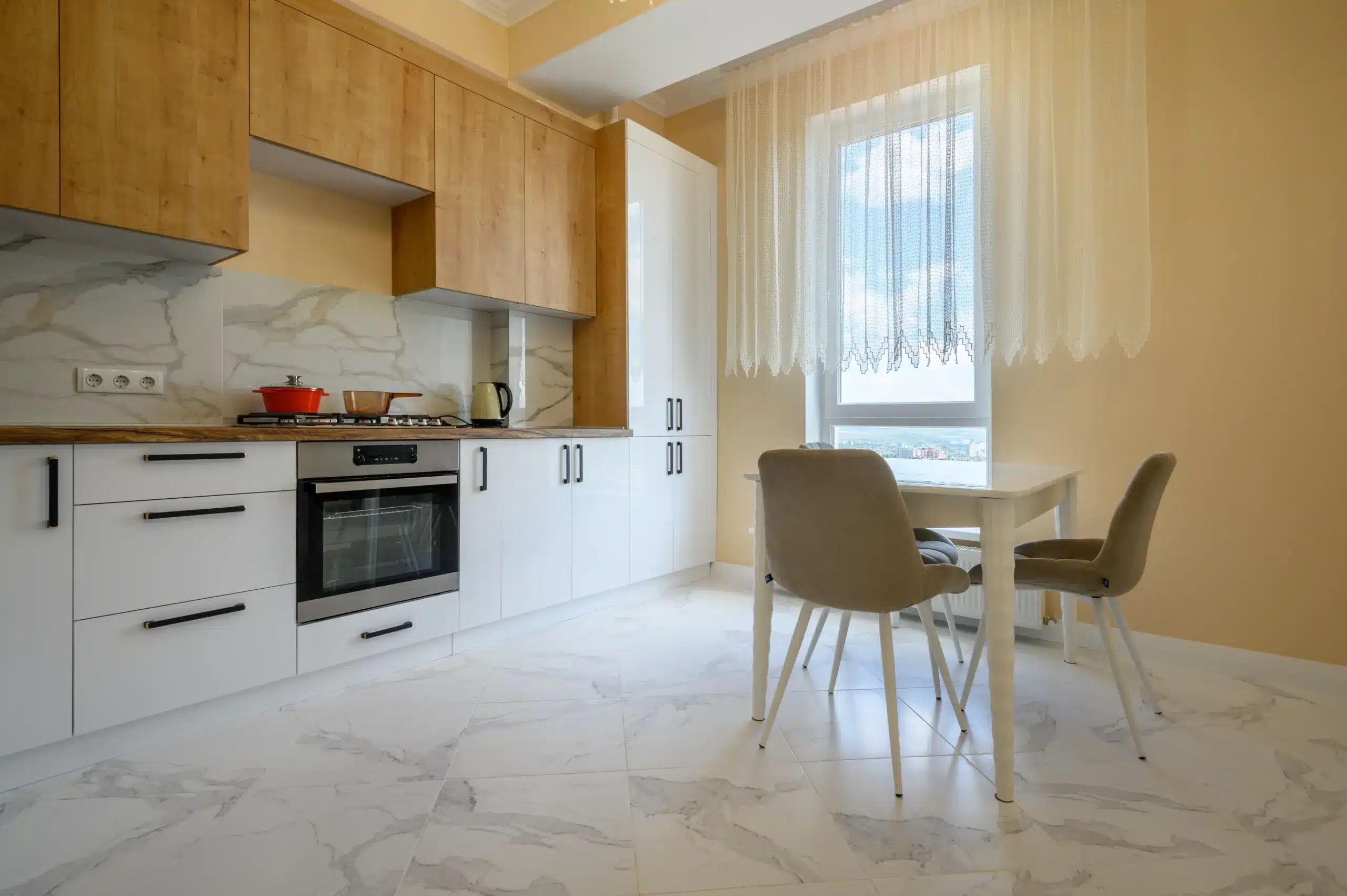
The kitchen floor is probably the surface that takes the most abuse in the entire house. It's where everything happens — rushed mornings with boots still wet, spills that get wiped up (or not fast enough), chairs pushed back without a second thought, pets trotting from one room to another. And in a family home in Charny, you add to that the realities of Quebec winters: salt, melting snow, humidity that settles in everywhere.
What looks beautiful in the store doesn't always keep its promises in real life. Many homeowners choose a kitchen floor based on appearance or price, and realize two or three years later that their choice doesn't hold up under their real conditions. The result: a premature replacement, unexpected costs, and the frustration of starting over sooner than hoped.
At Solutions Rénovation Québec (SRQ), a licensed RBQ contractor (5811-7821-01), we've been renovating kitchens in the Charny, Lévis and greater South Shore areas for years. We know the particularities of these homes — the bungalows from the 1980s, the subfloors that have absorbed moisture, the kitchens that have seen it all. Here's an honest comparison between ceramic and SPC vinyl to help you make the right choice, according to your home and your family.
Why is floor choice more important in a family kitchen in Quebec?
One might think that a kitchen floor is chosen like any other surface. That's rarely the case. An active family kitchen in Quebec is a particularly demanding environment — and materials that aren't designed for these conditions end up proving it fairly quickly.
It's not just about choosing what's durable in general. It's about choosing what's durable in your kitchen, in your home, with your family — taking into account the climate of Charny and the reality of your winters.
The realities of family kitchens in Charny and Lévis
A typical family kitchen in Charny isn't just a place where meals are prepared. It's the central passage space of the home. Children come in from outside and walk straight through the kitchen. Pets make constant back-and-forth trips. In winter, wet boots loaded with salt inevitably end up leaving marks at the foot of the back door or the adjacent entrance.
Add to that the humidity generated by cooking, the dishwasher, the sink — constant sources of steam and splashes that the floor absorbs daily. Close to the St. Lawrence River, homes in Charny and Lévis also live with higher ambient humidity than in inland regions of Quebec.
How freeze-thaw cycles and humidity accelerate material wear
Freeze-thaw cycles don't stay outside. They influence the very structure of homes — the concrete slab that contracts in winter and expands in spring, the variations in relative humidity between a very dry heated interior and a humid spring rising from the ground. These movements stress materials. A surface that doesn't tolerate these variations ends up warping, cracking or lifting.
In homes built between 1970 and 2000 — which represent a good portion of Charny's residential stock — subfloors don't always have the rigidity or waterproofing of recent constructions. That context changes what we recommend at installation.
The mistakes that cost dearly after a few years
We often see the same scenarios during our visits. A homeowner chose a tile floor without having the joints properly sealed — two years later, the grout is turning black and water has seeped under a few tiles. Another opted for low-end SPC because the price was attractive, on a subfloor that wasn't leveled — the planks creak when walked on and start to delaminate at the ends.
The common thread is a choice made without considering the whole picture: the material, the product quality, the condition of the subfloor, and the installation. Cutting a corner at any of these steps often means paying twice.
Before investing in a new kitchen floor, have your subfloor inspected. It takes thirty minutes and avoids a lot of surprises.
Contact SRQ for a free inspection → 418-476-1747
Ceramic — the robust and durable solution for heavily used kitchens
Ceramic has stood the test of time in Quebec kitchens for a simple reason: it lasts. Under the right conditions, with rigorous installation, a ceramic floor can last thirty to fifty years without structural replacement. That's a strong argument when thinking about long-term investment.
The advantages of ceramic for families
Ceramic and porcelain are impermeable on the surface. Oil, juice, sauce splashes — they wipe off an impermeable surface without the material being affected. Unlike wood, which can stain or swell, or laminate, which can delaminate, ceramic doesn't react to water on the surface.
It also resists scratches, repeated impacts and heat very well. For a kitchen that sees a lot of traffic and where dropped objects are inevitable, the solidity of ceramic is a real advantage. In Charny as everywhere in Chaudière-Appalaches, kitchens where real cooking happens — often and intensely — benefit greatly from this robustness.
Why proper joint installation is essential
Ceramic tile itself is waterproof. Its grout lines, however, are not waterproof by default. An unsealed cementitious grout is porous — it absorbs grease, traps dirt, and can let water through if cracks appear over time. For a family kitchen, an epoxy grout (non-porous, stain- and moisture-resistant) is almost always the best choice. And the silicone line around the perimeter — between the tile and the cabinets, between the tile and the baseboard — must be done with a quality product to prevent infiltration at these movement zones.
Beautiful ceramic tile on an installation that skipped these steps is a floor that will start causing problems in the exact spot where you least expect it.
The drawbacks often forgotten before buying
Ceramic tile is hard and cold. This isn't a criticism — it's a physical characteristic of the material. For someone who spends an hour standing while cooking every evening, or for children playing on the kitchen floor in the morning, this hardness and coldness eventually make themselves felt.
In a Quebec winter, a kitchen on a concrete slab without heated flooring can be uncomfortably cold underfoot in the morning. It's a reality that many homeowners don't measure before installing their ceramic tile — and that they then live with every fall.
The other point: a tile that takes a significant impact can crack locally. Replacement is possible, but it requires finding the same format and the same batch — which isn't always guaranteed a few years later.
When ceramic tile is the best choice
Ceramic tile performs best in large, high-traffic kitchens, in homes equipped with electric or hydronic heated flooring that corrects the coldness problem, or in families who want a floor they will truly never have to replace. For a heavily used kitchen, with a stable subfloor and careful installation, it's the choice that offers the longevity that's hardest to beat.
Want to see which ceramic tile formats and models best suit your kitchen?
Schedule a consultation with SRQ → solutionsrenovationquebec.ca | 418-476-1747
SPC vinyl — the practical and comfortable choice for many families
SPC vinyl (Stone Plastic Composite) has gradually established itself in Quebec kitchens in recent years. It's no coincidence. It meets concrete needs that ceramic tile doesn't always cover well — particularly everyday comfort and ease of maintenance — while offering water resistance that wood or laminate cannot match.
Why SPC is gaining ground in Quebec
Its main asset is its core. Composed of limestone and PVC, SPC is waterproof throughout its entire thickness — not just on the surface. A spill, water pooling for a few hours around the sink, wet feet in winter — none of this compromises the structure of the material. It doesn't swell, doesn't warp, doesn't lose its dimensional integrity when faced with moisture.
Maintenance is minimal. Regular sweeping, occasional damp cleaning — that's about it. No sealer to reapply, no special treatment, no special precautions around the sink. For a busy family that has other things to manage than maintaining their floor, it's a real and everyday advantage.
Why SPC works well in homes near the river
The higher ambient humidity in the Charny and Lévis areas — due to the proximity of the St. Lawrence River — has an impact on exterior building materials, but also on interior spaces, particularly in homes that are less well insulated or ventilated. SPC tolerates these conditions without issue. Its dimensional stability in the face of relative humidity variations makes it a material naturally well suited to the climatic context of the South Shore.
The concrete advantages for families with children or pets
Underfoot, SPC is noticeably more comfortable than ceramic tile. The integrated underlay (foam or cork, depending on the product) cushions shocks when walking, reduces footstep noise, and keeps a more neutral surface temperature. For someone who spends a lot of time standing in the kitchen, or for children who play and fall on the floor, this difference in comfort is truly felt.
Its wear layer resists pet claws, moved chairs, and frequent impacts well. A mid-to-high-quality SPC holds up without significant marks in normal family use, without requiring special daily precautions.
Mistakes to avoid with SPC vinyl
SPC isn't infallible, and there are frequent installation mistakes that compromise its durability. The first: a poorly leveled subfloor. If the surface isn't flat according to the manufacturer's prescribed tolerances, the planks will create pressure points at the joints, generate creaking when walking, and wear unevenly.
The second: choosing a product that's too low-end. Entry-level SPC often has a wear layer that's too thin, a less dense core, and inferior dimensional stability. Within a few years, in an active kitchen, these shortcomings show.
Why an RBQ-compliant installation changes durability
An installation by a qualified contractor begins with checking the subfloor's moisture, leveling irregularities, installing the appropriate membrane or underlay, and respecting perimeter expansion joints. These steps are not optional — they are what makes the difference between a floor that lasts twenty years and a floor that causes problems after two winters. And they are also what keeps the manufacturer's warranty valid if a problem arises.
Do you have a kitchen project in Charny or Lévis? Get a clear quote for your flooring choice.
Request your free quote → solutionsrenovationquebec.ca | 418-476-1747
Ceramic or SPC: which material to choose according to your family reality?
The honest answer is that there is no universally better solution. Both materials are valid — under the right conditions, with a good installation. What changes is which family and home profile each one best suits.
If your priority is maximum durability
Ceramic has the advantage here. A good-quality porcelain, properly installed on a stable subfloor with epoxy grout, can last thirty to fifty years (reasonable estimate) without structural replacement. It is the choice you make when you want to lay a floor once and not think about it again for two generations.
It is also more resistant to repeated localized impacts — a falling knife, a metal chair with worn tips, a kitchen where you often host people. If your kitchen is the heart of the home and you want the material that takes the most without showing wear, ceramic is hard to beat on this criterion.
If your priority is comfort and ease of maintenance
SPC clearly has the advantage. Warmer and softer underfoot, quieter when walking, easier to clean daily, and less demanding in maintenance over the long term — it better matches the pace of a busy family that wants a beautiful floor without complicating their life.
For a family with young children, pets, or parents who spend a lot of time standing in the kitchen, the daily comfort of SPC is a factor that really counts in the choice. And its water resistance makes it just as safe an option as ceramic for areas exposed to splashes.
If your home is older in Charny
Homes built between 1970 and 1990 in the Charny area often have subfloors with their own history — concrete that has drawn up moisture for thirty years, a few uneven areas, insulation between the slab and the floor that is sometimes absent or outdated.
In this context, ceramic remains a viable choice provided that the preparation is done rigorously — moisture test, leveling, appropriate membrane. SPC, for its part, tolerates residual moisture variations a little better and can be installed on a slab with a slightly higher moisture level, provided the recommended vapor barrier is installed. In older homes, it is often the choice that offers the least risk at installation.
Quick comparison table — ceramic vs SPC vinyl
| Criteria | Ceramics | SPC Vinyl |
| Estimated lifespan | 30 to 50 years | 20 to 30 years |
| Water resistance | Excellent (surface) | Excellent (total) |
| Comfort underfoot | Cold and hard | Warm and flexible |
| Maintenance | Joints to seal | Minimal |
| Scratch resistance | Very high | Good to very good |
| Installed cost (approx.) | 6 to 15 $/sq ft | 4 to 9 $/sq ft |
| Suitable for homes 25+ years old | Yes (with rigorous preparation) | Yes (with vapor barrier) |
All cost and lifespan estimates are reasonable estimates based on standard installation conditions in Quebec.
Still hesitating? We can guide you in choosing what suits your home and your family — with no pressure and no commitment.
Request a personalized recommendation → 418-476-1747
Why trust SRQ for your kitchen renovation in Charny?
A well-chosen but poorly installed floor does not give a good result. An ordinary floor, installed properly according to the rules of the art, can last longer than a premium product laid hastily. That is why the choice of contractor matters as much as the choice of material.
Expertise adapted to homes in Lévis and Charny
We have been working in the homes of Charny, Lévis, Saint-Romuald and the entire South Shore for years. We know the profile of these homes — the bungalows of the 1975 to 1990 era with their untreated slabs, the semi-open kitchens that have been expanded over the decades, the subfloors that have absorbed a good dose of spring moisture.
This local knowledge translates into our recommendations. We do not suggest a theoretically correct material — we suggest what will hold up in your home, with your family, under the real conditions of Charny.
A transparent approach from start to finish
Before the work begins, you have in your hands a detailed quote: materials, quantities, subfloor preparation, labor. Everything is separated and explained clearly. There is no vague line, no package that covers everything without detailing what is included.
If we discover something unexpected during preparation — a subfloor more humid than expected, an area that requires more leveling — we contact you before going further. You decide with full knowledge of the situation. The site is clean, adjacent areas are protected, and you get back a usable kitchen upon delivery.
What distinguishes SRQ from improvised contractors
SRQ operates under RBQ license 5811-7821-01, with Marco Savoie's direct responsibility on every project. The 5-year warranty on labor applies to all our installations — ceramic as well as SPC. With more than 500 residential projects completed in the region, we have installed kitchen floors under very varied conditions, and we know what to look for before starting.
Our teams follow the rules of the art at every step: moisture test, adequate leveling, appropriate membrane, compliant expansion joints. These are not details — they are the steps that make the difference between a result that holds and a result that disappoints.
Do you have a kitchen project in Charny or the surrounding area of Lévis? The estimate visit is free and without obligation.
Schedule your evaluation with SRQ → solutionsrenovationquebec.ca | 418-476-1747 | srq.quebec@gmail.com
Frequently asked questions about kitchen flooring in Charny
What is the best floor for a family kitchen?
It depends on your main priority. For maximum longevity: ceramic, installed correctly with epoxy grout. For everyday comfort and minimal maintenance: SPC vinyl. For families with active children and pets, SPC generally offers the best balance between practical resistance and living comfort.
Is SPC vinyl better than ceramic?
Neither is objectively superior. Ceramic lasts longer, resists localized impacts and extreme wear better. SPC is more comfortable, easier to maintain and offers total water resistance throughout its thickness. The right choice depends on your usage, your home and what you are prepared to maintain.
Is ceramic too cold in winter?
In a kitchen on a concrete slab without heated flooring, yes, ceramic can be uncomfortably cold in the morning during a Quebec winter. The most effective solution is an electric radiant heating system installed under the ceramic — it is an additional cost at installation, but it completely changes the winter comfort of the room.
Which material best resists splashes?
Both resist surface splashes well. The difference: ceramic is waterproof on the surface but its grout lines can absorb water if they are not sealed or if the grout is cracked. SPC is waterproof throughout its entire thickness, including joints. For an area directly exposed to frequent splashes, SPC is slightly more forgiving day to day.
Do ceramic grout lines require a lot of maintenance?
With standard cementitious grout, yes — a sealer must be applied regularly and you must watch for cracks. With epoxy grout, joint maintenance is practically nil: the surface is non-porous, does not retain dirt and does not require sealer. For a family kitchen, epoxy grout is almost always worth the additional investment.
How much does a kitchen floor cost in Charny?
Generally, for a standard residential kitchen: installed SPC vinyl ranges between 4 $ and 9 $ per sq ft depending on product quality (reasonable estimate); ceramic between 6 $ and 15 $ per sq ft depending on format and installation complexity (reasonable estimate). These estimates include labor but may vary if subfloor preparation requires significant corrections.
Is SPC durable with children?
Yes. It is even one of its strengths in a family context. Its wear layer resists scratches, frequent impacts and high traffic well. Cleaning is simple, it tolerates spills without damage, and it is softer and less cold underfoot — which is significant when children play on the floor.
Can SPC be installed over an old floor?
Sometimes yes, sometimes no — it depends on the condition and flatness of the existing floor. If the current floor is stable, flat and within prescribed tolerances, an overlay installation can be considered. If the surface is too irregular or if moisture is an issue, removal and complete subfloor preparation are necessary. This must be assessed during an on-site inspection.
Why hire an RBQ contractor?
A licensed RBQ contractor commits their professional liability on every project. This means an installation compliant with industry standards, a valid labor warranty, and a clear recourse if something goes wrong. For a kitchen floor — an investment you live with daily for fifteen to thirty years — this protection is not a luxury.
Which floor lasts the longest in Quebec?
Quality ceramic, properly installed, has the longest lifespan — potentially thirty to fifty years under the right conditions (reasonable estimate). Correct-quality SPC vinyl can last twenty to thirty years (reasonable estimate). In both cases, the actual lifespan depends as much on installation quality as on product quality.
Solutions Rénovation Québec — RBQ Licence 5811-7821-01 2552 chemin du Fleuve, Lévis, Québec G6W 1Y3 418-476-1747 | srq.quebec@gmail.com | solutionsrenovationquebec.ca Monday to Friday, 8 a.m. to 5 p.m.