
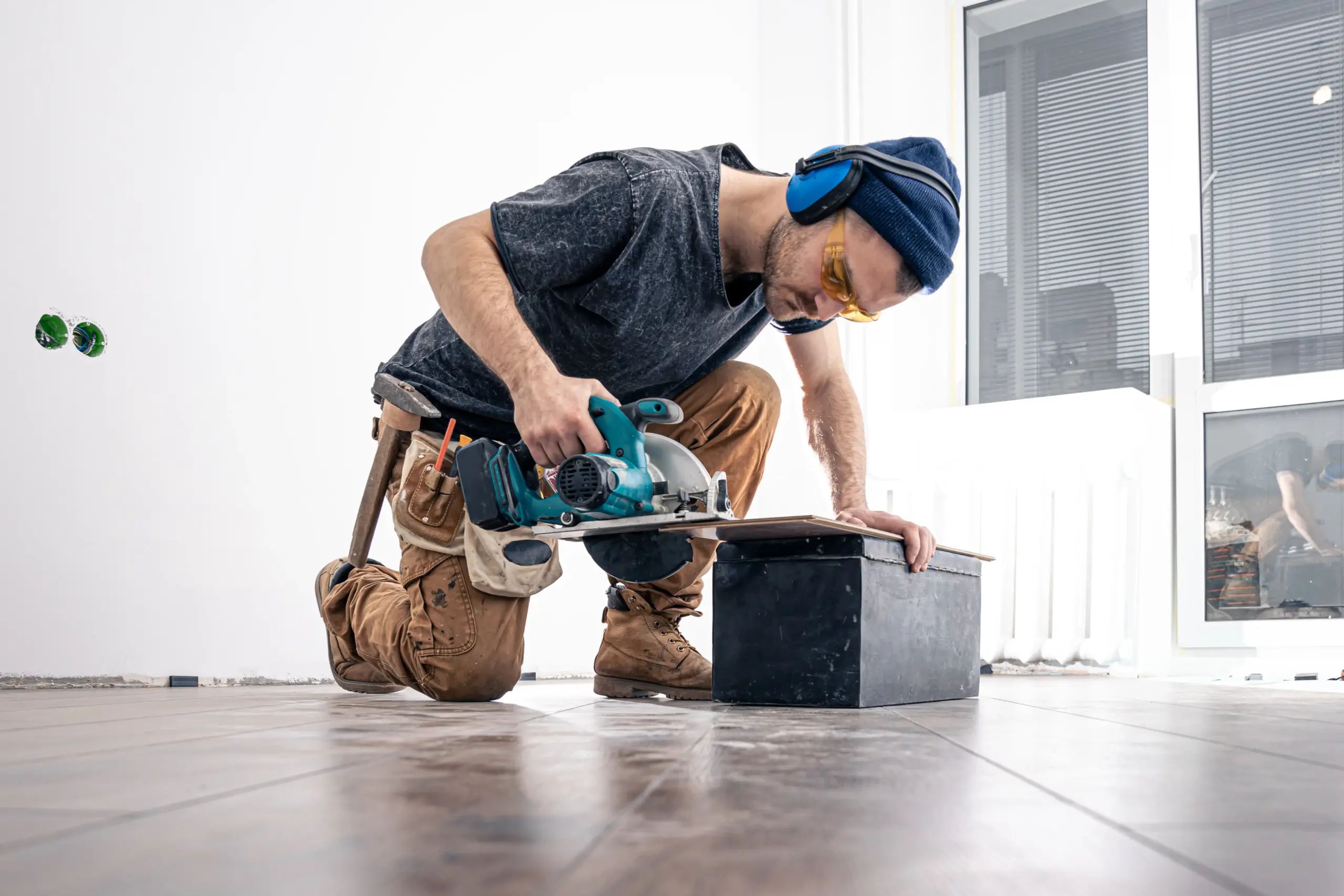
The short answer: yes, in several situations, it's entirely possible. Covering an old floor rather than tearing it out can save time and money. But it's not automatic.
It all depends on three things: the condition of the subfloor, the moisture level, and the structure underneath. Skipping this verification means risking hiding a problem that will resurface later — and that will cost more to fix.
At Solutions Rénovation Québec (RBQ license 5811-7821-01), we've been renovating floors in bungalows and homes 25 years and older in the Desjardins sector of Lévis for years. In this article, we explain when covering is a good idea, and when it's better to start over.
Installing a new floor over the old one: is it really a good idea?
For many homeowners, it's tempting. You look at the old floor, it seems fine, and you tell yourself that a simple covering will do the job at lower cost.
Often, that's true. Covering is fast, clean and economical when conditions allow. But «when conditions allow» is exactly where the success or failure of the project is decided.
The key is knowing how to distinguish a floor that can be covered without worry from a floor that hides a problem. That's where an inspection makes all the difference.
The advantages of covering rather than full removal
Reduced costs and construction time
Covering a floor first means avoiding demolition. No need to tear out the old covering, which eliminates a work step and the costs that come with it.
That means less dust, less debris to manage and a faster job site. For a floating floor, expect around $4 to $11 per square foot for installation (reasonable estimate that varies depending on the product and complexity). You move back in faster, with less disruption.
When this solution is particularly worthwhile
Covering shines in spaces already in good condition. A condo, a bungalow, bedrooms or living areas whose floor is stable and dry are excellent candidates.
If the support is solid, flat and shows no signs of moisture, covering is often the logical choice. You keep what works and add on top.
The risks that many homeowners discover too late
Here's the part we have to say frankly. Covering a floor without checking what's underneath sometimes means trapping a problem.
The moisture trap under the existing covering
It's the number one risk, especially in our Quebec basements often exposed to moisture. If you cover a damp floor, you trap that moisture.
Result: condensation stuck under the new covering, and ideal ground for mold. The floor looks new on the surface, but underneath, it's deteriorating silently. That's exactly the kind of problem you discover too late, when the smell or stains appear.
Leveling and structural problems
The other trap is unstable support. If the old floor moves, creaks or sags, the new covering will reproduce these defects — or even make them worse.
A support that isn't level causes creaking, joints that open up and a floor that doesn't feel solid underfoot. Covering doesn't fix a structural problem; it hides it temporarily.
Have your floor inspected before investing
A preventive inspection costs little and can save you thousands of dollars in future repairs. Have your floor inspected by Solutions Rénovation Québec before installing anything — we'll tell you frankly if covering is the right strategy.
What conditions must be met before covering an existing floor?
Before covering, three conditions must be met: a subfloor in good condition, a controlled moisture level, and compliance with livable heights. If one is missing, covering becomes risky.
Here's how we evaluate each of these conditions on site.
Check the condition of the subfloor
The essential criteria according to good building practices
The subfloor must be stable, flat and sound. Concretely, we look for a surface that doesn't move, with no sagging or movement when you walk on it.
We also check for the absence of structural damage: no weakened joists, no rot, no soft spots. A support that passes these tests can generally be covered; a support that fails must be corrected first.
Control moisture before installation
Why Lévis's climate changes everything
Moisture is the critical factor in our area. Freeze-thaw cycles, seasonal humidity and aging foundations make Quebec basements risky places.
Before installing, we measure the moisture level with a moisture meter. We generally aim to keep relative humidity below 50-60% for a healthy environment. If the level is too high, the source must be addressed — drainage, vapor barrier, ventilation — before thinking about covering. Otherwise, you're trapping the problem.
Respect minimum livable heights
The impact of a few millimeters on compliance
Covering adds thickness, and this thickness can cause problems. A livable space must maintain a minimum ceiling height, generally around 2.1 m in main rooms according to applicable standards.
A few millimeters can also affect how doors work, thresholds and the bottom of stairs. We plan these adjustments in advance to avoid a door no longer closing or a step becoming uneven — a detail that can become a safety issue.
Request an SRQ technical evaluation
These verifications require experience and the right tools. Request a technical evaluation from Solutions Rénovation Québec — we measure humidity, assess the subfloor and confirm feasibility before you invest.
What types of flooring can be installed over an existing covering?
Not all coverings are equally suited to overlaying. The right choice depends on the room, the humidity level and the existing substrate.
Here are the main options, with their strengths and limitations for our climate.
SPC Vinyl: The Most Popular Solution in Lévis
SPC vinyl (Stone Plastic Composite) has become the star choice, and for good reason. It is a rigid, stable and resistant covering that installs well over several existing surfaces.
Why it resists moisture better
Its great strength is its dimensional stability: it moves very little with variations in temperature and humidity. This makes it an excellent candidate for basements, where other materials would suffer. As a bonus, maintenance is simple and it imitates wood or stone well.
Laminate floating flooring
Laminate remains a popular and economical option, with a beautiful choice of appearances. It is installed floating, without gluing, which simplifies installation over an old floor.
Situations where it works well
Laminate performs best in dry spaces: bedrooms, upper floors, living areas protected from humidity. Where humidity is a concern — such as a basement — it is more vulnerable than SPC, so it is reserved for appropriate locations.
Hardwood: possible, but with caution
Hardwood is magnificent and durable, but it is also the most sensitive of the three to our climate. It can be installed over certain substrates, but with precautions.
The limits in the Quebec climate
Wood reacts to humidity variations: it swells when it is humid, contracts when it is dry. In a basement or an unstable environment, this can cause warping or joints that open. Its higher cost adds to these constraints, so it is mainly recommended for dry, well-controlled upper floors.
Ceramic and special cases
Ceramic is a special case. A new covering can sometimes be installed over it, but this requires careful evaluation.
When removal becomes preferable
Covering ceramic adds extra thickness and weight, which can cause problems for heights and the substrate. If the existing ceramic moves, is cracked or poorly adhered, the best approach is often to remove it. Covering an unstable substrate does not last over time.
Permits, RBQ and regulations: what homeowners need to know
Before starting a project, it is normal to wonder whether a permit is necessary. Here is what you need to know for the Desjardins sector, in Lévis.
Note: requirements can vary and evolve, so a check with the City of Lévis always remains wise.
Is a permit required in Desjardins for this type of work?
Situations generally exempted
A simple floor covering, without structural modification, is generally considered minor interior work that does not require a permit. A covering is changed, the structure is not touched.
That said, as soon as work touches the structure, plumbing or anything other than a simple covering, the rules change. This is why a municipal check is recommended at the slightest doubt — it is quick and avoids surprises.
Why working with an RBQ contractor remains advantageous
Reducing the risks of non-compliance
Even when a permit is not required, calling on an RBQ contractor provides real protection. An RBQ license (ours: 5811-7821-01) guarantees competence and compliance with good practices.
Added to this are insurance, a warranty on the work and proper documentation of the project. This documentation can be valuable at resale, and the warranty protects you if a problem arises. It is the difference between improvised work and work that someone stands behind.
Verify your project's compliance before the work
Before starting, make sure everything is within the rules. Have your project's compliance verified by SRQ — we know the local requirements and guide you to start off on the right foot.
Full removal or covering: which option is the most cost-effective?
This is the big question. The honest answer: it depends on the condition of your current floor. Covering costs less upfront, but it is not always the most cost-effective option in the long term.
Here is how to compare the two approaches intelligently.
Comparison of the two approaches
| Criteria | Covering | Full removal |
| Initial cost | Lower | Higher |
| Speed | High | Medium |
| Detection of hidden problems | Limited | Excellent |
| Durability | Variable | Superior |
Covering wins on cost and speed. Removal wins on problem detection and durability, because it allows you to see and correct what is hidden underneath. The right choice depends on the actual condition of your floor.
When SRQ recommends full removal
Sometimes, covering would be a mistake. Our role is to tell you frankly when that is the case.
The signs that do not lie
Full removal is recommended as soon as moisture, mold, sagging or structural damage is observed. These signs indicate an underlying problem that covering would only mask.
In these situations, removal allows you to clean up, repair and start again on solid foundations. It is more work upfront, but it is what prevents having to redo everything in two years. Doing it right the first time remains the least expensive in the end.
Get a detailed comparative quote
To know which option suits your floor, nothing beats an evaluation. Request a comparative quote from Solutions Rénovation Québec — we present both scenarios with clear costs, no hidden fees.
Why choose Solutions Rénovation Québec for your flooring work?
A flooring project involves moisture, structure and compliance. The choice of contractor makes the difference between a floor that lasts and a problem that keeps coming back.
Here's what we bring to a flooring project in the Desjardins area and the greater Lévis region.
Expertise adapted to the realities of Lévis and Desjardins
We know the homes here: bungalows, single-family homes, properties 25 years and older, with their typical basements and moisture issues. Freeze-thaw and seasonal humidity are our daily reality.
This experience translates into concrete decisions: we measure moisture, assess the substrate and recommend the right covering for the right place. No one-size-fits-all solution applied everywhere.
Our commitments to homeowners
When you entrust us with a project, here's what we put on the table:
- RBQ license 5811-7821-01 — a licensed and compliant contractor, led by Marco Savoie.
- 5-year warranty on labor — we stand behind our work over time.
- More than 500 projects completed — concrete experience, not promises.
- Clean and safe worksites — we work in your home as if it were our own.
- Total cost transparency — the agreed price is the price paid.
These commitments reduce the risk for you. It's exactly what we would look for ourselves before letting a team into the house.
A simple and transparent process
Our SRQ method
Our approach follows five clear steps: first the’inspection of the floor and moisture, then a detailed quote without surprises. Then comes the’execution careful workmanship, followed by a quality control to validate the result, and finally a clean delivery — we leave, you enjoy your floor.
You know at every step where your project stands. It's this clarity that builds trust.
Schedule your flooring inspection today
Ready to find out what suits your floor? Schedule your inspection with Solutions Rénovation Québec — we assess your situation and propose the best strategy.
Myths and realities about installing a floor over an existing one
There are quite a few misconceptions about floor covering. Let's sort out the most common ones.
Myth #1 – You can always install a new floor over the old one
False. It's often possible, but not always. An unstable, damp or damaged substrate must be corrected or removed first. Feasibility depends on the actual condition of the existing floor, not on a universal rule.
Myth #2 – Covering eliminates moisture problems
False, and it's the most costly mistake. Covering doesn't solve moisture — it traps it. Without controlling the source, you create a breeding ground for mold under the new covering.
Myth #3 – DIY always saves money
Not necessarily. A DIY installation without a proper assessment of the substrate and moisture can lead to a floor that creaks, warps or deteriorates. Redoing the work costs more than doing it right the first time.
Reality – A prior inspection determines the right strategy
The truth is that a prior inspection is what distinguishes a successful project from one that needs to be redone. Measuring moisture and assessing the substrate is what allows you to choose between covering and removal with full knowledge. It's the step that saves the most money.
FAQ – Installing a floor over an existing one in Desjardins
Can you install a floating floor over ceramic tile?
Often yes, provided the ceramic is solid, flat and well adhered. If it moves, is cracked or creates too much added thickness, removal becomes preferable. A prior assessment confirms what's appropriate.
How do you check moisture before installation?
With a moisture meter, which measures the substrate's moisture level. We generally aim for a relative humidity below 50-60 % for a healthy environment. If the level is too high, the source must be addressed before installing anything.
Does covering reduce resale value?
Not if it's done well. A quality covering on a healthy substrate adds a new floor that enhances the home's value. Conversely, a covering that hides a moisture or structural problem can become an issue at the pre-purchase inspection.
What's the best floor for a basement in Lévis?
SPC vinyl is generally the best choice for a basement. Its dimensional stability and moisture resistance make it well suited to the more humid environments typical of our basements.
Should old vinyl flooring be removed?
Not always. Old vinyl that is well glued, flat and dry can often serve as a substrate for a new covering. If it's peeling, warping or hiding moisture, it's better to remove it. That's decided after inspection.
Is a permit required in Desjardins?
For simple covering without structural modification, generally no. As soon as work touches the structure or anything other than a covering, that can change. If in doubt, check with the City of Lévis.
What is the lifespan of an SPC floor?
A quality SPC floor, properly installed, generally lasts many years with minimal maintenance. Its resistance to wear and moisture makes it a durable covering, especially in high-traffic spaces.
How much does a floor covering project cost?
The cost varies depending on the material and surface area. As a guideline, installation often falls in a range of about 4 $ to 20 $ per square foot depending on the chosen covering (reasonable estimate that varies by project). A precise quote requires an on-site evaluation.
Conclusion – The right flooring choice starts with a good inspection
Alors, peut-on installer du plancher par-dessus l’ancien à Desjardins? Oui, dans plusieurs situations — et c’est souvent une excellente façon de sauver du temps et de l’argent.
Mais tout repose sur trois conditions : un sous-plancher sain, une humidité maîtrisée et le respect des hauteurs habitables. Dans notre climat, l’humidité des sous-sols et le gel-dégel rendent l’inspection préalable indispensable. Recouvrir un problème ne le fait pas disparaître — ça le reporte, plus cher.
Au final, le bon choix se décide après une vraie évaluation. Un entrepreneur RBQ expérimenté mesure, évalue et vous recommande la stratégie qui protège votre investissement, recouvrement ou dépose. C’est ça, faire les choses comme il faut.
Schedule your flooring inspection today
Prêt à partir votre projet sur des bases solides? Request your free quote from Solutions Rénovation Québec or call us at 418-476-1747. On inspecte votre plancher, on vous conseille honnêtement, et on vous propose la meilleure solution — sans engagement.