
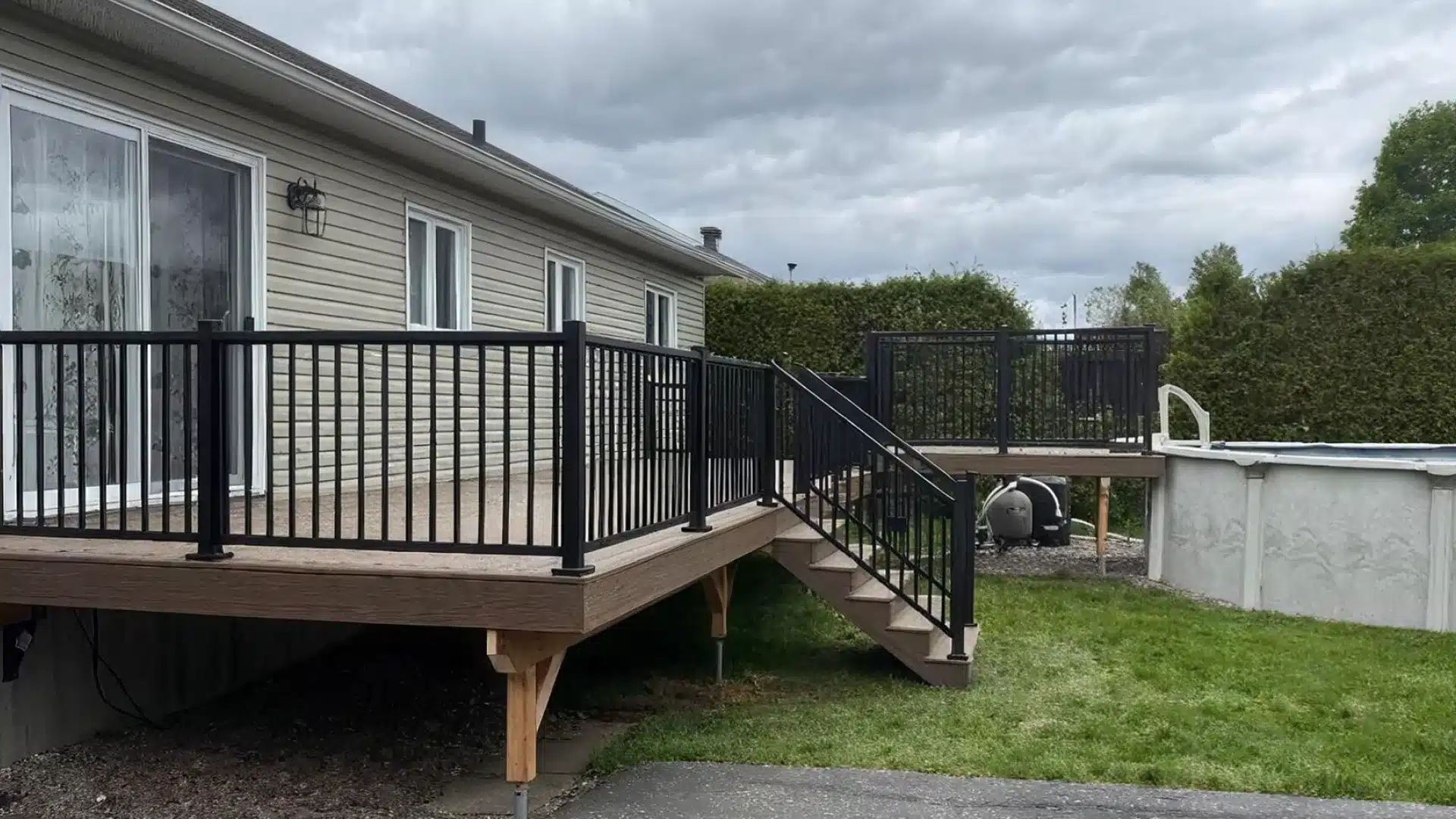
It’s a question we often hear: «A ramp is just a few boards and some screws, right? I should be able to do that myself.» For a bungalow or single-family home owner in Lévis, the idea of saving a few dollars is tempting.
The reality is that a ramp directly affects occupant safety. A poorly built stair step can be unpleasant; a poorly built ramp can send someone to the hospital. This is not a detail.
At Solutions Rénovation Québec (RBQ license 5811-7821-01), we have been installing ramps and guardrails suited to the local climate for years. In this article, we explain frankly what you can do yourself, what requires a professional, and why the difference matters.
Why this decision is more important than it seems
A ramp looks simple, but it serves a critical function: it prevents falls. When this is underestimated, risks are taken that you don’t see coming.
The owner is responsible for what happens on their property. If a ramp gives way or a slippery surface causes a fall, you are the first in line, not the hardware store that sold you the wood.
And there is the value aspect: a sloppy or non-compliant installation can become a problem at resale. An inspector will see it, and the buyer will negotiate it. What seemed like a saving becomes a loss.
A poorly designed ramp can lead to serious consequences
Injuries and civil liability
A ramp that is too steep, poorly anchored, or without a handrail increases the risk of falls. And when someone gets injured at your home — a relative, a visitor, a tenant — your civil liability may be engaged. This is not a rare scenario; it is a reality that insurers know well.
Potential refusal of certain insurance claims
In the event of an accident, an insurer may examine whether the installation complied with standards. A non-compliant ramp or one installed without a permit where one was required can complicate, or even compromise, a claim. You could end up paying out of pocket.
Problems when selling the property
During a sale, the pre-purchase inspection often highlights non-compliant installations. A questionable ramp becomes a point of downward negotiation, or a condition to be corrected before the transaction. The initial saving turns into a headache.
The particularities of Lévis’s climate increase the risks
In our area, winter changes everything. A ramp that looks fine in July can become a trap in January. Snow, ice, and freezing rain turn a surface into a skating rink.
Freeze-thaw cycles also work on anchors and foundations. A ramp poorly anchored in frozen ground can move, become unstable, and lose its solidity over the seasons.
That’s why an exterior ramp in Lévis must be designed for the climate: non-slip surface, adequate drainage, and anchors designed to withstand freeze-thaw. These are considerations that a DIY project often forgets.
Have your project evaluated before you start
Before buying materials or taking out tools, it’s worth knowing what applies to your situation. Request a consultation with Solutions Rénovation Québec — we will tell you frankly whether your project is feasible as DIY or whether it’s better to entrust it to a pro.
In what cases can a homeowner install their own ramp?
Let’s be clear: a homeowner has the right to do certain work on their own residence. The important point is that this right comes with obligations.
Doing the work yourself never exempts you from complying with the Construction Code or obtaining the necessary permits. Here is what the regulations really allow.
What the regulations really allow
Work carried out by the owner
In Quebec, an owner-occupant can generally perform work on their own residence without holding an RBQ license. The RBQ license targets contractors who perform work for others, not the owner working at home.
Conditions to respect
This permission does not remove other obligations. The work must comply with the Quebec Construction Code and the municipal regulations of Lévis. And depending on the project, a permit may be required even if you do everything yourself.
Legal limits of DIY
The limit is responsibility. If you do the work, you assume the result — compliance, safety, and the consequences in case of a problem. For a simple interior ramp, the risk is manageable. For a substantial exterior ramp, the stakes rise quickly.
Situations where a municipal permit may be necessary
Several exterior projects trigger the obligation for a permit in Lévis. Better to check before, not after.
Porch
A porch, especially if raised, generally involves specific guardrail requirements and often a permit. The height relative to the ground changes the applicable rules.
Balcony
A balcony, particularly on an upper floor, involves structural safety and guardrails. This type of installation is almost always regulated and may require a permit and an inspection.
Exterior ramp
A permanent exterior ramp, anchored to the structure, may require a permit depending on its size and configuration. Lévis’s urban planning department can confirm what applies to your specific case.
Myth or reality?
«A small ramp never requires a permit»
A myth to qualify. Size is not the only criterion. Height, location, and the permanent nature of the installation matter. A «small» ramp can still fall under a permit requirement. Check rather than assume.
«Installing a ramp is a simple project»
Myth. The installation looks simple, but compliance is not: precise slope, solid anchors, continuous handrail, guardrails of the right dimensions, drainage. Each of these points can fail an inspection if neglected.
« A homemade wooden ramp is always sufficient »
Myth. Wood can work, but an improvised homemade ramp does not automatically meet standards or the constraints of our climate. Without the right treatment, the right anchors and a non-slip surface, it ages poorly and becomes risky.
Check the requirements applicable to your property
Every property is different, and requirements vary. Have the requirements of your project verified by SRQ — we identify what applies to your home before you invest time and money.
The technical standards to comply with under the Quebec Construction Code
A compliant ramp must meet precise standards. These are not arbitrary numbers — each one aims to make the installation safe and usable by everyone.
Here are the main points. Note: exact requirements depend on the type of installation and may change, so always validate the standards in effect for your project.
Maximum slope and mandatory dimensions
Maximum slope
For an accessible access ramp, the recognized standard is a maximum slope of 1:12, or approximately 8.3%. Concretely, that means 12 units of length for each unit of height to overcome. A ramp that is too steep becomes dangerous and non-compliant.
Recommended minimum width
The ramp must be wide enough for safe use, particularly if it must accommodate a wheelchair or a walker. Insufficient width negates the very purpose of the ramp.
Mandatory rest landings
A long ramp requires rest landings at regular intervals, as well as at changes of direction. These landings allow users to catch their breath and maneuver safely. This is often forgotten in improvised projects.
Guardrail requirements
Minimum height
A guardrail must reach a minimum height set by the Code, which varies depending on the height of the fall to be prevented. Too low, it does not protect; this is one of the most commonly missed points in DIY.
Maximum spacing of balusters
The spacing between balusters is limited to prevent a child from passing their head or body through. This is an essential safety standard, especially in a home with young children.
Structural resistance
A guardrail must withstand a load — someone leaning, pushing, stumbling against it. This depends entirely on the quality of the anchors and materials. A guardrail that looks solid but gives way under pressure is the worst-case scenario.
Winter safety requirements
Snow management
In Lévis, an outdoor ramp must be easy to clear of snow and remain usable in winter. A design that accumulates snow or becomes unusable in the cold misses the mark.
Ice management
Ice is the number one enemy. A non-slip surface is not a luxury here, it is a necessity. Without it, a ramp becomes dangerous from the first freezing rain event.
Water evacuation
Water must drain away rather than accumulate and freeze. Good drainage and a well-designed surface prevent ice formation. This is a technical detail that separates a safe ramp from an accident waiting to happen.
Get a compliance verification before work begins
Meeting all these standards at the same time requires experience. Have your project's compliance verified by an SRQ specialist before starting — it's the best way to avoid a costly redo.
Why many DIY projects must be corrected afterward
We see it regularly in the field: homeowners who call us to correct a ramp they installed themselves. The intention was good, but the result is not compliant or not safe.
The problem is that a correction often costs more than if the work had been done properly from the start. Here are the most frequent errors.
The most frequent errors observed in the field
Wrong slope
Too steep a slope is the classic error. Without precise calculation, people try to «fit» the ramp into the available space, and it exceeds the safe slope. Result: a ramp that is difficult, even dangerous, to use.
Insufficient anchors
Poorly sized or poorly installed anchors mean a ramp that moves, becomes unstable and eventually gives way. In our climate, freeze-thaw amplifies this problem year after year.
Absence of a continuous handrail
A handrail must be continuous and well secured to provide reliable support along the entire length. A handrail that stops or wobbles does not fulfill its function when it is most needed.
Inadequate drainage
Without water management, the ramp accumulates moisture, freezes in winter and degrades faster. Neglected drainage means a slippery ramp and a shortened lifespan.
The real cost of corrections
Here is the trap of poorly executed DIY: you pay twice. Once for the initial installation, another to correct it.
Often, correcting means dismantling part of the structure before redoing it properly. Dismantling takes time and costs labor that would not be necessary on a well-planned new project.
In the end, the hoped-for savings disappear. That's why we often say: doing it right the first time is what costs the least.
DIY vs RBQ contractor comparison
Initial cost
DIY seems cheaper at first — you mainly pay for materials. An RBQ contractor costs more upfront, but that price includes compliance, the right materials and expertise.
Durability
A poorly designed DIY ramp degrades faster, especially in our climate. A ramp installed by a professional, with the right materials and anchors, lasts for years without issue.
Warranty
This is the major difference. A DIY ramp offers no warranty: if it fails, it's your problem. An installation by SRQ comes with a 5-year warranty on labor. If something goes wrong, we take care of it.
Which materials best withstand the Lévis climate?
The choice of material is decisive, because the ramp faces the worst conditions: rain, snow, salt, freeze-thaw, summer sun. Not all materials age the same way.
Here is an honest portrait of the options, with their strengths and limitations for our climate.
Aluminum: the preferred solution for Quebec
Corrosion resistance
Aluminum does not rust. In a climate where de-icing salt and humidity attack everything, this is a huge advantage. That is why aluminum is often preferred, particularly MC Mel welded products, designed to last.
Minimal maintenance
An aluminum ramp requires very little maintenance: no paint to redo, no sealant to reapply every year. Once installed, it stays beautiful and functional for a long time.
Winter performance
Welded aluminum remains stable and solid through freeze-thaw cycles. Combined with a non-slip surface, it is a robust choice for a ramp that must perform summer and winter in Lévis.
MC Mel aluminum — welded, rust-free, maintenance-free — is exactly the kind of product chosen for this reason.
Treated wood: advantages and limitations
Treated wood has its qualities: affordable, warm in appearance, and easy to work with. For a ramp that harmonizes with a wooden deck, it is a valid option.
But it has its limits. Wood moves, cracks, and requires regular maintenance — stain or sealant — to resist humidity and UV. Without this maintenance, it degrades faster in our climate.
It is a reasonable choice if you are prepared to maintain it. Otherwise, the lower initial investment is offset by maintenance over the years.
Composite and other options
Composite offers a compromise: less maintenance than wood, with a neat appearance. It resists humidity well and does not require staining.
Its cost is generally higher than wood, and its performance varies by product. It is an option to consider depending on your budget and the desired appearance, but aluminum often remains the best durability-maintenance ratio for our climate.
How SRQ selects suitable materials
Our approach always starts from your situation: the use of the ramp, exposure to weather, budget and desired aesthetics. We do not push a single product — we recommend what is suitable.
For the majority of outdoor ramps in Lévis, we favor aluminum for its durability and minimal maintenance. But if wood or composite better suits your project, we will tell you frankly.
Compare the options before investing
The right material depends on your project, not a universal rule. Request a quote from Solutions Rénovation Québec to compare the options and make an informed choice.
How much does a compliant ramp cost in Lévis?
The question of price always comes up, and that is normal. The figures below are orders of magnitude (reasonable estimates that vary depending on the project). A precise quote requires an on-site evaluation.
The price depends on the length, the material, the complexity of access and compliance requirements. Here are three typical scenarios.
Cost of a simple ramp
For a simple ramp, short span and direct configuration, generally expect around 2,400 $ to 3,800 $ (reasonable estimate).
This type of project suits a modest elevation change, without a complex landing or particular access constraints.
Cost of an accessible ramp with landing
For a ramp adapted for people with reduced mobility (PMR), with a rest landing and compliant accessible design, the range rises rather toward $4,500 to $7,500 (reasonable estimate).
The precise slope, landings and increased width require more materials and labor, which justifies the difference.
Complex projects and long-span access
For complex projects — long span, significant elevation change, multiple direction changes, difficult terrain — expect rather $9,000 to $15,000 and up (reasonable estimate).
These installations require custom design and a more elaborate structure to remain compliant and safe.
Available grants and tax credits
Good news: certain programs can lighten the bill, especially for accessibility ramps. Important — programs and their criteria change, so always verify current eligibility with the organizations concerned.
Tax credit for accessibility
Tax credits related to home accessibility may apply for work that improves the mobility and safety of a senior or a person with reduced mobility. Conditions vary, so inform yourself about the programs in effect at the time of your work.
Home adaptation program
Home adaptation programs exist to help homeowners finance accessibility work, such as installing a ramp. Eligibility depends on the situation; it is worth checking if you qualify before undertaking the project.
Why choose Solutions Rénovation Québec for your ramp project?
A ramp involves safety, compliance and durability. The choice of installer makes a real difference in the result — and in your peace of mind.
Here is what we bring to a ramp or guardrail project in Lévis and the surrounding area.
Expertise adapted to the realities of Quebec
We install ramps and guardrails designed for our climate. Freeze-thaw, ice, de-icing salt: we know what degrades an installation and what makes it last.
With more than 10 years of combined experience and over 500 projects completed, we have seen the consequences of shortcuts. That is why we design every ramp to remain safe and solid year after year.
A transparent process from start to finish
Quote
Everything begins with a free and detailed quote. We assess your need on site, explain the options, and provide a clear price, with no hidden fees.
Planning
We then plan the installation: choice of materials, compliance with standards, verification of permit requirements. You know what to expect before the work begins.
Installation and final inspection
The installation is done by the rules, then verified. We make sure the ramp meets safety standards and is solid. Clean site, careful work, and a final inspection before closing the project.
The trust signals that matter
When you entrust a security project, here is what should weigh — and what we put on the table:
- RBQ license 5811-7821-01 — a licensed and compliant contractor, led by Marco Savoie.
- 5-year warranty on labor — we stand behind our work.
- More than 500 projects completed — concrete experience, not promises.
- Clean and safe worksites — we respect your home and your family.
- Total cost transparency — the agreed price is the price paid, zero hidden fees.
These commitments reduce the risk for you. This is exactly what one would look for oneself before entrusting an installation that affects safety.
Discuss your project with an SRQ specialist
Do you have a ramp or guardrail project in mind? Talk to a Solutions Rénovation Québec specialist — we assess your need and offer you the best solution for your situation.
FAQ – Ramp installation in Lévis
Can a ramp be installed without a permit?
Sometimes, but not always. It depends on the type of ramp, its height, its location and whether it is permanent. An anchored exterior ramp or a raised gallery often requires a permit. Check with the City of Lévis before starting.
What is the maximum slope allowed?
For an accessible access ramp, the recognized standard is a maximum slope of 1:12, or about 8.3 %. In other words, 12 units of length for each unit of height to be overcome. A steeper slope is neither safe nor compliant.
Is a handrail mandatory?
In most cases yes, and it must be continuous, well secured and offer reliable support over the entire length of the ramp. It is an essential safety element, often neglected in DIY projects.
What height should a guardrail be?
The minimum height is set by the Construction Code and varies according to the height of the fall to be prevented. This is one of the most frequently missed points in DIY, so validate the standard applicable to your specific installation.
Is aluminum preferable to wood?
For durability and maintenance, often yes. Aluminum does not rust, requires almost no maintenance and withstands our climate well. Wood remains a valid option if you like its appearance and are prepared to maintain it regularly.
Does a DIY ramp affect home insurance?
It can. In the event of an accident, an insurer may examine whether the installation was compliant and whether a required permit had been obtained. A non-compliant ramp can complicate a claim. It is better to make sure everything is by the rules.
Are there financial aids for accessibility ramps?
Yes, certain tax credits and home adaptation programs may apply to accessibility work. The criteria change, so check your eligibility with the relevant organizations before undertaking the project.
How to avoid slippery surfaces in winter?
With a non-slip surface, good drainage to evacuate water before it freezes, and a design that facilitates snow removal. In Lévis, this is non-negotiable for a safe exterior ramp.
When must you absolutely hire an RBQ contractor?
As soon as the project involves structural safety, a significant height, a compliant accessibility ramp or a complex permanent exterior installation. The higher the safety stakes, the more essential the expertise of a licensed professional becomes.
How long does it take to install a ramp?
It varies depending on complexity. A simple ramp can be installed in a day or two, while a complex project with landings and custom design requires more time. Planning and permits can also add delay upstream.
Conclusion – DIY or professional: which option really protects your investment?
So, can you install a ramp yourself in Lévis? In some cases, yes — an owner-occupant has the right to do work on their own residence. For a simple interior ramp, it is conceivable.
But compliance is more complex than it seems. Precise slope, guardrails of the right dimensions, solid anchors, non-slip surface, drainage, permits: every detail counts, and each one can turn a ramp into a risk if missed. In our climate, the winter safety issue adds a layer of complexity that DIY often underestimates.
In the end, the real question is what protects your investment and your family. A ramp installed by an experienced, compliant and guaranteed RBQ contractor is peace of mind — and often the least expensive option once you count the avoided reworks.
Get a free quote for your ramp project in Lévis
Ready to do things right? Request your free quote from Solutions Rénovation Québec or call us at 418-476-1747. We assess your project on site, advise you honestly, and offer you a solid and durable installation — with no obligation.