
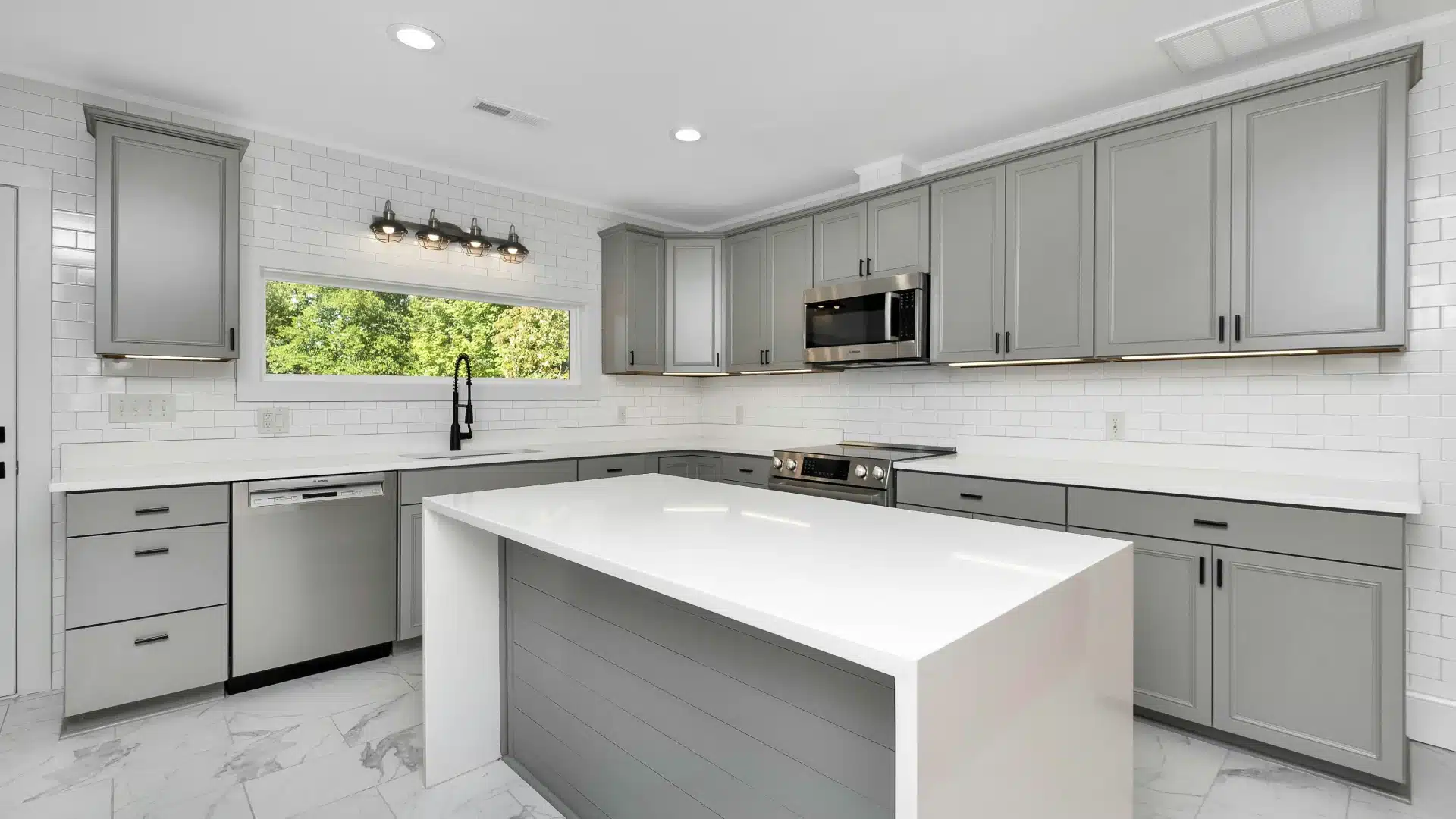
The short answer: yes, in most cases, it's possible — and it's often an excellent way to refresh a kitchen without tearing everything down. Replacing only the countertop costs much less than a full renovation.
But there's a condition: your cabinets must be in good enough condition to be worth keeping. Solid, level cabinets can receive a new countertop without issue; tired cabinets are another story.
At Solutions Rénovation Québec (RBQ license 5811-7821-01), we've been evaluating kitchens in Lévis homes for years. In this article, we explain when keeping your cabinets is the right decision, and how to avoid the pitfalls.
Request a free evaluation of your existing cabinets before choosing a new countertop.
Why more and more homeowners in Lévis are choosing a partial kitchen renovation
Partial renovation is trending, and it's easy to understand why. Redoing an entire kitchen is a big investment and a worksite that causes disruption for a long time.
Changing only the countertop means getting a good part of the «new kitchen» effect for a fraction of the price and disruption. For many families, it's the smart compromise.
It's also a response to the current context: with tight budgets, we look to maximize the impact of every dollar spent. And a countertop is what we see and touch every day.
The possible savings compared to a full renovation
The numbers speak for themselves. A partial kitchen renovation — countertop and a few adjustments — often falls in the range of $12,000 to $25,000 (reasonable estimate that varies by project).
A full renovation, with new cabinets, plumbing and reconfiguration, climbs rather toward $30,000 to $60,000 (reasonable estimate). The gap is major. If your cabinets are still good, the return on investment of a partial renovation is hard to beat.
Modernizing the appearance without major demolition
A new countertop transforms the look of a kitchen. It's the central element, the one that catches the eye. Changing it is often enough to give the whole room a fresh look.
As a bonus, you avoid heavy demolition. Less dust, less debris, a shorter worksite. And this modernization can add value to your home, without the investment of a full renovation.
A popular solution for homes 25 years and older
In bungalows and single-family homes 25 years and older in Lévis, we often see good solid wood cabinets topped with an outdated or damaged countertop.
These kitchens are ideal candidates for a partial renovation. Cabinets from that era are frequently sturdier than many recent models — it's worth keeping them and putting the budget toward a beautiful, durable countertop.
In which cases can the existing cabinets be kept?
Keeping the cabinets isn't decided by a quick glance. Three things must be checked: their solidity, their level, and the absence of hidden moisture problems.
Here's how we evaluate each of these points before installing a new countertop.
Checking the solidity of the cabinet boxes
The cabinet boxes — the structure of the cabinets — must be solid to support a countertop, especially heavy materials like quartz or granite. A weakened box won't hold the load over time.
We examine the wall attachment, the condition of the material and the overall sturdiness. If the boxes are sound, they can receive a new countertop; if they're tired, it's better to know before.
Signs indicating that the cabinets are still usable
Good indicators: solid hinges that hold well, the absence of swelling or delamination of the material, and adequate wall attachment. If your cabinets check these boxes, they're probably worth keeping.
Checking the level of the cabinets
A countertop must rest on a level base, otherwise it undergoes stresses that can crack it — especially for stone. Cabinets that have shifted over time may no longer be perfectly level.
We check this with precision before installation. Adjustments are sometimes necessary to create a flat and stable base. It's a technical step that makes the difference between a countertop that lasts and one that cracks.
Why standard height is important
Kitchen cabinets are generally around 90 to 92 cm in finished countertop height. Respecting this height ensures comfortable use and a stable installation. If adjustments are required, we plan them to keep the whole functional and level.
Detecting hidden moisture problems
This is the point that can't be neglected in our Quebec homes. Moisture often hides under the sink, along exterior walls or behind the cabinet boxes.
We inspect these risk areas before installing the new countertop. Covering up a moisture problem makes it worse silently — so we address the source first.
Common risks in Quebec homes
The usual culprits: infiltration around the plumbing, condensation on a cold wall, or deterioration of materials caused by chronic moisture. In our homes exposed to freeze-thaw and seasonal humidity, these signs deserve real attention.
Have the actual condition of your cabinets checked before investing in a new countertop.
What are the risks when only the countertop is replaced?
Changing a countertop looks simple, but a few pitfalls lurk when the checks aren't done. Knowing them means avoiding them.
Here are the three problems we see most often when a countertop is replaced without adequate evaluation.
Incompatible cabinets
Not all cabinets are ready to accommodate just any countertop. Weak cabinet boxes won't support the weight of a heavy stone like quartz or granite.
If a heavy countertop is installed on inadequate cabinets, you risk sagging or even breakage. The compatibility between the cabinet and the chosen material must be validated from the start.
Poor fastening of the new countertop
A poorly secured countertop moves, vibrates and eventually comes loose or cracks. Fastening must be done properly, with the right support and the right techniques depending on the material.
This is precision work. A sloppy installation shows quickly: a joint that opens, a corner that lifts, a countertop that isn't solidly anchored. This is precisely what a professional installation avoids.
Inadequate joints and water infiltration
The joints — around the sink, against the wall, between sections — are essential. A poorly made joint lets water through, and water causes damage: swelling of cabinets, mold, deterioration.
This is often where problems begin. Careful sealing in the right place is what protects your investment long term.
Impact of Lévis's climate and humidity variations
Our climate adds extra pressure. Humidity variations between dry winter and humid summer make materials work. An inadequate joint in this context degrades faster, and moisture that infiltrates can lead to mold. That's why we pay particular attention to sealing here.
Which material to choose for a durable countertop in Quebec?
The choice of material determines the durability, maintenance and cost of your countertop. Each has its strengths — the right choice depends on your use and your budget.
Here are the three most common options, with indicative price ranges.
Quartz
Quartz has become the star choice, and for good reasons. It is a very resistant, non-porous engineered material that requires almost no maintenance.
Its moisture resistance makes it an excellent choice for our climate — no annual sealer, no worries with water. Expect around $50 to $150 per square foot depending on quality and finish (reasonable estimate). It's an investment, but an investment that lasts.
Granite
Granite offers a high-end look and a unique natural stone — each slab is different. It's durable and gives a lot of character to a kitchen.
Since granite is natural and porous, it requires periodic sealing to stay protected. As for price, expect approximately $50 to $190 per square foot depending on the type of stone (reasonable estimate). It's a choice for those who love the authenticity of real stone.
Laminate
Laminate is the economical option par excellence. Today's models imitate stone and wood surprisingly well, for a fraction of the price.
At approximately $6 to $30 per square foot (reasonable estimate), it's unbeatable for a tight budget. It is less resistant than stone to heat and scratches, but for many kitchens, it's an excellent value for money.
Material comparison
Here's a quick overview to help you compare:
| Material | Cost | Durability | Maintenance | Moisture resistance | Appearance |
| Quartz | High | Excellent | Very low | Excellent | Modern, uniform |
| Granite | High | Excellent | Moderate (sealer) | Good (if sealed) | Natural, unique |
| Laminate | Low | Good | Low | Medium | Varied, imitations |
Get a personalized estimate based on your kitchen and the chosen material.
Do you need a permit to replace a countertop in Lévis?
This is a frequent question, and the good news is that in most cases, the answer is simple. Here's what you need to know.
Note: requirements can vary and evolve, so checking with the City of Lévis remains wise at the slightest doubt.
Work generally exempt
Replacing a countertop without modifying plumbing, electrical or structural elements is generally considered minor interior work. In this case, no permit is usually required.
We change the countertop, we don't touch the rest — it's the equivalent of an aesthetic refresh. This is precisely what makes this partial renovation so accessible.
Situations requiring additional verifications
Things change as soon as the project goes further. Moving a sink, modifying plumbing or touching the electrical circuit brings additional requirements into play.
In these cases, it's better to verify what applies and ensure that the work complies with current standards.
Plumbing or electrical modifications
If you change the sink location or add outlets near the countertop, the Quebec Construction Code imposes specific rules — notably outlets with ground fault circuit interrupters (GFCI) near water points, for safety. These projects benefit from being entrusted to professionals who know the requirements.
How Solutions Rénovation Québec secures this type of project
A successful countertop project is a project well evaluated before starting. Our approach aims to eliminate unpleasant surprises.
Here's how we go about ensuring a countertop replacement goes well, from start to finish.
Complete technical evaluation before work
Everything starts with an on-site evaluation. We examine your cabinets, your current countertop and the entire kitchen to understand the real state of things.
This step allows us to tell you frankly whether your cabinets can be kept, and which countertop material best suits your situation. No guessing, no surprises along the way.
Verification of humidity, level and structure
We then check the three critical points: humidity in risk areas, the level of the cabinets, and the solidity of the boxes. This is what determines the feasibility and durability of the project.
If we detect a problem — humidity, weak box, cabinet that has moved — we tell you and propose a solution before installing the new countertop. Fixing the cause first is what avoids having to redo everything later.
Installation compliant with RBQ best practices
The installation is done according to the rules of the art: adequate support, solid fastening, carefully sealed joints. Each material has its requirements, and we respect them.
RBQ license 5811-7821-01
We operate under RBQ license 5811-7821-01, led by Marco Savoie. This compliance is your protection: work done according to standards, by a contractor who is accountable for it. This is not an administrative detail, it is a guarantee of seriousness.
5-year warranty on labor
We back our work with a 5-year warranty on labor. If something goes wrong with the installation, we take care of it. That is the commitment we make to every client.
More than 500 projects completed
With more than 500 projects completed and more than 10 years of combined experience, we have seen just about every kitchen configuration that homes in Lévis can offer. This experience translates into careful work and good advice.
Talk to an SRQ specialist to find out if your cabinets can be kept.
Myths and realities about replacing a countertop
A few misconceptions circulate on the subject. Let's sort out fact from fiction.
Myth — All countertops are easy to install
False. Installation looks simple, but each material has its own requirements for support, fastening and handling.
Reality — Each material has its requirements
Quartz and granite are heavy and require solid support and expert handling. Laminate is lighter but requires careful joints. Knowing these differences is the basis of a successful installation.
Myth — No risk of humidity
False, especially in Quebec. Water around the sink and along the walls is a reality, and a poorly sealed countertop lets humidity cause damage.
Reality — Joints are essential in Quebec
Careful sealing of joints is what protects your cabinets and your countertop from infiltration. With our humidity variations, this is far from a detail — it is what makes the whole thing last.
Myth — Doing it yourself always costs less
Not necessarily. The idea of saving with DIY is appealing, but it assumes that everything goes well.
Reality — Mistakes often cost more
A stone countertop cracked during installation, a leaking joint, damaged cabinets: these mistakes are expensive to fix. Often, the «economical DIY» ends up costing more than professional installation. Doing it right the first time remains the cheapest.
FAQ – Replacing a countertop in Lévis
Can a countertop be replaced without touching the cabinets?
Yes, in most cases, provided that the cabinets are solid, level and free of humidity problems. It is a very common and economical partial renovation when the cabinets are in good condition.
How much does a quartz countertop cost in Lévis?
Expect around 50 $ to 150 $ per square foot depending on quality and finish (reasonable estimate). The final price depends on the surface area, thickness and complexity of the installation. An accurate quote requires an on-site evaluation.
Is a permit required?
For a simple countertop replacement without modification to plumbing, electricity or structure, generally no. If the project involves moving the sink or modifying the electrical circuit, check the requirements with the City of Lévis.
How do I know if my cabinets are still solid?
Check the hinges, the absence of swelling or delamination, and the fastening to the wall. Firm boxes, without movement or damage, are a good sign. A professional inspection confirms their capacity to support a new countertop.
Is quartz better than laminate?
It depends on your priorities. Quartz is more durable, resistant to humidity and maintenance-free, but more expensive. Laminate is much more affordable and well suited to a tight budget. Both have their place depending on use and budget.
How long does the installation take?
For a simple countertop replacement, installation often takes a day or two, depending on the material and complexity. Custom stone fabrication may add a lead time upstream, between taking measurements and installation.
Can the backsplash also be changed?
Absolutely, and it is often a good idea to do it at the same time. A new backsplash completes the look of the countertop and allows the junction with the wall to be properly sealed, which protects against humidity.
What are the risks related to humidity?
Undetected humidity or a poorly sealed joint can cause the boxes to swell, mold and deterioration of materials. In our climate, this is the main risk — hence the importance of checking and sealing properly.
Does a partial renovation increase the value of the home?
Yes, a new and well-installed countertop refreshes the kitchen, which is a determining room at resale. For a moderate investment, the impact on the home's appeal can be appreciable.
Why call on an RBQ contractor?
Because an RBQ license guarantees competence, compliance with standards and clear accountability. For an installation that involves weight, joints and sometimes plumbing, the expertise of a licensed professional protects your investment.
Conclusion – An economical solution if the cabinets are still in good condition
So, can you keep the cabinets and just change the countertop in Lévis? Yes, in most cases — and it's one of the most economical ways to modernize a kitchen, especially in homes 25 years and older with good old solid cabinets.
Success depends on a few principles: checking the real condition of the cabinets, choosing a material suited to your use and your budget, complying with standards when plumbing or electrical are affected, and above all preventing moisture problems with well-made joints. In our climate, this last point is non-negotiable.
In the end, having the countertop installed by a qualified contractor is what turns a good idea into a lasting project. An honest assessment, compliant installation and a warranty make the difference between a kitchen refreshed for years and a repair that comes back to haunt you.
Request your free estimate with Solutions Rénovation Québec or call us at 418-476-1747 to find out if your kitchen is eligible for a durable partial renovation — with no obligation.