
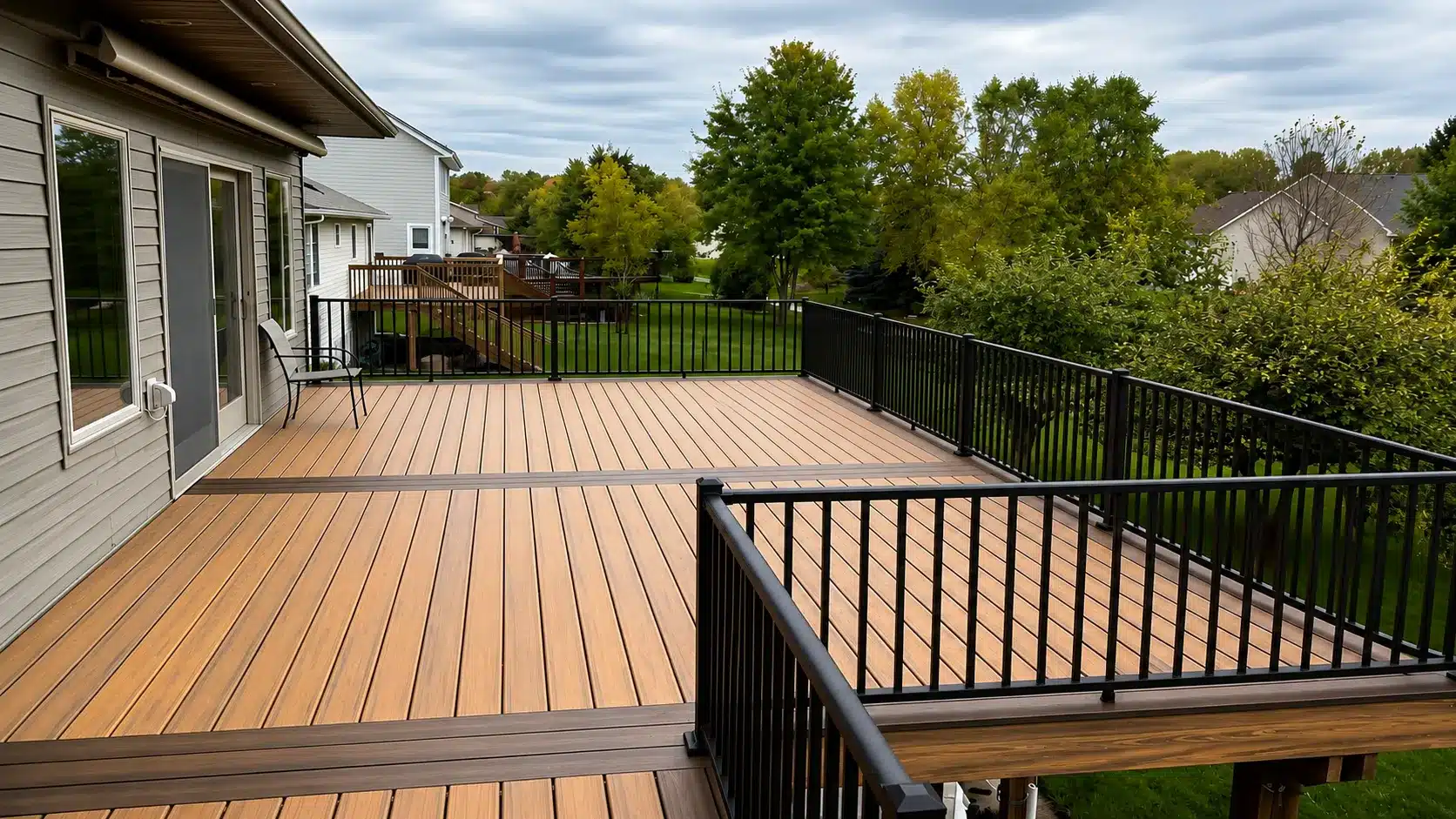
When the time comes to choose a railing for an outdoor patio, most homeowners hesitate between two options: wood, for its warm and natural look, and aluminum, for its durability and low maintenance. Both have their supporters. Both also have their limits, and in a neighborhood like Vieux-Lévis, these limits are not the same as elsewhere.
What makes this choice particular here is the climate context. The proximity of the St. Lawrence River, the long winters, the repeated freeze-thaw cycles and the salt that is spread on surfaces for six months of the year, all of this stresses outdoor materials in a way that homeowners often underestimate at the time of purchase.
The numbers speak for themselves: a quality aluminum railing lasts 20 to 30 years without major maintenance. A wood railing, with regular and well-done maintenance, lasts 10 to 15 years before requiring replacement. This is not a detail, it is the foundation on which you must build your decision.
Why the climate of Lévis strongly influences the choice of materials
You don't choose a patio railing à in Old Lévis the way you would for a house in British Columbia or Ontario. The region's climate is among the most demanding in Canada for outdoor installations, and this is directly reflected in the lifespan of the materials installed.
The St. Lawrence River generates constant ambient humidity for a good part of the year. This humidity infiltrates the wood fibers, the metal fasteners, the joints and the anchor points. Combined with the negative temperatures of winter, it creates cycles of expansion and contraction that accumulate season after season.
De-icing salt makes the situation even worse. Homeowners who maintain their stairs and driveway in winter inevitably project salt onto the bases of the railings. On wood, this accelerates surface degradation and promotes rot at the contact points with the ground. On ordinary metals, it corrodes the fasteners. On quality aluminum, the resistance is clearly superior, field data shows that aluminum resists 20 to 30% better to freeze-thaw than wood in our climatic conditions (reasonable estimate).
The impacts of freeze-thaw on outdoor railings
Freeze-thaw is the phenomenon that causes the most damage to outdoor railings in Quebec. When water infiltrates the wood fibers and freezes, it expands. This repeated movement creates microscopic cracks that gradually enlarge. After three or four winters, these cracks become entry points for moisture and insects, and the structure begins to lose its rigidity.
The concrete risk is structural weakening. A railing that appears visually acceptable may have lost a significant part of its mechanical resistance. On an outdoor staircase in winter, this is a dangerous situation.
Anodized aluminum does not undergo this phenomenon. It does not absorb water, does not swell, does not crack. Comparative data report a structural failure rate of less than 5% over 15 years for aluminum, compared to 20 to 30 % for untreated wood under the same conditions (reasonable estimate based on field experience in outdoor renovation in Quebec).
The specific challenges of patios in Old Lévis
The houses in the Old Lévis sector have their own particularities. Many are properties of 25 to 70 years, with patios and terraces exposed to the river winds. River humidity is more pronounced there than elsewhere in the region, a difference that is clearly felt in the condition of outdoor materials after a few years.
In a neighborhood with heritage character, there is also an aesthetic dimension to consider. The patio railing is part of the property's image, and in this context, the choice between wood and aluminum is not solely technical. We will come back to this.
Does your patio show signs of wear? Request a free inspection, we come to evaluate the condition of your railing and your structure on site, free of charge and without obligation.
Wood railing: advantages and limits for a patio
Wood remains popular, and we understand why. There is something naturally warm about a well-made wood railing, especially on a patio that integrates with the traditional architecture of Old Lévis. It is a material that can be painted, stained, customized, and that easily harmonizes with existing structures.
But we must be honest about what this implies over the long term. Wood is not a passive material in a climate like ours, it requires attention, regularity, and a maintenance budget that is often underestimated at the time of installation.
Advantages of a wood railing
The initial cost, first. A treated wood railing generally costs less to purchase and install than an aluminum railing of equivalent quality. For homeowners with a limited short-term budget, this is a real argument.
Traditional aesthetics is also a concrete advantage in certain contexts. On an ancestral home or a patio with a more classic style, a well-built and well-maintained wood railing integrates naturally. It can be cut, profiled and finished to harmonize with the woodwork and existing architectural elements of a house in Old Lévis.
Customization is also easier. You can modify dimensions, add carved details, change the color from one season to another. This is a flexibility that aluminum offers less easily.
Maintenance required for a wood railing
This is where the picture gets complicated. An outdoor wood railing in Quebec must be repainted or restained every 5 to 7 years to maintain its protection against the elements (reasonable estimate). In practice, this maintenance represents an annualized cost of approximately 10 to 20% of the initial installation price, depending on the type of wood, the chosen finish and the labor required.
It's not just a question of cost. It's a question of time and attention. Each maintenance cycle requires preparing the surface, applying the protective product, letting it dry, and doing it again properly so that the protection holds. When maintenance is neglected or delayed, problems arise faster.
Risks if maintenance is neglected
Rot is the first risk. In the contact areas between the wood and the patio structure, the bases of the posts, the anchor points, the sections in contact with the ground or close to the ground, moisture accumulates and the wood degrades from the inside. This process is often invisible until the structure begins to give way.
Cracks caused by freeze-thaw cycles come next. Without an intact protective layer, water penetrates the fibers, freezes, expands, and creates cracks that widen each winter. The resulting structural deformation can compromise the solidity of the whole, and it is rarely visible from the outside before reaching an advanced stage.
Are you concerned about your wooden ramp? Contact us for an evaluation, we come to look at the actual condition of the installation and tell you what can be repaired and what needs to be replaced.
Aluminum ramp: durability and low maintenance
Aluminum has gradually replaced wood as the material of choice for patio ramps in Quebec. This isn't a trend, it's a logical response to the climate constraints here. The adoption of aluminum ramps for patios and balconies has increased by approximately 15% in 2026 (reasonable estimate based on trends in the exterior renovation sector).
The main reason: maintenance-free durability. In a context where winters last six months and materials are constantly stressed, a product that lasts 25 to 30 years without paint, without treatment and without partial replacement is a major economic and practical advantage.
The main advantages of aluminum
Durability, first. A quality aluminum ramp lasts 20 to 30 years in the climatic conditions of Old Lévis. No rot, no swelling, no cracks caused by frost. Aluminum does not react to moisture the way wood does, it is fundamentally a different material in its properties against the elements.
Resistance to salt and moisture is another decisive advantage in our context. Aluminum naturally develops an oxide layer on its surface that protects it from corrosion, and unlike paint on wood, this protection does not flake and requires no intervention to maintain.
Cleaning comes down to an occasional rinse with water in the spring, to remove salt and sand deposits accumulated during the winter. That's it.
Aesthetics and modern styles available
A common misconception we still hear: aluminum looks «cold» or «industrial.» That hasn't been true for a long time. Current systems offer a range of custom colors, textured finishes that convincingly imitate wood, and contemporary designs that fit just as well in a heritage home as in a modern construction.
For Old Lévis homeowners concerned about respecting the aesthetics of their neighborhood, there are aluminum options with profiles and finishes that harmonize naturally with traditional architecture. Today's aluminum is no longer that of 1980s apartment building railings.
Want to see the available options? Contact us for a consultation, we present the models suited to your patio and the aesthetics of your property.
Real comparison: wood vs aluminum over 20 years
To make an informed decision, you need to look at both options over the same period of time. Here is the honest comparative picture.
| Criteria | Here is the comparative portrait between the two main materials on the dimensions that matter: | Aluminum |
| Lifespan | 10–15 years | Wood |
| Maintenance | High (painting, staining, repairs) | Minimal (occasional cleaning) |
| Initial cost | Lower | Higher |
| Total cost over 20 years | High (cumulative maintenance + replacement) | Stable |
Wood costs less upfront. Over 20 years, with painting or staining cycles, occasional repairs and earlier replacement compared to aluminum, the total cost often reverses. This is the mathematical reality we explain to homeowners who compare only on the initial installation price.
Aluminum also represents an advantage for property value. A well-installed aluminum patio ramp can increase the perceived value of a property by 5 to 10% (reasonable estimate), not because the ramp itself is worth much, but because it signals serious maintenance and durable material choices, which buyers evaluate.
Which choice for a home in Old Lévis?
There is no universal answer, it depends on three factors: the style of the property, the exposure conditions, and the budget available in the short and long term.
For a heritage home where traditional aesthetics are a priority and where an owner is ready to commit to regular maintenance, wood remains a valid option, provided you use quality wood, stainless steel fasteners, and don't postpone maintenance.
For the majority of Old Lévis homeowners who want a durable, maintenance-free solution adapted to Quebec winters, aluminum is the most logical answer. There are now systems that integrate perfectly with heritage aesthetics, the compromise between durability and style is no longer necessary.
Still hesitating? Request an estimate for your patio, we come to evaluate your situation on site and present both options with real numbers for your configuration.
RBQ standards for patio ramps in Quebec
Regardless of the material chosen, residential patio ramps in Quebec are subject to the requirements of the Construction Code. These standards are not suggestions, they define what is safe and what is not.
Regulatory height of guardrails
The Régie du bâtiment du Québec establishes minimum heights according to the installation configuration. For a terrace or a balcony whose fall height is less than 1.8 m, the guardrail must measure at least 900 mm. For a fall height greater than 1.8 m, the minimum height increases to 1,070 mm.
These measurements apply to the vertical height from the joists of the patio to the top of the handrail. A guardrail that is too low is not compliant, and in existing homes where the original ramp was installed before current standards, an upgrade may be necessary.
Importance of a compliant installation
A well-built patio ramp must withstand specific lateral and vertical loads. The anchoring in the patio structure must be sized to absorb a sudden impact load, not just the static weight of someone leaning gently.
A licensed RBQ contractor knows these requirements and knows how to apply them depending on the type of structure on which the railing is installed. He chooses the appropriate fasteners, ensures that the anchors penetrate into the structural elements and not only into the siding surface, and documents the work so that you have a record of compliance.
Risks of non-compliant installation
A poorly anchored railing can appear solid for one or two summers, and begin to deteriorate after the first freeze-thaw cycles that stress the fasteners. The risk of instability is real, and the consequences of an accident on a deck can be serious.
Legally, an owner whose railing does not comply with the Construction Code assumes potential civil liability in the event of an accident. Home insurance may refuse to cover the claim if the work was carried out without a licence or without a permit. This is a concrete legal protection that working with a licensed contractor offers you.
Not sure whether your current guardrail is compliant? Contact us, we come to verify the installation on site and provide you with a clear assessment.
Why you should trust Solutions Rénovation Québec
We have been working on patios, terraces and outdoor stairs in the Lévis region for over 10 years. We know the challenges of homes in the Vieux-Lévis area, local climate requirements, and the products that truly perform over time.
Certified residential contractor
Solutions Rénovation Québec holds the RBQ licence 5811-7821-01. All our railing and guardrail installations are carried out in accordance with the standards of the Quebec Construction Code. Our licence can be verified directly on the Régie du bâtiment website, and we encourage you to confirm it, as you would for any contractor you consult.
Our clients give us an average rating of 4.9 out of 5. This result comes from a simple way of working: we do what we committed to do, within the announced timelines, with no surprises on the invoice.
Exterior renovation expertise in Quebec
With over 500 projects completed in the region, we have installed railings of all configurations, on existing patios, raised terraces, and outdoor stairs in wood, concrete or stone. We work on 1980s bungalows, recent single-family homes, and heritage properties in the Vieux-Lévis area.
We master both materials, treated wood and aluminium, and we are able to advise you objectively based on your actual situation, not on what is easiest to sell.
Clear and transparent process
Here's how we work on each project:
- On-site inspection: assessment of the existing structure, configuration requirements and applicable standards
- Detailed quote: line-by-line pricing, with no ambiguity
- Safe execution: compliant installation, appropriate fastenings, clean and organized worksite
- Cleaning and final inspection: we check every point before leaving, and we do not close a worksite until you are satisfied
Guarantee for 5 years on labor on all our installations.
Your patio deserves a railing that lasts. Request a free quote or call us at 418-476-1747, Monday to Friday, 8 a.m. to 5 p.m.
FAQ: Patio railings in Quebec
What is the lifespan of a wooden railing?
With regular maintenance, staining or painting every 5 to 7 years, annual inspection of fastenings and replacement of deteriorated sections, a treated wood railing can last 10 to 15 years in the climate of the Lévis region. Without maintenance, this lifespan can be reduced by half. The quality of the wood at the outset, the protection of the anchors and exposure to the elements are the main factors influencing longevity.
Does aluminium rust in Quebec?
No. Aluminium does not rust; it is a chemical property of the metal. It develops a layer of alumina on its surface that naturally protects it from corrosion, without any treatment. Unlike paint on wood, this protection does not flake and regenerates itself if the surface is slightly scratched. This is why aluminium is particularly suited to the winter conditions of Vieux-Lévis and the Lévis region in general.
How much does a patio railing cost in Lévis?
Treated wood railings generally range between 80 $ and 150 $ per linear metre, installation included. Aluminium railings cost between For standard aluminum railings, prices generally range between depending on the model and the complexity of the installation (reasonable estimates for the Lévis-Québec region in 2026-2026). These prices vary depending on the patio configuration, the type of anchoring required and the finishes chosen. An on-site quote will give you a precise figure for your project.
Do aluminium railings really require zero maintenance?
Practically speaking, yes. An occasional rinse with water in the spring to remove salt and sand residue, and an annual visual check of the anchors, is all that a quality aluminium railing requires. We are talking about zero to one maintenance intervention per decade (reasonable estimate). No paint, no stain, no anti-corrosion treatment. For an owner who wants an installation they can forget about after installation, this is the most consistent option.
What guardrail height is required by the RBQ?
According to the standards of the Régie du bâtiment du Québec, an exterior residential guardrail must measure at least 900 mm for surfaces with a fall height of less than 1.8 m, and 1,070 mm for higher surfaces. These measurements are taken from the patio floor to the top of the handrail. A railing that is too low is not compliant, even if it appears stable and well built.
Can you replace only the railing of an existing patio?
Yes, in the vast majority of cases. During the inspection, we assess whether the patio structure is sound and whether it can accommodate the anchors of a new railing. If the patio itself is in good condition, we install the new railing without touching the existing structure. This is often the most economical solution when the patio is still functional but the railing has reached the end of its life.
Is wood safe in winter?
A well-maintained wooden railing in good condition is safe in winter. The problem is that the condition of a wooden railing deteriorates gradually and the deterioration is not always visible from the outside. A post that appears fine may have lost some of its mechanical strength due to internal moisture. In winter, when surfaces are slippery and people lean more heavily on railings, a weakened structure presents a real risk. This is why an annual inspection is recommended for wooden railings in our climate.
Does aluminium increase the value of a home?
Yes, indirectly but measurably. A well-installed aluminium patio railing can contribute to an increase in the perceived value of the property of 5 to 10% (reasonable estimate). Not because the railing itself represents great value, but because it signals durable material choices and serious maintenance, two elements that buyers evaluate, especially in areas like Vieux-Lévis where properties have character and where the quality of maintenance is visible.
Solutions Rénovation Québec (SRQ), RBQ-certified general contractor RBQ license: 5811-7821-01 2552 chemin du Fleuve, Lévis, Québec, G6W 1Y3 Tel.: 418-476-1747 | renovationsolutionsquebec.ca Areas served : Lévis, Quebec, Beauce, Chaudière-Appalaches, Centre-du-Québec, Mauricie, Estrie