
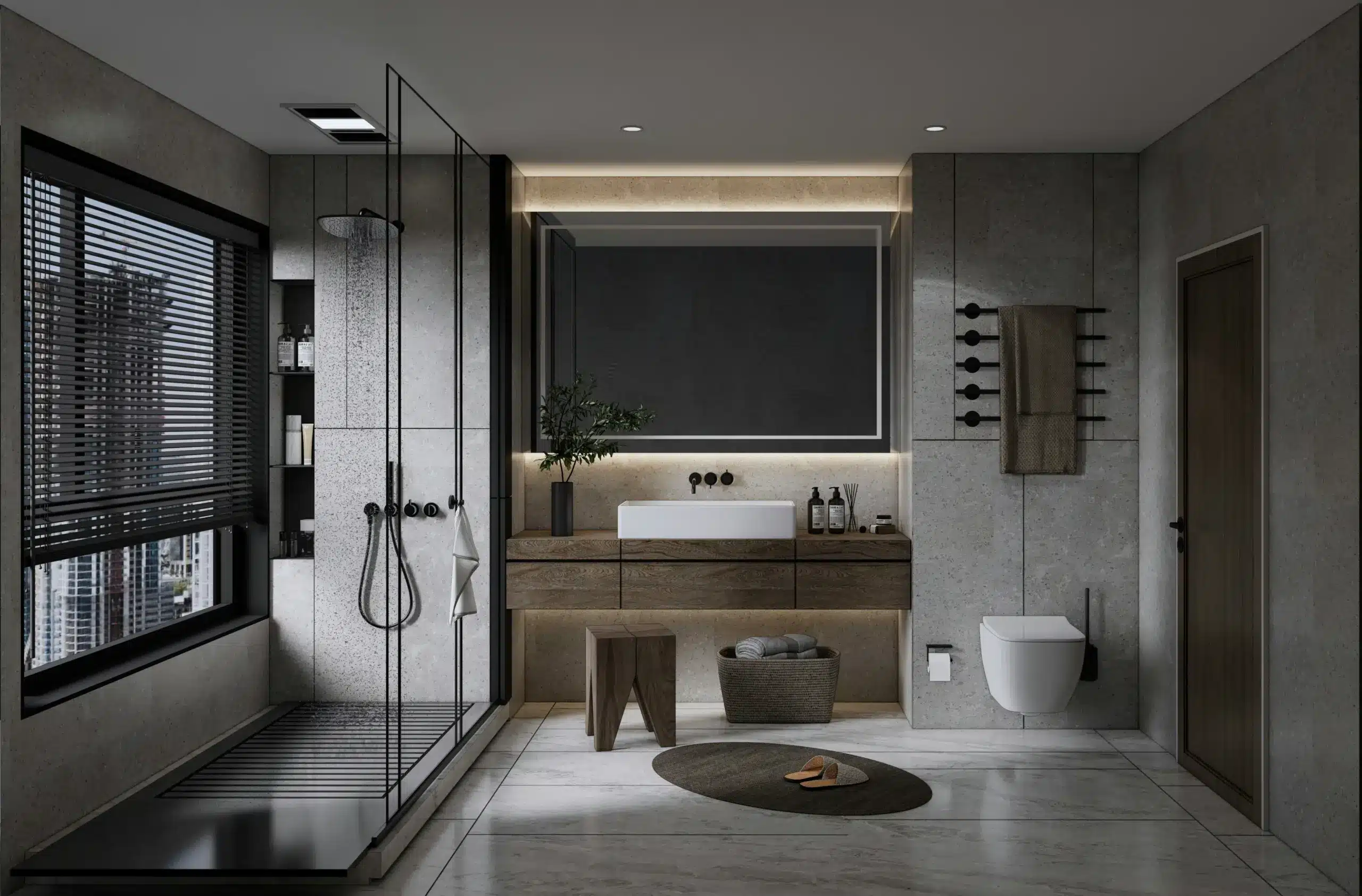
You've probably seen these gorgeous bathrooms on Instagram or Pinterest: rain shower, textured ceramics, subdued lighting, zen ambiance. Makes you want to.
But is it just a passing fad, or does it really make sense for a home in Lévis? And above all, is it realistic for your budget and your type of property?
At Solutions Rénovation Québec, we've been renovating bathrooms for over 10 years. We've seen the spa trend explode, and unlike other fashions that disappear after a few years, this one is here to stay. And why? Because it meets a real need: to have a place to relax at home, without having to go out and pay a fortune for a spa.
We'll explain what really works in a spa bathroom in Lévis, what it costs, and above all, how to avoid costly mistakes related to humidity and the Quebec climate.
Why spa bathrooms are so popular with Quebec homeowners
A spa bathroom isn't just a matter of luxury. It's become a priority for many homeowners who want to improve their quality of life without moving.
Since the pandemic, people are spending more time at home. They're looking for spaces that make them feel good, where they can relax after a stressful day. The bathroom is the perfect place for this.
Well-being at home: a sustainable priority
It's estimated that around 75 % of interior renovations in Quebec now incorporate spa elements in the bathroom (a reasonable estimate based on industry trends). These include rain showers, heated floors, soft lighting and finishes that create a relaxing ambience.
This trend exploded during the pandemic, but unlike other trends, it's not going away. Why not? Because well-being at home has become a real priority. People want to go out less to relax and more to create comfortable spaces at home.
A well-designed spa bathroom also improves resale value. Buyers are actively looking for homes with modern, functional bathrooms. A beautiful bathroom can make the difference between two comparable properties.
A trend adapted to existing homes in Lévis
What's interesting is that the spa bathroom adapts very well to existing homes. You don't need a new house or a major extension to create this space.
Many bungalows and single-family homes in Lévis are 25 years old or more. These homes often have outdated, small bathrooms with bathtubs that are no longer used. Transforming this space into a modern spa bathroom is feasible, with impressive results.
You can replace an old bathtub with a large rain shower, install underfloor heating, add textured ceramic tiles, and create a zen atmosphere without demolishing the whole house.
Spa bathroom in Quebec: what the climate really dictates
Creating a spa bathroom in Lévis is not the same as in California or Florida. Our climate imposes specific constraints: humidity, ventilation, risk of frost and temperature variations.
To ignore these realities is to create problems that will cost you thousands of dollars in repairs in a few years.
Moisture and mould: the real danger in spa bathrooms
Spa bathrooms generate a lot of humidity. Rain showers, steam baths and prolonged use create a lot of water vapor, which needs to be properly evacuated.
We estimate that around 30 % of failures in renovated bathrooms are due to poor sealing or insufficient ventilation (a reasonable estimate based on our field experience). The result: mold behind the walls, rot in the structure, and unpleasant odors.
Waterproofing is crucial. This means installing waterproof membranes behind the ceramic tiles, especially in the shower and around the bathtub. We use products like Kerdi or equivalent, which create a total barrier against water.
Joints must also be properly grouted with water-repellent grout and sealed regularly. Poor grouting can allow water to seep in, and you won't notice the problem until it's too late.
Mechanical ventilation: mandatory, even with a window
Many people think that a window is enough to ventilate a bathroom. But this is not true. In winter, nobody opens their window when it's -20°C outside.
The Quebec Construction Code requires mechanical ventilation in all bathrooms. For a standard bathroom, we're talking about a fan that exhausts at least 50 CFM. For a spa bathroom with rain shower, a minimum of 80 to 100 CFM is recommended.
The fan must exhaust the air directly outside, not into the attic. We still see installations where the fan blows humidity into the attic, creating mold and deteriorates insulation.
A good ventilation system works automatically with a humidity sensor or timer. This ensures that humid air is evacuated even if you forget to turn on the fan.
Cold weather and plumbing: costly mistakes to avoid
Pipes in exterior walls can freeze in winter if insulation is inadequate. This is especially true of homes built in the 1970s and 1980s, where wall insulation was minimal.
When renovating a bathroom, we always check the plumbing layout. If there are pipes running through a outside wall, We add insulation or move them to an interior wall.
Underfloor heating systems must also be installed correctly, with a thermostat to prevent overheating. A floor that is too hot can damage ceramics and create cracks.
How much will a spa bathroom cost in Lévis in 2026?
Let's talk budget. A spa bathroom is a serious investment. You want to know exactly what it's going to cost and what you're going to get in return.
Costs vary enormously depending on the size, materials and level of finish you choose.
Realistic budgets based on trim level
Here's what we regularly see in Lévis for an average-sized full bathroom (about 50 to 70 square feet):
Standard spa bathroom20,000 to 30,000 $ Includes demolition of old bathroom, rain shower, good-quality ceramic tile, heated floor, modern vanity, adequate ventilation and compliant installation. RBQ.
High-end spa bathroom35,000 to 50,000 $ or more This adds luxury ceramics, high-end faucets, a steam system, recessed lighting with dimmer, premium finishes, and sometimes a freestanding bathtub.
Individual elements:
- Full rain shower: 4,000 to 8,000 $
- Underfloor heating: 1,500 to 3,000 $
- Ceramic wall and floor tiles: 3,000 to 8,000 $ depending on quality
- Modern vanity with countertop: 2,000 to 6,000 $
- Adequate mechanical ventilation: 800 to 1,500 $
These prices include labor, materials and RBQ-compliant installation. If structural or plumbing problems are discovered along the way, allow for a contingency of 10 to 20 %.
Return on investment and property value
A well-renovated spa bathroom can increase the value of your home by 5 to 15 % (reasonable estimate based on industry data). On a 375,000 $ home, that's between 18,750 and 56,250 $.
The return on investment is generally 3 to 5 years if you sell. If you stay in your home, the return is immediate in terms of quality of life and daily comfort.
Potential buyers attach great importance to bathrooms. An outdated bathroom can scare buyers away, even if the rest of the house is impeccable. A beautiful, modern bathroom can justify a higher selling price and speed up the sale.
Want to know how much your spa bathroom project would cost? Contact SRQ for a free, transparent estimate.
RBQ standards and rules for spa bathrooms
Renovating a bathroom isn't just about aesthetics. There are strict standards to meet for safety, compliance and durability.
These standards exist for good reason: to avoid accidents, prevent water infiltration, and guarantee that the installation will last.
Mandatory dimensions, safety and accessibility
The Quebec Construction Code imposes minimum dimensions for bathrooms. A shower must measure at least 90 cm x 90 cm (about 36″ x 36″). For a true spa shower, we recommend 120 cm x 120 cm minimum to have enough space.
Grab bars are mandatory in certain situations, especially if you want your bathroom to be accessible or meet universal accessibility standards. Even if it's not mandatory for you now, it can become an asset when you resell.
Electrical outlets must be at a minimum distance from water sources and protected by a ground fault circuit interrupter (GFCI). Sockets cannot be installed directly above the sink or in the shower.
The floor should have a slight slope towards the drain to prevent water accumulation. It seems obvious, but we still see poorly leveled showers where water remains in puddles.
Plumbing and electrical: why the RBQ license is non-negotiable
Plumbing and electrical work in a bathroom must be carried out by contractors holding the appropriate RBQ licenses.Category 15.5 for plumbing and 16.0 for electrical work.
Why is this important? Because improper installation can lead to leaks, seepage, short circuits and worse. And if something goes wrong, your insurance may refuse to cover the damage if the work wasn't done by a qualified contractor.
Plumbing work includes relocating or adding pipes, installing the shower, sink, toilet and all connections. All work must comply with the Quebec Plumbing Code.
Electrical work includes installation of sockets, lighting, fan and underfloor heating. Each circuit must be correctly sized and protected by the appropriate circuit breakers.
What SRQ does to ensure total compliance
At SRQ, we coordinate all trades to ensure that every aspect of the project meets RBQ standards. We hold a general contractor's license (RBQ 5811-7821-01), which allows us to oversee the entire project.
We do a complete inspection before we start to identify potential problems: old plumbing, non-compliant electricity, weakened structure, insufficient ventilation. This avoids unpleasant surprises during the project.
The necessary permits are obtained from the municipality. For a complete bathroom renovation, a permit is generally required, especially if the plumbing or electrical systems are modified.
And we guarantee all our work for 5 years on labor. If a problem arises due to an installation error, we correct it free of charge.
Key materials and elements for a truly sustainable spa bathroom
A spa bathroom isn't just pretty to look at. Materials must be durable, moisture-resistant and adapted to the Quebec climate.
Choosing the right materials from the outset avoids costly repairs and ensures that your investment will last.
Ceramics and stone: the best choices for Quebec climates
Porcelain tile is the best choice for bathrooms in Quebec. It resists humidity, doesn't crack with temperature variations, and is easy to clean.
We recommend medium to large format ceramic tiles (12″ x 24″ or larger) for walls and floors. This reduces the number of joints, which reduces the risk of infiltration and facilitates maintenance.
To create a spa atmosphere, you can use textured ceramic tiles that imitate natural stone, wood or concrete. Matte effects are popular because they better hide water marks and give a modern look.
The floor must be slip-resistant, especially in the shower. Always choose ceramic tiles with an adequate coefficient of friction to prevent falls.
Rain shower, lighting and Zen atmosphere
The rain shower is the signature element of a spa bathroom. We recommend a showerhead at least 10 inches in diameter, installed on the ceiling for a real rain effect.
You can also add an adjustable hand shower rail for added flexibility. Some systems include wall-mounted jets for a massaging effect, but this adds to the cost and complexity of installation.
Lighting makes all the difference. We combine several types: recessed ceiling lighting with dimmers, indirect lighting behind the mirror, and sometimes LED strips to create a soft ambience.
Light colors are important: warm white (2700-3000K) for a relaxing ambience, natural white (3500-4000K) for functional washbasin lighting.
Underfloor heating and winter comfort
Electric floor heating completely transforms the winter bathroom experience. No more walking on cold ceramic tiles.
We install a system of heating cables under the ceramic tiles, controlled by a programmable thermostat. You can program the floor to be warm in the morning when you get up, and cooler the rest of the day to save energy.
Operating costs are reasonable: around 0.50 $ to 1.00 $ per day for a standard bathroom (a reasonable estimate). The comfort is well worth it, especially in January and February.
Myths and facts about spa bathrooms
We hear all kinds of claims about spa bathrooms. Some are true, others not at all.
Here's the most common question, and the real answer.
«It's too expensive, it's just for the rich».»
False. An accessible spa bathroom can start at around 15,000 to 20,000 $ for a complete renovation of a small bathroom. Yes, you can spend 50,000 $ or more if you want something really high-end, but you don't have to if you want a beautiful, functional and relaxing bathroom.
«No need for mechanical ventilation if you have a window».»
Completely wrong. In fact, it's dangerous. The Quebec Construction Code requires mechanical ventilation in all bathrooms. A window isn't enough, especially in winter when no one opens it. Without proper ventilation, you'll have mold, condensation and structural problems in a few years.
«I can do the work myself and save money.»
Technically possible for some elements, but risky. DIY bathroom mistakes typically cost 20 % more to correct than an initial professional installation (reasonable estimate). And if you make plumbing or waterproofing mistakes, water damage can cost you tens of thousands of dollars.
Why entrust your spa bathroom to SRQ
We've renovated hundreds of bathrooms in Lévis and throughout the Chaudière-Appalaches region. We know the challenges of the local climate, the problems typical of homes 25 years and older, and how to create a spa bathroom that will last.
Our approach isn't just to make something beautiful. It's about making something beautiful, sustainable and compliant.
A climate- and sustainability-conscious approach
Humidity and temperature variations are the worst enemies of a bathroom in Quebec. We always install complete waterproofing membranes, adequate mechanical ventilation and moisture-resistant materials.
Properly insulate pipes in exterior walls to prevent freezing. Make sure drainage works perfectly. And choose materials that can withstand freeze-thaw cycles and constant humidity.
Each project is tailored to your type of home. If you have a 1970s bungalow, we'll probably have to improve attic ventilation and reinforce the floor before installing ceramic tiles.
Security, transparency and peace of mind
We hold a valid RBQ license (5811-7821-01), which guarantees that all our work complies with the Quebec Construction Code. We're insured, and you have legal recourse if something goes wrong.
We have completed over 500 home renovation. Our spa bathrooms include all safety, accessibility and durability standards.
All our work is covered by a 5-year labor warranty. The process is transparent: detailed quotation with all costs, no hidden charges, clean execution, daily site clean-up.
We coordinate all the trades: demolition, plumbing, electricity, ceramics, painting. You have a single point of contact for the entire project.
Ready to discuss your spa bathroom project? Contact SRQ for a free consultation - call us at 418-476-1747 or e-mail srq.quebec@gmail.com.
FAQ: Spa bathrooms in Lévis
Do I need a permit to install a rain shower?
Yes, in most cases. If you're modifying the plumbing or electricity, a municipal permit is usually required. We'll take care of all the paperwork for you.
Does a spa bathroom use more water?
It depends on how you use it. A rain shower can consume between 10 and 15 liters per minute, compared with 7-9 liters for a standard shower. But if you take shorter showers, total consumption may remain similar.
Is it compatible with an old house?
Yes, absolutely. Bathrooms in 1970s and 1980s homes are often renovated. Sometimes you have to reinforce the floor, improve the plumbing or add ventilation, but it's perfectly feasible.
How long does the work last?
For a complete bathroom, count between 2 and 4 weeks, depending on complexity. If structural or plumbing problems are discovered, this can add a few days.
How can I avoid mould in the long term?
Three things: complete waterproofing at the time of installation, adequate mechanical ventilation that works well, and regular maintenance (cleaning joints, starting the fan after every shower, wiping down damp surfaces).
Is underfloor heating expensive to operate?
No, not really. About 0.50 $ to 1.00 $ per day for a standard bathroom (reasonable estimate). If you use a programmable thermostat, you can optimize costs by heating just when you need it.
Can a spa bathroom be installed in the basement?
Yes, but you have to make sure that ventilation is adequate and that drainage works properly. Basements often have more humidity, so waterproofing must be impeccable.
What's the difference between a rain shower and a standard shower?
The rain shower has a larger shower head (10 inches or more) installed on the ceiling. Water falls directly on you like real rain, instead of coming from an angle. It's much more relaxing.
Are high-end faucets and accessories worth the extra cost?
It depends. High-medium quality faucets (Moen, Delta) last a long time and work well. Very high-end faucets add style, but aren't always necessary. We'll guide you according to your budget.
How do I care for ceramic tiles and grout?
Clean regularly with mild, non-abrasive products. Seal joints once a year with a water-repellent sealant. Wipe surfaces after every shower, if possible, to prevent limescale build-up.
Conclusion: a sustainable spa bathroom, not just a beautiful one
A spa bathroom isn't just a passing fad. It's an investment in your quality of life, in your family's comfort, and in the value of your home.
But for it to work in the long term, it has to be done properly: complete waterproofing, adequate ventilation, durable materials, and RBQ-compliant installation.
At SRQ, we create spa bathrooms that will please you for decades, not just a few years. We respect standards, use materials adapted to the Lévis climate, and guarantee our work for 5 years.
Transform your bathroom with an RBQ contractor who understands the Lévis climate - contact Solutions Rénovation Québec at 418-476-1747 or srq.quebec@gmail.com.